Scripting Your Dream Life: How to Use Tarot for Manifestation Journaling
What is scripting?
Scripting is the manifestation technique that puts you in the director’s chair of your own life. Instead of writing affirmations or wish lists, you write a detailed narrative of your life as if your desires have already come true. Present tense. Full sensory detail. Emotions included.
It looks something like this:
“I wake up in my apartment — the one with the big windows that let in morning light. I stretch, and I feel this deep contentment in my chest. Not excitement exactly, more like… rightness. My phone buzzes with a message from my team about a project I’m genuinely proud of. I make coffee in my favorite mug and sit by the window, looking at the city below, knowing that today I get to do work that matters to me…”
That’s scripting. You’re writing the movie of your life, and you’re already living in it.
Why scripting works (the psychology)
Scripting isn’t just wishful thinking on paper. Here’s what’s actually happening:
Your brain can’t fully distinguish between vivid imagination and reality. When you write a detailed sensory scene — the warmth of the coffee, the light through the window, the feeling in your chest — your nervous system responds as if it’s real. This isn’t metaphysical speculation; it’s how visualization works in sports psychology, performance training, and cognitive behavioral therapy.
It clarifies vague desires. “I want to be happy” is meaningless to your subconscious. “I’m sitting at a table with three close friends, laughing about something ridiculous, and I feel completely myself” — that’s specific enough for your brain to orient toward.
It reveals resistance. When you try to write a scene and something feels fake or forced — that’s information. The places where your script feels hollow are the places where you don’t actually believe it’s possible. That’s where the real work is.
It trains your reticular activating system. The RAS is the brain’s filter for what’s relevant. When you script in detail, you’re programming your filter to notice opportunities, people, and resources that match your vision. You’ll start “coincidentally” encountering things that align with what you wrote.
How to script: step by step
Step 1: Choose your time frame
You can script:
- A single perfect day in your desired life (most common and powerful)
- A specific scene — the moment you get the news, the first day at the job, the conversation with the person
- A year from now — where you are, what you’ve accomplished, how you feel
Start with a single day. It’s the most immersive format.
Step 2: Set the mood
This matters more than you’d think. Don’t script while stressed, rushed, or distracted. You need to be in a state where your imagination can fully activate.
Put on music that matches the feeling of your desired life. Light a candle. Make tea. Give yourself at least 20 minutes of uninterrupted writing time.
Step 3: Write in present tense, first person
Not “I will have…” but “I have…” Not “I hope to feel…” but “I feel…”
This is non-negotiable. The present tense is what makes scripting different from goal-setting. You’re not planning — you’re inhabiting.
Step 4: Include all the senses
See it: What does your space look like? What are you wearing? What’s the light doing? Hear it: Music playing? Someone’s voice? City sounds? Birds? Feel it: The physical sensations — warmth, texture, movement. And the emotions — peace, joy, pride, love. Smell and taste: Coffee, fresh air, perfume, food. These ground the script in your body.
Step 5: Include specific moments, not just descriptions
Don’t just describe the setting. Write moments:
“My phone rings and it’s the call I’ve been waiting for. I hear the words and I have to sit down because my legs go soft. I’m laughing and crying at the same time…”
Moments create emotional engagement. Descriptions create scenery. You need both, but moments are what make your nervous system believe it.
Step 6: End with gratitude
Close your script with a line of genuine thankfulness: “I’m so grateful this is my life. I can’t believe how far I’ve come, and I can feel there’s still so much more.”
Adding tarot to your scripting practice
Here’s where it gets interesting. Tarot prevents scripting from becoming a rigid rehearsal of the same scene. Cards introduce elements you wouldn’t have thought of, and those surprises often hold the deepest insights.
The 3-card scripting spread
Pull three cards before you write:
- The feeling — What emotional quality is your desired life built on?
- The action — What are you doing in this life? What does the day involve?
- The release — What have you let go of to get here?
How to use the cards
If your “feeling” card is the Empress: Write a scene saturated with sensory abundance — the texture of your sheets, the taste of your breakfast, the warmth of sunlight on your skin. Your script today is about physical, embodied pleasure.
If your “action” card is the Eight of Pentacles: Write about work — detailed, focused, skilled work that you love. Your script today features you in flow state, creating something meaningful.
If your “release” card is the Ten of Swords: You’ve let go of something painful — a belief, a relationship, a pattern that was exhausting you. Write your script from the morning AFTER that release. Notice how light you feel.
The cards give your script direction without dictating it. They’re creative prompts from your subconscious, surfaced through symbol and image.
Tarot scripting example
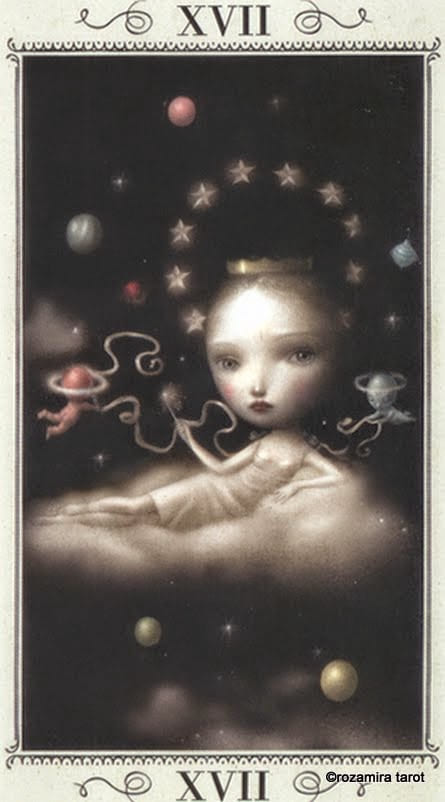
Cards pulled: The Star (feeling), Three of Pentacles (action), Five of Cups reversed (release)
“I wake up and the first thing I notice is quiet confidence. Not loud, not proving anything — just a steady knowing that I’m on the right path. (Star energy)
Today I’m meeting my collaborators. We sit around the table with our laptops and notebooks and ideas, and it feels like creative electricity. Everyone brings something different. I bring the vision; they bring skills I don’t have. Together we’re building something none of us could build alone. (Three of Pentacles)
I used to spend mornings replaying what went wrong. Not anymore. Those cups that spilled — I’ve turned around. I see what’s still standing. I see what’s growing. (Five of Cups reversed)
I drive home with the windows down, and I realize I’m humming. I haven’t hummed in months. That’s how I know things have shifted — not through dramatic breakthroughs, but through humming.”
Common scripting mistakes
Being too generic. “I live in a beautiful house and have a great job” doesn’t activate anything. WHICH house? WHERE? What does it SMELL like? The details are the mechanism.
Scripting from lack. If your script reads like a complaint about your current life in disguise — “Unlike NOW, I finally have…” — you’re scripting from scarcity. Write purely from the place of having. Don’t reference what you don’t have.
Scripting too often. This is a quality practice, not a quantity one. Once a week is plenty. Every day creates obsessive monitoring energy — the opposite of trust. Write it, feel it, release it.
Ignoring what feels fake. If you write “I feel completely at peace” and your body screams “no you don’t” — don’t push through. Explore the resistance. It’s showing you what needs healing before this vision can land.
Making it a monthly practice
Here’s a sustainable rhythm:
New moon: Write a fresh script for the coming cycle. Pull your 3 tarot cards. Let the cards and the lunar energy shape a new vision or deepen the existing one.
Weekly: Reread your script once. Notice what still resonates and what has shifted. Don’t rewrite — just notice.
Full moon: Reflect on what from your script has started appearing in your real life. Even small echoes count. Write them down as evidence that the scripting is working.
Monthly: Update your script. Your vision will evolve. That’s not failure — it’s growth. The person who starts scripting in January will want different things by March, and that’s exactly right.
The truth about scripting
The best scripts aren’t fantasies. They’re permissions. When you write a scene where you’re confident, loved, successful, and at peace — you’re giving yourself permission to believe that’s possible. And belief changes behavior. And behavior changes outcomes.
Your tarot cards add depth to that permission. They show you which doors to open, which feelings to trust, and which old stories to finally close. The cards don’t write your script for you — they make sure your script comes from the truest part of you.
Pick up your pen. Pick up your deck. Start writing the life that’s waiting for you to notice it’s already begun.
Frequently Asked Questions
What is scripting for manifestation?
Scripting is a journaling technique where you write about your desired future in present tense, as if it's already happening. Instead of 'I want a fulfilling career,' you write 'I wake up excited about my work. My morning starts with...' The detail and emotion make your brain treat the vision as real, which shifts your behavior and focus toward making it happen.
How is scripting different from affirmations?
Affirmations are short repeated statements ('I am abundant'). Scripting is narrative — you write a full scene or day in your desired life with sensory details, emotions, and specific moments. Scripting engages your imagination more deeply because you're creating a story, not repeating a phrase. Both work; scripting is more immersive.
How often should I do manifestation scripting?
Once a week or once a month is ideal. Unlike affirmations, scripting doesn't benefit from daily repetition — doing it too often can create obsessive energy. Write one detailed script, reread it weekly, and update it monthly as your vision evolves. Quality of emotional engagement matters more than frequency.
How do I add tarot to my scripting practice?
Pull 3 cards before you script: one for the feeling you're calling in, one for the action needed, and one for what to release. Let these cards shape your script — if you pull the Empress, write a scene rich with abundance and sensory pleasure. The cards prevent you from scripting on autopilot and add unexpected directions to your vision.