Tarot and Therapy: Can They Work Together? What Therapists Actually Think
The question I get most from therapists’ clients
It usually sounds something like this: “I love tarot, and I’m in therapy. But I feel weird bringing my readings up with my therapist. Is that silly?”
It’s not silly. It’s actually one of the most interesting questions at the intersection of spirituality and mental health.
Because the honest answer is: tarot and therapy can absolutely work together. They already do, more often than you’d think. But they serve different functions, and confusing those functions is where problems start.
What therapy does that tarot can’t
Let’s start with what’s non-negotiable. Therapy provides things that tarot simply cannot:
Clinical assessment. A therapist can identify patterns that may indicate depression, anxiety, PTSD, or other conditions. Tarot cards can’t diagnose anything.
Therapeutic relationship. The relationship between you and your therapist IS the healing tool. Years of research show that the therapeutic alliance — feeling seen, heard, and safely held by another human — is the strongest predictor of positive outcomes. A deck of cards can’t hold space for you the way a person can.
Evidence-based interventions. CBT, EMDR, DBT, somatic experiencing — these are tested protocols with measurable outcomes. Tarot has no clinical evidence base.
Safety and boundaries. Therapists are trained to manage crisis, recognize danger signs, and maintain ethical boundaries. If you’re in a crisis, you need a human, not a card.
Accountability. A therapist will gently but firmly challenge you. Cards show you what you project onto them — which sometimes means they tell you what you want to hear.
What tarot does that therapy sometimes can’t
Now here’s where it gets interesting. Tarot has some qualities that traditional talk therapy doesn’t always access:
Speed of access to emotional material. A single card pull can surface a feeling that might take weeks to arrive at through talking. The visual, symbolic nature of tarot bypasses intellectual defenses in ways that verbal processing sometimes can’t.
Permission to explore the irrational. Therapy, especially cognitive-behavioral approaches, tends to focus on rational thought patterns. Tarot gives permission to explore the non-rational: intuition, symbolism, mystery, spiritual meaning. For people whose inner life is rich with these dimensions, tarot meets them where they are.
Autonomy and empowerment. In therapy, the therapist holds significant power. In a tarot practice, YOU are the reader, the interpreter, the meaning-maker. This self-directed quality can be deeply empowering — especially for people healing from situations where their agency was taken away.
Daily accessibility. You can pull a card every morning. You can’t (and shouldn’t) call your therapist every morning. Tarot provides a consistent daily reflection practice that exists between therapy sessions.
The language of archetypes. Some experiences don’t translate well into clinical language. “I feel like the Tower has hit” communicates something that “I’m experiencing a major life disruption” doesn’t quite capture. Archetypal language carries emotional weight that clinical terms can strip away.
How therapists actually use tarot
More therapists use tarot than you might expect. Here’s how it typically works in practice:
As a projective technique
This is the most common clinical use. Like Rorschach inkblots or the Thematic Apperception Test, tarot cards present ambiguous imagery that the client interprets. What they see reveals their inner concerns, fears, and desires.
A therapist might say: “Pull a card that represents how you’re feeling about this situation.” The client’s interpretation of whatever card appears becomes the therapeutic material — not the card’s “official” meaning, but what the client projects onto it.
As a narrative tool
Narrative therapy helps clients re-author their life stories. Tarot naturally supports this: laying out a past-present-future spread invites the client to construct a narrative about where they’ve been, where they are, and where they’re going. The cards provide structure for storytelling that might otherwise feel overwhelming.
As an emotional access point
Some clients struggle to identify and articulate their emotions — especially those with alexithymia (difficulty recognizing feelings) or those who tend to intellectualize. A card image can provoke an emotional response that words alone can’t: “When I see this card, I feel… sad. No, angry. Actually both.”
As a bridge for spiritual clients
For clients whose spiritual practice is central to their identity, dismissing tarot can feel like dismissing a part of them. Therapists who understand this use tarot as a bridge — honoring the client’s spiritual framework while working within therapeutic goals.
When tarot hurts more than it helps
I need to be honest about this. Tarot can become harmful when:
It replaces professional help. Using tarot to manage suicidal ideation, severe anxiety, or trauma responses instead of seeking therapy is dangerous. Cards can’t hold you safe during a flashback.
It creates dependency. If you can’t make any decision without pulling cards first — what to eat, whether to text back, whether to leave the house — tarot has become a compulsion, not a practice. This is anxiety using tarot as a coping mechanism, and a therapist can help you address the underlying anxiety.
It feeds avoidance. Pulling cards about your ex instead of processing the breakup. Doing daily readings about your career instead of actually making the phone call. Tarot can become a sophisticated way to avoid action under the guise of “seeking guidance.”
It increases anxiety. If the Tower makes you panic about the future, or Death sends you spiraling, or you can’t sleep after a difficult reading — the practice is currently doing more harm than good. Step back. Talk to someone.
The reader holds too much power. If you’re seeing a reader (not reading for yourself) and they’re making you feel dependent, afraid, or like you need to come back urgently — that’s manipulation, not guidance. A good reader empowers you. A harmful one creates dependency.
How to combine tarot and therapy well
If you want to use both, here’s how to do it with integrity:
Tell your therapist
You don’t need your therapist to believe in tarot. You need them to be curious about what it means to you. Say: “I have a tarot practice that I find meaningful for self-reflection. I’d like to be able to bring insights from my readings into our sessions.”
A good therapist will work with this. They’ll ask what drew you to tarot, what you get from it, and how it fits into your larger self-understanding. If they dismiss it dismissively, that’s information about the therapeutic fit.
Use tarot between sessions
Therapy happens once a week (or less). Life happens every day. Tarot can fill the gaps. Pull a card each morning and journal about it. Notice themes that arise between sessions. Bring those observations to therapy.
This turns tarot into a data-gathering tool for therapy — your daily emotional temperature check.
Let therapy hold the hard stuff
Tarot can surface painful material. That’s its gift. But tarot can’t process that material safely — therapy can.
If a reading surfaces a childhood memory, a buried grief, or a fear you weren’t aware of — bring it to your therapist. The reading opened the door; the therapy walks you through it.
Don’t use tarot to avoid therapeutic work
If your therapist suggests something uncomfortable — confronting a pattern, trying a new behavior, processing a trauma memory — and your next instinct is to “check the cards” about whether you should… notice that pattern. The cards might give you permission to avoid. Your therapist is asking you to grow.
Maintain separate roles
Tarot is your personal reflection practice. Therapy is your clinical support. Don’t ask your tarot deck to be your therapist, and don’t ask your therapist to be your tarot reader (unless they specifically offer that integration).
What the Temperance card teaches about this balance
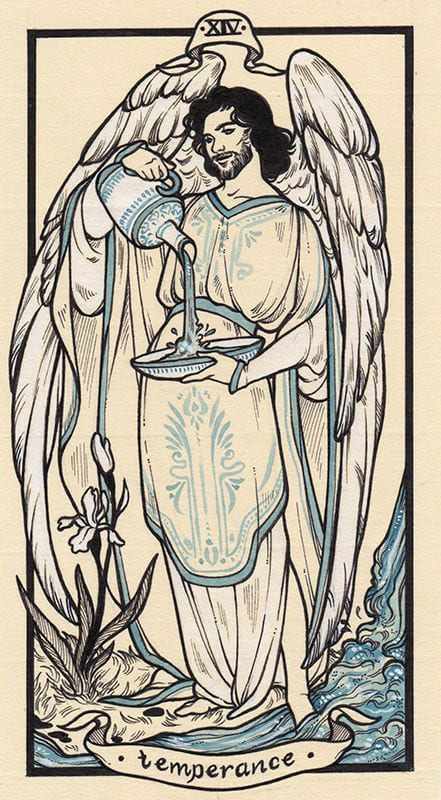
There’s a reason I chose Temperance for this article’s illustration. This card represents the art of blending two different things into something greater than either alone.
The angel on the card pours water between two cups — not replacing one with the other, but finding the flow between them. That’s the relationship between tarot and therapy at its best: two different containers for human experience, each with its own gifts, each made stronger by acknowledging what the other offers.
Tarot gives you symbols. Therapy gives you skills. Tarot opens doors. Therapy helps you walk through them safely. Neither is complete without the respect for what the other does.
The practical takeaway
If you’re in therapy and you have a tarot practice — you’re not being silly, contradictory, or “too spiritual.” You’re integrating different ways of knowing yourself. That’s actually very psychologically healthy.
If you have a tarot practice but are NOT in therapy and you’re dealing with something heavy — please consider finding a therapist. The cards can show you the wound. A therapist can help you heal it.
And if you’re a therapist reading this — thank you for your curiosity. Your clients who use tarot aren’t escaping reality. They’re using a centuries-old symbolic language to understand it. Meeting them there might open doors in your work together that you didn’t expect.
Frequently Asked Questions
Can tarot cards be used in therapy?
Yes. A growing number of therapists use tarot as a projective technique — similar to how Rorschach tests work. Clients draw cards and share what they see, giving the therapist insight into their inner world. Tarot isn't the therapy itself; it's a tool that can open doors to deeper conversation within a therapeutic framework.
Is tarot a substitute for therapy?
No. Tarot is excellent for self-reflection, pattern recognition, and exploring emotions, but it cannot diagnose conditions, provide clinical treatment, or hold therapeutic boundaries. Think of tarot as a journal that talks back — insightful, but not a replacement for a trained professional who can help you process trauma, manage symptoms, and build coping strategies.
What do therapists think about tarot?
Opinions vary. Many therapists, especially those trained in Jungian, narrative, or expressive arts approaches, see tarot as a legitimate projective tool. Others are skeptical. The key distinction most make: tarot is useful when it promotes self-reflection and emotional exploration, and harmful when it creates dependency, anxiety, or replaces proper treatment.
How do I bring up tarot with my therapist?
Be direct: 'I use tarot for self-reflection and it's been meaningful to me. Would you be open to discussing my readings in session?' A good therapist will be curious about what the practice means to you, even if they don't use tarot themselves. If they dismiss it entirely without exploring why it matters to you, that tells you something about the fit.