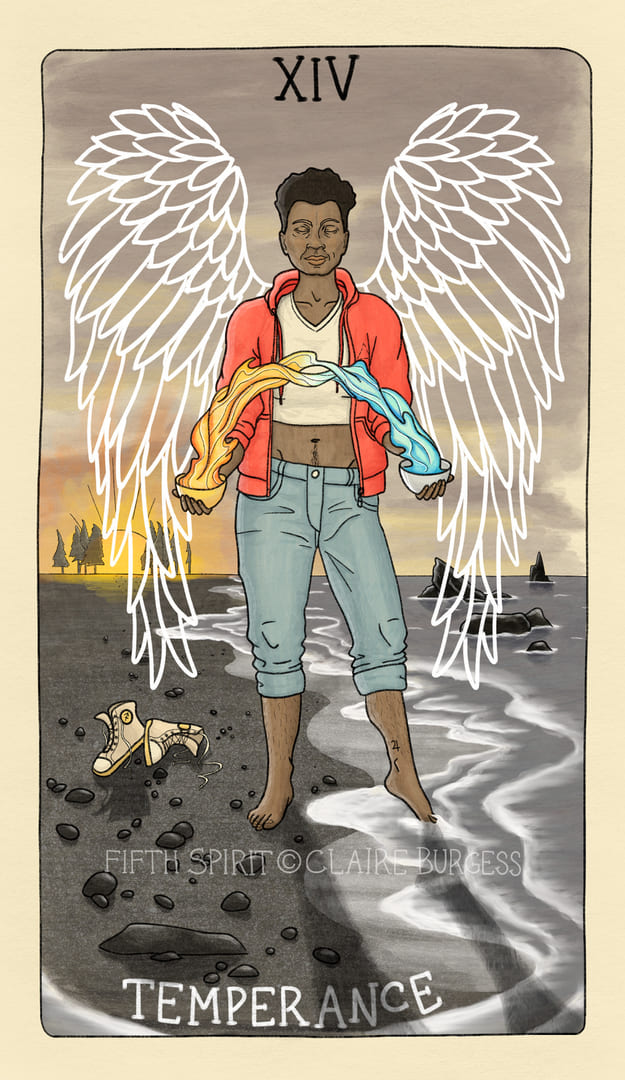
Temperance
Temperance (14) is a liminal, alchemical card of rebirth and integration that follows the surrender of the Hanged One and the transformative work of Death. It portrays an angelic border-walker who bridges binaries and mixes opposites, emphasizing fluid synthesis over rigid moderation or abstinence. Rooted in the Latin temperare, the card highlights combining in proper measure and the strengthening interplay of opposites—hot and cold, inner and outer—so they can function together. In readings, Temperance invites embracing contradiction, harmonizing inner and outer worlds, and living with prismatic complexity and ongoing transformation.
Keywords
Title
14. Temperance
Associations
Fire / Sagittarius (Jupiter)
Keywords
Internal harmony, expanding beyond boxes/binaries, fluidity; interweaving, mixing of opposites, non-linear healing
Quote
I pass death with the dying and birth with the new-wash'd babe, and am not contain'd between my hat and boots... — Walt Whitman, Leaves of Grass
Meaning
After Death, life.
Rebirth and integration
After the surrender of the Hanged One, after the transformative cocoon-shroud of Death, we rebirth in Temperance a winged thing. Temperance is the angel of liminality, the border walker, the bright phoenix arisen. They exist between worlds, bridging binaries, alchemizing opposites. They do this because they know that duality is an illusion, and they know that because they've gone through Death and are yet alive. A card of great complexity and healing, Temperance begins a process of internal-external alchemy, where we can integrate the disparate parts of our selves and our lives and understand that we are whole.
Historical sidetrack
But before we go any further, we must take a brief historical sidetrack into the word 'temperance' itself. This is a very old word that has been shifted in modern consciousness by the Temperance Movement of the 19th and 20th centuries, which railed against alcohol consumption and turned America dry (at least legally) from 1920 to 1933, the era known as prohibition. But Tarot's Temperance is not about teetotaling or abstinence. Instead, it's about alchemy.
Etymology and history
If we go back to its roots, the word temperance comes from the Latin verb temperare, which means 'to mix' or 'to combine,' with a connotation of combining in proper or appropriate measure. The word eventually evolved to connote self-restraint and moderation, as embodied by the Platonic cardinal virtue of Temperance, who is classically shown pouring water from one vessel into another, and whose image has graced card 14 since the very first Tarot deck. In the Renaissance, when Tarot was created, the virtue Temperance was thought to be mixing water into wine in order to avoid intoxication while, one assumes, still enjoying the buzz. Far from demanding abstinence, then, Temperance actually encourages the enjoyment of pleasures in a way that is balanced, moderate, and does not go to extremes. Ironically, the prohibition-pushing Temperance Movement—which at one point involved hacking up saloons with a hatchet, courtesy of movement leader Carry A. Nation—was quite literally lacking in temperance.
Modern nuance
All that being said, you won’t find the words 'balance' or 'moderation' in my guidewords for Temperance here, because I find those words in their modern connotation simply too rigid. 'Moderation' brings to mind precisely weighed and measured portions of carbs and healthy fats, “balance” an equally careful and intentional teetering. Temperance, I believe, is something much more fluid and holistic than that.
Integration over morality
Temperance is not about artifice or morality, but about existing in a state of inner-outer flow from which we can respond to the happenings of life in a way that's adaptive, full-bodied, and aligned with the prismatic complexity of our unadulterated spirit. Rachel Pollack writes that the card 'combines the elements of life. In reality it combines the elements of the personality, so that the person and the outer world will flow together naturally.' Tracing back further, A. E. Waite hints at the same: 'It is called Temperance fantastically, because, when the rule of it obtains in our consciousness, it tempers, combines, and harmonizes the psychic and material natures.'
Tempers and synthesis
The word that Waite uses, 'tempers,' comes from the same root as 'temperance,' but refers to the process of strengthening metal by exposing it to extremely hot and cold temperatures—two opposites, two extremes. So Temperance is not a process of restraining or homogenizing our polarities, after all, but of allowing them to work together in functional combination and harmony. Temperance is not lukewarm; they are hot and cold simultaneous.
Symbolism of binaries
Temperance's two cups represent the binaries with which the human mind orders the world—hot and cold, good and bad, inner and outer, passive and active, feminine and masculine. But while the cups are separate, their contents are mixing. This duality is a repeating symbol throughout the Major Arcana, appearing in the two pillars of the High Priestess, the Hierophant, and Justice, as well as the two sphinxes (or in our case, roller skates) of the Chariot and elsewhere. The High Priestess stands between their contrasting pillars silently, as if keeping a secret. The Chariot holds their opposite sphinxes in controlled balance, but still holds them apart. Temperance is the first card in the deck in which the duality begins to bend.
Subversive synthesis
Temperance mixes their two cups together in a radical act of non-binariness, in a subversive synthesis that defies the rules of physics and social norms. Waite himself specifies that the Temperance angel 'is neither male nor female,' and that they are 'pouring the essences of life from chalice to chalice,' and that 'hereof is some part of the Secret of Eternal Life.' Life isn't meant to be boxed into containers, but lived fluidly and fully, in a constant state of flux and exchange. It's no wonder that many Tarot practitioners (including myself) have dubbed Temperance the Queerest Card in the Deck.
Integration and plurality
So Temperance does not want us to water down our extremes until we become bland and tepid as a room-temperature glass of skim milk. Instead, they want us to ecstatically bridge all of our disparate parts, all of our contradictions, and allow them to talk to each other, to cross-pollinate, to co-exist, to temper. Temperance is not either/or; they are both/and. When Temperance appears in readings, they encourage us to break out of our mental boxes that insist things are either This or That, and ask why not both? They invite us to harmonize our outsides with our insides so we may live in our truth, and to accept the contradictory parts of our personalities, thoughts, beliefs, desires. Temperance teaches that none of us can be reduced to just one thing; we are each manifold. Poet, humanist, sensualist, and beloved 1800s queer granddaddy Walt Whitman sums it up nicely: 'Do I contradict myself? / Very well then I contradict myself, ( I am large, I contain multitudes.)'
Painting
In our Temperance card for Fifth Spirit Tarot, the angel holds two cups, one a lunar silver and the other solar gold, their contents of water and fire combining in a gravity-defying alchemical arc. The angel stands with one foot on the beach and one in the surf, bridging the elements of earth and water with their body, while their wings symbolically tie in the fourth element of air. The sun rises in the background, marking the rebirth of Temperance in the birth of a new day, and a stormy sky gathers, as happens when hot and cold fronts meet. The landscape in the card is inspired by an actual place, about three miles up a volcanic beach in Olympic National Park on the Washington coast, on Quileute and Hoh indigenous lands, where my partner and I honeymooned (a Temperance event itself, after the death/rebirth of marriage). We both recognized this place as a kind of liminal sanctuary then, a fringe space where the earth and air and fire and water rip and clash and merge at the edges, shaping each other at the borders of the world, old and new at once, constantly becoming.
Conclusion
Temperance knows that more than one thing can be true at the same time—we can hold sorrow and joy, fear and excitement, love and rage simultaneously. We are each soft and hard, weak and strong, a jumble of conflicting desires and thoughts and beliefs. We are each hurting and healing, living and dying, all at once, all the time. That's what's so glorious about the experience of living. That's Temperance.
Visual Description
A winged figure stands barefoot on a dark, rocky shoreline with rolled jeans and a red jacket, holding two streams of liquid—one golden and one blue—that arc between their hands and intermingle. Large white-outlined angelic wings frame the figure and the sky is a dusky mix of grays and warm sunset tones. A pair of shoes lies discarded on the pebbled beach nearby while waves lap at the figure’s feet and rock formations jut from the sea in the distance. The Roman numeral XIV appears at the top of the card and the title TEMPERANCE is printed at the bottom.
Fifth Spirit tarot
💜 Please support creators. Buy official decks.
ℹ️ Disclaimer
All card images and descriptions are taken from public sources. They are used for review purposes only. All rights to these images and descriptions belong to their creators. If you believe there is a copyright infringement, please contact us at [email protected].