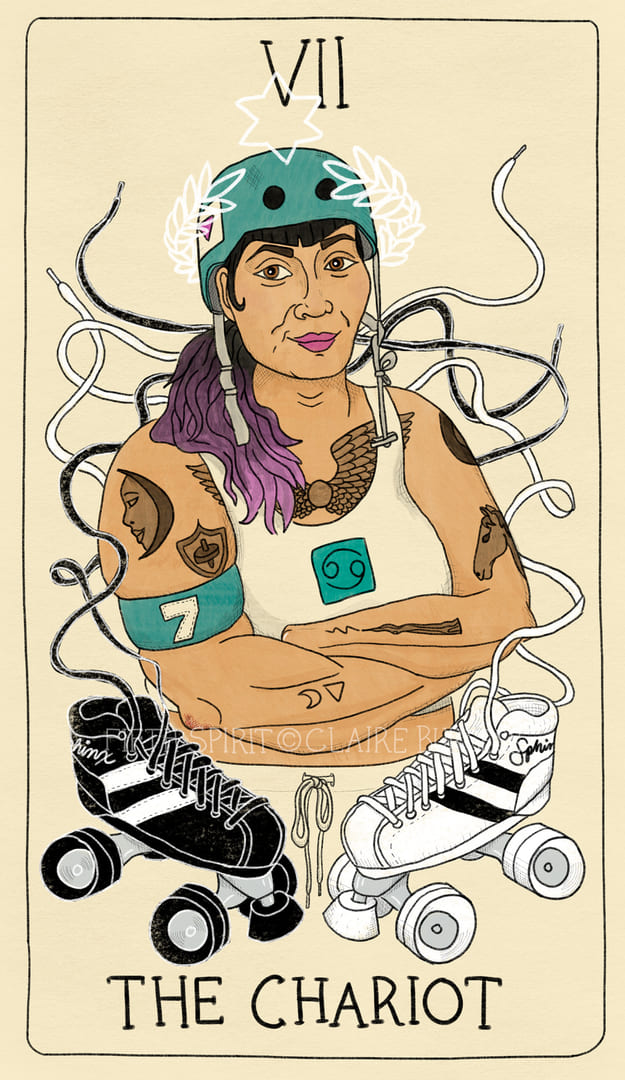
The Chariot
The Chariot represents movement with a mission: progress driven by self-discipline and alignment rather than mere worldly achievement. It emphasizes balancing opposing forces—will and desire, intuition and reason—so all parts of the self pull together toward a higher purpose. Drawing on Plato's chariot allegory and imagery from the Smith-Waite deck, the card calls for thoughtful direction, discipline, and integration of past lessons. True progress and success occur when our faculties are in alignment and we act from inner knowledge toward the evolution of the soul.
Keywords
Card Name
7. The Chariot
Associations
Water / Cancer (Moon)
Keywords
Self-discipline, progress, purpose, movement informed by inner knowledge; balance of will, desire, and reason.
Quote
Compare the torrent and the glacier. Both get where they are going. — Ursula K. Le Guin, Left Hand of Darkness
Meaning
Once we've chosen ourselves in the Lovers, once we've left the garden gate, the Chariot pulls up with a set of wheels. But this is no joy ride—the Chariot's work is movement with a mission.
Process Over Achievement
Descriptions for the card often focus on success, victory, triumph, but the Chariot is not actually about the moment of achievement; it's about how to get there. So before the Chariot puts the proverbial pedal to the metal, we must first pause to consider where exactly we're going. What dreams are we pursuing? What goals? In our modern world where worth is measured in productivity, where success is a bullet point on a resume, where Jacob's Ladder is an elevator to a penthouse, our direction is easily confused. We proceed mindlessly forward, driven by competition, ego, survival, attainment, blithely checking the boxes on the grocery list of life. We chase a ghost of commodified happiness, expecting to catch up to it any day now, continually just beyond the next milestone, the next purchase, the next big thing. The compass spins chaotically, lacking a true north.
Soul Evolution Versus Mundane Success
The Chariot doesn't care about promotions, profits, social advancements, not unless those things correspond with the opening and evolution of our highest selves, of our divine purpose. For that is the Chariot's mission: not mundane successes, but the continued evolution of the soul. (Try putting that on your resume.)
Plato's Allegory
In Plato's Phaedrus dialogue, the soul is described as a chariot with a charioteer driving two horses, one white and one black, the likely inspiration for the black and white sphinxes suggested by Eliphas Levi and depicted in the Smith-Waite Chariot. These contrasting steeds, like the High Priestess's dark and light pillars, represent duality and contradiction, all the seemingly opposed parts of our selves, our lives, the world, our souls. In his allegory, Plato describes the charioteer as the intellectual force of reason that, like any driver, must balance and direct these conflicting horses into working together to pull the soul-chariot forward. The objective of Plato's Chariot of the Soul is to proceed through the course of lifetimes toward the soul's transcendence.
Wholeness Required
In this allegory, and in the Chariot card, we cannot move forward with only one horse, only one side of ourselves. We move forward with all of us, with our whole soul, or we do not move at all.
Balanced Action
The Chariot invites us not into a reckless charge, but into action informed by inner knowledge and divine wisdom. They ask us to gather all the parts of ourselves, to rein in our wild desires along with our insistent will, our dream-knowings along with our well-reasoned stratagems, and apply them all to the furthering of our soul purpose. As a roller-skater can’t move without balance and alignment, both skates working in opposite reciprocal harmony to propel the skater forward, so the Chariot can’t move without the balance and cooperation of mind and heart, intuition and intellect, receptivity and action, will and desire.
Arcana References
In the Smith-Waite deck, there are references to each of the Major Arcana cards that came before, hidden in the symbols that decorate the chariot and the charioteer, many of which are retained in the tattoos on Fifth Spirit’s Chariot. The Chariot calls upon each of these archetypal energies, Magician to Lovers, manifestation to individuation, and sets off on their path. This is another side to the Chariot, as an aggregation of experience and varied wisdom, a preliminary step toward unifying all these contradictory elements and dualities, these paradoxes of the self, these dark and light sphinxes of the soul. These seemingly polar forces won't be truly unified and integrated until the final trump, The World, but here in the Chariot we are able for the first time to hold them in balance, with thoughtfulness and discipline, and use them to their highest purpose: the progress of the soul.
Progress and Alignment
This progress can occur in tandem with life events and achievements, with the pursuit of noble endeavors or the small simple things that light up our souls. When the Chariot appears in a reading, it asks that we summon all the parts of ourselves to the service of whatever that thing may be. When all our faculties are awake and in alignment, when we’re in touch with our higher purpose, when we’re tuning in to the soul, that’s when we can make real progress toward our best and truest lives.
Conclusion
And that's success.
Visual Description
A determined skater faces forward with arms crossed, wearing a teal helmet decorated with a white laurel motif and a star above it, and a sleeveless top bearing a Cancer glyph. Purple hair falls over one shoulder and numerous tattoos mark the skater's arms and chest, including wings and other symbols. Two roller skates, one black and one white, sit at the figure's feet and their laces curl and loop behind like reins. The card is bordered and labelled with the Roman numeral VII at the top and the title THE CHARIOT at the bottom.
Fifth Spirit tarot
💜 Please support creators. Buy official decks.
ℹ️ Disclaimer
All card images and descriptions are taken from public sources. They are used for review purposes only. All rights to these images and descriptions belong to their creators. If you believe there is a copyright infringement, please contact us at [email protected].