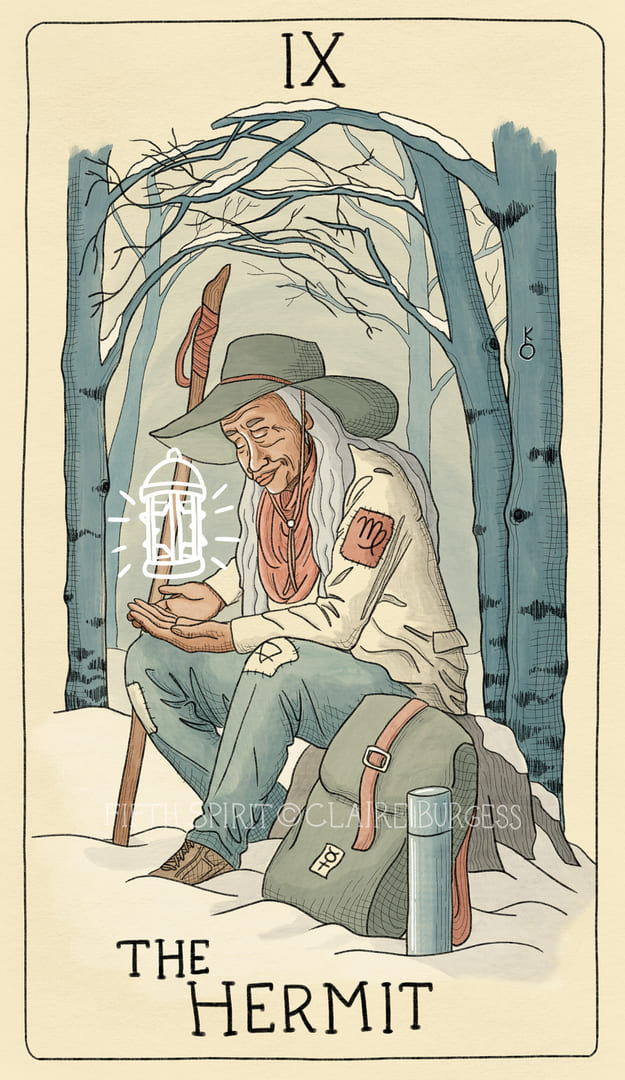
The Hermit
The Hermit represents a solitary seeker who withdraws from the world to discover inner wisdom and authentic direction. This card asks you to turn away from societal expectations and consult your own counsel, embracing necessary solitude and reflection. The Hermit is paradoxically both recluse and mentor: after inward discovery they may emerge to guide others with the lantern of the soul. Its imagery—the lantern and the hexagram—symbolizes inner illumination and the unity of opposing forces, and walking this path requires courage and may be lonely but ultimately leads to original truth.
Keywords
Associations
Earth / Virgo (Mercury)
Keywords
Reflection, soul-searching, inner wisdom, solitude, the unorthodox path, following your own truth, an unorthodox mentor.
Quote
Go out in the woods, go out. If you don't go out in the woods nothing will ever happen and your life will never begin. — Clarissa Pinkola Estés, Women Who Run with the Wolves
Archetypes
The Hermit is the ancient wild man of the woods, long hair filled with twigs and tangles. They're the guru on the mountaintop, meditating in silence for twenty years. They're the grisly misanthrope in their off-the-grid cabin, grumbling about sheeple and refusing to pay taxes. They're the nomadic witch in her chicken-legged hut, the poet communing with nature at Walden pond, the wizened Jedi master in the swamp, emerging to mentor the naïve young hero. Help you, I can.
Isolation and Counsel
An essential quality of the Hermit is a certain degree of isolation. That can be a literal one (the hut, the pond, the swamp) or a figurative one, a withdrawal inwards into the wilderness of the self. But the Hermit's isolation does not require that we cut off our loved ones, dump our partners, and go walk into a forest somewhere never to be seen for nine years. No, not that (though sometimes that, depending on your situation). What the Hermit requires is that we turn away from the counsel of others, from the loud and established rules of society, from all the “shoulds” endlessly foisted upon us, and seek our own council instead.
Rebel Nature
Because of their tendency to defy society's rules with the nonchalance of someone who's seen through them and found them lacking, the Hermit has a bit of the rebel about them. Not a rebel without a cause, but not necessarily a rebel with one either, the Hermit rebels simply by refusing to conform, by going about their life guided by their own light and in pursuit of their own truth. They're often regarded as eccentric at best and unhinged at worst, which are both words that dominant culture uses to describe the tastes and behaviors of those who they do not understand. But the Hermit doesn't mind. They are unconcerned with the opinions of the status quo.
The Path and Campbell
The Hermit's path can be a lonely one, and one fraught with the dangers and difficulties of not being accepted by mainstream society, but such is the path of the seeker of internal and original wisdom. In Bill Moyers' interview with Joseph Campbell as recorded in The Power of Myth, Campbell discusses the difference between personal myths, or dreams, and societal myths, or what we may call conventional beliefs and norms. Campbell says this of the juncture of the two: “If your private myth, your dream, happens to coincide with that of the society, you are in good accord with your group. If it isn't, you've got an adventure in the dark forest ahead of you.” Campbell goes on to remark that these unconventional dreamers, if forced to live in a system that doesn't understand them, will be labeled "neurotic," a now out-of-date term that we can consider here to mean derided by society as abnormal or irrational. Moyers points out that many "visionaries and even leaders and heroes" could be considered as such, to which Campbell agrees: Yes, they are... They've moved out of the society that would have protected them, and into the dark forest, into the world of fire, of original experience. Original experience has not been interpreted for you, and so you've got to work out your life for yourself... You don't have to go far off the interpreted path to find yourself in very difficult situations. The courage to face the trials and to bring a whole new body of possibilities into the field of interpreted experience for other people to experience—that is the hero's deed.
Campbell's Hermit
Campbell's description here, of the hero whose dream does not match the societal norms, who ventures into the dark forest away from the well-trod ("interpreted") path, who eventually brings their wisdom back to others who dare to walk similar paths of their own—that's the Hermit.
Dual Roles
The Hermit of the Tarot plays two paradoxical roles. They are the solo recluse, withdrawing into the wilderness of the self to discover their unique path without the help of society; and they are also the improbable guide, appearing from the wilderness to share their wisdom with the lost traveller, to shine their lantern and reveal the way. In effect, the Hermit is both sides of the inner journey in Campbell's dark forest, encompassing embarking on the inward path and emerging from the other side to guide others on their own.
Imagery and Symbols
Either way you look at it, the Hermit requires us to turn our backs on the known world and its protections and comforts, to go inwards to explore our hidden truths, which we have been prepared for with the courage of Strength. In the Hermit for Fifth Spirit Tarot, we see a solo traveller in a dark and snowy wood, pausing for a moment to meditate or seek their inner guidance. Their lantern is not a literal one but a figurative one, an illuminated outline, representing the light of the soul and its original wisdom. The star is the six-pointed hexagram, formed by the overlapping of two triangles: the upward-pointing triangle that is the glyph for fire, and the downward-pointing one that is water. In their overlapping, the triangles also create the glyphs for air and earth, making the hexagram a longstanding symbol of unity and balance by the combining of the seemingly opposing forces of nature. (Recall the two opposing horses of the soul in the Chariot.)
Following the Light
In the Hermit, we locate this lantern, this unified light of the soul, and we follow it where it leads, to the discovery of the path that is authentically ours, through the dark forest to our own chicken-legged hut, to our own Walden pond, from where we may, from time to time, give others guidance on their paths, but always with the knowledge that they have to walk the path themselves. Always by themselves.
Conclusion
The world may call them rebels, but those who walk by their own light are holy.
Visual Description
A solitary older figure sits on a snowy ground among bare winter trees, holding a small glowing lantern sketched in white light above his cupped hands. He wears a wide-brimmed hat, long gray hair, a patched jacket with a stitched symbol on the sleeve, and leans on a wooden staff planted in the snow. A backpack and a thermos rest beside him, and a hiking stick protrudes behind him. The Roman numeral IX appears at the top of the card and the title THE HERMIT is printed at the bottom; a faint artist watermark crosses the lower center.
Fifth Spirit tarot
💜 Please support creators. Buy official decks.
ℹ️ Disclaimer
All card images and descriptions are taken from public sources. They are used for review purposes only. All rights to these images and descriptions belong to their creators. If you believe there is a copyright infringement, please contact us at [email protected].