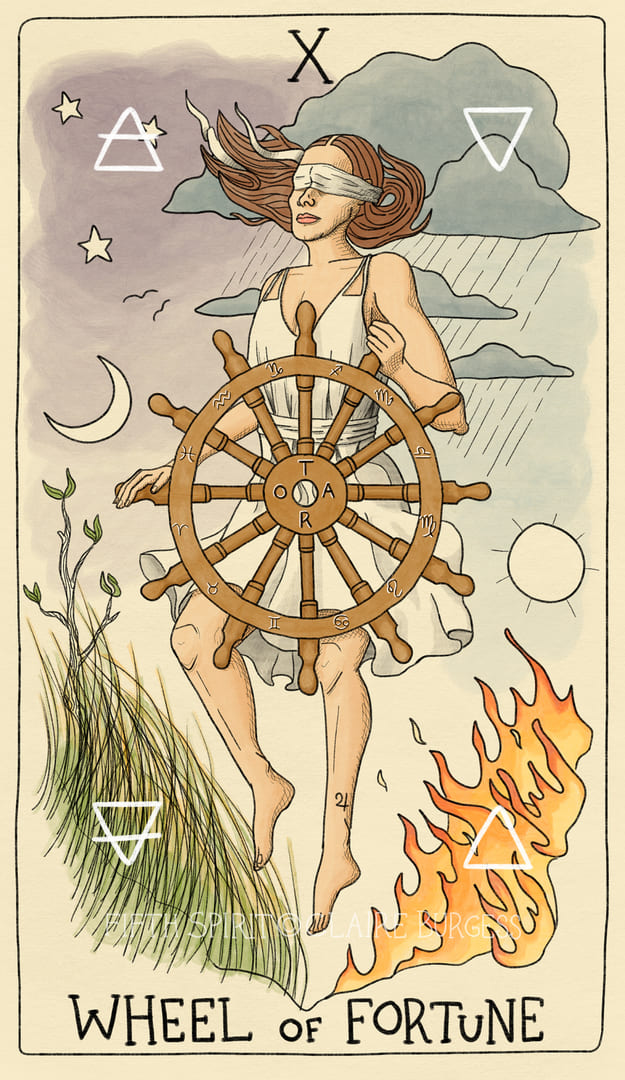
Wheel of Fortune
The Wheel of Fortune represents the eternal cycles of life and the inevitability of change that lies beyond our control. Its circle symbolism connects macrocosm and microcosm—seasons, planets, atoms—and conveys themes of life, death, rebirth, and unity. The card emphasizes that events are not inherently good or bad, and fairness is not guaranteed; our power is in how we respond. When the Wheel appears it often signals a turning point or unexpected intersection with larger forces, urging acceptance, centeredness, and focused action on what we can change.
Keywords
Associations
Fire / Jupiter
Keywords
The eternal cycle, external change, forces beyond your control, turning point, respond instead of react.
Quote
Chance rules our lives, and the future is all unknown. Best life as we may, from day to day. — Sophocles, Oedipus Rex
Meaning
Overview
The wheel of the year, the wheel of life, the Wheel of Fortune. Wheels are everywhere in our consciousness, perhaps because of their essential shape, one found in religions and spiritualities across time and location, one ever-present in nature itself: the circle.
Circles in Nature
The sun is a circle, and so is the moon, and so are the moon's phases. The seasons turn in a repeating circle of winter, spring, summer, fall. The planets orbit in circles (or ellipses), and the Earth itself is a circle (or sphere) that revolves (in a circle) on its axis. On the micro level, atoms are circles, with their encircling bands of electrons, and energy flows in a circle, recycling itself. Circles are everywhere.
Symbolism of the Circle
It's no surprise then that the circle has come to symbolize eternity, immortality, life/death, the soul, even God. In the Tarot, the circle represents an essential concept that lies under the entire metaphysical Tarot system, that of the endlessly repeating cycle of life-death-rebirth, of totality and of nothingness, and of the unity of all things. In the Fool, we were present in the circle as the number 0, the number of the void, of nothingness and of anythings, of absolute potential. In the Wheel of Fortune, we meet the circle in its function as the cycle, the ever-turning wheel that moves the heavens, the seasons, and our own fortunes as they intersect these powers beyond our control.
Lack of Control
That's the most difficult thing about the Wheel of Fortune, I think: that we can't control it. The Wheel may bring misfortunes or snags in our plans, but it may just as easily bring unexpected boons and opportunities, and we have no power over either. For this reason, the card has over time become conflated with good luck or bad luck, but luck has little to do with it. Tarot teacher Lindsay Mack has a saying that she applies to many of the cards: "It's not good or bad; it just is." That is certainly true of the Wheel of Fortune.
Fairness and Fate
When difficulties befall us, it's not necessarily because we have done something to deserve them. The same is true of happy opportunities and windfalls. Hard times fall on good people, and assholes slip through life greased with ease and privilege. It's not fair, but the Wheel is not about fairness. The Wheel is about one simple, and difficult, and universal cosmic truth: shit happens.
Historical Rota Fortunae
The Wheel of Fortune in Tarot is based on a much older concept of the same name, which goes back to the Middle Ages and earlier, to ancient Rome. The medieval wheel of fortune—or Rota Fortunae in Latin—was often depicted as a giant, spoke wheel with a king on top, a beggar on the bottom, and two other people on the sides—one reaching upwards as the wheel rotates them from the bottom toward the top, and one clinging desperately as the wheel rotates them from the top downward. The wheel was turned by the Roman goddess Lady Fortuna, who wears a blindfold to show that she is unbiased or even random, and who is the precursor to our modern-day Lady Luck. The Rota Fortunae is an allegory that reminds us that there are forces beyond our control, that our fates are not completely in our own hands, and that even kings are brought low.
Resistance and Acceptance
Like the people on the upwards and downwards sides of the medieval wheel of fortune, we often try to force the wheel to turn in our favor. We hungrily grasp at what may lift us upward, and we flail and kick when our fortunes are turning downward. When we're at the bottom, it's easy to lose faith or become mired in self-pity, and when we're at the top, it's easy to take our position for granted or assume a pompous invincibility. Fighting the wheel is an exercise in futility, like trying to stop the moon or make the Earth spin backwards. We can't force the wheel to turn, but turn it always does.
Reading Implications
When the Wheel appears in a reading, it can herald something unexpected intersecting our lives, for better or worse. It signals contact with the greater, ever-turning macrocycle, the interconnected web of all life and energy and souls. It reminds us that we're a part of something much bigger than our understanding, and that that's exactly how it's supposed to be.
Response and Serenity
Our power in the Wheel of Fortune is in how we choose to respond to our circumstances. Rather than reacting against our fortunes, can we work with them instead? Can we make peace with what's outside of our control, and focus on improving our lives through what is? The key is to work with the wheel, not against it. I'm not a religious person, but I think the popular "Serenity Prayer" adopted by Alcoholics Anonymous and other recovery programs puts it best: "Give me the serenity to accept the things I cannot change, the courage to change the things I can, and the wisdom to know the difference." Joseph Campbell has an observation about the medieval wheel of fortune: "if you are attached to the rim of the wheel of fortune, you will be either above going down or at the bottom coming up. But if you are at the hub you are in the same place all the time." Lindsay Mack has a similar teaching about the card, to seek the center of the wheel. So in our Wheel of Fortune moments (or days or weeks or years), when we find ourselves at the mercy of forces beyond our control and/or comprehension, the most important thing we can do is stay centered in the present moment, tend to what is within our power, and release the rest. That’s the way to serenity. That’s the hub. That’s the center of the circle.
Visual Description
A blindfolded woman in a white dress floats centrally, holding a large wooden ship's wheel marked with zodiac glyphs; letters in the wheel's hub appear to form the word T O A R. A Roman numeral X is printed at the top and the title WHEEL OF FORTUNE runs along the bottom. The sky shows stars and a crescent moon on the left, clouds and rain to the right, a simple sun disk, and elemental triangle symbols and small patches of grass and flame at the lower corners. The overall palette is muted watercolor with clear linework and the figure's hair and dress move as if in wind.
Fifth Spirit tarot
💜 Please support creators. Buy official decks.
ℹ️ Disclaimer
All card images and descriptions are taken from public sources. They are used for review purposes only. All rights to these images and descriptions belong to their creators. If you believe there is a copyright infringement, please contact us at [email protected].