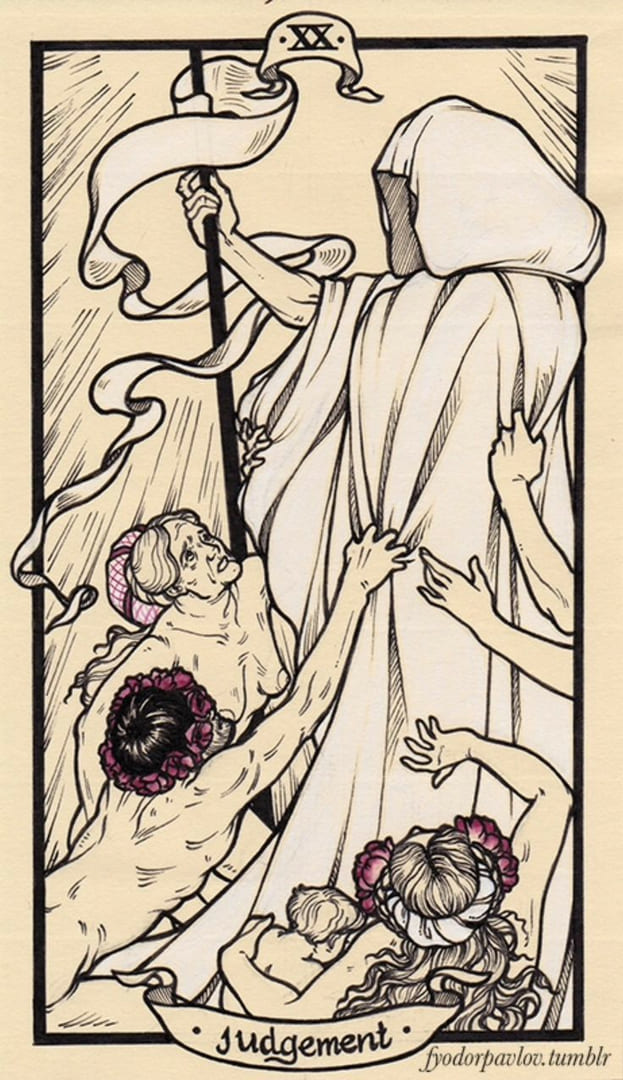
Judgement
The Judgement card focuses on self-accountability and internal scrutiny rather than societal judgment. It emphasizes the importance of honest self-evaluation and introspection. The design portrays a figure open to various interpretations—be it angelic, divine, or a personification of judgement itself—reflecting a personal and impartial inner critic. The card's light colors symbolize hope and new beginnings despite the often challenging nature of self-reflection.
Keywords
Card Development
This card developed a little differently from the rest. Before I drew the cards at their full size, I would sketch out the composition in a small thumbnail drawing with a bunch of notes. So, for Judgement, I had sketched out a relatively traditional Smith-Waite inspired design, complete with three figures popping out of their graves, tombstones and all, with parting clouds and beribboned trumpets crossed above them. It was a good design, very classical and attractive, and I was content enough with it. But when I went to bed that night, it just didn’t feel right. The next morning, as I was cutting my paper down to size, I opened my sketchbook and drew a completely different thumbnail, which resulted in the card you see.
Design and Intuition
Simpler and somewhat different from the traditional Smith-Waite inspired cards, and, in the end, far closer to my reading of the card.
Meaning
If Justice is the card of our accountability to society, Judgement is the card of our accountability to ourselves. It is intuitive and it looks within rather than without. It puts a mirror up to our nature, impassively, and lets us stand up to our own scrutiny and criticism. Our job then is to be honest with ourselves and be confident in having done our best to be able to withstand that self-evaluation. I did not want to include an explicitly angelic figure, because it implies the presence of a god. Our greatest judge should be ourselves, not some vague outside lofty power.
Figure Interpretation
But I did include a figure that can be interpreted in many different ways. I was thinking of Charon, Hades's ferryman who gathers souls and carries them across to the underworld, holding a staff that could in fact be his oar. He is impartial and eternal, he cannot be bribed or cajoled, and he will always be there to do his job. But the figure can also be an angel to those who wish. They can be god, or death, or a personification of Judgement itself—all of that is up to the individual reader, and the figure's affiliation is left intentionally vague. The people around appear in distress, because self-criticism is difficult and frequently painful, but I chose light colors for the card as a sign of hope and newness.
Fyodor Pavlov tarot
💜 Please support creators. Buy official decks.
ℹ️ Disclaimer
All card images and descriptions are taken from public sources. They are used for review purposes only. All rights to these images and descriptions belong to their creators. If you believe there is a copyright infringement, please contact us at [email protected].