The High Priestess
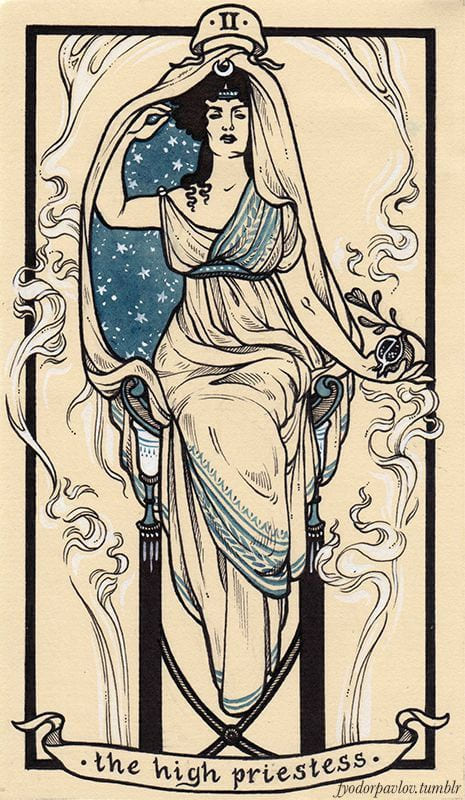
The High Priestess represents mystery, knowledge, and the power of intuition. Portrayed as Pythia, the Oracle of Delphi, she symbolizes a powerful and self-sufficient figure. Her imagery includes the combination of symbols from various goddesses and historical figures, cloistering aspects that historically empowered women, and suggests meditative seclusion to overcome self-doubt and confusion when reversed.
Keywords
Introduction
Otherwise known as La Papesse, the High Priestess is another one of those cards that, outside of some recurring symbolism, has been interpreted in wildly different ways. Pope Joan, the Virgin Mary, the goddesses Isis and Juno have all been pointed to as origins and inspiration for the archetypal figure of the High Priestess. Visually however, none of them sat quite right with me. Keeping them all in mind, I eventually settled on Pythia, the Oracle of Delphi, as the more accurate representation for me, of what the High Priestess stands for.
Symbolism
The black and white pillars that support the roof of the High Priestess’s temple in the Smith-Waite illustration have become instead the tall legs of the curule that lift her up as she sits over the chasm. And instead of the veil, she is enveloped in the intoxicating vapors that rise from the crack in the mountain to bear up her prophecy, knowledge and mysteries. The Virgin (specifically Our Lady of Guadalupe) is referenced in her starry cloak, and Persephone is also present in the pomegranate she holds (normally, the veil behind the High Priestess is embroidered with pomegranates). A crescent moon crowns her forehead, linking her to the Moon coming up later in the Major Arcana. Though I left out a more obvious depiction of water imagery from the card, it is implied in the white and blue color choice.
Cloistered Aspect
The cloistered aspect of the High Priestess was one thing that kept popping up in my research, and one that I had to wrestle with a bit in my interpretation of the card. Historically, the cloistering of women in nunneries and convents, in harems, in Russian terems, was a restrictive effort to keep them out of power. At the same time, many women used their cloistering to their advantage, joining convents in order to escape marriage and attain education and creative freedom, and forging entire communities within their own personal sphere. In that context, my High Priestess is a powerful, mysterious and self-sufficient figure who uses her seclusion to her advantage and goes into it on her own terms.
Reversed Meaning
Reversed, the High Priestess suggests that there are outside influences clouding our judgement and blocking our inner voice. She points to self-doubt, confusion and mistrust. She urges us to seek meditative seclusion, go inward, and focus on trusting our intuition.
Fyodor Pavlov tarot
💜 Please support creators. Buy official decks.
ℹ️ Disclaimer
All card images and descriptions are taken from public sources. They are used for review purposes only. All rights to these images and descriptions belong to their creators. If you believe there is a copyright infringement, please contact us at [email protected].