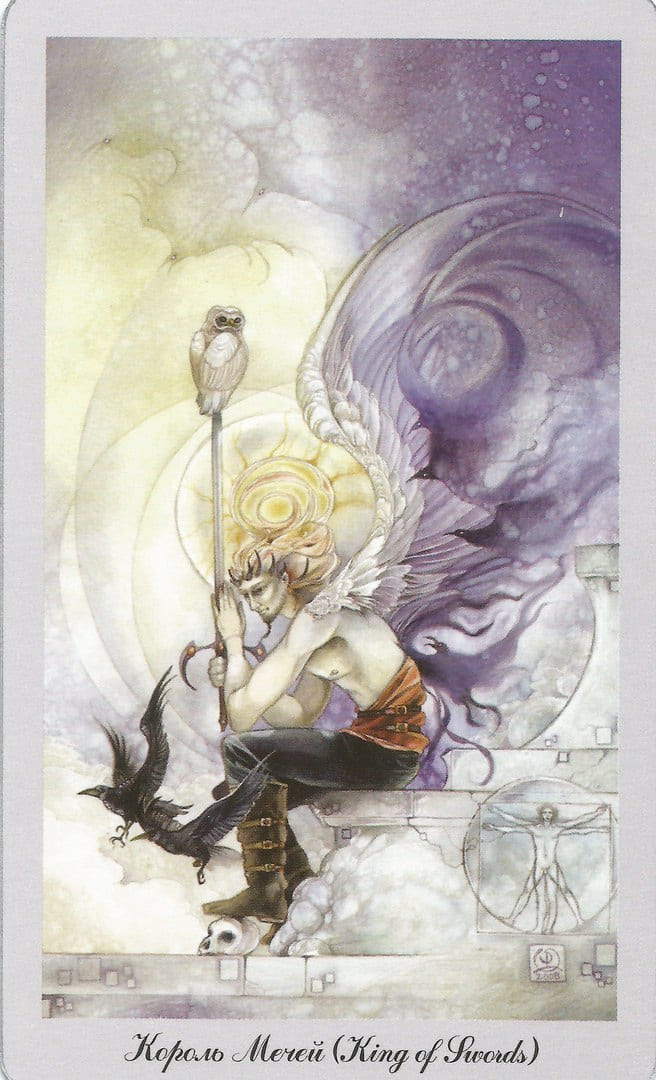
King of Swords
The King of Swords stands as a paragon of strength and morality, holding power over life and death. He is a leader driven by wisdom and the pursuit of truth, balanced by ancient knowledge and vigilant guardians. This card symbolizes the fusion of intellect and action, embodying royal authority and timeless wisdom.
Keywords
Introduction
Like a raised sword, he stands ready, a bastion of strength and morality. He holds power over life and death. He is a warrior king, whose sword is always unsheathed, ready to spring into action if necessary.
Leadership and Wisdom
He is a leader, triumphantly standing at the front line of his army. He completes his actions by following the path of truth, illuminated by the blade of his sword. He is captivated by the quiet wisdom of the owl perched at the very tip of his sword's blade, with ancient knowledge swirling in its eyes as people believe about owls.
Mirror of Knowledge
He is the mirror reflection of the owl and is also guided by the dark ravens that pave the way beside him, similar to Huginn and Muninn, Odin's pair of ravens representing 'thought' and 'memory'. They fly out in search of truth and return to whisper their findings in his ear. Together, they balance night and day – the ravens are the stark brightness of the Sun, while the owl is the truth heard clearly only in the velvety light of stars and the moon.
Symbolism of Royalty
The shadows of the night descend upon his shoulders like a mantle of purple, a color associated with royal power by the ancient Greeks. At the base of his throne, the Vitruvian Man by Leonardo da Vinci is engraved, symbolizing the erasure of the boundary between art and science, symmetry in the human body, and in the entire universe.
Explanation
Huginn and Muninn are a pair of ravens in Norse mythology that fly all over the world of Midgard and inform the god Odin of events. Huginn means 'thought' and Muninn means 'memory' in Old Icelandic.
Vitruvian Man
The Vitruvian Man is a drawing by Leonardo da Vinci around 1490-92 as an illustration for a book on Vitruvius' works, placed in one of his journals. It depicts a naked man in two superimposed positions with arms and legs apart, inscribed in a circle and square. The drawing and its accompanying notes are sometimes called the canonical proportions.
Shadowscapes tarot
💜 Please support creators. Buy official decks.
ℹ️ Disclaimer
All card images and descriptions are taken from public sources. They are used for review purposes only. All rights to these images and descriptions belong to their creators. If you believe there is a copyright infringement, please contact us at [email protected].