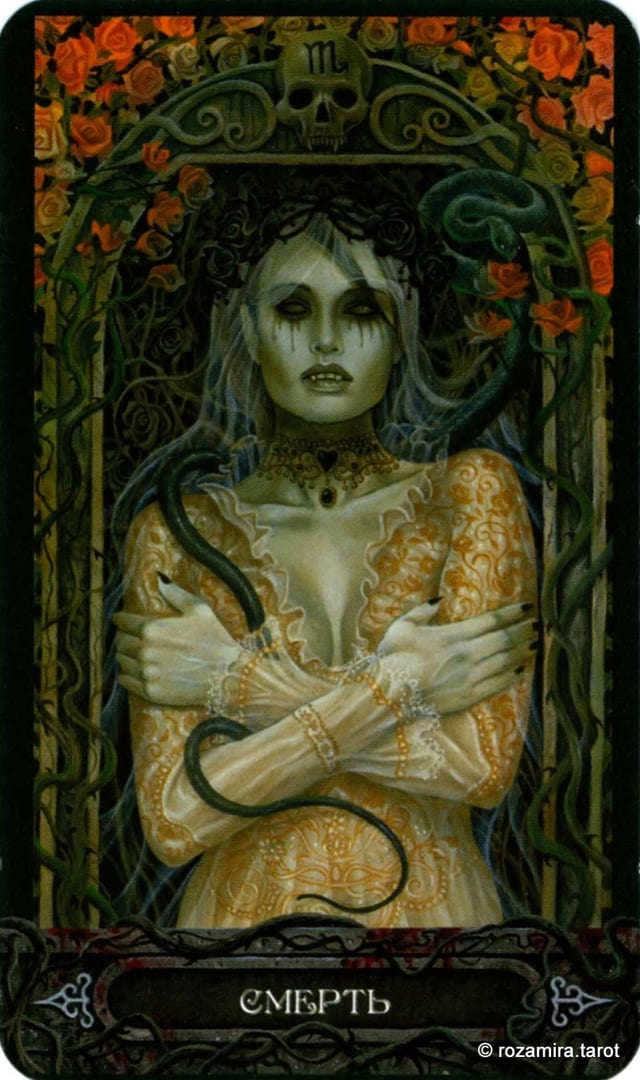
Death
The Death card rarely refers to physical death but instead represents transformation, endings, and new beginnings. It signifies the completion of important cycles and the necessary release of the old to make way for the new. This card teaches us that all experiences become part of our continuous growth, and we should let go of the past with gratitude rather than clinging to it. Death symbolizes rebirth and renewal, reminding us that nothing truly disappears—everything is transformed.
Keywords
Alchemy
Zodiacal trump of Scorpio; dominion of Mars, Pluto ascending; connects Tiphareth and Netzach on the Tree of Life
Kindred Souls
Child of the Great Transformation; Thanatos; Hypnos
Essence
Transformation. Conclusions. Changes. Rebirth. Sleep, passivity and resurrection. Liberation from the obsolete and moving forward. Mysteries of life and death. Coming successes and development. Parting and separation. Growth and decline. Fear of death. Initiation, astral travel or witchcraft. The underworld. Past lives. Spiritual growth and development.
General Meaning
The Death card rarely relates to physical death—it rather indicates the logical development of existing circumstances. In reality, it is no more a symbol of physical death than any other Major Arcana card, since the essence of cards can manifest in any situation. For example, the departure of a beloved from life could equally be expressed by the Sun card (as happy memories) or Temperance (as separation and reunion); in fact, the feelings accompanying the loss of a loved one could be represented by any card. The Death card is primarily connected with conclusions and transformations. It may indicate the completion of an important event, followed by great changes. It may signify the end of a cycle, period, or chapter in our life, or announce the moment when one door closes so another can open in its place. These changes can become very painful for us if we focus all our emotions on what was lost, rather than understanding that everything old must inevitably come to an end, and only this ending can give birth to something new.
Types of Endings and Beginnings
This may mean the completion of some pleasant event, such as a vacation or time spent with friends or family, or a sad event, such as job loss, relationship breakup, or the death of a beloved. This same card may speak of moving to a new residence or changing jobs. Saying goodbye to the past can be difficult, especially if pleasant memories remain, however changes are necessary for us to reach new levels of life. Not all changes and transformations cause sadness and regret. The Death card symbolizes any changes and therefore can describe the beautiful completion of something old and an equally wonderful beginning of something new, for example, the successful completion of a project, success resulting from hard work, or the end of single life and the beginning of family life. This card may announce the completion of a negative period in our life. We fear change and death because we perceive them as destruction and oblivion, when in reality they are transformation from one state to another.
Continuous Transformation
For us to develop and improve in any sphere of life, the old must die and give birth to the new. We constantly part with various stages of our life—with childhood, youth, old acquaintances, our own ideas about ourselves, with old habits and beliefs—but each parting brings us a new meeting. In every moment we die in the present to be reborn in the future. Ultimately we lose nothing, since everything that happened to us becomes part of us and participates in the continuous process of our development. The Death card teaches us that any experience acquired in life is a permanent source of our growth and that we should part with the past easily and with gratitude, not clinging to it. And death itself is not an end, but a transformation. The physical shells we shed become nutrients that feed new, just-born life, similar to how fallen leaves decompose and supply energy to young plants. Fear of death or change prevents us from enjoying and finding joy in life to the fullest. Recognizing that nothing disappears but only transforms, we stop fighting the very cyclical nature of existence. Understanding and accepting death, we acquire the ability to enjoy all the wonders and delights of life.
Practical Applications
In relation to professional or practical questions, this card indicates the end of some activity, freeing us to perform new duties. It may also testify to the completion of specific work or a project. Regarding relationships, some period in their development may have come to an end—this could be, for example, the end of an intimate period if your family is expecting a child, or a change in our obligations and attachments. This card may predict separation or the end of a relationship. On a personal level, the Death card may symbolize liberation from false ideas about oneself or from outdated worldviews that hinder our spiritual development. It calls us to rid ourselves of words, emotions and thoughts that are no longer necessary—this may cause sadness, but along with it will come a sense of liberation and satisfaction.
Analysis and Symbolism
Vampire myths widely use concepts of death and awakening. The card depicts a female Vampire immersed in deep, death-like sleep, her body in a state of hibernation, lethargic coma. Her body is dead, but deep within her black blood is already ripening and awakening. Her soul undergoes a process of decomposition, slowly sinking into the Underworld. She transforms like a butterfly enclosed in a cocoon and experiencing evolutionary changes within it. The emanations of decomposition spread to the roses surrounding her, sucking the color from them. On the other hand, she thus absorbs the energy of blooming to resurrect herself to life. Old blood seeps from her eyes, squeezed out by the fresh blood of her latest victim. The black heart-shaped jewel crowning her necklace is a symbol of love and death—the nature of love as an act of self-death. The snake entwining her represents decomposition and becoming, which is why it slides from the grave (death) to the roses (birth) to taste their fragrance. This card is ruled by Scorpio, the most stable of the water signs. The life-sustaining force of water also symbolizes immortality, as does the snake shedding its skin.
Mythological Themes
Descent into the Underworld for spiritual rebirth is a widespread theme in many mythologies (the most famous being the Greek myth of Persephone). It reflects the idea that the essence of new life can be extracted from the decomposing essence of old life. Old matter decomposes and rots, fertilizing the soil for new life to emerge, testifying that death is a necessary continuation and complement to life. Decomposing matter gives life energy to a new seed. Such transformations we can observe in nature during seasonal changes. Winter brings death necessary for new life to appear in spring. Nature's shed skin, containing the energy accumulated over summer, returns to the soil, saturating it with nutrients that will nourish new life sprouting the following spring. Such dying of the old and birth of the new occurs not only in the material world but can characterize the sequence of events in our lives—rebirths, family creation, new beginnings. This phenomenon is also present in the creative process—in the accumulation and use of memories, ideas and impressions that may belong to the past preceding our birth or even have subconscious origin. Gathered into a unified whole, purified of excess and transformed according to our desires, these legacies of the old turn into that life-boiling mass from which something completely new and beautiful is born. This could be a work of art, something related to our personal spiritual experiences, or some blindingly ingenious discovery.
Astrological Significance
Scorpio, being the astrological sign of the Death card, represents water (emotions) in its most balanced state. Like all zodiacal Major Arcana cards, it is accompanied by three Minor cards over which it rules. These are the Five of Cups (disappointment), Six of Cups (pleasure), and Seven of Cups (highest aspiration of sensual pleasures, frivolity and intoxication). When we balance disappointment and frivolity, they transform into deep pleasure (Six of Cups), transforming into new hopes or emotional uplifts. The female Vampire wears a crown of thorns on her head. In many myths, a thorn-studded crown symbolizes enchanted sleep, stupefaction or death caused by magical spells, which in numerous fairy tales corresponds to a needle prick after which the character falls into sleep for hundreds of years. The thorn bush is also symbolically connected with sharp, radical methods of healing, with disinfection as when using antiseptic agents, and with the sharp smell of pine needles. Therefore the Death card is directly related to healing, in which everything old is put to death to clear the path for the new.
The Nature of Eternal Life
Death is not eternal oblivion but transition to a new state and further development. Only life is eternal in essence, if not in form. It is necessary to exhale air from the lungs to free them for a new breath. In this case we exhale air not to part with it forever, but to get the opportunity to inhale a new portion of it. If we tried to hold our breath, to preserve the air in our lungs, we would simply suffocate. This idea fully applies to attempts to hold onto old grievances or disappointments and to the inevitable transformation that comes with physical death, for upon completing our earthly path we feel peace as we part with our anxieties and worries, our happiness becomes boundless, and our searchings and achievements dissolve in the blissful calm of the Eternal. And then we find rest in the inexpressible beauty and glory of the Divine and, truly liberated, rush toward new, unimaginable horizons.
Shadow
The deep shadow of the Death card is the pain and fear of parting; we must spend some time grieving our losses and coming to terms with them. Inability to accept change and resistance to it (that is, striving to hold onto the past or preserve obsolete relationships) can develop into depression, self-pity or bitterness. Often the long and agonizing completion of some events or relationships proves much more painful and torturous than accepting change accompanied by a sharp and decisive break of old bonds. Poisoning leads to slow but inevitable destruction. Sometimes the shadow position of this card indicates stagnation in relationship development or their completion, despair generated by illusions or inability to accept one's fate. We may feel like we're suffocating, feeling completely helpless. The shadow aspect of the Death card may be a warning that something in our life will soon undergo dramatic changes, and they will be painful for us; then we must prepare for them by calming our heart and mind. Perhaps we resist some changes in our life from fear of the unknown or don't want to change ourselves.
Visual Description
A pale, veiled woman stands with her arms crossed over her chest like an effigy, wearing an ornate laced gown and a dark heart-shaped pendant. Black snakes coil around her arms and torso, threading through a frame of thorny vines and blooming roses. Above her head a skull is set into an arched stone frame, marked with the Scorpio glyph, while shadowed foliage fills the background. The composition suggests a funerary or sepulchral tableau enclosed by twisting greenery and floral decay.
Tarot of Vampyres
💜 Please support creators. Buy official decks.
ℹ️ Disclaimer
All card images and descriptions are taken from public sources. They are used for review purposes only. All rights to these images and descriptions belong to their creators. If you believe there is a copyright infringement, please contact us at [email protected].