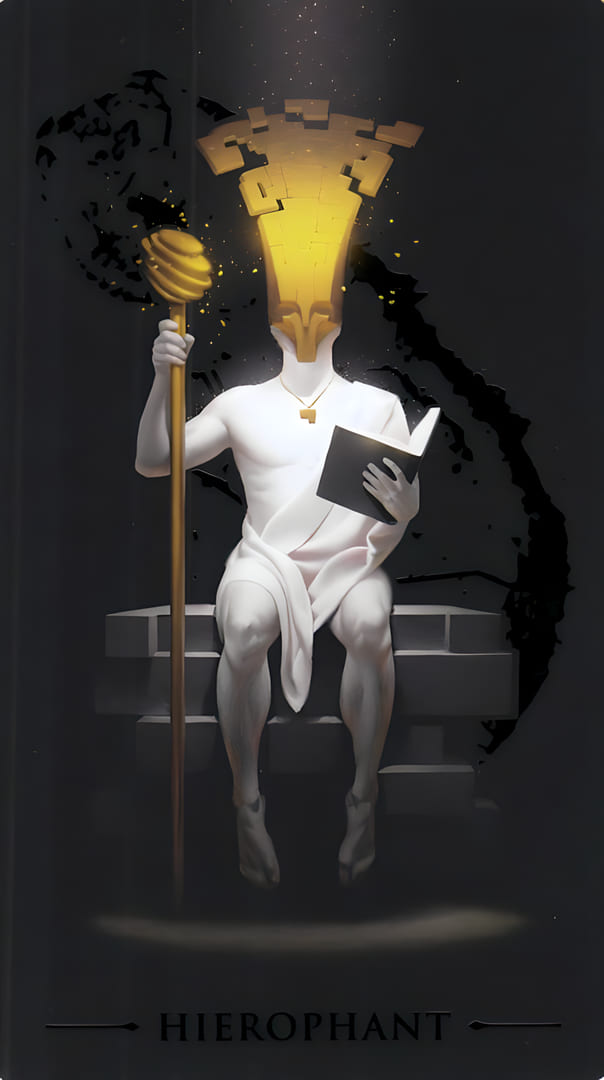
The Hierophant
The Hierophant symbolizes a call to join a community and share common beliefs for a greater purpose. While it reflects the importance of tradition and cooperation, it also acknowledges the potential for both positive and negative outcomes. The card emphasizes the everlasting nature of ideas and traditions, maintained through mutual effort and shared beliefs. Its imagery and symbols reflect the interconnectedness and collective goals of its members.
Keywords
Belief, Cooperation, Community, Tradition
Call to Join
The Hierophant asks us to join the fold: to believe how he believes, to study what he studies, and to band together to achieve a common goal. This card symbolizes a call to be part of something greater. The figure sits on a throne of rectilinear bricks, each stacked and shaped to support the greater whole. Likewise, his golden headdress reflects a similar interconnectedness, as a multitude of puzzle pieces assemble to create the entirety of the mask, obfuscating his face, an identity that garners less and less important as he takes on the meanings and teachings of his group. Men are just flesh and bone, but their ideas can live forever. 'Pass these ideas down, and become part of a greater, eternal whole.'
Symbolism of the Staff
His staff reflects these words, topped by a golden nest of bees. Ubiquitous for their teamwork, these bees work, reproduce, and if necessary, die for the greater good of the hive and queen.
Dual Nature of Group Beliefs
While blind obedience and iron-fisted hierarchies are common negative traits of this card, it is important to note that groups and shared beliefs are neutral in nature; they can be used to band a group together for either good or evil.
Additional Artwork
Lake Mungo, Australia, is depicted behind the Hierophant. It is the location of the world’s oldest ritually cremated human remains. The presence of ritual cremation implies both a concerted group effort for burial, as well as a shared set of beliefs surrounding the death and potential afterlife of an individual, important enough to warrant a burial ceremony. This body, 'Mungo Woman,' was buried approximately 40,000 years ago, and implies that human concerns of the afterlife have existed for at least such time.
True black tarot
💜 Please support creators. Buy official decks.
ℹ️ Disclaimer
All card images and descriptions are taken from public sources. They are used for review purposes only. All rights to these images and descriptions belong to their creators. If you believe there is a copyright infringement, please contact us at [email protected].