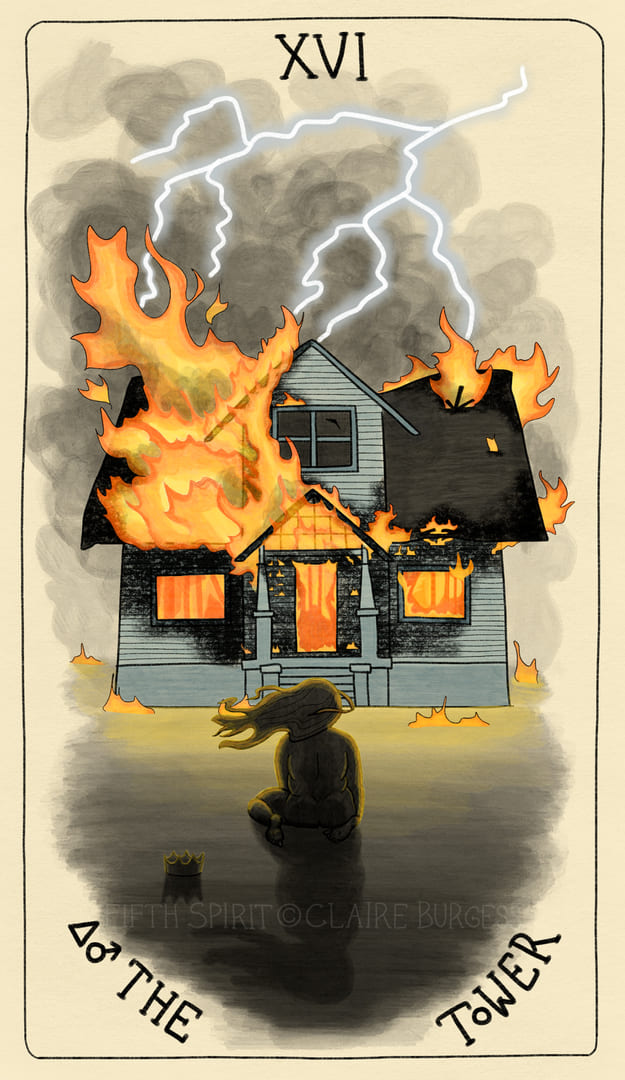
The Tower
The Tower represents the sudden dismantling of false structures—beliefs, identities, and illusions—often brought about by a jarring revelation or crisis. It liberates by exposing truth, but the process is frequently violent and disorienting rather than gentle. While it can catalyze necessary release and growth, it can also involve undeserved suffering and loss that resist moral consolation. The card asks us to respond with self-compassion and reconstruction, acknowledging trauma while working toward a new, humbler foundation.
Keywords
Card Title
16. The Tower
Associations
Fire / Mars
Keywords
Deconstruction of beliefs/worldview/identity/ego, revelation, upheaval, external or internal crisis that brings massive change.
Quote
... we wake up electrified out of the coma by our own souls' airplanes roaring over the roof they've come to drop angelic bombs the hospital illuminates itself imaginary walls collapse O skinny legions run outside O starry-spangled shock of mercy the eternal war is here O victory forget your underwear we're free — Allen Ginsberg, "Howl"
Meaning
Purpose Options
What is the purpose of a tower? Some options: a) to protect the people within it, b) to exalt the glory and/or power of a god, kingdom, or person, c) to imprison the people within it. Much of the time, when “a” or “b” are the intent, “c” is the result. And so the lightning cometh.
Metaphorical Definition
Metaphorically, a tower is anything we've built to create the comforting illusion of safety and security. Some towers are built of denial, the refusal to see what's right in front of us, whether that's dysfunctional relationships, toxic employment situations, uncomfortable truths, or our own repressed needs and desires. Some towers are built of ego; accomplishments and self‑righteousness perilously stacked like bricks in a never‑ending construction battle to be taller than the other guy. Some towers are the cathedral spires of belief erected by culture, family, religion, school, worshipful beliefs that we hold to be true because we've never thought to question them—or perhaps we have questioned them, deemed that the world outside the tower sure looked mighty scary, and then fortified the walls with a shellacking of denial.
Towers as Prisons
We stay in these towers because we think they help us, we think we need them, but we do not. In these towers we are not kings but prisoners, and we look at our dungeon walls and think how fortunate we are to be so protected. The Tower card, with its divine lightning and its thunder of toppling stones, liberates us from our false beliefs and self‑delusions. But it doesn't do it gently.
Historical Imagery
The earliest known Tower cards (the trump is, like the Devil, missing from the original deck), depict a single tall stone tower in flames, with flames falling from the sky. Later versions add a crown or a crown‑like top to the tower, a symbol of power and ego, which is in the process of being blasted from its lofty perch by an explosion or lightning. (Note the crown in our Fifth Spirit card, forgotten on the ground to the left of the person.) As Robert M. Place notes in his book Tarot, Magic, Alchemy, Hermeticism, and Neoplatonism, such images of flaming towers were commonly found in Renaissance church murals as a reference to the destruction of the city of Babylon in the final book of the Bible: Revelation. (Yes, the one with the apocalypse—no biggie.) The flaming tower in these images is thought to represent the Tower of Babel, which, although the structure isn't mentioned specifically in Revelation, was the most iconic landmark of that city. In this symbol, we have false beliefs (idolatry of non‑Christian gods) wrapped up with pride (the tower was built to reach the heavens, according to Genesis), all being destroyed with a divine cataclysmic Zeus‑style lightning bolt of holy fury.
Internal vs Literal
In reality, the Tower card usually doesn’t herald literal, external destruction. The Towers exist in our minds, carefully built thought‑palaces to shield us from the blustery howling truth of the world and of ourselves. When the lightning bolt comes, then, it takes shape as an epiphany that throws beliefs or identities into question, or a horrible “a‑ha” moment when the lightning's flash reveals a thing that can never be un‑seen. The word “apocalypse” comes from the Koine Greek word apokalypsis, which means “unveiling.” That’s it. That’s the end of the world: a veil pulled back.
Release and Transition
As hard as they can be to experience, these kind of internal Tower epiphanies release us from situations, institutions, or mindsets that were ultimately harmful and confining. The Tower is the natural next step from the Devil in this way, because once we’ve seen the puppeteer, reality as we know it starts crumbling. The Tower is also like the Wheel of Fortune in that our only power is in how we respond to it, what we do about it, what we make of it.
Contemporary Examples
The Tower always comes down internally, but it can begin externally, with actual destruction, as well. As I write this in the summer of 2020, we’re six months into the COVID‑19 pandemic and three months into the Black Lives Matter uprising against police brutality and institutionalized racism—both bona fide collective Tower moments of the highest order. These two events have been and continue to be veritable lightning storms, blasting away the fortress of illusion that we’ve so carefully built to convince ourselves that we’re safe, or superior, or righteous, or equal, or protected, or that everything’s fine, really everything’s fine. In the illumination of that lightning, we as a collective and as individuals are beholding the ugly, systemic truths of our Towers, and we have a choice: we can either stay inside the burning building, or proceed swiftly to the exit and watch the fucker burn.
Resistance to Change
Inevitably, though, some people see the flash and feel the flames and then do their dead‑level best to save the structure. They put a patch over the charred gap in the wall, hang a pretty picture on it, and continue on as if their house isn't full of holes. But none of us can avert the Tower forever. For those people, the Tower will come again, because, as Rachel Pollack writes, “The universe, and the human mind will not allow us to stay forever imprisoned in our towers of illusion and repression.” If we cannot free ourselves peacefully then the forces of life will arrange an explosion.
Not Always Beneficent
I could end it there. With this refrain of Tower‑as liberator, this beneficent lightning that frees us from our mental prisons, our rotten houses, our skyscrapers built on top of graveyards. It's a nice story, to think that the only falling towers are the ones that need to fall—but it's not the whole story.
Undeserved Suffering
The fact is that we don't always call the Tower down on ourselves with our denial and ego and false gods. Sometimes shitty things happen and we don't deserve them. Sometimes our safety is violated and it's not for some personal development story arc. Sometimes there is no redeemable reason that can ever be worthy of our bottomless loss. Sometimes our towers are wrecking‑balled and we're left shivering in the cold, worse off than we were before, with no tidy moralistic ending to wrap like a conciliatory blanket around our shoulders.
Trauma and Meaning
Natural disasters, tragic accidents, chronic and terminal illnesses, sexual assault. Do these things transform a person? Yes. Is there a way of contextualizing these horrors so they may be regarded as a kind of superhero origin story, some essential experience that makes us the strong and empathetic and resilient people we are? Sure. Should we then thank the radioactive spider that bit us because we can now shoot webs from the holes in our wrists? I think the answer is complicated, and it probably changes over time, and it can only be answered by the person bitten.
Aftermath and Self-Love
“Love thine enemies because they are the instruments of your destiny,” Joseph Campbell says, in a spin on the oft‑trotted Bible verse. But I don’t think we are required to love our tragedies or perpetrators, though they certainly do have a hand in our making. Instead, I think that the important thing—the necessary thing—is that we must come to love ourselves in the aftermath. To love all the broken places, all our storm‑ravaged obliterated hollows, all our PTSD lightning flashes, all our smoking rubble and snowy fields of ash, all the parts the enemy touched.
Rebuilding
If we can do that, then one day in the future we may find ourselves in a new place—not a tower but a little cottage somewhere, or a houseboat, or a tiny apartment with a camellia bush outside, windows open to the breeze and crowd‑song—and although we never intended to be here, although this is not the future we had ever imagined for ourselves, although we still bear the lightning scars, we may reflect that this new place we've made is not half bad. This is a mighty fine place to be.
Visual Description
A two-story house is engulfed in bright orange flames that pour from windows and the roof while thick gray smoke billows into a stormy sky. Jagged white lightning forks across the clouds above the burning building. In the foreground a solitary, shadowed figure with long hair sits on the ground facing the house, and a small crown lies on the ground nearby. The scene is framed by a pale border with the Roman numeral XVI at the top and the word THE TOWER at the bottom.
Fifth Spirit tarot
💜 Please support creators. Buy official decks.
ℹ️ Disclaimer
All card images and descriptions are taken from public sources. They are used for review purposes only. All rights to these images and descriptions belong to their creators. If you believe there is a copyright infringement, please contact us at [email protected].