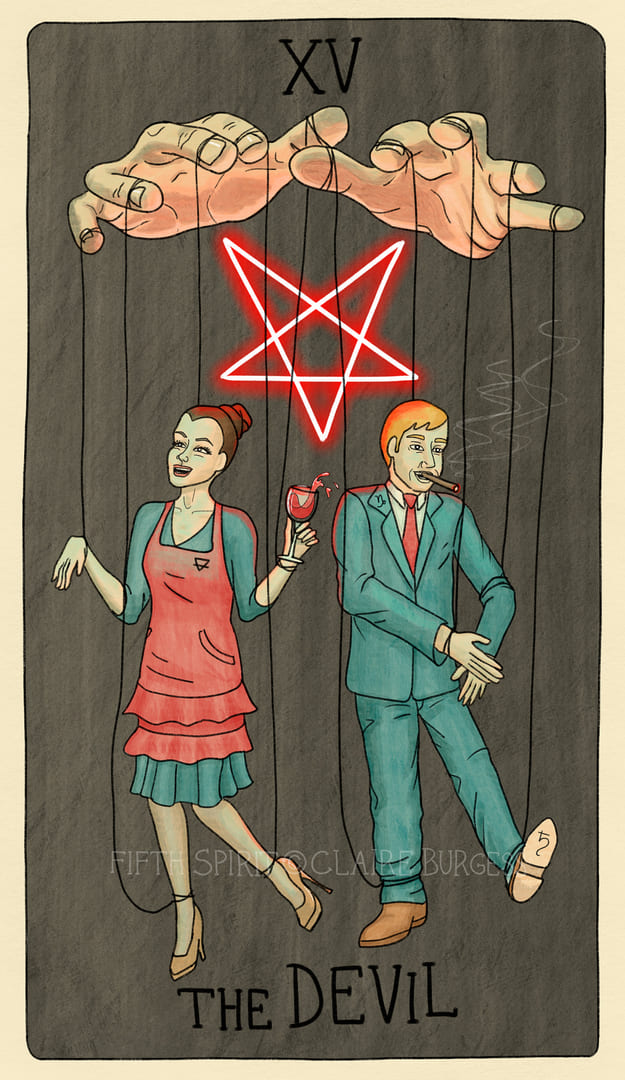
The Devil
The Devil card points to forces that bind and control—addictions, oppressive systems, self-limiting beliefs, and toxic relationships—that work against our best interests. It exposes how cultural, economic, and interpersonal powers can gaslight and normalize harm, convincing us there's no alternative. Rather than literal evil, the card highlights material bondage and complicity, urging awareness of the chains or strings that restrain us. Recognizing these constraints is the first step toward liberation; once we feel the pull we can find the scissors and free ourselves.
Keywords
Associations
Earth / Capricorn (Saturn)
Keywords
Oppression, dependence, destructive indulgence; self-limiting behaviors, thoughts, or beliefs.
Quote
We are each our own devil, and we make this world our hell. — Oscar Wilde
Meaning
Old Scratch, Lucifer, Beelzebub, Mephistopheles, the Stranger at the crossroads—the Devil has many names and faces. But the Devil we meet in the Tarot has little to do with Dantean fire and brimstone, nor with rock 'n' roll or women in red, nor with flying broomsticks and names signed in black books at midnight. No, this Devil is far more insidious than that. This is Devil as concept, Devil as lifestyle, Devil as economic power structure. This Devil is whatever controls you against your best interests, whatever oppresses you and tells you it's for your own good, whatever gaslights you into depending on them while they destroy you, whatever convinces you that it's just how it is; there's no other way; best get used to it. Nietzsche declared that God is dead. Well, the Devil's alive and running for congress.
Historical Depictions
In most decks since the earliest known Devil cards appeared in the pack in the 15th century (the card is missing from the first deck, the Visconti‑Sforza), the Devil has been depicted as part‑human part‑beast, usually with antlers or a goat head, bird or bat wings, hairy Pan‑like legs tapering to chicken feet, female‑acted breasts, and a phallus or, alternately, a second face for a groin. This découpage demon was supposed to be evil incarnate, in addition to encapsulating the horrors of chaos and illogic in its fantastical and beastly appendages. The Devil represented humans succumbing to their animal urges, their sinful lustful gluttonous natures, the sexual desires of the flesh—all things that are sure to land your immortal soul in H‑E‑Double‑Hockey‑Sticks. Other things that were devilish: literate women and people of color, women wearing pants, homosexuality, interracial relationships, the entire African continent, people with melanated skin and everything to do with them, non‑Christian religion (infidels!), folk magic and folk remedies (witchcraft), midwifery, gender nonconformity, clothes that showed your ankles, women enjoying sex—you get the idea. The Devil has a long history of being wielded by the godly to control, exploit, colonize, murder, and oppress whoever they wanted.
Personal Anecdote
When I picked up my first Tarot deck in high school and beheld Pamela Colman Smith's glorious Baphomet for the first time, I felt an unholy tremor of fear sliver up my spine, afraid that by merely looking at it, the Devil would come to get me. I actually looked over my shoulder. That's how deep my Christian upbringing had gotten me, despite the fact I had secretly not believed in God since third grade, had crossed my fingers while signing the chastity pledge at the end of Abstinence Summer Camp, had refused to wear white to my confirmation, and was already engaging in same‑sex make‑outs with my crushes. (Maybe the Devil had been with me all along.) Regardless, the warnings about the Tools of Satan echoed in my ears, and what‑ifs spiraled down my brainstem, and then my hands were putting the cards back into the box and hiding them behind some innocuous paperbacks on my bookshelf. That's how the Devil is meant to work. The Devil is supposed to scare you into submission, so that even your own private thoughts aren't safe lest the Devil hear them.
Traditional Interpretation
Traditionally, the Devil card is interpreted as material bondage, meaning whatever earthly things we are dependent on, desirous of, obsessed with, or beholden to. These material false idols are typically said to be money, possessions (cool clothes, big houses, fast cars), drugs and alcohol, rich foods, sexual gratification—all the usual pleasure palace fare. While this card can certainly address those items when they're causing a dependence, addiction, or disruption in a person's life, outright demonizing the sensual material experience is just more sanctimonious self‑flagellatory Bible‑thumping, in my humble opinion. The Devil might still live at the bottom of a bottle of booze, but the Devil also lives in our state houses, our boardrooms, our police cruisers, our social norms, and our consciousness.*
Examples of the Devil
The Devil is the emotionally abusive spouse that gaslights you out of your every emotion and opinion until you question your own sanity. The Devil is the punishing, miserable job you return to day after day because you were taught that you're lucky to have a job at all. The Devil is the doctor who dismisses your chronic pain as due to your weight and prescribes you a controversial seizure drug because it curbs the appetite. The Devil is not being able to jog in your own neighborhood because you're Black and reasonably concerned that a white person will call the cops on you, endangering your life. The Devil is the corporate oil pipeline demolishing your sacred ancestral land and a fragile ecosystem because circumventing it would cost more money. The Devil is the reverend convincing you that your sexuality and/or gender identity is an abomination of nature, which you never really believed but was still enough to delay your self‑acceptance and your happiness for over a decade, land you in abusive relationships, and bring you at one point to consider suicide. And the Devil is whoever taught that reverend the same thing.
Depictions of Chains
In many Tarot decks, the Devil is depicted with two people chained at its feet. Instead of screaming in horror at the demon behind them, the two people usually appear to be quite calm, even pleased, as if they are unaware of their chains and the shaggy Devil‑beast looming behind them. Unaware, or complicit. Our Devil for Fifth Spirit Tarot exchanges the Baphomet for a pair of ominous puppet‑master hands, pulling the strings of two humans below. The couple face away from each other, one in an executive suit, arm outstretched for a handshake, and the other in heels and an apron, laughing at someone’s (probably unfunny) joke. Yes, this Devil card certainly has an opinion. It’s not meant to lambast businesspeople or home cooks or stay‑at‑home parents or people who like wine and cigars, but instead to provide a mirror‑in‑caricature for the dominant culture, which we can so easily find ourselves adhering to without even thinking about it. Or perhaps we do think about it; perhaps we know it’s wrong for us and we choose it anyway because we are convinced that it’s the only way to survive. To quote Rachel Pollack, “The Devil's power rests in the illusion that nothing else exists.”
Call to Notice
The Devil card, when it shows up in a reading, alerts us to the presence of these chains, these strings, and urges us to pay attention to them, to track them to the source, to discover what machinations are behind them so we may discover how to free ourselves. The Devil is seldom a welcome card in a reading, but that's only because we don't want to examine our choices and actions and find that they are corrupted, harmful, or are not our own. The Devil is actually a wonderful card, I say, because becoming aware of it starts the revolution. As Paul Foster Case writes, the Devil is “also what brings renewal, because we can make no real effort to be free until we feel our limitations.” Until we feel the strings, their yank and restraint, their chafing at the wrists and ankles, we'll never get up the guts to find the scissors.
Action
Do you feel it, just there? Snip.
Footnote
* Many others besides me have addressed the Devil in this socio‑political light, including Tarot teacher Lindsay Mack and host Corinna Rosella of the "Rise Up! Good Witch" podcast. Deck creators are doing the same, including Egan, whose bone‑chilling Devil card for the Delta Enduring Tarot (2017) features a cop car slowly following a Black boy in a hoodie, referencing the violent and unjust targeting of BIPOC by the police; and Brandi Logan Hernandez (a.k.a. Sir Bran the Blessed) whose Devil for The Holy Othered Tarot (2020) is a white man in a business suit (the only white man in the deck) with words including “patriarchy,” “whiteness,” and “colonialism” scrawled on his bloody hands.
Visual Description
At the top of the card the Roman numeral "XV" is visible and the bottom reads "THE DEVIL"; a faint watermark "FIFTH SPIRIT © CLAIRE BURGESS" spans the lower middle. Two large hands hover at the top, each fingertip controlling thin black strings that descend to two marionette figures below. A bright red neon pentagram glows between the hands and the puppets. The left puppet is a smiling woman in a pink apron holding a glass of wine, and the right puppet is a man in a teal suit smoking a cigar; both have strings attached to their limbs against a dark background.
Fifth Spirit tarot
💜 Please support creators. Buy official decks.
ℹ️ Disclaimer
All card images and descriptions are taken from public sources. They are used for review purposes only. All rights to these images and descriptions belong to their creators. If you believe there is a copyright infringement, please contact us at [email protected].