5 Tarot Spreads for Career and Money Decisions You Can Use Today
Why tarot works for career questions
Career and money questions are some of the most common — and most useful — things to bring to tarot. Not because the cards will tell you which job to take or when you’ll get a raise. They won’t. But they will show you the dynamics you’re not seeing: the fear underneath your “logical” reasoning, the opportunity you’re ignoring, the pattern that keeps you stuck.
Financial decisions feel like they should be purely rational. But anyone who’s agonized over a job offer or stayed too long at a miserable job knows — emotion drives these choices more than spreadsheets do. That’s exactly where tarot excels.
Here are five spreads I use for different career and money situations, from quick check-ins to deep strategic reads.
Spread 1: The Career Check-In (3 cards)
Best for: Quick clarity on your current work situation. Use weekly or whenever work feels “off.”
Layout: Three cards in a row, left to right.
| Card 1 | Card 2 | Card 3 |
|---|---|---|
| Current energy | What needs attention | Hidden opportunity |
Position 1: Current energy — The dominant energy in your work life right now. Not what you think is happening — what’s actually happening energetically.
Position 2: What needs attention — The thing you’re avoiding, overlooking, or underestimating at work. This is often the most useful card in the spread.
Position 3: Hidden opportunity — Something available to you that you haven’t noticed or acted on yet. This could be a skill, a connection, a project, or a shift in perspective.
How to read it: Start with card 2. That’s your action item. Then see how card 1 explains why you haven’t addressed it yet, and card 3 shows what opens up when you do.
Sample reading
You pull Five of Pentacles (current energy), The Emperor reversed (needs attention), Page of Wands (hidden opportunity).
Translation: You’re feeling undervalued or financially strained at work (Five of Pentacles). The issue is a lack of structure or authority — maybe you’re not setting boundaries, or leadership is disorganized (Emperor reversed). The opportunity? A new creative project or learning something new that reignites your enthusiasm (Page of Wands). The Five of Pentacles isn’t about the money — it’s about feeling left out in the cold. Fix the authority problem and the creative spark becomes available.
Spread 2: The Job Fork (7 cards)
Best for: Choosing between two specific career options — two job offers, stay vs. leave, promotion vs. lateral move.
Layout: Two columns of three cards each, with one card between them at the top.
         [1]
    [2]       [5]
    [3]       [6]
    [4]       [7]
Card 1: The deciding factor — The core thing that should drive this decision. What matters most here?
Card 2: Option A — daily reality — What everyday life looks like if you choose this path.
Card 3: Option A — growth potential — Where this option leads in 6-12 months.
Card 4: Option A — likely outcome — The probable result of taking this path.
Card 5: Option B — daily reality — The everyday experience of the other option.
Card 6: Option B — growth potential — Where this option goes in 6-12 months.
Card 7: Option B — likely outcome — The probable result of taking this path.
How to read it: Start with card 1 — it frames everything. Then read each column as a mini-story. Compare the two outcomes (cards 4 and 7). But don’t just pick the “better” outcome card — look at the daily reality cards. A great outcome means little if the daily experience makes you miserable.
When two paths look equal
If both columns read similarly, the spread is telling you the decision isn’t about the external options — it’s about something internal. Go back to card 1 (the deciding factor) and dig into what it’s really asking. Often the real question isn’t “which job?” but “what do I actually want from my career right now?”
Spread 3: The Money Mirror (5 cards)
Best for: Understanding your relationship with money. Not a specific financial decision — the deeper patterns that drive all your financial decisions.
Layout: A cross pattern.
         [2]
    [1]  [5]  [3]
         [4]
Card 1: What you learned about money — The money story you inherited from family, culture, or early experiences. This runs deeper than you think.
Card 2: What money means to you now — Your current emotional relationship with money. Security? Freedom? Status? Power? Fear?
Card 3: Your money blind spot — What you don’t see about your financial patterns. The unconscious behavior that helps or hinders you.
Card 4: What blocks your financial growth — The specific obstacle between you and the financial life you want. This is often internal.
Card 5: The path to financial alignment — The shift in mindset, behavior, or action that would transform your relationship with money.
How to read it: This spread works best when you sit with it for a while. Card 1 often triggers recognition — “oh, that’s why I do that.” Card 3 is the one to pay most attention to, because by definition, you can’t see your blind spot without someone (or something) pointing it out.
I love this spread because it takes money out of the purely practical realm and acknowledges what it actually is: one of the most emotionally charged topics in adult life. You can budget perfectly and still feel terrible about money if you haven’t examined what money represents to you.
Spread 4: The Negotiation Prep (4 cards)
Best for: Preparing for a salary negotiation, pitch meeting, contract discussion, or any situation where you need to advocate for your value.
Layout: Four cards in a row.
| Card 1 | Card 2 | Card 3 | Card 4 |
|---|---|---|---|
| Your true value | What they see | Your leverage | Your approach |
Card 1: Your true value — What you actually bring to the table. Not what you think you should be worth — what you genuinely offer. If this card surprises you, good. You might be underestimating yourself.
Card 2: What they see — How the other party perceives you and your value. The gap between cards 1 and 2 is often where the negotiation lives.
Card 3: Your leverage — The strongest asset you have going into this conversation. Play this card, metaphorically speaking.
Card 4: Your approach — The energy or strategy that will serve you best. Aggressive? Collaborative? Patient? Let the card guide your tone, not just your words.
How to read it: If card 1 is strong but card 2 is weak, your problem isn’t value — it’s visibility. If card 3 is a Major Arcana card, your leverage is bigger than you think. If card 4 is a Cups card, lean into emotional connection rather than hard numbers.
Spread 5: The Five-Year Vision (6 cards)
Best for: Long-term career direction. When you’ve lost your sense of purpose at work, or you’re wondering “what am I even building here?”
Layout: A path from left to right, slightly ascending.
[1] → [2] → [3] → [4]
                    ↑
               [5] [6]
Card 1: Where you stand now — Your current career position, honestly assessed.
Card 2: What you’re ready to release — The career identity, habit, or belief that no longer serves your growth.
Card 3: What’s trying to emerge — The new direction or skill that wants to develop. This card often hints at something you’ve been curious about but haven’t pursued.
Card 4: Your five-year destination — Not a prediction, but a possibility. The career reality that becomes available if you follow this trajectory.
Card 5: The skill to develop — The practical capability or knowledge that bridges where you are and where you’re heading.
Card 6: The internal shift required — The mindset, belief, or emotional change needed to actually make this journey. This is often harder than the external work.
How to read it: Read cards 1-4 as a timeline. Then read cards 5 and 6 as the “how” — what the journey requires from you practically and emotionally. If card 4 seems unrelated to your current field, stay open. Career pivots often look impossible until you see the thread connecting where you’ve been to where you’re going.
Career cards to watch for
Certain cards carry extra weight in career readings. Here are the ones that consistently signal something important:
The Emperor — Authority, structure, leadership. In career readings, this often points to stepping into a management role or establishing clear boundaries at work.
The Chariot — Forward movement, determination, competing priorities coming together. Excellent in outcome positions — suggests you’ll drive through obstacles.
Eight of Pentacles — Mastery through practice. You’re building something through daily effort. Stay the course.
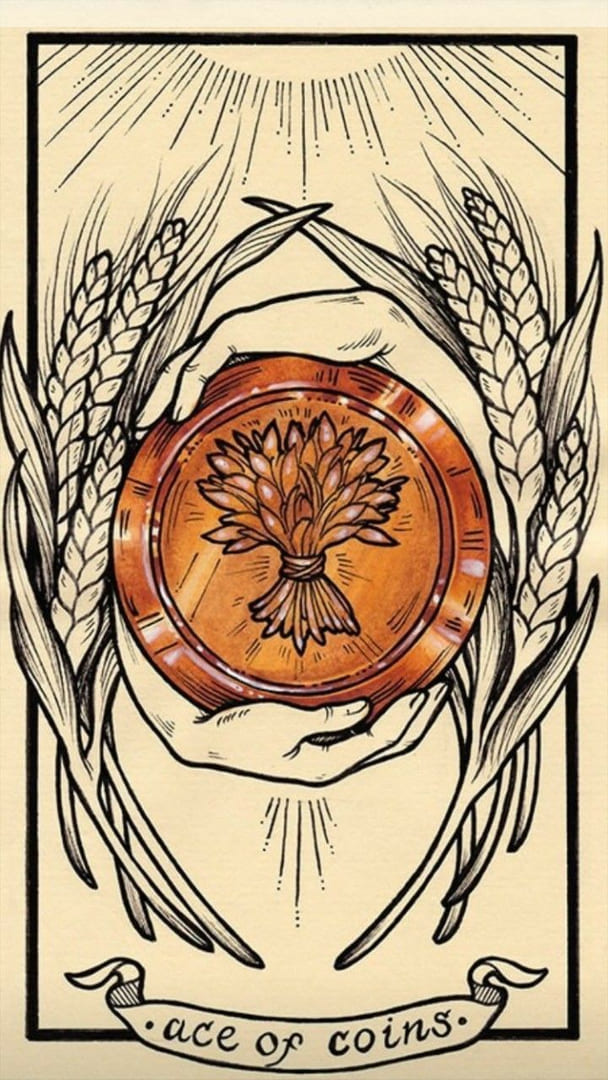
Ace of Pentacles — A new financial beginning. A job offer, a business opportunity, a fresh start with money. When this shows up, be ready to act.
Ten of Pentacles — Long-term prosperity, legacy, financial stability that extends beyond just you. The “retirement fund” card.
The Tower — In career readings, this usually means a job loss, dramatic restructuring, or an ending that feels sudden. Uncomfortable but often necessary. What comes after the Tower is usually better than what came before.
Four of Pentacles — Holding on too tightly. In career readings, this warns against staying somewhere out of fear rather than genuine desire. Are you clinging to security at the expense of growth?
Tips for better career readings
Be specific with your questions. “How is my career going?” gets you a vague answer. “What do I need to know about transitioning to freelance design in the next 6 months?” gets you something you can actually use.
Separate the emotional from the practical. If every career reading turns into an emotional processing session, do a feelings-focused spread first (like The Money Mirror), then come back to the practical question with a clearer head.
Don’t read on career decisions when you’re panicking. If you just got fired or received a terrible review, give yourself 48 hours before pulling cards. Panic doesn’t read well — it sees threats in every card and misses the guidance.
Track your career readings over time. Themes emerge when you can look back at three months of readings and see that the same card keeps showing up. That repetition is the deck pointing you toward something you haven’t acted on yet.
The cards don’t know which job pays more or which company has better benefits. But they know what’s happening inside you — the ambition you’re suppressing, the risk you’re afraid to take, the value you don’t see in yourself. That’s information no salary comparison spreadsheet can give you.
Frequently Asked Questions
Can tarot really help with career decisions?
Tarot doesn't predict which job offer to take — it reveals your internal state, hidden fears, and blind spots around the decision. When you're stuck between options, tarot helps you see what's really driving your hesitation or attraction to each path. The cards reflect your subconscious priorities, which often leads to clearer decision-making.
Which tarot cards indicate money coming in?
The Ace of Pentacles signals a new financial opportunity. The Nine of Pentacles suggests financial independence. The Ten of Pentacles indicates long-term wealth and stability. The Empress can signal abundance flowing in. But context matters — a 'money card' in a challenge position means something different than in an outcome position.
What's the best tarot spread for choosing between two jobs?
Use the Job Fork spread (spread #2 in this guide). It lays out 7 cards — one column for each option plus a deciding factor card. It compares the daily reality, growth potential, and likely outcome of each path side by side, making the decision tangible rather than abstract.
How often should I do career tarot readings?
For active decisions like job searches or negotiations, weekly check-ins with a quick 3-card pull work well. For bigger questions like career direction, monthly readings with a larger spread give better perspective. Avoid daily career readings for the same question — you'll just confuse yourself with too much input.