The Hermit Tarot Card Meaning: Solitude, Wisdom & the Light Within
First impression
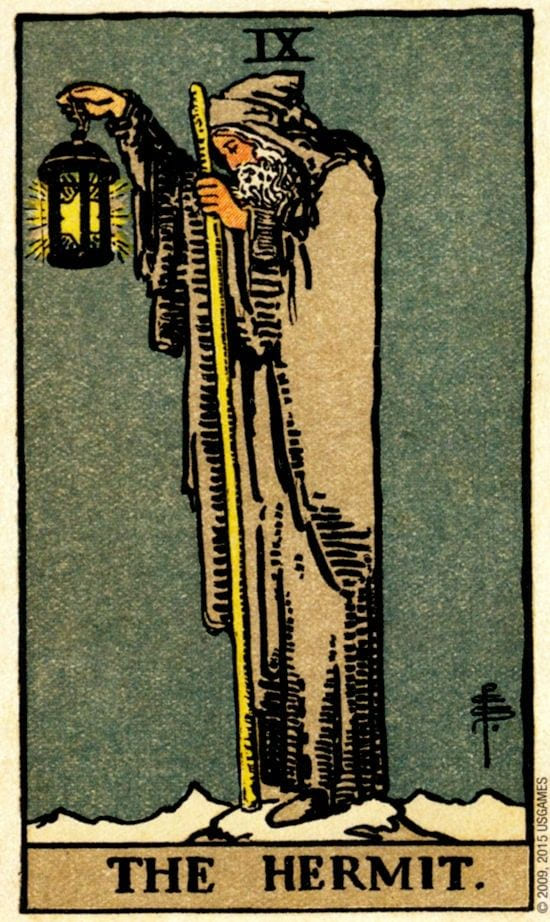
An old man on a mountaintop, alone in the dark, holding a lantern. That’s the Hermit — and at first glance, he looks lonely. But look closer. He’s not lost. He climbed that mountain on purpose. The darkness isn’t threatening — it’s chosen. And the lantern isn’t searching for something outside. It’s illuminating the path for others who might follow.
The Hermit is one of the most misunderstood cards in tarot. People see “alone” and panic. But the Hermit’s solitude isn’t loneliness — it’s the kind of aloneness that’s necessary for finding truths that can’t be discovered in noise, crowds, or constant connection. Some answers only come in silence.
Card number IX in the Major Arcana. After the raw courage of Strength (VIII), the Hermit offers something subtler: the wisdom to know when action isn’t the answer. Sometimes the bravest thing you can do is stop, step away, and listen.
Symbolism
The mountain peak — He didn’t stumble here. He climbed. The mountain represents achievement through sustained effort, but also perspective — from the peak, you see what you couldn’t see in the valley. The Hermit’s wisdom comes from having done the work to gain elevation.
The lantern — The most important symbol. Inside it sits a six-pointed star (the Seal of Solomon), representing wisdom. The lantern casts a small circle of light — not a floodlight, but enough for the next step. The Hermit doesn’t need to see the whole path. Just the next step is enough.
The grey cloak — Neutrality, withdrawal from the material world, wisdom that comes from detachment. Grey is neither black nor white. The Hermit has moved beyond simple dualities into nuanced understanding.
The staff — Authority and support, but also the practical tool of a walker. The Hermit isn’t meditating in a cave. He’s moving, walking, journeying inward while his feet still touch the ground. This is practical wisdom, not abstract philosophy.
The snow — Purity, clarity, the cleansing effect of solitude. Snow also means cold — the Hermit’s path isn’t comfortable. Real wisdom has a cost: the warmth of easy company, the comfort of consensus, the distraction of busyness.
His posture — Slightly bowed, looking down at the path before him. Not gazing at the sky for divine revelation. Looking at the ground, the next step, the practical truth. The Hermit’s spirituality is grounded.
Upright meaning
The Hermit upright is a call to go inward. Not forever — for a season. The world will wait. Your question will still be there. But right now, the answer isn’t in another conversation, another opinion, another Google search. It’s inside you, and you need quiet to hear it.
When this card appears, it typically signals:
- Time for solitude — Not isolation, not withdrawal from life. Intentional alone time to process, reflect, and reconnect with your own truth. Cancel the plans that drain you. Protect the space that restores you.
- Inner guidance — The answers you need are already within you. Stop polling friends, reading articles, asking everyone what they think. The Hermit says: you already know. Get quiet enough to hear it.
- A mentor or teacher — The Hermit can represent a wise guide who has walked the path before you. Someone older, experienced, possibly unconventional, who offers truth rather than comfort.
- Spiritual seeking — A phase of deepened spiritual practice, whatever that means to you. Meditation, journaling, nature walks, tarot practice itself. The Hermit’s lantern is whatever lights your inner way.
- Patience — Not everything needs to happen now. Some things need to incubate in the dark before they’re ready for the light. The Hermit trusts timing.
The Hermit doesn’t rush. In a world that demands constant availability, productivity, and social performance, this card is radical: stop. Be alone. Think. The answer will come when you’ve created enough space for it.
Reversed meaning
The Hermit reversed has two faces, and they’re opposites:
Too much isolation: You’ve withdrawn beyond what’s healthy. What started as needed solitude has become avoidance. You’re hiding — from people, from decisions, from life itself. The reversed Hermit says: the inner work is done (or done enough for now). It’s time to come back to the world with what you’ve learned.
Not enough reflection: The other extreme. You’re so busy, so social, so constantly stimulated that you have no inner life at all. No time alone, no introspection, no silence. The reversed Hermit here is a warning: you’re running from yourself, and eventually you’ll have to stop.
Loneliness vs. solitude: In the reversed position, the Hermit’s constructive solitude can become genuine loneliness — feeling disconnected, unwanted, or forgotten. This isn’t the chosen aloneness of the upright card. This is isolation that hurts.
Refusing wisdom: Ignoring your inner voice, dismissing gut feelings, choosing external validation over internal truth. The reversed Hermit has the lantern but refuses to look at what it illuminates.
Spiritual bypassing: Using “inner work” or “taking space” as an excuse to avoid real-world responsibilities. The shadow of the Hermit is the person who retreats from life permanently under the guise of spiritual development.
In love and relationships
Upright: The Hermit in love isn’t rejection — it’s preparation. If you’re single, this card says the time alone isn’t wasted. You’re building the self-awareness that will make your next relationship deeper and more authentic. Don’t rush toward partnership out of fear of being alone.
In a relationship, the Hermit can mean needing space — not from your partner, but for yourself within the relationship. Healthy partnerships allow for individual growth. If you’ve lost yourself in “us,” the Hermit says: reconnect with “I.”
Sometimes the Hermit represents a relationship with someone deeply introspective or emotionally reserved. They love quietly, through quality time and shared silence rather than grand gestures.
Reversed: In relationships, the reversed Hermit often signals isolation problems. One partner withdrawing emotionally, refusing to communicate, or using “I need space” as a wall rather than a boundary. It can also mean fear of intimacy — wanting connection but being terrified of the vulnerability it requires.
For singles, the reversed Hermit can indicate loneliness that has become painful rather than productive. It may be time to open up, put yourself out there, and risk the messiness of connection.
In career and finances
Upright: The Hermit in career readings signals a period of reflection about your professional path. Is this work aligned with your values? Are you pursuing the right goals, or someone else’s? The Hermit doesn’t quit a job impulsively — he steps back to evaluate, then acts from clarity.
This card can also represent working alone, independent consulting, creative solitude, or academic research. Work that requires deep focus and minimal collaboration.
Financially, the Hermit advises conservative, considered decisions. This isn’t the time for bold investments or big purchases. Gather information. Reflect. The opportunity isn’t going anywhere.
Reversed: In career, the reversed Hermit suggests you’ve been working in isolation for too long. Collaboration is needed. Networking matters. Your ideas need other people’s input. If you’ve been overthinking a career decision, the reversed Hermit says: you have enough information. Act.
Financially, either analysis paralysis (overthinking every financial decision) or the opposite — not thinking at all, spending without reflection. Find balance.
In health and wellbeing
Upright: The Hermit supports quiet healing practices. Rest, meditation, gentle movement, adequate sleep. This card doesn’t prescribe intense gym routines or radical dietary overhauls. It prescribes stillness and attention. Listen to what your body is telling you in the silence.
The Hermit can also suggest seeking a specialist or wise practitioner — someone who can illuminate what’s unclear about a health situation.
Reversed: Health isolation — refusing to see doctors, hiding symptoms, neglecting self-care while convincing yourself you’re “fine.” The reversed Hermit also warns about mental health: prolonged isolation can worsen depression and anxiety. If you’ve been alone too long, your wellbeing needs community.
Combinations with other cards
Hermit + High Priestess: Double intuition. Two cards of inner knowing and mystery. Together, they say: the answer is deep within, and you need significant quiet to access it. Trust the process even if others don’t understand.
Hermit + Star: Solitude leading to hope and healing. The Hermit’s withdrawal period ends in the Star’s renewal. This combination says: the alone time isn’t permanent, and what you find in the silence will restore you.
Hermit + Tower: Forced solitude after upheaval. The Tower destroys, and the Hermit processes. Together: a major disruption is followed by necessary alone time to integrate what happened. Don’t rush back to normal.
Hermit + Moon: Confusion in solitude. The Hermit seeks clarity, but the Moon brings illusion. Together: your inner journey is muddied by fears and fantasies. Don’t trust every thought that comes in silence — some are wisdom, some are shadows.
Hermit + Four of Swords: Rest upon rest. An emphatic message: stop. Completely. This combination often appears during burnout or recovery from illness. Your body and mind need deep, extended stillness.
Hermit + Six of Cups: Solitude that leads to nostalgia or reconnecting with the past. Time alone may bring up old memories, childhood patterns, or the desire to return to simpler times. Let those memories inform your present without trapping you in the past.
Hermit + Ace of Wands: Solitude sparking creative inspiration. The quiet period generates a powerful new idea or passion. The Hermit incubated something; the Ace brings it to life. Get ready to emerge with fire.
The card’s advice
The Hermit’s advice is paradoxically simple: be alone with yourself and see what happens.
Not the performative kind of alone — not the bubble bath with a face mask and a podcast. Real alone. No input. No entertainment. No distraction. Just you and whatever comes up when the noise stops.
Most people are terrified of this. The Hermit isn’t. He knows that everything worth finding is found in silence — not because silence is magical, but because silence is where you can finally hear what you’ve been drowning out.
Take the walk. Sit in the quiet. Journal without a prompt. Look at the cards without needing a specific answer. Let yourself not know for a while. The knowing comes after.
Try it yourself
The Hermit’s Three Questions — Pull three cards in silence. Before pulling, sit with closed eyes for one full minute. Then draw:
- What am I avoiding by staying busy? — The truth your activity is drowning out.
- What does my inner voice want to say? — The message that needs silence to be heard.
- What will I find if I truly stop? — What waits at the center of the stillness.
Read slowly. Don’t rush to interpret. Let the cards sit before you for a while before assigning meaning. The Hermit teaches patience with the process, not just patience with results.
The Hermit’s lantern is small. It doesn’t illuminate everything — just the next step. That’s enough. It’s always been enough.
Frequently Asked Questions
Is the Hermit a yes or no card?
Generally no — or at least 'not yet.' The Hermit says slow down, reflect, and gather wisdom before acting. It's not refusing your question; it's saying the answer requires more contemplation. If your question is about whether to take time alone or pursue self-knowledge, then it's a clear yes.
What does the Hermit mean in a love reading?
Upright, the Hermit suggests a period of solitude is needed — either to find yourself before entering a relationship, or to seek deeper meaning within an existing one. It doesn't mean loneliness; it means intentional time with yourself. Reversed, it can warn against isolation that has gone too far, or fear of intimacy disguised as independence.
Does the Hermit mean I'll be alone forever?
No. The Hermit represents a season, not a sentence. It says you need time alone right now to develop insight that will serve all your relationships later. Many people meet meaningful partners shortly after a Hermit period — because they've done the inner work that makes them ready for genuine connection.
What zodiac sign is the Hermit?
Virgo. The Hermit carries Virgo energy — analytical, detail-oriented, service-minded, and drawn to refinement. The connection to Virgo explains the Hermit's focus on self-improvement and discernment rather than isolation for its own sake. This is purposeful solitude, not avoidance.