The Kabbalah and Tarot: The Mystical Connection Explained
The hidden architecture
Beneath the images on your tarot cards — beneath the Fool stepping off the cliff, beneath the Tower crumbling, beneath the Star pouring water — there is a structure. It’s invisible unless you know where to look, but once you see it, it changes how you understand every card.
That structure is the Kabbalah — specifically, the Tree of Life.
The Kabbalah is a Jewish mystical tradition dating back centuries. The Tree of Life is its central diagram — a map of how divine energy flows from pure, infinite source into physical reality, passing through ten spheres (Sephiroth) connected by twenty-two paths.
When French occultist Eliphas Levi mapped the twenty-two Major Arcana cards to those twenty-two paths in the 1850s, he created a correspondence so elegant that it transformed tarot from a fortune-telling tool into a map of consciousness itself.
Was this connection original to tarot? No. The Italian card makers of the 1400s knew nothing about Kabbalah. But the correspondence works so well that it has become the foundation of esoteric tarot practice — the architecture beneath the art.
The Tree of Life: a quick map
Imagine a diagram with ten circles arranged in three columns, connected by lines. Each circle is a Sephirah — a sphere of existence:
The three pillars:
- Left pillar (Severity): Binah, Geburah, Hod — structure, discipline, form
- Right pillar (Mercy): Chokmah, Chesed, Netzach — expansion, generosity, flow
- Middle pillar (Balance): Kether, Tiphareth, Yesod, Malkuth — harmony, integration, grounding
The ten Sephiroth (top to bottom):
- Kether — Crown. Pure divine unity. The source of everything.
- Chokmah — Wisdom. The first impulse of creation. Raw creative force.
- Binah — Understanding. The first form. The mother that gives creation structure.
- Chesed — Mercy. Abundance, expansion, generosity without limit.
- Geburah — Severity. Discipline, boundaries, the necessary force that shapes.
- Tiphareth — Beauty. The heart of the Tree. Harmony and balance.
- Netzach — Victory. Emotion, desire, the force of attraction.
- Hod — Splendor. Intellect, communication, the power of thought.
- Yesod — Foundation. The subconscious, dreams, the astral world.
- Malkuth — Kingdom. Physical reality. The world you can touch.
How the Minor Arcana maps to the Tree
This is the simpler connection and a good place to start.
Each numbered card in the Minor Arcana corresponds to a Sephirah:
| Number | Sephirah | Energy | Example |
|---|---|---|---|
| Ace | Kether | Pure potential | Ace of Cups = the seed of emotional experience |
| 2 | Chokmah | First impulse | Two of Wands = the first spark of creative vision |
| 3 | Binah | Form taking shape | Three of Pentacles = craftsmanship, structure |
| 4 | Chesed | Stability, abundance | Four of Wands = celebration, established joy |
| 5 | Geburah | Conflict, testing | Five of Swords = mental conflict, challenge |
| 6 | Tiphareth | Harmony, beauty | Six of Cups = nostalgic harmony, emotional beauty |
| 7 | Netzach | Desire, emotion | Seven of Cups = desires and fantasies |
| 8 | Hod | Intellect, detail | Eight of Pentacles = focused skill, craftsmanship |
| 9 | Yesod | Foundation near completion | Nine of Wands = persistence before the end |
| 10 | Malkuth | Manifestation | Ten of Pentacles = material completion |
This is why the Fives in tarot are always challenging — they correspond to Geburah, the sphere of severity and necessary destruction. And it’s why the Sixes feel balanced — they correspond to Tiphareth, the sphere of harmony and beauty.
The four suits map to the four worlds of Kabbalah:
- Wands = Atziluth (Archetypal world, fire, pure will)
- Cups = Briah (Creative world, water, emotion)
- Swords = Yetzirah (Formative world, air, thought)
- Pentacles = Assiah (Material world, earth, physical reality)
The Major Arcana and the twenty-two paths
The twenty-two paths connecting the Sephiroth on the Tree of Life correspond to the twenty-two Major Arcana cards. Each path is also assigned a Hebrew letter.
Here are the most important correspondences:
The Fool — Path 11 (Kether to Chokmah)
Hebrew letter: Aleph (ox, breath, primal energy) The very first path on the Tree — the leap from pure unity into the first impulse of creation. The Fool steps off the cliff because at this level, there is no cliff. There is only the breath of beginning.
The Magician — Path 12 (Kether to Binah)
Hebrew letter: Beth (house, container) The Magician gives form to the Fool’s raw energy. Beth means “house” — the first container, the first structure. Energy is channeled into manifestation.
The High Priestess — Path 13 (Kether to Tiphareth)
Hebrew letter: Gimel (camel, journey) The longest path on the Tree — connecting the highest point (Kether) to the heart center (Tiphareth). The High Priestess is the vehicle for this journey, carrying knowledge across the vast desert between divine and human consciousness.
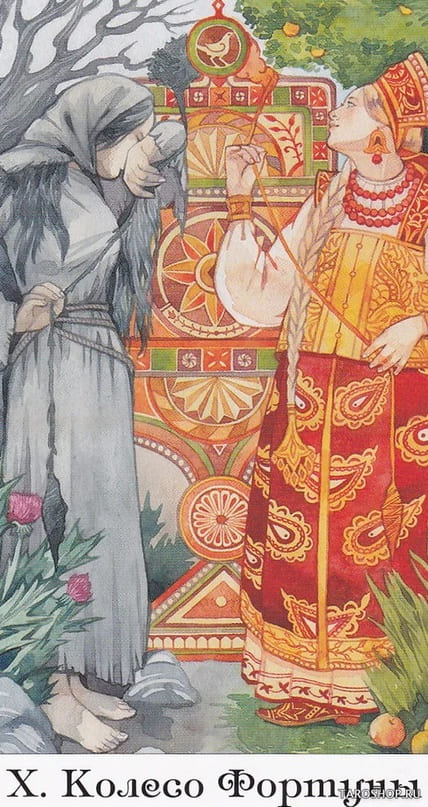
The Wheel of Fortune — Path 21 (Chesed to Netzach)
Hebrew letter: Kaph (palm, grip) The Wheel turns between mercy (Chesed) and desire (Netzach), showing how fortune rises and falls through the interplay of abundance and want. Kaph — the palm of the hand — suggests both grasping and releasing.
Death — Path 24 (Netzach to Tiphareth)
Hebrew letter: Nun (fish, the depths) Death connects desire (Netzach) to harmony (Tiphareth) — suggesting that transformation requires the death of attachment. The fish swims into unseen depths before rising transformed.
The World — Path 32 (Yesod to Malkuth)
Hebrew letter: Tav (mark, signature, completion) The final path — from the subconscious foundation to physical reality. The World is the signature of completion, the mark that says: the journey through all 22 paths is done.
How Kabbalah changes your readings
Position on the Tree
When you understand where a card sits on the Tree, its meaning gains depth. The Five of Cups isn’t just “grief” — it’s grief as an expression of Geburah, the necessary severity that strips away what doesn’t serve the soul’s growth. The loss is purposeful, even if it doesn’t feel that way.
Path relationships
When two Major Arcana cards appear in the same reading, check which Sephiroth their paths connect. If the Fool and the World appear together, you’re seeing the entire Tree — the first path and the last, beginning and completion, alpha and omega. That’s not a coincidence. It’s an architecture.
Elemental balance
The four suits’ connection to the four Kabbalistic worlds tells you what level of experience the reading is addressing:
- Lots of Wands? The reading is about your spiritual will and purpose (Atziluth)
- Lots of Cups? It’s about your emotional and creative life (Briah)
- Lots of Swords? It’s about thought, conflict, and mental patterns (Yetzirah)
- Lots of Pentacles? It’s about physical, material reality (Assiah)
Kabbalah without the complexity
You don’t need to master the entire Tree of Life to benefit from this connection. Start with two simple practices:
Practice 1: Learn the Sephirah for each number (1-10). When you see a Five, think “Geburah — severity, challenge, necessary destruction.” When you see a Six, think “Tiphareth — beauty, harmony, balance.” This alone adds a meaningful layer to every pip card reading.
Practice 2: When a Major Arcana card appears, consider it as a path — a bridge between two modes of being. The card isn’t just a static image. It’s a journey from one state of consciousness to another. Where does the path start, and where does it lead?
The Kabbalah doesn’t replace intuitive reading. It enriches it — giving you a map that explains why the cards are arranged the way they are and why certain patterns keep appearing. The architecture was there all along. Now you can see the blueprint.
Frequently Asked Questions
How are Kabbalah and tarot connected?
The connection was established by French occultist Eliphas Levi in the 1850s, who mapped the 22 Major Arcana cards to the 22 letters of the Hebrew alphabet and the 22 paths on the Kabbalistic Tree of Life. This wasn't an original historical connection — tarot and Kabbalah developed independently — but the correspondence is so elegant that it has become central to esoteric tarot practice.
What is the Tree of Life in tarot?
The Tree of Life is a Kabbalistic diagram showing 10 spheres (Sephiroth) connected by 22 paths. Each sphere represents a different aspect of existence — from pure divine energy (Kether) to physical reality (Malkuth). In tarot, the 22 Major Arcana cards map to the 22 paths between spheres, and the 10 numbered cards in each suit correspond to the 10 Sephiroth.
Do I need to know Kabbalah to read tarot?
No. Most tarot readers work without any Kabbalistic knowledge and give excellent readings. But if you're interested in the esoteric dimension of tarot — why the cards are structured the way they are, what deeper patterns connect them — Kabbalah provides the most developed framework for understanding those connections. Think of it as an optional advanced course, not a prerequisite.
Are the Hebrew letters on tarot cards important?
They are if you practice Kabbalistic tarot. Each Hebrew letter carries its own symbolic meaning — Aleph means 'ox' (primal energy), Beth means 'house' (container), Gimel means 'camel' (journey). Knowing these meanings adds a layer of interpretation: the Fool carries Aleph, suggesting raw, uncontained primal energy. But plenty of excellent readers never reference the Hebrew letters at all.