Review: Mucha Tarot — Art Nouveau in Cards
Some decks are tools. Some are art. The Mucha Tarot manages to be both — and that’s what makes it special. Every card feels like a page from an Art Nouveau exhibition catalog, yet it reads as cleanly as a traditional Rider-Waite-Smith deck. That combination is rarer than you’d think.
I’ve used this deck extensively in my card meanings articles, and it’s become one of my working decks. Here’s why it earned that place.
First impressions
The first thing you notice when you open the box is the color palette. Warm golds, soft peaches, muted teals. Every card sits within an ornamental Art Nouveau frame, and the frames vary by suit — each card has its own breathing space within a consistent visual language.
The second thing: there are no card titles. Major Arcana are marked with Roman numerals only. Minor Arcana show the number and suit symbol. It’s disorienting for about five minutes, then becomes a genuine advantage — you read the images instead of the words. Your intuition starts working harder.
About the deck
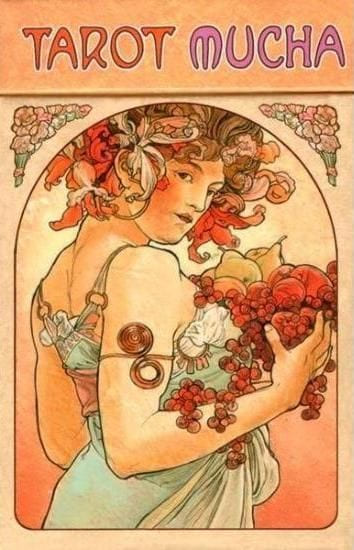
The Mucha Tarot (Tarot Mucha) is a Lo Scarabeo deck inspired by the work of Czech painter Alphonse Mucha (1860–1939), one of Art Nouveau’s most iconic figures. The illustrations are by Giulia F. Massaglia with coloring by Barbara Nosenzo. The companion guidebook — 128 pages in six languages — was written by Lunaea Weatherstone.
78 cards, standard 70×120mm size. Suits are Cups, Discs (Pentacles), Staves (Wands), and Swords. Court cards follow the Page, Knight, Queen, King structure. Everything is built on the RWS framework, so if you know traditional tarot, you’ll feel at home immediately.
Visual style
Mucha’s style is instantly recognizable: flowing organic lines, floral motifs, draped feminine figures, a sense of European Belle Époque elegance. Massaglia and Nosenzo translated this aesthetic into tarot with remarkable fidelity to Mucha’s original sensibility while keeping every scene readable as a tarot card.
The palette is restrained and elegant — warm golds, soft greens, gentle peach and blue tones. Card backgrounds have a parchment quality that adds vintage warmth. Print quality is high, the cardstock is solid with a light gloss.
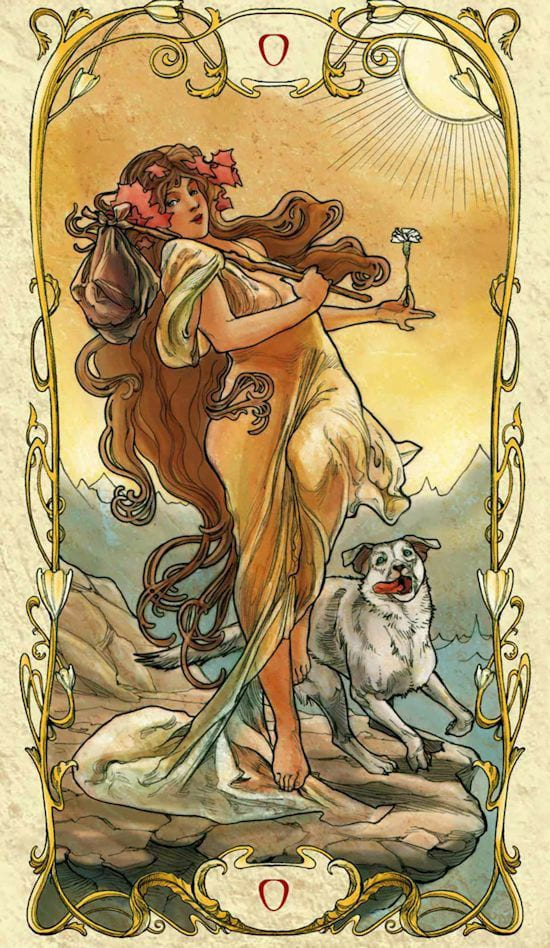
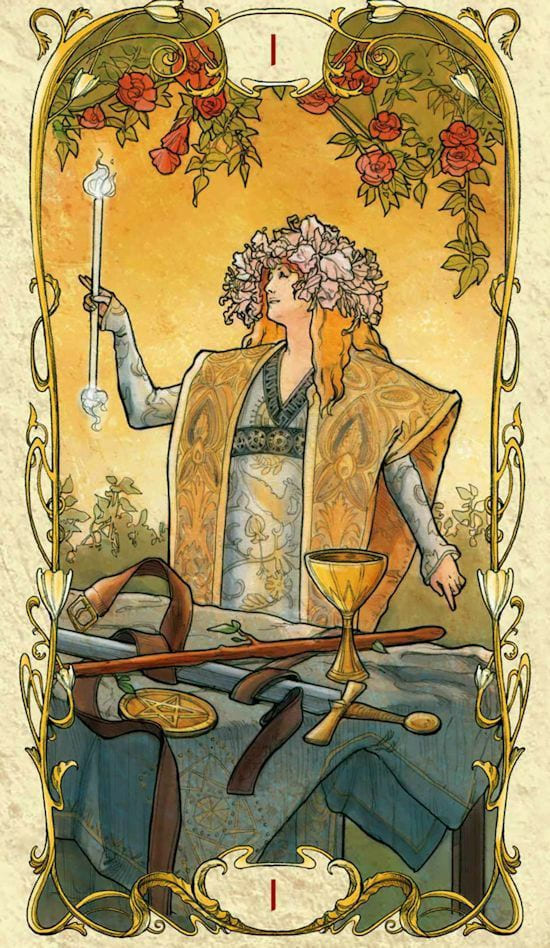
The most striking feature: several traditionally male cards are reimagined as female figures. The Fool, The Magician, The Hermit, Justice, and the Wheel of Fortune all depict women. This isn’t arbitrary — Mucha was famous for his female muses, and the deck stays faithful to that artistic vision.
Core themes
Femininity as power. This isn’t just “a pretty deck with women.” The female figures here are active protagonists — they create, travel, wield tools, hold the reins. Replacing male figures with female ones opens unexpected readings of familiar cards. The Fool isn’t a naive youth but a free woman choosing her path. The Magician holds all four suit tools with quiet, absolute confidence.
Art Nouveau and cycles. Mucha’s style is inseparable from nature: botanical ornaments, changing seasons, blooming and decay. In the context of tarot, this reinforces the theme of cycles — birth, growth, transformation, completion.
Beauty as language. The deck communicates through aesthetics. Even the heaviest cards — Death, The Tower — maintain a certain grace. If the stark imagery of traditional RWS makes you uncomfortable, this deck covers the same ground with more gentleness.
Favorite cards
The Fool — a young woman with long auburn hair in flowing gold-green robes, standing on rocks above the clouds. She carries a bundle on a stick and holds a small flower. A white dog runs beside her. The warm golden sky behind her doesn’t feel like danger — it feels like dawn. This is a Fool who chose her journey, not one who stumbled into it.
The Magician — a feminine figure in golden-amber robes with a flower crown. All four suit symbols sit on the table before her. The image is thought to reference Sarah Bernhardt, the legendary Belle Époque actress whom Mucha frequently painted. The magic here is soft but absolutely certain.
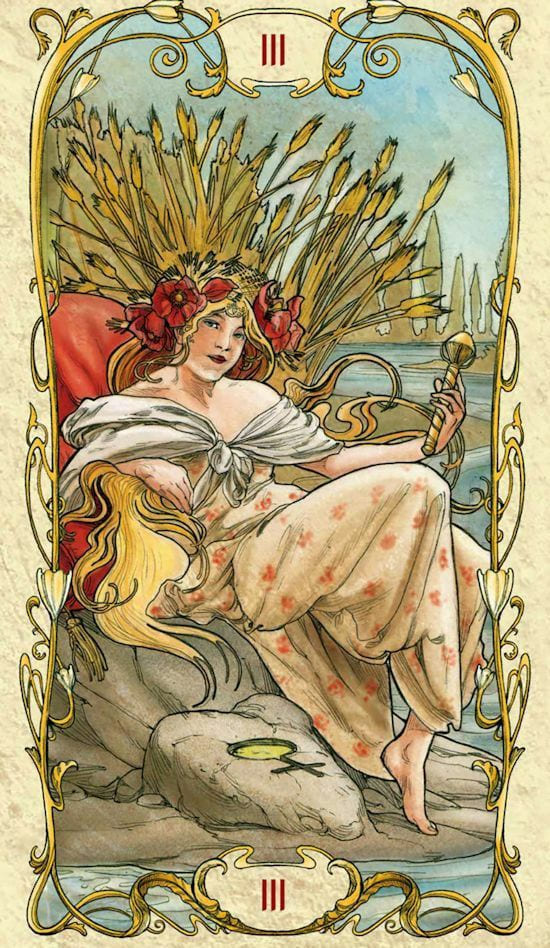
The Empress — arguably the most majestic card in the deck. A crowned woman sits on a rock with an explosion of wheat sheaves behind her, radiating outward like sun rays. She holds a lyre. Everything in this card speaks of abundance — not material wealth, but creative, natural overflow.
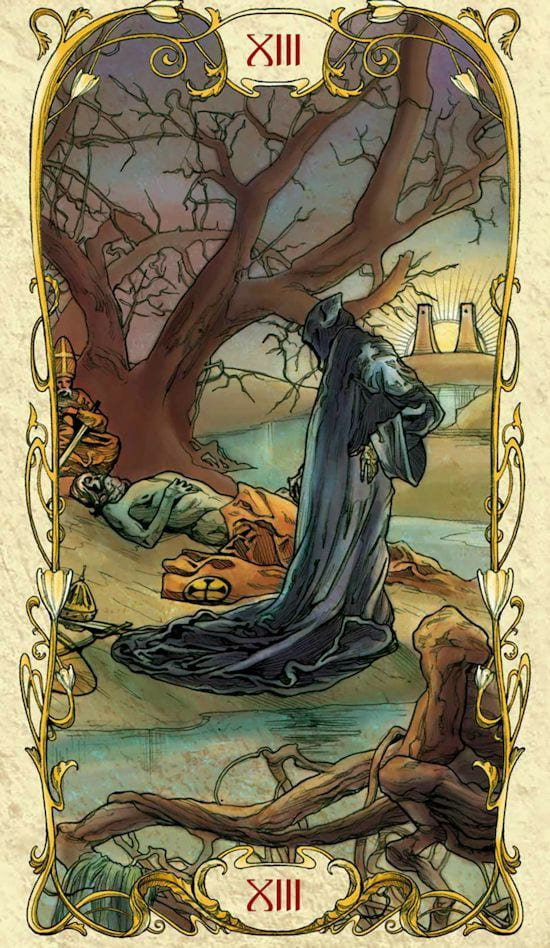
Death — one of the deck’s most striking departures. A dark hooded figure stands over a fallen knight in golden armor beneath a bare tree hung with lanterns. The landscape is desolate — water, ruins, grey sky. The palette shifts dramatically to dark browns, purples, and steel. Against the warm gold of the rest of the deck, this card stops you. That’s exactly why it works.
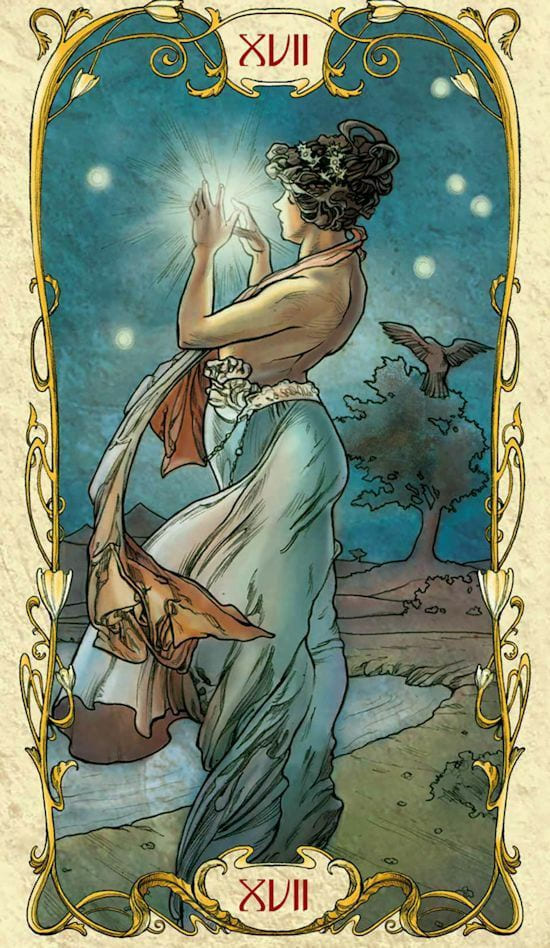
The Star — a woman with dark upswept hair in flowing blue-white robes stands by the water, holding starlight in her cupped hands. A hawk flies nearby. Deep blue night sky, scattered stars. One of the most atmospheric cards in any deck I’ve worked with — it genuinely seems to glow.
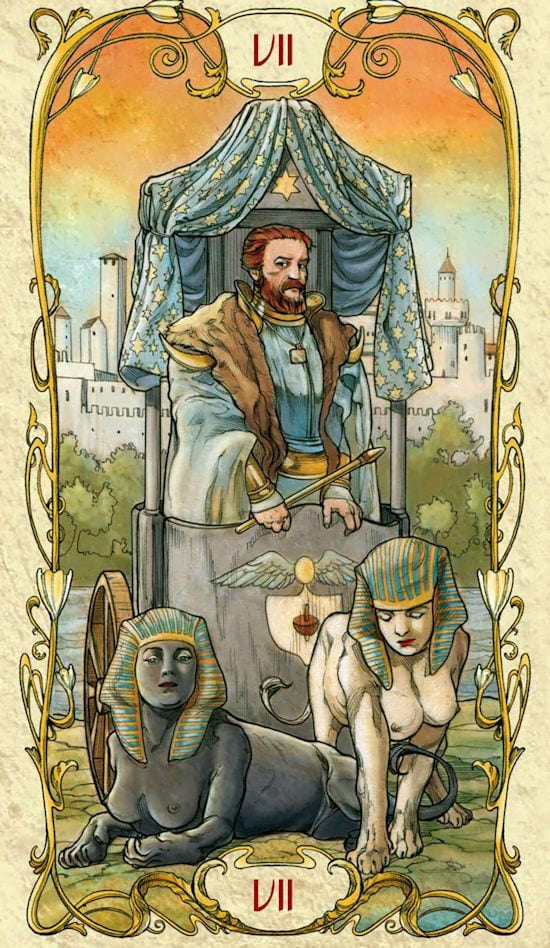
The Chariot — one of the few cards where the central figure remains male. A bearded man (believed to be Alphonse Mucha himself) sits beneath a blue canopy, with two sphinxes before him. A female figure sits at the base of the chariot — the inner force driving the whole structure forward.
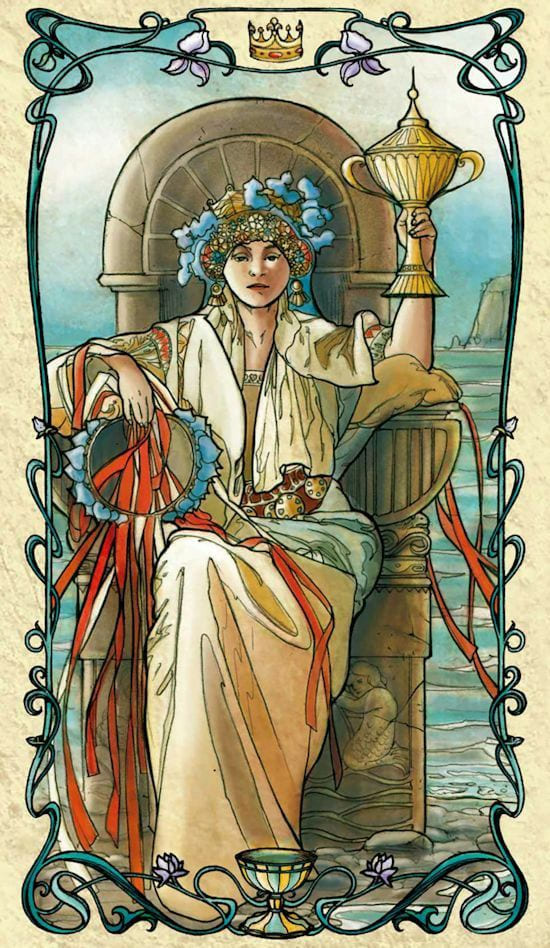
Queen of Cups — the soul of this deck. A woman in white robes with a blue floral crown sits on a waterside throne, holding a golden chalice. Serenity, depth, inner clarity. A quintessential Mucha heroine — and a quintessential Queen of Cups. A perfect match.
How to work with this deck
Card of the day — works beautifully. The lack of titles forces you to really look at each card every morning rather than relying on automatic recognition.
Self-exploration spreads — the deck excels at questions about inner life, creativity, femininity, and life transitions. Its aesthetic encourages meditative, unhurried reading.
Daily use — the card quality supports constant handling. Sturdy cardstock, good printing, comfortable size.
Professional readings — entirely suitable. The imagery is clear and follows RWS, so clients don’t need explanations of unusual symbolism. One note: the card backs are asymmetrical, which can reveal card orientation if you read reversals.
Who is this deck for
Aesthetes. If visual beauty matters to you in a deck, the Mucha Tarot is one of the most elegant options available. It doesn’t shout or shock — it invites you into a world of flowing lines and soft light.
Beginners. RWS structure, clear imagery, a solid guidebook included. The absence of titles isn’t an obstacle — it’s an invitation to develop your visual reading skills from the start.
Readers working with feminine themes. Goddess meditations, feminine archetype exploration, cycles of womanhood — the deck provides rich material.
Who might look elsewhere: those who prefer sharp, direct symbolism. The deck is gentle, and some readers may find its softness insufficient for blunt answers. Also, if you rely heavily on reversals, the asymmetrical card back may be an issue.
Deck pairings
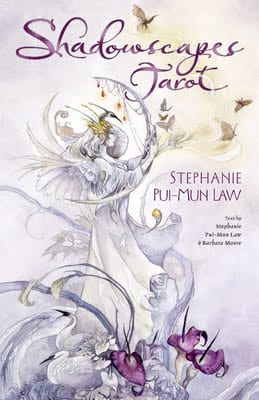
Shadowscapes Tarot — if you love the Mucha Tarot, Shadowscapes will likely resonate too. Similarly flowing, artistic, nature-infused. A good partner for comparative readings.
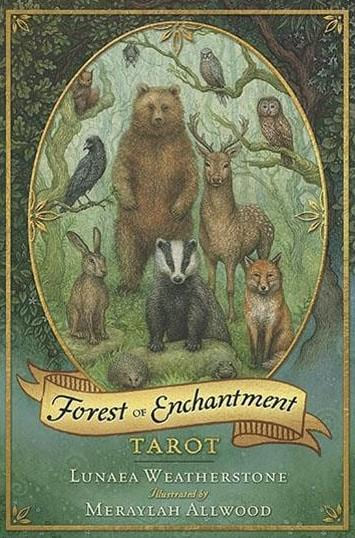
Forest of Enchantment Tarot — another Lo Scarabeo deck, and interestingly, the guidebook was also written by Lunaea Weatherstone. If woodland magic and natural imagery speak to you, these two form a beautiful pair.
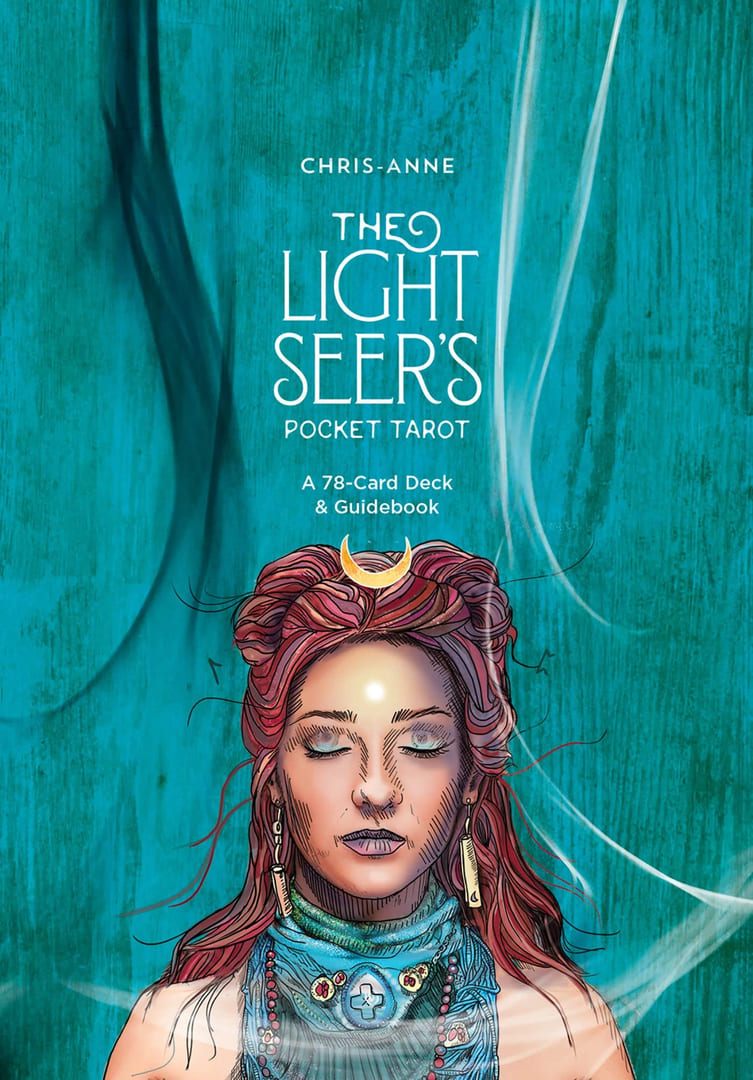
Light Seer’s Tarot — for contrast. If Mucha is classical Art Nouveau, Light Seer’s is modern, vibrant, and energetically different. Together they cover a wide range of moods and reading situations.
Try this deck in our Telegram bot — it’s available for readings right now.
Frequently Asked Questions
Is the Mucha Tarot good for beginners?
Yes — it follows the Rider-Waite-Smith structure closely, making it very readable. The only learning curve is the absence of card titles (only Roman numerals and suit symbols), but most readers adapt quickly.
How many cards are in the Mucha Tarot?
78 cards: 22 Major Arcana and 56 Minor Arcana. The suits are Cups, Discs (Pentacles), Staves (Wands), and Swords. Standard tarot structure throughout.
What are the main themes of the Mucha Tarot?
The deck is inspired by Czech Art Nouveau painter Alphonse Mucha. Its core themes are femininity, natural beauty, and life cycles. Several traditionally male cards are reimagined as female figures, opening new interpretive possibilities.
Who created the Mucha Tarot?
Illustrations by Giulia F. Massaglia, coloring by Barbara Nosenzo, inspired by the work of Alphonse Mucha. Published by Lo Scarabeo. The companion guidebook was written by Lunaea Weatherstone.