Tarot Spreads for Beginners: 7 Layouts You Can Learn Today
A spread is a pattern. You lay cards in specific positions, and each position asks a different question. The card that lands there answers it.
That’s the entire concept. Everything else is just variations on which questions you ask and how many cards you use.
If you’re new to tarot, the instinct is to jump straight to the biggest, most complex spread you can find. Resist that instinct. Start small. A one-card pull done with real attention teaches you more than a ten-card spread done in confusion.
Here are seven spreads, ordered from simplest to most complex. Start at the top and work your way down as your confidence grows.
1. The one-card pull
Cards: 1 | Best for: Daily guidance, quick answers, learning card meanings Difficulty: Absolute beginner
This is your foundation. Every experienced reader I know still does one-card pulls regularly.
How to do it:
- Shuffle while thinking about your question or the day ahead
- Draw one card
- Look at the image before checking any meanings
- Sit with it for a moment — what’s your gut reaction?
- Then check the meaning and see how it connects
Sample questions:
- “What energy should I focus on today?”
- “What do I need to know about this situation?”
- “What’s the lesson I’m learning right now?”
Why it works for beginners: You’re only interpreting one card. No relationships between cards to figure out, no positions to remember. Just you and one image having a conversation. Do this daily for two weeks and you’ll know more about tarot than reading ten books cover to cover.
2. The yes/no pull
Cards: 1 | Best for: Simple yes/no questions Difficulty: Absolute beginner
Sometimes you need a direct answer. This isn’t the most nuanced reading, but it has its place.
How to do it:
- Ask a clear yes/no question
- Draw one card
- Upright = Yes (or lean toward yes)
- Reversed = No (or lean toward no)
- The specific card adds nuance to the answer
Important: Not every question should be yes/no. Tarot is better at “how” and “why” than “will this happen.” But when you need a quick directional answer, this works.
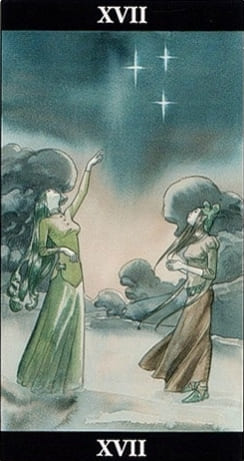
Example: You ask “Should I apply for this job?” and draw The Star upright. That’s a yes — and not just any yes. It’s a yes filled with hope, inspiration, and alignment. The Star says this opportunity connects to something meaningful for you.
3. Past, present, future
Cards: 3 | Best for: Understanding the arc of a situation Difficulty: Beginner
The classic three-card spread that probably 90% of tarot readers learn first.
Layout: Three cards, left to right.
| Position 1 | Position 2 | Position 3 |
|---|---|---|
| Past | Present | Future |
| What shaped this | Where you are | Where this is heading |
How to read it:
- Card 1 (Past): What attitudes, feelings, or events from the past are influencing the current situation? This isn’t ancient history — it’s the recent background that created today’s context.
- Card 2 (Present): What forces are at work right now? What’s happening in the situation as it stands today?
- Card 3 (Future): What can happen based on the current trajectory? This isn’t fate — it’s the most likely outcome if things continue as they are.
Reading tip: The story flows left to right. Card 1 causes Card 2, which leads to Card 3. If you don’t like what Card 3 shows, Cards 1 and 2 tell you what to change.
4. Situation, action, outcome
Cards: 3 | Best for: Decision-making, practical guidance Difficulty: Beginner
This is my favorite three-card variation for people who want actionable advice.
Layout: Three cards, left to right.
| Position 1 | Position 2 | Position 3 |
|---|---|---|
| Situation | Action | Outcome |
| What’s happening | What to do | What results |
How to read it:
- Card 1 (Situation): What is the current state of affairs? This card describes the reality you’re working with — no wishful thinking, just what is.
- Card 2 (Action): What actions can you take to address the situation? This is the advice card — the thing you should actually do.
- Card 3 (Outcome): What result can you expect from taking that action? This shows the likely consequence of following Card 2’s guidance.
Why I prefer this to past/present/future: It’s more useful. Instead of just showing you a timeline, it tells you what to do. Card 2 is almost always the most important card in this spread.
5. Mind, body, spirit
Cards: 3 | Best for: Self-check-in, holistic awareness, well-being Difficulty: Beginner
A beautiful spread for checking in with yourself, especially when something feels off but you can’t pinpoint what.
Layout: Three cards, left to right.
| Position 1 | Position 2 | Position 3 |
|---|---|---|
| Mind | Body | Spirit |
| What you’re thinking | How you’re feeling physically | What your deeper self says |
How to read it:
- Card 1 (Mind): What is the state of your mental world? What thoughts are dominating? What’s your mindset?
- Card 2 (Body): What is your physical state telling you? How are you feeling in your body? What does your body need?
- Card 3 (Spirit): What does your higher self, intuition, or deeper wisdom want you to know?
When to use it: Monday mornings. The start of a new season. When you feel “off” but don’t know why. After big life changes. As a monthly check-in.
6. The relationship check-in
Cards: 3 | Best for: Love and relationship questions Difficulty: Beginner to intermediate
A simple but revealing spread for understanding the dynamics in any relationship.
Layout: Three cards, left to right.
| Position 1 | Position 2 | Position 3 |
|---|---|---|
| How I feel | What’s really happening | What to do |
| My subjective experience | The objective reality | The best path forward |
How to read it:
- Card 1 (How I feel): Your emotional experience of the relationship. This is subjective — it’s your inner world, which may or may not match reality.
- Card 2 (What’s really happening): The objective state of the relationship. This card often reveals truths that Card 1’s emotions might be obscuring.
- Card 3 (What to do): The action that would be most beneficial for you. Not what your partner should do — what you can do.
Important note: Pay attention to the gap between Card 1 and Card 2. When your subjective experience (Card 1) differs significantly from objective reality (Card 2), that’s where the real insight lives.
7. The Celtic Cross
Cards: 10 | Best for: Deep exploration of a complex situation Difficulty: Intermediate (but worth learning)
This is the “big one.” Ten cards. Ten positions. Centuries of tradition. Don’t attempt it until you’re comfortable with three-card spreads — but once you’re ready, there’s nothing else quite like it.
Layout:
              [5]

  [4]    [1][2]    [6]         [10]
                                [9]
              [3]               [8]
                                [7]
Cards 1-6 form a cross shape. Cards 7-10 form a column to the right.
Positions:
- Heart of the Matter — The core of your current situation
- Challenge — What’s blocking or complicating things (laid across Card 1)
- Foundation — The underlying basis, how you can influence the situation
- Recent Past — Something from above — how fate or external forces intervene
- Possible Outcome — What from the past still influences the situation
- Immediate Future — What’s coming soon, near-term developments
- You — How you’re currently behaving in this situation
- Environment — How the people around you are influencing things
- Advice — The guidance from the cards
- Outcome — How the situation will resolve if the advice is followed
Reading tip: Don’t try to interpret all ten cards independently. Read them in pairs: Cards 1+2 (situation and challenge), Cards 3+5 (below and above), Cards 4+6 (past and future), Cards 7+8 (internal and external). Then Card 9 gives advice, and Card 10 shows the result.
When to wait: If ten cards feels overwhelming, you’re not ready yet. That’s fine. Go back to three-card spreads for another few weeks. The Celtic Cross will be here when you need it.
How to choose the right spread
The spread you pick depends on the question:
“What should I focus on?” → One-card pull
“Should I do this?” → Yes/no pull
“What’s the big picture?” → Past, present, future
“What should I do?” → Situation, action, outcome
“How am I really doing?” → Mind, body, spirit
“What’s happening in my relationship?” → Relationship check-in
“I need a deep dive into everything” → Celtic Cross
Start simple. A well-read one-card pull is worth more than a confused ten-card spread. As you gain experience, you’ll naturally gravitate toward the layouts that match your reading style.
Common spread mistakes to avoid
Doing too many spreads on the same question. One spread, one question. If you keep re-drawing because you didn’t like the answer, you’ll just confuse yourself and erode your trust in the process.
Using a complex spread for a simple question. “Should I text them back?” does not need a Celtic Cross. One card. Done.
Ignoring the position meanings. In a Past/Present/Future spread, Card 1 means something different than Card 3 — even if it’s the same physical card. Always interpret through the lens of the position.
Forgetting to formulate a clear question. “Tell me everything” is not a question. Be specific. The clearer your question, the clearer the answer.
Your homework
This week, try two different three-card spreads on the same question. Do a Past/Present/Future reading, then do a Situation/Action/Outcome reading on the same topic. Compare the results. Notice how different frameworks illuminate different aspects of the same situation.
That comparison is where you start developing your own reading style — and that’s when tarot stops being something you’re learning and starts being something you know.
Frequently Asked Questions
What is the easiest tarot spread for beginners?
The one-card daily pull is the best starting point. It requires no memorized positions, teaches card meanings through direct experience, and builds intuition faster than any multi-card spread. Do it every morning for two weeks and your progress will be significant.
Should beginners learn the Celtic Cross spread first?
No — start with one-card or three-card spreads first. The Celtic Cross has 10 positions with complex relationships between them. Most beginners who jump straight to it get overwhelmed and confused. Build up gradually.
How many tarot spreads should a beginner learn?
Two or three spreads is enough to start. Master the one-card pull, then the past-present-future three-card spread. Once those feel comfortable, add a decision-making spread. Depth with fewer spreads beats shallow familiarity with many.
What is the three-card tarot spread?
The three-card spread is the most popular beginner layout, with cards placed left to right representing past, present, and future. It provides just enough context to tell a story without overwhelming new readers with too many positions to interpret.
How long does it take to learn to read tarot spreads?
With daily one-card pulls, most beginners feel comfortable with basic readings within 2-4 weeks. Fluent multi-card reading typically takes 3-6 months of consistent practice. The key is regularity, not quantity.