Winter Solstice Tarot: Rest, Reflection, and Returning Light
The longest night asks you to sit still
There’s a moment on the Winter Solstice — somewhere between the last gray light fading and the full weight of the longest night settling in — when the world gets very, very quiet. The kind of quiet that most people fill with noise because they’re not sure what they’d hear if they didn’t.
This is the night that tarot was made for.
Not the quick daily pull on your commute. Not the frantic “does he like me” spread at midnight. This is the night for the readings that go deep — the ones that ask you to look at the full arc of a year, to sit with what you’ve been avoiding, and to find the small, stubborn flame that’s still burning inside you even when everything outside has gone dark.
The Winter Solstice — Yule, if you follow that tradition — is the astronomical moment when the Northern Hemisphere tilts furthest from the sun. It’s the shortest day and the longest night of the year. And embedded in that darkness is a promise: after tonight, the light returns. One minute more of daylight tomorrow. Then two. Then five. The wheel turns.
That tension between darkness and returning light is one of the most powerful energies you can work with in tarot. Because tarot has always been about exactly this — sitting in the unknown, trusting that understanding will come, and letting the cards illuminate what you can’t yet see on your own.
Why the Solstice and tarot belong together
Every culture on Earth has marked the Winter Solstice in some way. Bonfires, feasts, candles in windows, evergreen boughs brought indoors. The impulse is always the same: when the darkness is at its deepest, you bring light. When the cold is at its worst, you gather together. When the world looks dead, you surround yourself with things that are still green.
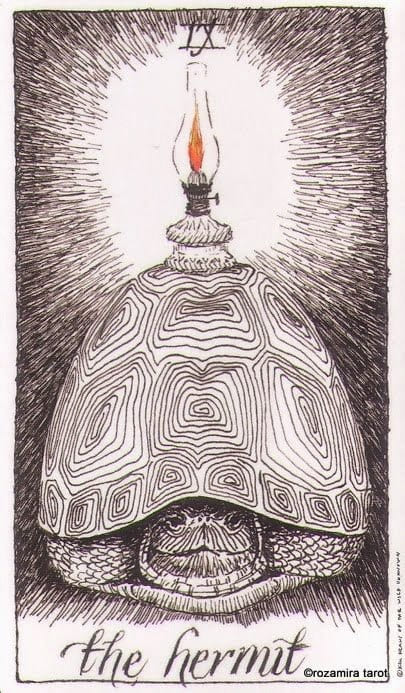
Tarot taps into this same instinct. You sit in the uncertainty, shuffle the deck, and pull a card — and suddenly there’s a point of illumination. A way to see what was invisible a moment ago. The Hermit doesn’t banish the darkness; he carries a lantern through it. That’s what a Solstice reading does.
Here’s why the longest night is uniquely suited to deep tarot work:
The year is at its hinge point. The Solstice sits at the threshold between the old year’s descent and the new year’s ascent. It’s not quite the end and not quite the beginning — it’s the pivot. Readings done at this threshold have access to both: what’s completing and what’s emerging.
Darkness invites honesty. There’s something about long winter nights that strips away pretense. The social performance of summer, the productive momentum of autumn — all of that has fallen away. What’s left is what’s real. The cards you pull on the Solstice tend to be raw and true in a way that readings at other times of year sometimes aren’t.
Rest is not optional. The natural world is dormant. The trees are bare. The ground is frozen. Everything is conserving energy, waiting, resting. If you’ve been pushing through exhaustion, ignoring your body’s signals, running on willpower and caffeine — the Solstice is the night when even the Earth says: enough. Sit down.
The returning light gives you something to plant. This isn’t just about reflection — it’s about intention. The light that returns after the Solstice is new light. Fragile, barely perceptible at first, but growing. Any insight you gain on the longest night becomes a seed that grows with that returning light.
Cards with special Winter Solstice significance
Not every card in the deck resonates equally with Solstice energy. These are the ones that carry particular weight when they appear in a Winter Solstice reading:
The Hermit
This is the Solstice card. Full stop. The Hermit is the figure who walks into the longest night voluntarily, carrying nothing but a lantern and whatever wisdom they’ve earned through experience. When The Hermit appears in a Solstice reading, the message is unmistakable: this is your time to go inward. Not because you’re lonely or lost, but because what you need to find can only be found in solitude and stillness.
The Hermit doesn’t fear the dark. He knows it’s where the most important work happens.
The Moon
If The Hermit carries a lantern, The Moon is the landscape he walks through — strange, shadowed, full of things that look different than they are. The Moon in a Solstice reading speaks to the deep unconscious material that surfaces during winter’s long nights. Dreams become more vivid. Anxieties sharpen. Things you buried in the busy months crawl to the surface.
The Moon doesn’t ask you to solve what it reveals. It asks you to witness it. To let yourself feel the discomfort of not-knowing without rushing to fix it.
The Star
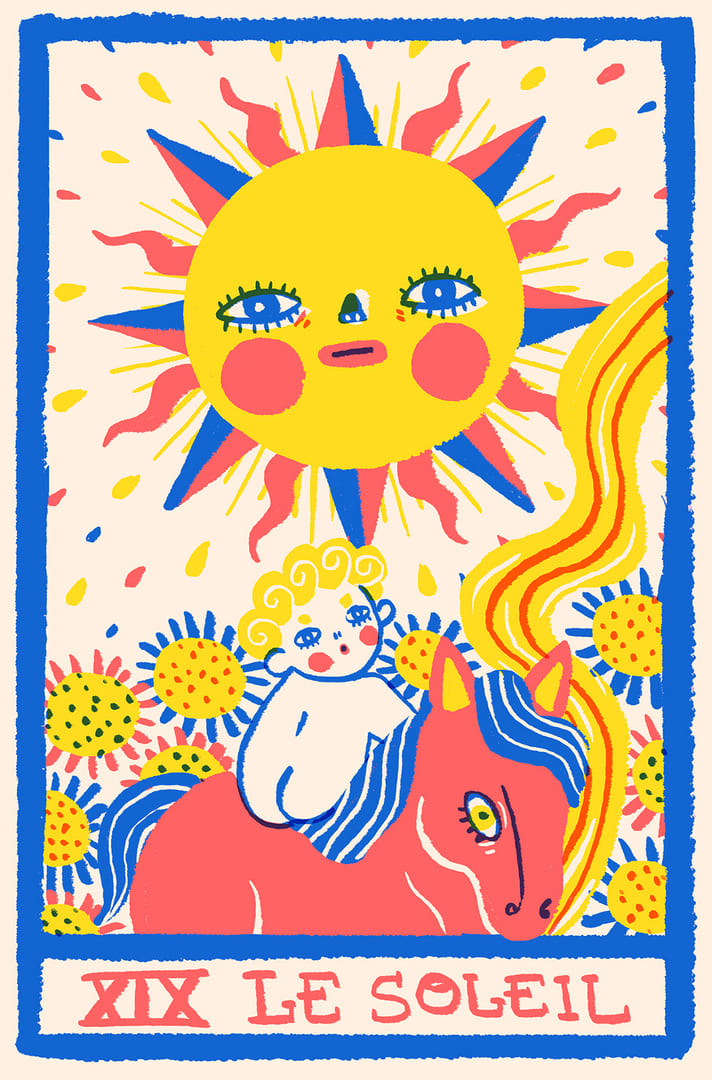
The Star is the returning light. She’s what comes after The Tower’s destruction and The Moon’s confusion — the quiet, steady hope that emerges when the worst is over and healing becomes possible. In a Solstice reading, The Star is the promise embedded in the longest night itself: this darkness is temporary. The light is already on its way back.
When The Star appears on the Solstice, pay attention. Something you thought was lost is about to be restored.
Four of Swords
This is the card of sacred rest — the knight lying still, eyes closed, swords on the wall. Not dead. Not defeated. Recovering. The Four of Swords in a Solstice reading is permission to stop. To actually rest, not just scroll on your phone while lying on the couch and call it relaxation.
The Solstice version of the Four of Swords says: your fallow period has purpose. The ground needs winter to be fertile in spring. So do you.
Temperance
The angel of patience, standing with one foot in water and one on land, pouring light between two cups in an impossible, alchemical act. Temperance at the Solstice speaks to the slow, quiet transformation that happens when you stop forcing things and let them integrate on their own timeline.
Winter is Temperance season. The changes you made this year — the lessons you learned, the habits you tried to build, the wounds you started to heal — they’re still being processed. Temperance says: trust the slow work. It’s working even when you can’t see it.
The Longest Night spread: a seven-card Solstice reading
This is the spread I come back to every year. It follows the arc of the Solstice itself — from descent into darkness to the first glimmer of returning light.
- The darkness I carry. What heaviness from this year am I still holding?
- What the darkness teaches. What lesson lives in the difficulty I’ve faced?
- What I need to release. What must I set down before the light returns?
- The seed in the dark. What’s been quietly growing inside me, even when I couldn’t see it?
- The returning light. What new energy or possibility is beginning to emerge?
- How to tend the flame. What practice or habit will help me nurture what’s emerging?
- The Solstice gift. What wisdom does this longest night offer me?
How to work with this spread
Lay the cards in a line from left to right, but leave a distinct gap between cards 3 and 4. That gap is the pivot — the Solstice moment itself, the hinge between descent and ascent. Cards 1-3 are the descent into darkness. Card 4 is what lives in the dark. Cards 5-7 are the returning light.
Read the descent cards first. Sit with them. Don’t rush to the light. The whole point of the Solstice is that you honor the darkness before celebrating the dawn.
When you get to card 4 — the seed in the dark — spend extra time here. This is often the most important card in the spread. It shows what’s been germinating beneath the surface of a difficult year, the growth you couldn’t see because you were too busy surviving.
Then move into the returning light. Let it feel like relief. Because it is.
The Returning Light spread: three cards for Solstice morning
If the Longest Night spread is for Solstice evening, this one is for the morning after — the first day when the light begins its slow return. Keep it simple. Three cards. Three questions.
- What am I leaving in the dark? What stays in the old year?
- What am I bringing into the light? What do I carry forward?
- The first step. What’s the single most important thing I can do as the light grows?
This spread works beautifully as a follow-up to the Longest Night spread, but it also stands alone. If you only have time for one Solstice reading, this is a good one — concise but potent.
Year in Review spread: twelve cards for twelve months
This is the big one. Not for the faint-hearted or the short on time — this reading asks you to look at the entire year, month by month, and find the thread that connects it all.
Pull twelve cards, one for each month. Lay them in a circle, like a clock face, starting with January at the 12 o’clock position and moving clockwise. Then pull a thirteenth card for the center: the heart of the year, the core lesson that runs through everything.
For each month, ask: What was the essential energy or lesson of this month for me?
Don’t try to match the card to specific events. Instead, look for the feeling, the energy, the undercurrent. Sometimes the connection will be obvious — you’ll pull the Tower for the month everything fell apart, or the Three of Cups for the month you found your people. Sometimes it’ll be subtler. Trust that.
After you’ve laid all twelve, look at the circle as a whole:
- Where are the Major Arcana concentrated? Those were your big growth periods.
- Where do the Swords cluster? That’s where you were doing mental or painful work.
- Where are the Cups? That’s where your emotional life was most alive.
- Is there a progression? A story? Let it tell itself.
The center card — the heart of the year — is your takeaway. This is what the entire year was about, distilled into a single image.
Yule Gifts of Wisdom: a four-card intention spread
This spread uses the imagery of Yule gift-giving, but the gifts come from your own deeper knowing. Think of each card as a wrapped package from your unconscious mind — something you need but didn’t know to ask for.
- The gift of release. What am I being given permission to let go of?
- The gift of insight. What truth is being revealed to me now?
- The gift of strength. What inner resource am I being reminded I have?
- The gift of direction. Where is the new light asking me to go?
This is a gentler spread, and a good one to do if you’re tired, if the year has been hard, if you don’t have the energy for heavy shadow work. Sometimes the kindest thing the cards can do is remind you of what you already have.
Creating your Solstice reading ritual
The Solstice isn’t just another night to pull cards. It’s an event — the longest night of the year, a threshold moment, a turning point. Your reading should feel different from a Tuesday morning card pull. Here’s how to create that feeling:
Light and darkness
This is the most important ritual element. The Solstice is fundamentally about light in darkness, so work with that literally. Turn off the overhead lights. Light candles — real ones, not your phone flashlight. If you’re doing the Longest Night spread, light one candle before you begin and add a candle for each returning-light card you turn over. By the time you reach card 7, you should be surrounded by a growing glow.
Some readers light a single candle at sunset on Solstice Eve and let it burn through the night — a vigil flame to keep the light alive through the darkest hours. If that speaks to you, do it (safely, please — use a contained candle on a fireproof surface, and don’t fall asleep next to it).
Evergreens
Bring something green to your reading space. A sprig of pine or cedar, a few holly leaves, a small potted rosemary plant. Evergreens are the original symbol of endurance through winter — they’re the living proof that not everything dies in the dark. Having them present during your reading is a reminder that something in you, too, remains alive and growing even when everything else feels dormant.
Warm drinks
This is not frivolous. Holding a warm cup while you contemplate your cards changes the reading. It grounds you in your body, slows you down, and creates comfort. Spiced tea, mulled cider, hot chocolate, golden milk — whatever feels like warmth and nourishment to you. Sip between cards. Let the reading take its time.
Music (or silence)
Some readers like ambient music during Solstice readings — something without words, something that sounds like snow falling or fire crackling. Others prefer complete silence. Both work. What doesn’t work is your Spotify playlist with lyrics that pull your attention away from the cards. Whatever you choose, let it deepen your focus rather than distract from it.
Time
Give yourself at least an hour for a Solstice reading. Two if you’re doing the Year in Review spread. This is not a speed run. You’re sitting with the longest night of the year — let your reading match that energy. Slow down. Breathe between cards. Let silence do its work.
Journaling prompts for the Solstice
After your reading — or instead of one, if you’re not feeling called to the cards this year — these prompts pair beautifully with the energy of the longest night:
For The Hermit energy: What have I learned this year that I could only have learned alone? What does my solitude teach me that company cannot?
For The Moon energy: What am I afraid to look at? If I let myself feel the thing I’ve been avoiding, what do I think would happen? What if I’m wrong about that?
For The Star energy: Where do I see the first signs of hope? What small, quiet thing is starting to heal? If I trusted that healing was already happening, how would I live differently?
For the Four of Swords energy: Where am I exhausted? Not just tired — genuinely depleted? What would real rest look like for me, and what story am I telling myself about why I can’t have it?
For Temperance energy: What am I trying to force that needs more time? Where would patience serve me better than effort? What if the slow path is the right one?
For the Solstice itself: If the returning light could illuminate one area of my life, where would I point it? What do I want to see more clearly in the year to come?
Write by candlelight if you can. Let your handwriting be messy. Don’t edit or censor. The longest night is the safest time to be honest with yourself — the darkness holds everything.
The gift of the darkest night
Here’s what I’ve learned from years of Solstice readings: the darkest night isn’t the enemy. It’s the invitation. It’s the world saying, “You’ve done enough. You’ve run enough. You’ve produced and performed and pushed through enough. Tonight, just be here. Just be still. Let the darkness hold what you’re too tired to carry.”
And then — always, without fail — the light comes back. Not because you earned it. Not because you performed the right ritual or pulled the right card or wrote the right journal entry. The light comes back because that’s what light does. The wheel turns. The days lengthen. The seeds you couldn’t see in the dark begin to push through the soil.
Your Solstice reading won’t change the world. But it might change how you move through it. It might help you name the weight you’ve been carrying so you can set it down. It might show you the seed that’s been growing in the dark so you can tend it in the light. It might simply give you permission to rest — real rest, not performative self-care, but the deep, animal rest of a creature who knows that winter is for sleeping.
Light your candle. Shuffle your deck. Sit with the longest night.
The light is already on its way.
The Elvi Tarot app is your companion for deep seasonal readings and everyday guidance alike. With over 100 beautifully illustrated decks and AI-powered interpretations that meet you where you are, Elvi helps you explore the cards with warmth, honesty, and real insight — whether you’re sitting with the Solstice or pulling a quick morning card. Try your next reading with Elvi and see what the cards have to say.
Frequently Asked Questions
What tarot cards are associated with the Winter Solstice?
The Hermit is the quintessential Winter Solstice card — the solitary figure carrying a lantern through darkness perfectly mirrors the longest night. The Moon represents the deep unconscious work of winter, The Star reflects the returning light and hope, the Four of Swords embodies sacred rest, and Temperance speaks to the patient alchemy of the season. The World can also appear as the completion energy of the dying year.
How do I create a Winter Solstice tarot ritual?
Start by dimming the lights and lighting candles — at least one for each card position in your spread. Set out evergreen branches (pine, cedar, or holly) to represent what endures through darkness. Brew a warm drink like spiced tea or cider. Pull your cards slowly and reflectively, journaling about each one. End by lighting a final candle to honor the returning light. The key is slowing down — solstice readings shouldn't be rushed.
When should I do my Winter Solstice tarot reading?
The most powerful time is on Solstice night itself (December 21 or 22, depending on the year), ideally after sunset when the longest night has officially begun. However, the energy of the solstice extends a few days in either direction, so any time within that window works. Some readers do a spread on Solstice Eve and a follow-up on Solstice morning to honor both the darkness and the returning light.
Can I do a Winter Solstice spread if I don't celebrate Yule?
Absolutely. The Winter Solstice is an astronomical event, not exclusive to any spiritual tradition. The longest night and the return of light are universal human experiences that have been marked by cultures worldwide for thousands of years. You don't need to follow a specific path to sit with the darkness, reflect on the year behind you, and set intentions as the light begins to grow again.