Best AI Tarot Apps in 2026: How to Choose One
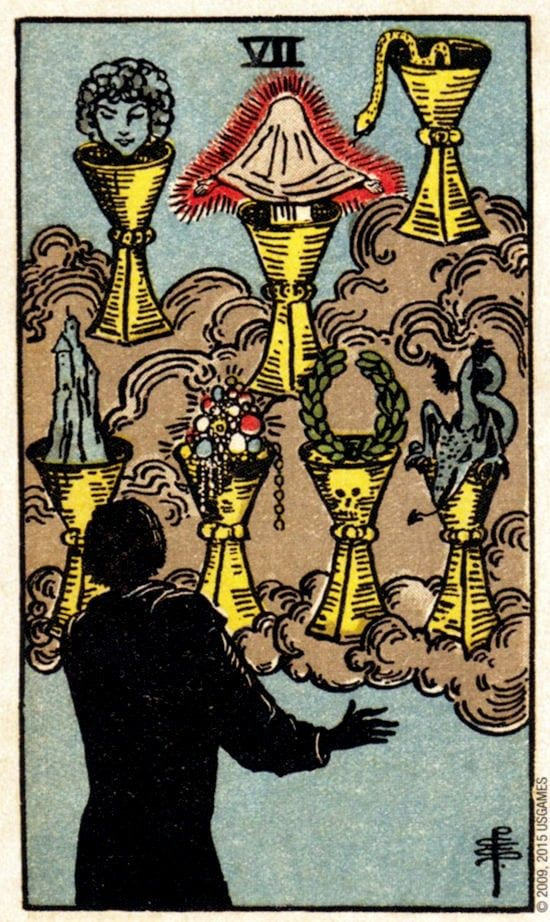
Seven cups to choose from
If you’ve googled “best tarot app,” you’ve already felt it: dozens of apps, every one promising “the most accurate reading.” You’re standing in front of a display of seven cups, like in the picture, with no idea which one holds something real and which one holds fog.
I’ve tried almost every type — from chatbots to standalone apps. And I learned one thing: there is no “best” app in a vacuum. There are three different types, and each is good for something different. Let’s go through them honestly, and at the end I’ll give you five questions that cut through the fog.
Three types of AI tarot
Every AI tarot app and site comes down to three types. They differ not in “accuracy” (that’s a myth) but in what, exactly, you walk away with.
1. General-purpose chatbots
This is ChatGPT and its lookalikes. You set the reader role with a prompt, and it lays out cards right there in the chat.
What’s good: free or nearly so, instant, flexible — you can ask for any spread. And its knowledge of the cards is real.
Where it’s weaker: it doesn’t shuffle a real deck (it picks cards from your text), it can’t show images, it forgets you after every chat, and it talks in a flat assistant voice. More on that in the dedicated guide to reading tarot with ChatGPT.
2. Free “draw-a-card” sites
There are hundreds of them: you land on the page, press a button, draw a card, and read a pre-written paragraph from a database.
What’s good: fast, free, nothing to set up. A solid first try to see whether tarot is for you at all.
Where it’s weaker: the interpretation is the same for everyone — it’s text from a database, not an answer to your question. One card, zero context, no memory. After a couple of pulls you start recognizing the same paragraphs.
3. Dedicated AI tarot readers
These are apps and bots that do one thing — read cards. Elvi belongs here.
What’s good: an honest shuffle of a full deck, real images from the deck you chose, memory of your past readings and questions, and a reader’s voice rather than a general assistant’s. It’s basically an attempt to keep the strengths of the first two types and drop the weaknesses.
Where it’s weaker: usually not entirely free — depth costs money, like a good app in any other field. And, like all tarot, it won’t predict the future (nobody can).
How to choose yours: five honest questions
Don’t compare apps by their “99% accuracy” promises — that’s marketing. Compare them on substance. Here are five questions worth answering before you choose.
- Is the draw honest? Does the app shuffle a real deck, or does it pick “convenient” cards? A good one draws what fell, even when that’s uncomfortable.
- Does it show the cards? Half of tarot is the image. If you only see text, you lose half.
- Does it remember you? Does it come back to your past readings — or are you a stranger to it every single time?
- Does it sound like a conversation? Is the interpretation written for you, or is it a database paragraph everyone gets?
- What does it promise? If an app promises exact dates and a guaranteed outcome, close it. That’s not tarot — it’s fear marketing.
Where Elvi fits in all this
I’ll be honest, no “we’re the best”: Elvi is the third type — a dedicated AI tarot reader. It was built around exactly those five questions: an honest draw, real cards, memory of your story, a human voice, and no promises to predict the future.
That doesn’t mean a chatbot or a free site is “bad.” For a quick try, they’re great. But if tarot is, for you, not a one-off curiosity but a way to look at your life more clearly now and then, it helps to use something that remembers what you asked last time.
Try it yourself
Take one question — a real one, something that actually weighs on you. And ask it in two places: a free site and a dedicated AI tarot reader. The difference shows up immediately — not in which cards came up, but in whether the answer talks to you or just spits out text.
And remember: an app is only a tool. The seven cups on the display all promise different things, but the real one is the cup you bring an honest question to. The rest is fog.
Frequently Asked Questions
What's the best AI tarot app in 2026?
There's no single 'best' — it depends on what you need. For a quick answer, a chatbot like ChatGPT works; for a random card, a free site does. If you want an honest draw, real card images, and an app that remembers your story, choose a dedicated AI tarot reader like Elvi.
Are free AI tarot apps any good?
Yes, for trying it out. Free sites and chatbots give a fast result and help you figure out whether tarot is for you at all. The downside is that interpretations are often generic, with no memory and no honest shuffle. When you want to go deeper, a dedicated AI reader makes sense.
How is an AI tarot app different from ChatGPT?
ChatGPT is a general-purpose tool: it'll draft an email and lay out cards, but without a true random draw and without memory. A dedicated AI tarot reader shuffles a full deck, shows the real cards, remembers your past readings, and speaks in a reader's voice from the first word.
What should I look for when choosing a tarot app?
Five things: whether the draw is genuinely random, whether it shows real card images, whether it remembers your story, whether the interpretation reads like a conversation rather than a database entry, and whether it avoids promising exact dates and guarantees. That last one is the biggest red flag.