How to Celebrate Mabon: Rituals and Tarot Practices
Ritual is just attention with intention
Here is a secret about ritual that experienced practitioners sometimes forget to tell beginners: a ritual is not a performance. It is not a spell. It is not a ceremony that requires perfect execution to work. A ritual is simply paying attention to something on purpose — and letting that attention change you.
At Mabon, what you are paying attention to is the turn. The turn from light to dark, from growing to composting, from gathering to releasing. The Autumn Equinox is the hinge of the year, and these rituals are ways of standing at that hinge with open eyes.
You can do one of them or all of them. You can do them on the equinox itself or any day that week. You can do them in a forest clearing with candles and crystals, or in your kitchen with an apple and a single thought. The season does not grade you on presentation.
1. The gratitude feast
This is the oldest and most universal Mabon ritual — the Witch’s Thanksgiving. It predates any formal tradition. People have been sitting down with the harvest and saying thank you for as long as there have been people and harvests.
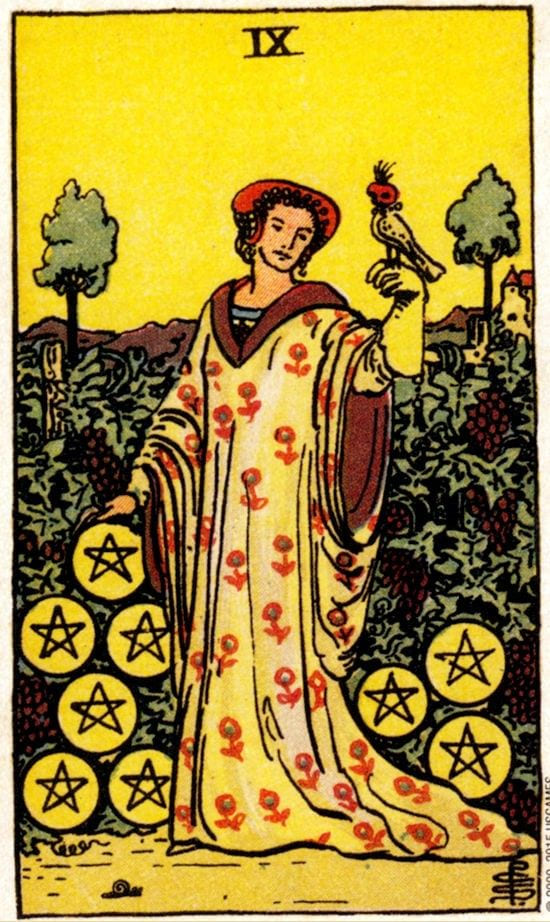
How to do it: Cook with what the season offers — apples, squash, root vegetables, grapes, nuts, bread, cider or wine. Set a table that feels beautiful to you. Before eating, go around the table (or, if alone, go through the seasons in your mind) and name one specific thing you are grateful for from each quarter of the year. Spring, summer, the summer that just ended, and the autumn that is beginning.
The tarot addition: Place the Nine of Pentacles in the center of your table as an anchor — the card of the full harvest, standing in abundance. After the meal, pull one card with the question: “What abundance am I not yet seeing?“
2. The balance candle ceremony
The equinox is the moment of perfect balance — twelve hours of light, twelve hours of dark. This simple ceremony makes that balance visible and felt.
How to do it: Choose two candles — one light (white, gold, or yellow), one dark (black, deep purple, or dark red). Place them side by side on a flat surface. Light them at the same time. Sit with them in silence for a few minutes. Feel the equality. Neither candle is more important. Neither flame is more real.
Then let them burn. Tomorrow the dark gains a few seconds more. But tonight — tonight they are equal.
The tarot addition: While the candles burn, pull two cards. Place one by the light candle (What is illuminated in my life right now?) and one by the dark (What is hidden that I need to look at?). Let the flames read alongside the cards.
3. The release ceremony
Mabon asks us to let go of what has completed its cycle — just as the trees let go of leaves and the garden releases the last of its fruit. This ceremony gives that release a physical form.
How to do it: On a small piece of natural paper, write what you are ready to release. Be specific. Not “negativity” but “the fear that I will fail at this new project.” Not “bad habits” but “checking my phone every time I feel uncomfortable.” Specificity is honesty, and honesty is what makes release work.
Then choose how to return it to the earth:
- Bury it. Dig a small hole, place the paper inside, cover it. The earth composts everything.
- Burn it. In a fireproof dish, safely light the paper and watch it transform to ash. Scatter the ash outside.
- Release it to water. If you are near a stream or river, let the paper float away. (Use biodegradable paper only.)
The tarot addition: Before writing, pull one card with the question: “What am I still holding that is ready to be released?” Let the card name what your conscious mind might be avoiding.
4. Apple divination
Apples are the sacred fruit of Mabon — the quintessential harvest, the fruit of knowledge, the gift of the autumn orchard. There is an old tradition of cutting an apple in half horizontally to reveal the five-pointed star inside (the seed pattern forms a pentagram). This is one of the oldest forms of seasonal divination.
How to do it: Take a fresh apple. Hold it for a moment and think about the coming dark half of the year. Then cut it in half horizontally (across the middle, not top to bottom). Look at the star pattern inside. Count the seeds you see — tradition says they carry messages:
- Five full seeds: Abundance and health through winter
- Fewer than five: Something needs attention before winter comes
- More than five: An unexpected gift is coming
Then eat the apple. Let the first taste of autumn ground you in the present.
The tarot addition: After cutting and examining the apple, pull one card to expand on its message. The apple gives you the broad stroke; the card gives you the detail.
5. The ancestor’s place setting
Mabon is the beginning of the descent into the dark half of the year — the season when the veil between worlds thins, leading up to Samhain. Many traditions set an extra place at the Mabon table for ancestors, honoring those who harvested before you.
How to do it: At your Mabon meal, set one extra place — a plate, a glass, a napkin. Serve a small portion of everything you eat. This place is for those who came before: a grandmother, a mentor, a friend who has passed, or simply the unnamed line of people whose lives led to yours.
During the meal, speak to them. Tell them about your harvest this year. Ask for their guidance as you enter the darker months. Listen for answers in the quality of the silence.
The tarot addition: Pull one card and place it at the ancestor’s setting. Ask: “What message do my ancestors have for me at this turning of the year?” Read the card as if it were spoken in a voice much older than yours.
6. The equinox walk
This is the simplest ritual and sometimes the most powerful. No tools, no preparation. Just you and the turning earth.
How to do it: On the day of or near the equinox, take a walk outside. Go slowly. Notice everything the season is doing: the angle of light, the drying grasses, the first colored leaves, the smell of the cooling air. As you walk, mentally sort your year into two categories: what I gathered and what I released.
When you find a natural boundary — a bridge, a fence line, a place where forest meets field — stop there. Stand at the threshold. Acknowledge that you are crossing from one half of the year into another. Then step across.
The tarot addition: Before your walk, draw one card and carry it in your pocket. Do not look at it until you reach your turning point. When you do, pull it out and read it there, standing at the boundary between seasons.
7. The Mabon tarot ceremony
This is the most immersive practice — a full tarot ritual designed specifically for the equinox.
How to do it: Create a quiet space. Place two candles (light and dark), something from the harvest (an apple, leaves, acorns), and your deck on a cloth. Light the candles. Take several deep breaths, feeling the balance of the equinox in your body — equal inhale, equal exhale.
Shuffle your deck with the intention of meeting the season honestly. Then lay out five cards in a horizontal line:
- The harvest — What grew this year that I can be grateful for
- The weight — What is heaviest in my life right now
- The balance point — Where I find equilibrium between holding on and letting go
- The release — What must return to the earth
- The seed in the dark — What I plant now that will grow through winter and emerge in spring
Read each card slowly. There is no need to rush. The equinox gives equal time to every question.
When you are finished, blow out the light candle first. Let the dark candle burn a few moments longer — the dark half of the year begins.
Making it yours
The most important thing about Mabon rituals is this: they belong to you the moment you do them. You do not need to follow these instructions exactly. Add music. Invite friends. Do them in your pajamas. Do them in a park. Skip the ones that do not resonate and spend longer with the ones that do.
The equinox does not care about your ritual’s production value. It cares about your presence. Show up for the turn of the year — however you show up — and the turn will show up for you.
Frequently Asked Questions
What are the most important Mabon rituals?
The core Mabon rituals center on balance, gratitude, and release. A gratitude feast with seasonal foods, lighting balanced candles (one dark, one light), and a release ceremony where you bury or burn what you are ready to let go of. Add a tarot reading for deeper self-reflection. You can do any of these alone or combine them.
Can I celebrate Mabon alone?
Absolutely. Many of the most meaningful Mabon practices are solitary — journaling by candlelight, walking in nature, preparing a seasonal meal for yourself, and pulling tarot cards. Mabon honors the inward turn of the year, making solo celebration especially fitting.
What foods are traditional for a Mabon feast?
Apples (the quintessential Mabon fruit), grapes, pears, squash, pumpkin, root vegetables, nuts, bread, cider, and wine. Anything harvested in late September works. The tradition is the Witch's Thanksgiving — a gratitude meal where you name what the year has given you before eating.
How do I create a Mabon altar?
Gather items that represent the season and the themes of balance and harvest: fallen leaves, apples, acorns, pinecones, a small pumpkin or gourd, two candles (one dark, one light), and any tarot cards that feel right. Arrange them on a cloth in autumn colors — deep red, orange, gold, brown. There is no wrong way to do this.