Justice and Temperance in Tarot: The Cards of Mabon
Two cards, one equinox
There are seventy-eight cards in a tarot deck, and yet when the Autumn Equinox arrives, two of them step forward as if they have been waiting all year. Justice. Temperance. The two cards of balance — and the two faces of what Mabon is actually asking.
They are not the same card. They are not interchangeable. And understanding how they differ is understanding how Mabon itself works.
Justice holds a sword and a scale. It measures. It divides. It tells you what is equal and what is not — and it does not apologize for the answer. Justice is the astronomical equinox: twelve hours of light, twelve hours of dark, measured to the second, no sentiment involved.
Temperance holds two cups and pours between them. It blends. It harmonizes. It finds the point where two things that seem opposite become one flowing stream. Temperance is the felt equinox: the day you stand between summer and winter and realize they are not enemies — they are two halves of the same breath.
At Mabon, you need both. The honest measurement. And the graceful blending.
Justice at the equinox
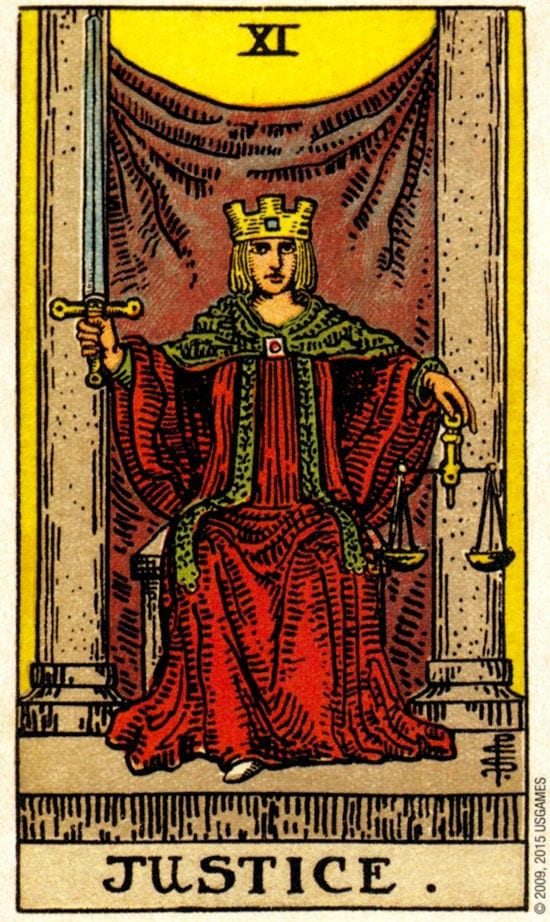
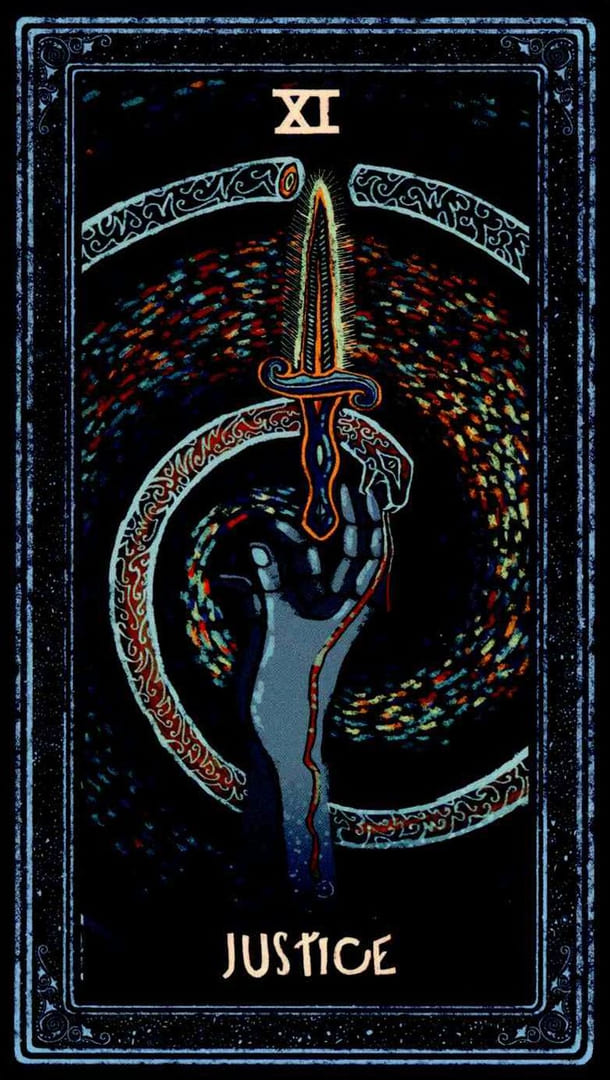
Look at Justice closely. The figure sits on a throne between two pillars — one light, one shadow, like the two halves of the year. In one hand, a sword pointed upward — truth that cuts. In the other, scales — perfectly balanced, like the equinox itself.
Justice does not comfort. It clarifies. And at Mabon, that clarification is precisely what is needed.
What Justice asks at Mabon
“What has earned its place?” Justice at the equinox asks you to look at everything in your life — relationships, habits, beliefs, projects, commitments — and honestly assess what has earned its continued place. Not what you wish had earned it. Not what you hope will earn it. What actually has.
“What is owed?” This is not about debt in a financial sense. It is about balance. Have you been giving more than you receive somewhere? Receiving more than you give? Justice notices these imbalances with perfect clarity. The equinox is the moment to notice them too.
“What is the fair exchange?” Every season asks for a trade. Spring asks you to trade rest for growth. Summer asks you to trade peace for intensity. Mabon asks: what do you trade for the coming dark? What do you release to earn the right to rest? Justice defines the terms.
Justice reversed at Mabon
When Justice appears reversed in a Mabon reading, it signals that something in your weighing is off. You are being unfair — to yourself, to someone else, or to the truth. Perhaps you are holding onto something that the scales clearly show should be released. Perhaps you are releasing something valuable out of guilt rather than genuine readiness. Reversed Justice at the equinox says: check your scales. Something is tipping that should not be.
Justice in the Smith-Waite tradition
In the original Smith-Waite deck, Justice is card XI — placed between the Wheel of Fortune (X) and the Hanged Man (XII). This placement is not accidental. The Wheel turns (Mabon’s turning year), Justice weighs (Mabon’s honest assessment), and the Hanged Man surrenders (Mabon’s letting go). These three cards in sequence are the entire story of the equinox.
Temperance at the equinox
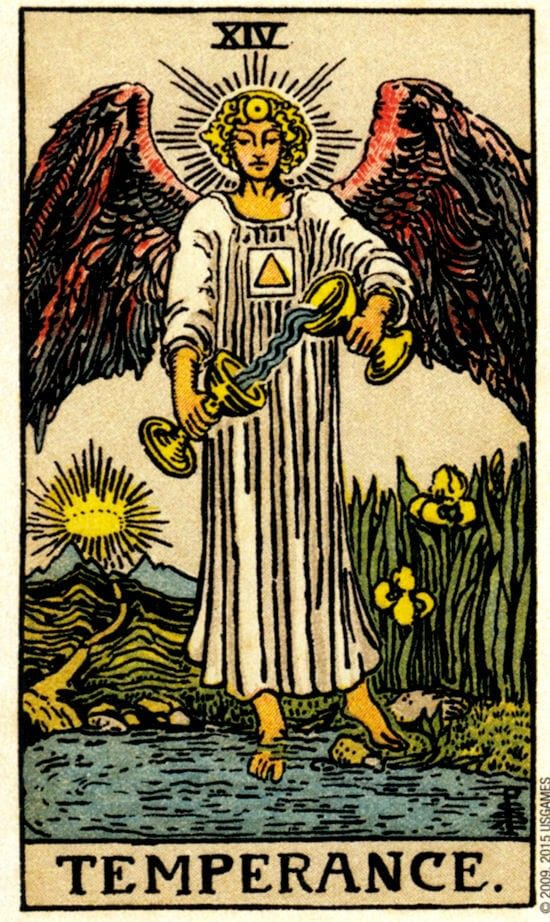
Now look at Temperance. An angel stands with one foot on land and one in water — earth and emotion, the material and the fluid, perfectly straddled. Between two cups, a stream of water flows in an impossible arc, defying gravity, because Temperance does not obey the rules of ordinary physics. It follows the rules of harmony.
Where Justice divides to measure, Temperance combines to heal.
What Temperance asks at Mabon
“Can you hold both?” Light and dark. Summer and winter. Gratitude and grief. Abundance and loss. Temperance at Mabon says: you do not have to choose. The equinox holds both. So can you.
“Where is the flow?” Temperance is not about static balance — scales sitting still. It is about dynamic balance — water moving between cups, energy circulating, the living equilibrium that exists in motion. At Mabon, Temperance asks: where in your life is energy flowing well? Where has it become stagnant?
“What needs blending?” Perhaps your practical life and your spiritual life have separated. Perhaps your need for rest and your fear of falling behind are at war. Temperance asks you to pour one into the other — not choosing a winner, but creating something new from the combination.
Temperance reversed at Mabon
Reversed Temperance at the equinox suggests you are out of harmony — forcing something that needs patience, rushing a process that needs time, or refusing to blend two things that belong together. The autumn harvest cannot be rushed. Wine takes time. Fruit ripens on its own schedule. Reversed Temperance says: stop forcing. Let the blending happen naturally.
Temperance in the Major Arcana sequence
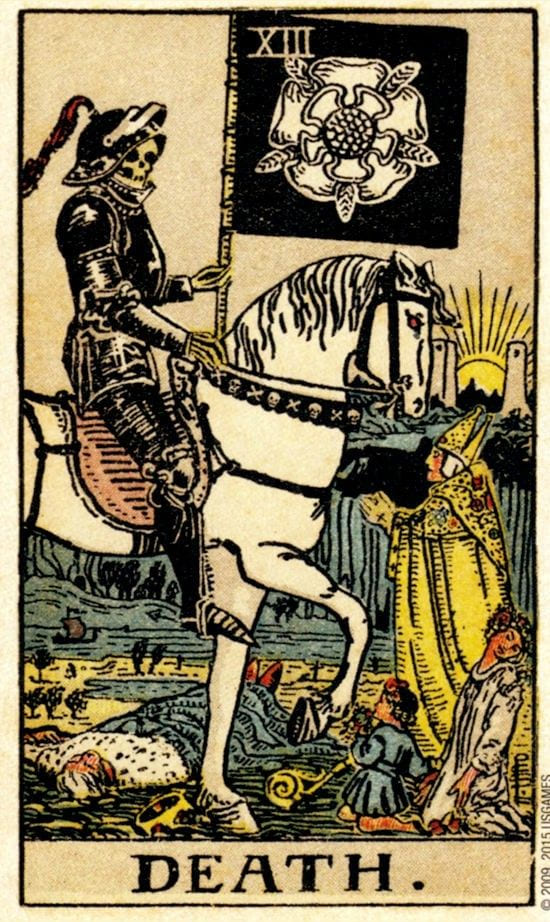
Temperance is card XIV, placed between Death (XIII) and the Devil (XV). This tells you everything about its role at Mabon. After the great transformation of Death (the dying garden, the ending season), Temperance arrives to integrate — to take what remains and what was lost, and blend them into something sustainable. Temperance is what happens between the ending and whatever comes next. It is the pause where composting becomes soil.
How they work together
Here is the secret that makes Mabon readings so powerful: Justice and Temperance are not competing perspectives. They are a conversation.
Justice says: This is what the scales show. This is what is equal and what is not. Here is the truth, measured precisely.
Temperance says: Good. Now let us work with that truth. Let us take what the scales show and find the flow — the way to move forward that honors both sides.
In a reading, if you pull both cards:
- Justice tells you what is true — the honest assessment of where you stand
- Temperance tells you what to do about it — how to integrate, blend, and find harmony with that truth
You cannot have Temperance without Justice. Blending only works if you know what you are blending. And you cannot have Justice without Temperance. Knowing the truth is not enough — you have to live with it, move with it, let it flow.
Reading Justice and Temperance at Mabon
A two-card equinox spread
This is the simplest and most direct way to work with these cards at Mabon.
Separate Justice and Temperance from your deck. Place them face up, side by side — Justice on the left, Temperance on the right. These are not cards you pulled. They are the anchors, the frame of the reading.
Now shuffle the remaining cards and pull one for each:
Card under Justice: What needs to be honestly weighed in my life right now? Where do the scales need attention?
Card under Temperance: What needs to be blended or harmonized? Where does flow need to be restored?
Read the pulled cards through the lens of their anchors. The card under Justice gets read with Justice’s clarity — sharp, honest, no sentiment. The card under Temperance gets read with Temperance’s grace — flowing, integrating, looking for harmony.
Recognizing them in seasonal readings
When Justice appears unprompted in a Mabon reading, pay extra attention. The equinox is amplifying its message. Whatever position it falls in, read it as: this is where honest measurement is needed. Do not soften this with wishful thinking.
When Temperance appears unprompted, read it as: this is where grace is needed. You have two things that seem incompatible. They are not. Find the pour between them.
When both appear in the same reading — and at Mabon this happens more often than you might expect — the reading is telling you that this equinox is especially important for your personal balance. The universe is not being subtle. It is saying: weigh, blend, find your center. The dark half of the year depends on how honestly you do this.
The cards no one expects
There are other cards that carry Mabon energy — Death, the Wheel of Fortune, the Hanged Man, the Nine of Pentacles. They are all important. But Justice and Temperance are the two that define this sabbat, because they define what balance actually means.
Balance is not stillness. It is not a problem you solve once and then forget. Balance is an ongoing act — measuring and blending, weighing and flowing, being honest and being graceful, all at the same time.
The equinox lasts a day. But the balance it asks you to find lasts a lifetime.
Justice gives you the scale. Temperance gives you the pour. And Mabon gives you the moment — the one perfect, equal, honest day — to use them both.
Frequently Asked Questions
Why are Justice and Temperance associated with Mabon?
Both cards embody balance — the defining quality of the equinox. Justice weighs with precision (equal day, equal night, no exceptions). Temperance blends with grace (finding the perfect middle between opposing forces). Together they represent the two faces of Mabon's equilibrium: the objective measurement and the intuitive harmony.
What does it mean when Justice appears in a Mabon reading?
Justice at Mabon asks you to weigh honestly. What in your life is fair? What has earned its place? What has overstayed? The equinox divides light and dark without sentiment, and Justice asks you to do the same with your commitments, beliefs, and patterns. It is a card of honest accounting.
What does Temperance mean at the Autumn Equinox?
Temperance at Mabon is the angel of the equinox — standing with one foot in the light and one in the dark, pouring between them to create perfect balance. It means finding harmony not by choosing one side but by holding both. It asks you to blend gratitude with letting go, harvest with release.
How are Justice and Temperance different from each other?
Justice measures — it uses a scale, it is precise, it deals in fairness and consequence. Temperance mixes — it uses flow, it is intuitive, it deals in harmony and integration. Justice asks 'Is this equal?' Temperance asks 'Does this flow?' At Mabon, you need both: the honest measurement and the graceful blending.