Review: Green Witch Tarot — Earth Magic
First impressions
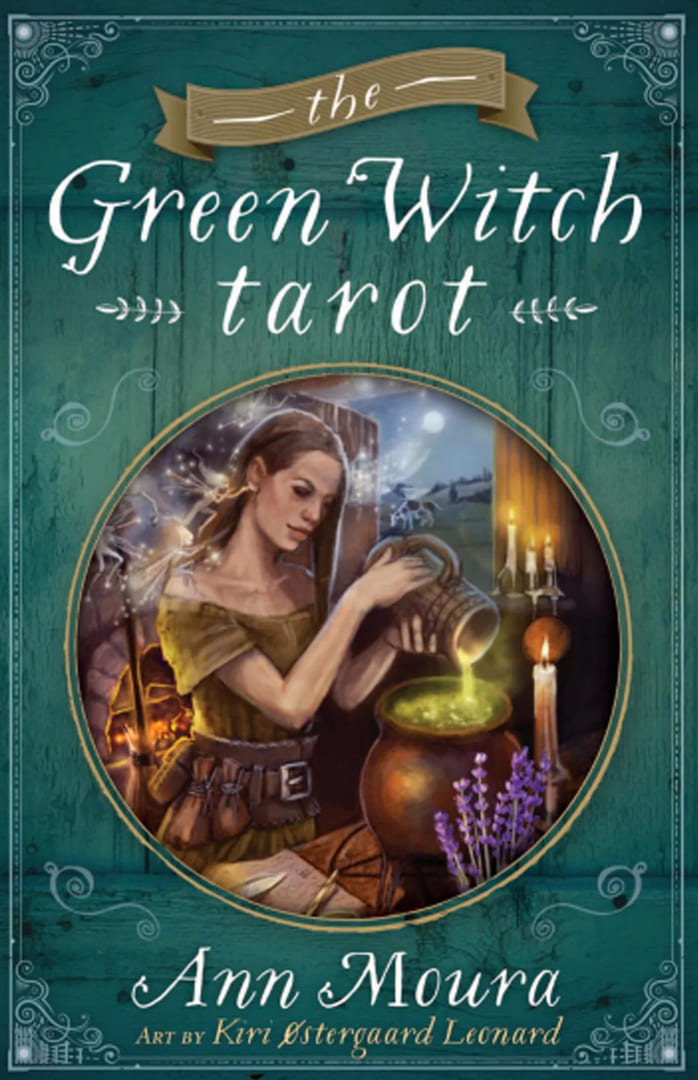
I came to this deck during a phase when I wanted something fundamentally different from the Rider-Waite — not just different art, but a different philosophy. The Green Witch Tarot delivered exactly that: not a reskin, but a complete system built around Green Witchcraft and the pagan calendar.
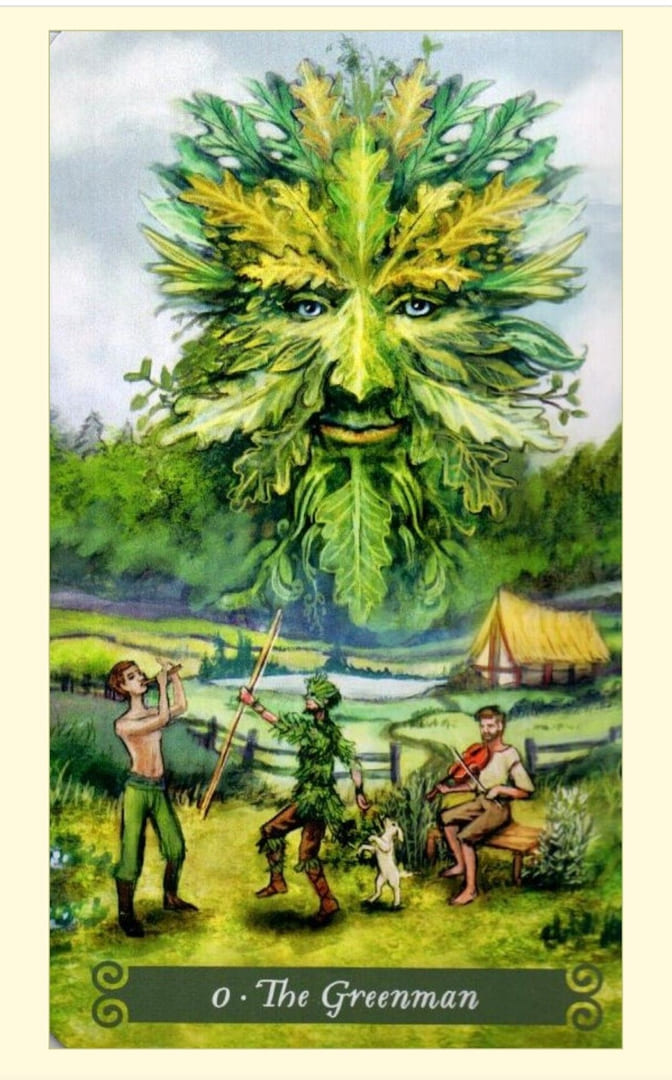
The first thing that hits you — there’s no Fool standing on a cliff’s edge. Instead, a massive Green Man face woven from oak leaves gazes down from the sky, while below, dancers in leaf costumes play fiddle and flute as a white dog leaps alongside them. You realize immediately: this deck doesn’t just dress the Rider-Waite in green. It speaks an entirely different language.
About the deck
Created by Ann Moura, author of the renowned Green Witchcraft book series, with artwork by Kiri Østergaard Leonard. Published by Llewellyn in 2015, it was immediately praised — Aeclectic called it “one of the most outstanding tarot releases of 2015.”
78 cards in the standard structure, but deeply reworked. All 22 Major Arcana are renamed to reflect pagan theology. The Minor Arcana suits are partially preserved: Wands and Pentacles remain, while Swords become Athames (ritual daggers) and Cups become Chalices. Court cards follow the traditional Page, Knight, Queen, King system.
The set includes a substantial 240-page companion book — not just a list of meanings, but an introduction to Green Witchcraft complete with tarot history, detailed card symbolism, meditations, and ritual outlines.
Visual style
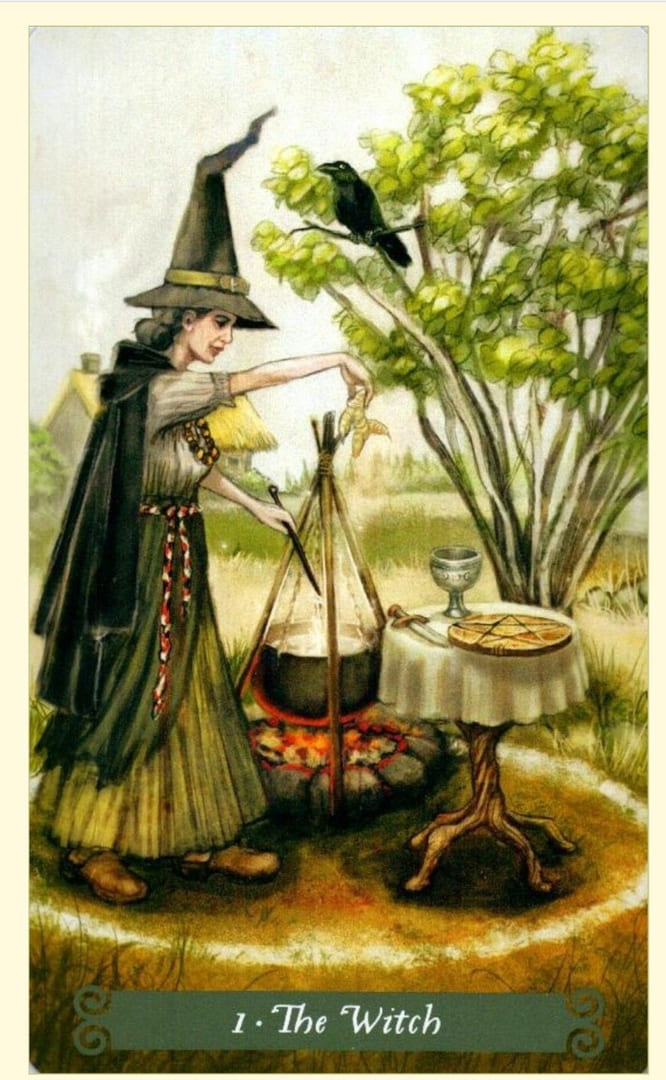
The cards are borderless with green title banners at the bottom. Artist Kiri Leonard created what I’d call a “pseudo-medieval witch village” — stone circles, herb-filled meadows, bubbling cauldrons, all painted with such vivid detail that you want to linger on every card.
The palette leans into rich earth tones: deep greens, warm browns, evening blues, vibrant reds and yellows. Each card reads like a small panorama with real depth and perspective. The cardstock is thin but not flimsy, with a low-sheen matte finish — it shuffles smoothly without sticking or slipping. The back design features a non-reversible pentacle with roses on a wooden background.
Core themes
Ann Moura didn’t just rename the cards — she built a coherent system where every Major Arcana connects to a specific Sabbat on the Wheel of the Year, an aspect of deity, or a pagan practice.
Here are the key transformations that reshape the deck’s philosophy:
- The Fool → The Green Man — god of spring fertility instead of a naive traveler
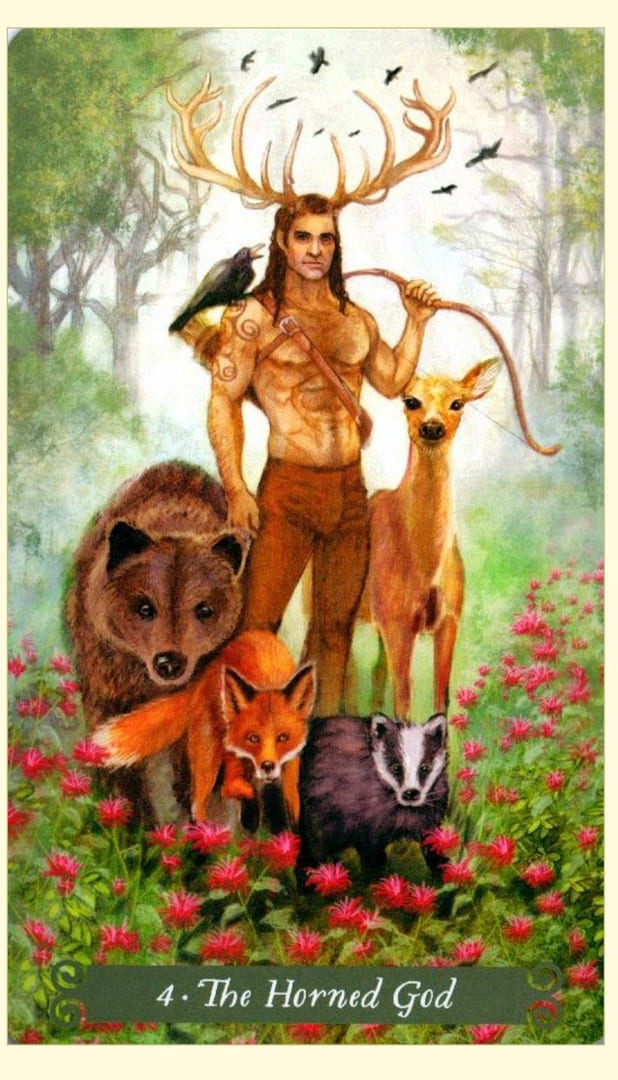
- The Emperor → The Horned God — lord of the forest, nature’s protector
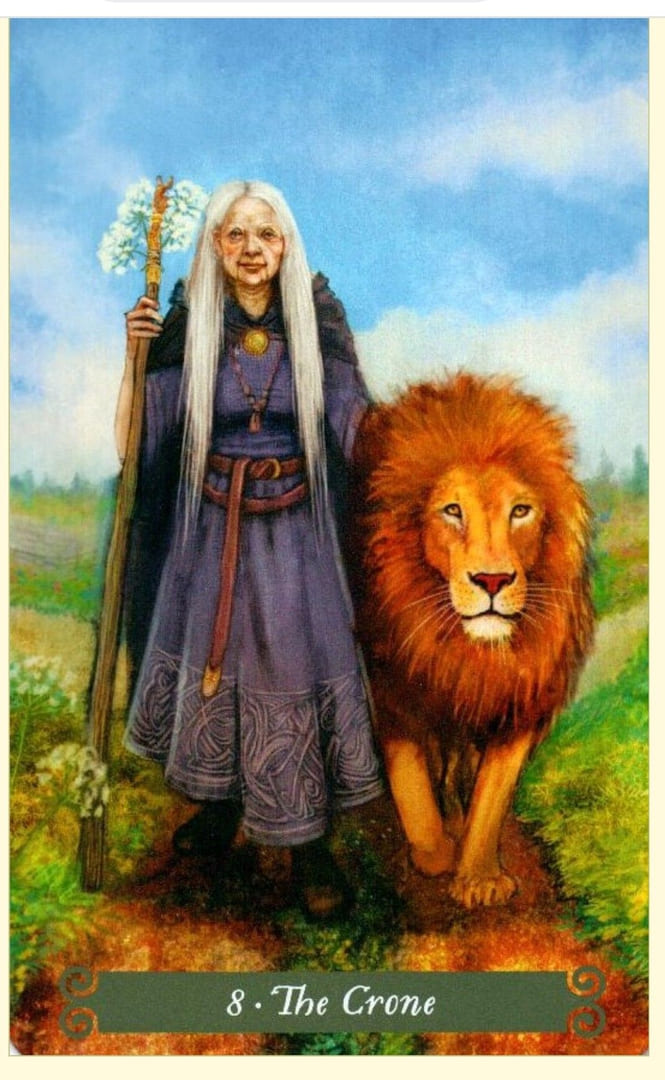
- Strength → The Crone — goddess wisdom in her elder aspect
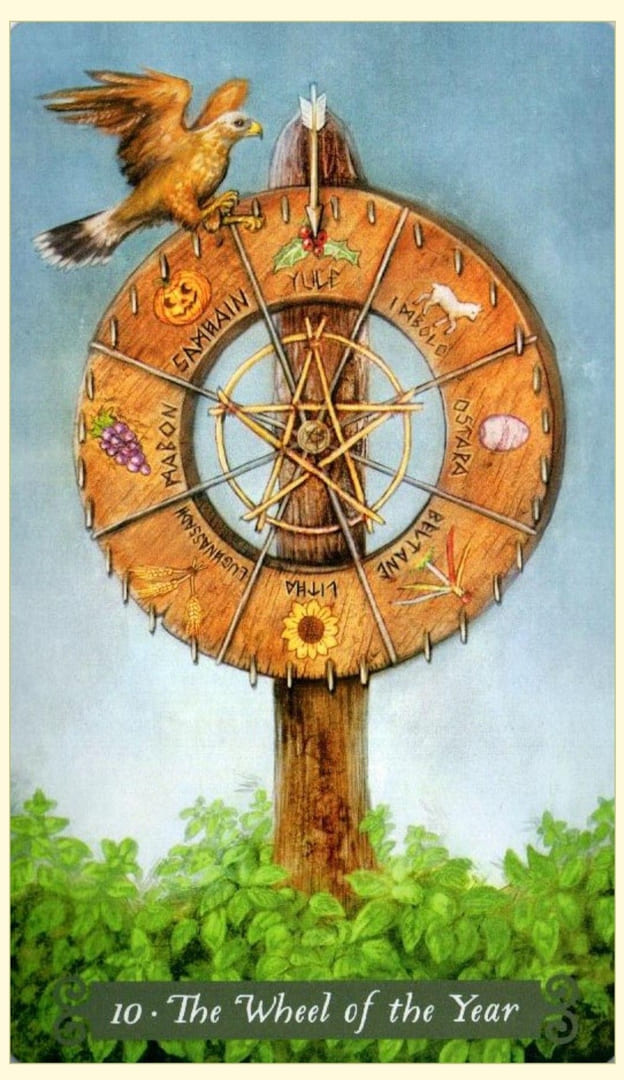
- Wheel of Fortune → Wheel of the Year — eight Sabbats instead of blind chance
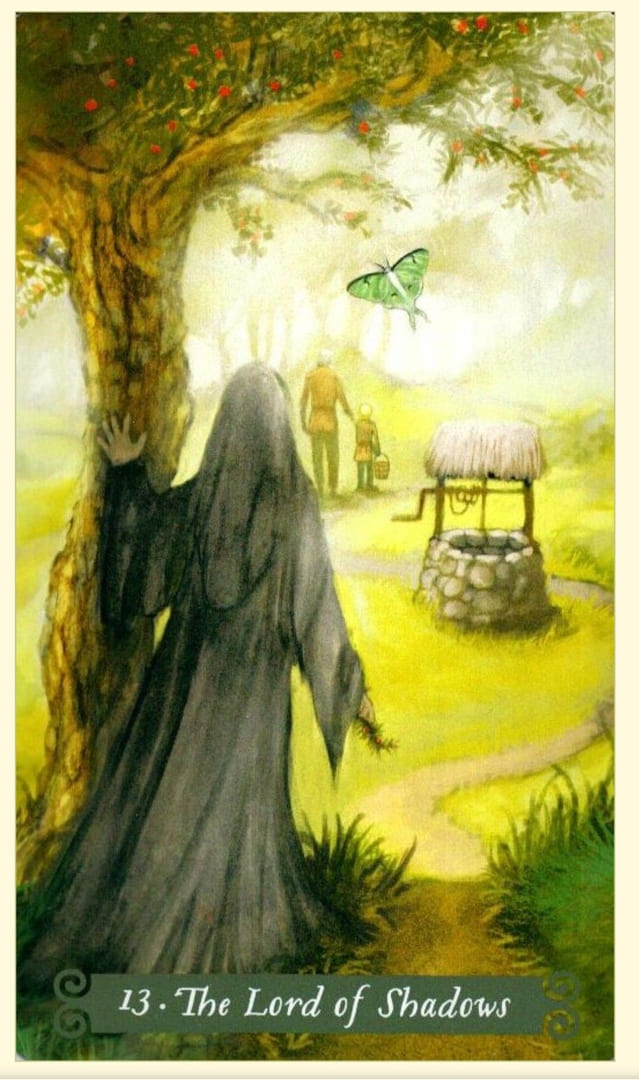
- Death → Lord of Shadows — gentle transition, not destruction
- The Devil → Nature — freedom of choice instead of enslavement
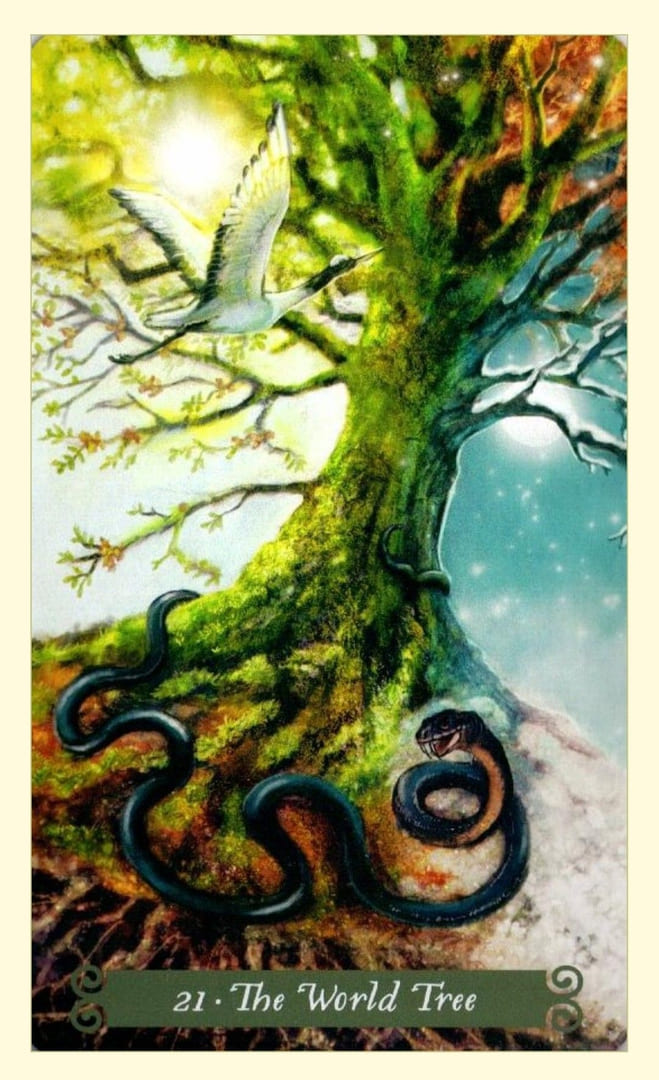
- The World → The World Tree — universal cycles, connection between realms
This isn’t cosmetic. When the Devil card becomes “Nature,” it stops frightening and starts asking: what limitations are you placing on yourself? When Death transforms into a quiet observer by a yew tree, transformation feels like a natural process rather than a blow.
Favorite cards
The Horned God (IV — The Emperor)
A bare-chested man with branching antlers stands surrounded by forest creatures — bear, fox, deer, badger. Ravens circle overhead, and red wild bergamot blooms at his feet. But notice: he doesn’t tower over the animals — they stand beside him as equals. That’s the essence of this pagan Emperor: authority through care, not through control.
The Crone (VIII — Strength)
One of the warmest cards in the deck. An elderly woman with long white hair in purple robes walks beside a golden lion — not taming him, just walking together, companions on the path. She carries a staff adorned with angelica flowers. This card reminds you: true strength isn’t aggression — it’s the quiet confidence that reassures everyone around you.
The Lord of Shadows (XIII — Death)
Perhaps the most beautiful reimagining of Death I’ve encountered. A dark cloaked figure stands by a yew tree heavy with red berries, leaning against the trunk. It doesn’t advance — it watches as a grandfather and grandchild walk toward the sunlight, carrying a full bucket of water from a stone well. A green luna moth flies from the shadows into the sun-drenched clearing. Transition, not ending.
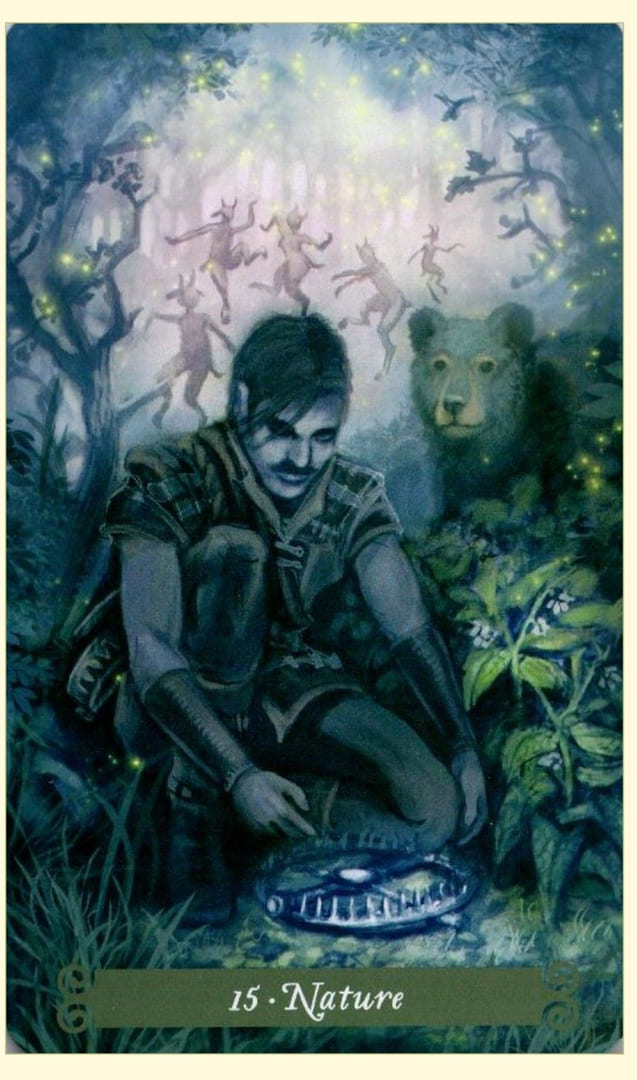
Nature (XV — The Devil)
Placed next to the Lord of Shadows, this card becomes even more striking. A hunter crouches in a dark forest, setting a metal trap — unaware that a bear watches from behind. In the misty distance, faun-like spirits dance among fireflies, beckoning toward freedom. The entire blue-green twilight scene poses a question: are you the one setting the traps you’re caught in? And are you ready to dance?
The Wheel of the Year (X — Wheel of Fortune)
A rustic wooden wheel divided into eight segments, each labeled with a Sabbat name — Yule, Imbolc, Ostara, Beltane, Litha, Lughnasadh, Mabon, Samhain. A pentacle sits at the center, the arrow pointing to Yule — the moment of transition from darkness to light. A hawk soars nearby, basil grows at the base. Instead of impersonal Fortune — the rhythm of nature itself.
The World Tree (XXI — The World)
A mighty ash tree whose branches span the entire card. The left side shows spring and summer: green foliage, bright sun, a white crane flying through the light. The right — autumn and winter: bare branches, the moon, snowflakes. A dark serpent of wisdom coils around the roots. “As above, so below” — literally rendered. When this card appears, it tells you: the cycle is complete, and you stand at the threshold of something new.
How to work with this deck
The Green Witch Tarot reveals itself best when you work with it in rhythm with nature:
- Card of the day — draw one each morning and reflect on it through the lens of the current season. The Wheel of the Year reads very differently at Yule than at Litha
- Seasonal spreads — create a spread for each Sabbat to explore the coming period. The companion book offers meditations for every season
- Herb work — every card features a symbolic plant. Study them: wormwood for The Green Man, bergamot for The Horned God, angelica for The Crone, basil for The Wheel of the Year
- Pairing — this deck pairs beautifully with nature-themed oracles for an additional layer of insight
Who is this deck for
If you practice Wicca, Green Witchcraft, or simply feel drawn to pagan philosophy — this could become your primary working deck. It speaks your language, and familiar spreads will take on new depth.
If you’re brand new to tarot — I wouldn’t recommend starting here. The renamed Arcana will create confusion when you’re learning from books based on the Rider-Waite system. Better to master the basics first, then come back.
But if you’re already confident reading classic tarot and looking for a deck with a different lens — this is an excellent choice. Familiar archetypes open up through nature, seasons, and mythology, and that freshness revitalizes your practice.
An honest downside: the renaming does throw you off sometimes. The energy of “Nature” is fundamentally different from the energy of “The Devil.” When “Strength” becomes “The Crone,” you have to rebuild your associations. For some that’s a feature; for others, a barrier.
Deck pairings
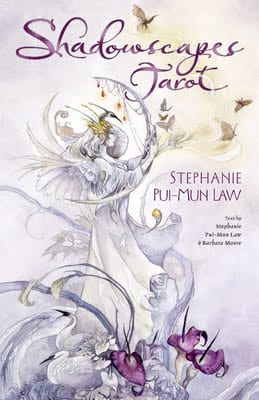
- Shadowscapes Tarot — if you love the nature themes of the Green Witch but want a more ethereal, fantasy aesthetic, Shadowscapes makes a beautiful companion
- Forest of Enchantment Tarot — another woodland deck, but focused on fairy tales and forest myths rather than witchcraft practice. Together they create a complete picture of forest magic
- Everyday Witch Tarot — a lighter, more playful witch deck. If Green Witch is for serious work, Everyday Witch is for daily questions and lighthearted moments
Try The Green Witch Tarot in our app — Elvi Tarot 🌿
Frequently Asked Questions
Is The Green Witch Tarot good for beginners?
It's better suited for readers already familiar with the Rider-Waite system. Nearly all Major Arcana are renamed (The Fool becomes The Green Man, The Devil becomes Nature), which can be confusing without a solid foundation.
How many cards are in The Green Witch Tarot?
78 cards — 22 Major Arcana and 56 Minor Arcana. The structure is standard, but two suits are renamed: Swords become Athames and Cups become Chalices.
What are the main themes of The Green Witch Tarot?
Green Witchcraft, the Wheel of the Year and its eight Sabbats, herbalism, Celtic mythology, and a deep connection to the natural world. Every card is infused with pagan philosophy.
How does The Green Witch Tarot differ from the Rider-Waite?
All Major Arcana are reimagined through a pagan lens: The Emperor becomes The Horned God, Strength becomes The Crone, Death becomes The Lord of Shadows, The World becomes The World Tree. Christian symbolism is replaced entirely.