Thoth Tarot Explained: Aleister Crowley's Controversial Deck
The deck people argue about
Every tarot community eventually has the Thoth conversation. Someone mentions Crowley’s deck, and the room divides. Half the people light up — they’ve found something in the Thoth that no other deck gives them. The other half recoil — they can’t separate the deck from the man, or they find it impenetrably dense.
Both reactions are reasonable. The Thoth tarot is simultaneously one of the most brilliant and most difficult decks ever created. It rewards deep study more than almost any other tarot system. It also demands more from the reader than most are prepared to give.
This guide explains what the Thoth actually is, how it works, and why it matters — without requiring you to have an opinion about Aleister Crowley as a person.
The creation story
Crowley and Harris
The Thoth deck was created between 1938 and 1943 through a collaboration between Aleister Crowley and Lady Frieda Harris. Crowley provided the symbolic framework — detailed instructions for every card based on his decades of esoteric study. Harris, an accomplished artist with no prior interest in the occult, painted them.
What was supposed to be a six-month project became a five-year obsession. Harris repainted many cards multiple times — some went through dozens of versions — as she and Crowley refined the visual expression of increasingly complex ideas.
The result is visually unlike any tarot before or since. Harris’s painting style was influenced by projective synthetic geometry and Futurism, giving the cards a dynamic, almost mathematical quality that perfectly suits their intellectual content.
Publication history
Crowley died in 1947 without seeing the deck published. Harris died in 1962. The Thoth was finally published in 1969 — over two decades after its creation — and has been in continuous print ever since.
This delayed publication means the Thoth entered tarot culture during the counterculture era, when interest in esoteric traditions was exploding. It found an audience ready for it.
What makes Thoth different
Renamed cards
The Thoth renames several Major Arcana cards, and these aren’t just cosmetic changes — they reflect different philosophical positions:
- Strength → Lust — Where Waite saw gentle mastery of the animal self, Crowley saw the ecstatic embrace of primal energy. Lust isn’t about sexual desire (though it includes that) — it’s about passion for life itself.
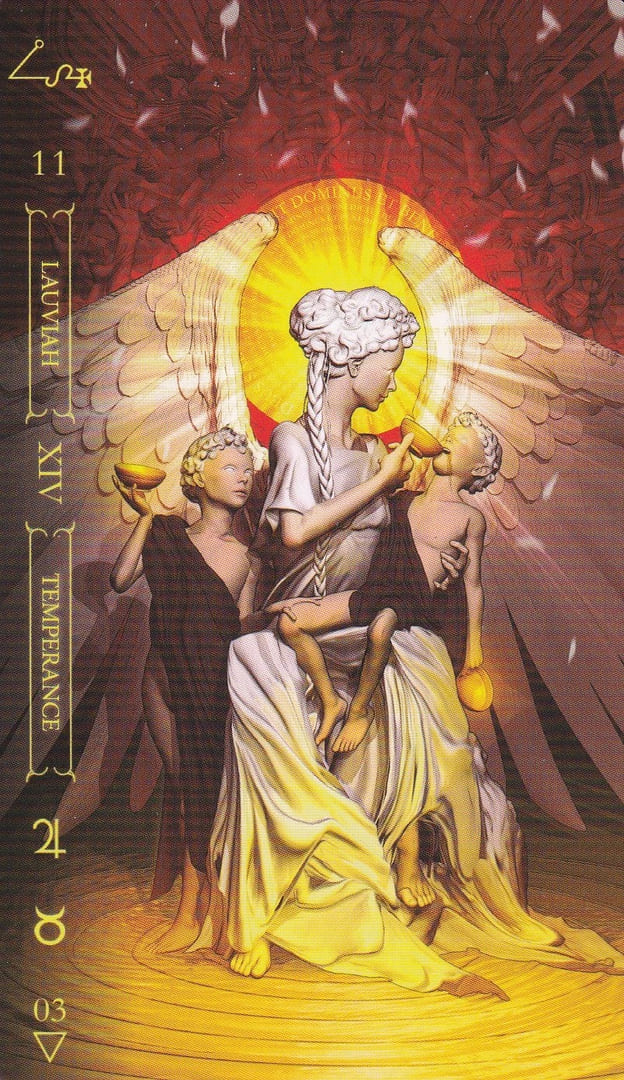
- Temperance → Art — Where Waite emphasized balance and moderation, Crowley saw active alchemical transformation. Art is the process of combining opposites to create something new.
- Judgement → The Aeon — Where Waite depicted the Christian Last Judgement, Crowley depicted the dawning of a new spiritual age (the Aeon of Horus in his Thelemic system).
- The World → The Universe — Expanding the concept from earthly completion to cosmic totality.
Court cards
The Thoth replaces the traditional Page-Knight-Queen-King system with Princess-Prince-Queen-Knight:
- Princess = Earth, the material manifestation
- Prince = Air, the intellectual force
- Queen = Water, the emotional depth
- Knight = Fire, the active will
This isn’t arbitrary. It reflects Crowley’s elemental system where each court card embodies a specific element within its suit’s element, creating sixteen unique elemental combinations.
Pip cards
Like the Marseille and unlike the RWS, Thoth pip cards don’t show narrative scenes with human figures. Instead, they’re abstract compositions of suit symbols, colors, and geometric patterns.
But unlike the Marseille, they’re not simple arrangements. Each pip card is a complex painting that visually expresses its meaning through color, form, and dynamic energy. The Five of Disks (“Worry”) looks heavy, constrained, and troubled. The Six of Cups (“Pleasure”) flows with warm, balanced harmony.
Each pip card also carries a keyword — Dominion, Love, Abundance, Strife, Pleasure, Science, Valor, Swiftness — that gives the reader an immediate interpretive anchor.
The intellectual framework
Kabbalah
Like the Golden Dawn system it inherits, the Thoth maps every card to the Kabbalistic Tree of Life. But Crowley took this further than Waite, making the Kabbalistic structure more visible and central to interpretation.
Each pip card corresponds to a Sephirah. Each Major Arcana corresponds to a path. Each court card corresponds to an elemental combination. Nothing in the Thoth is arbitrary — every design choice connects to this underlying architecture.
Astrology
Every card in the Thoth carries an astrological attribution:
- Major Arcana correspond to planets, zodiac signs, or elements
- Pip cards correspond to specific decanates (10-degree segments of the zodiac)
- Court cards correspond to zodiac quadrants
This means you can read the Thoth as an astrological chart as well as a tarot spread — or use both systems simultaneously.
Thelema
Crowley’s personal religion, Thelema, pervades the deck. The central principle — “Do what thou wilt shall be the whole of the Law” — isn’t about doing whatever you want. It’s about discovering and fulfilling your true purpose (your “True Will”).
This philosophy shapes how the cards are interpreted. The Thoth doesn’t offer comfort or reassurance the way some modern decks do. It asks: are you living according to your true nature? If not, what’s in the way?
How to read the Thoth
Start with the keywords
Every pip card has a keyword printed on it. Start there. “Interference” (Eight of Swords), “Happiness” (Nine of Cups), “Ruin” (Ten of Swords). These aren’t suggestions — they’re precise labels that Crowley assigned based on the card’s Kabbalistic and astrological position.
Use the colors
Harris’s color choices follow the Golden Dawn’s color scale system. The dominant colors in each card carry specific elemental and Sephirotic meanings. You don’t need to memorize the entire color scale, but noticing which colors dominate a card tells you something about its energy.
Read the geometry
The shapes and lines in Thoth cards aren’t decorative. Intersecting lines suggest conflict or interaction. Spirals suggest evolution. Balanced compositions suggest harmony. The visual dynamics of the card mirror its meaning.
Respect the system
The Thoth rewards systematic study more than intuitive improvisation. While you can certainly read it intuitively — Harris’s paintings are powerful on a purely visual level — the deck was designed as a complete esoteric system. The more of that system you understand, the more each card reveals.
Thoth vs RWS: which should you use?
This isn’t really a competition. They’re different tools for different purposes.
Choose RWS if you:
- Want illustrated scenes that tell stories
- Prefer intuitive, image-based reading
- Are interested in psychological and emotional exploration
- Want the widest selection of guidebooks and learning resources
Choose Thoth if you:
- Want a deck with deep esoteric structure
- Are interested in Kabbalah, astrology, and ceremonial magic
- Prefer abstract imagery that doesn’t predetermine interpretation
- Want to challenge yourself intellectually as a reader
Many serious readers use both — RWS for narrative, psychologically-oriented readings and Thoth for esoteric, structurally-oriented work.
The Crowley question
You don’t have to admire Crowley to use his deck. Plenty of excellent Thoth readers find the man personally objectionable and the deck intellectually magnificent. These aren’t contradictory positions.
The Thoth tarot is bigger than its creator. It synthesizes centuries of Western esoteric tradition — Kabbalah, astrology, alchemy, ceremonial magic — into a coherent visual system. That synthesis is Crowley’s achievement, but the traditions it draws from belong to no single person.
Use the deck if it speaks to you. Leave it if it doesn’t. The cards don’t care about your opinion of the person who designed them. They care whether you’re willing to do the work.
Frequently Asked Questions
What is the Thoth tarot deck?
The Thoth tarot is a 78-card deck designed by Aleister Crowley and painted by Lady Frieda Harris between 1938 and 1943. It's one of the three most influential tarot decks alongside the Rider-Waite-Smith and the Tarot de Marseille. The Thoth deck encodes Crowley's personal magical philosophy, Kabbalistic correspondences, astrological associations, and elements of his religion Thelema into densely layered, visually intense artwork.
Is the Thoth tarot good for beginners?
Generally no. The Thoth deck is designed for readers who already have a foundation in tarot and are ready to explore esoteric symbolism in depth. The card imagery is abstract and symbolic rather than narrative, and many cards carry meanings that differ significantly from Rider-Waite-Smith conventions. Most teachers recommend learning with RWS first and approaching Thoth once you have solid reading experience.
How does Thoth tarot differ from Rider-Waite-Smith?
Several key differences: Thoth renames Strength to 'Lust' and Temperance to 'Art.' The court cards are Princess, Prince, Queen, and Knight instead of Page, Knight, Queen, King. The pip cards are abstract and geometric rather than illustrated with scenes. And the entire deck is organized around Crowley's Thelemic philosophy rather than Waite's Christian mysticism.
Why is Aleister Crowley controversial?
Crowley cultivated a deliberately provocative public persona, calling himself 'The Great Beast 666.' He was a ceremonial magician, drug experimenter, and social provocateur in early 20th-century Britain. His personal life was genuinely troubled. But his contributions to Western esotericism — including the Thoth tarot — are scholarly and sophisticated, separate from his public persona.