What Is Mabon? Tarot and the Autumn Equinox
The day the scales tip
There is a single day each autumn when the light and the dark weigh exactly the same. Not approximately. Not roughly. Exactly. Twelve hours of daylight. Twelve hours of night. The scales balanced to the grain.
And then — between one breath and the next — the dark begins to win.
That day is Mabon.
Mabon (pronounced MAY-bon) falls on the Autumn Equinox — September 20th, 21st, 22nd, or 23rd, depending on the year — and it is the second of three harvest festivals on the Wheel of the Year. Where Lammas celebrated the first grain cut in the height of summer, Mabon celebrates the full harvest: fruit heavy on the branch, wine in the press, cellars filling for winter. And behind all that abundance stands a truth you can feel in the cooling air: the light is leaving. The dark half of the year begins today.
For those of us who read tarot, Mabon is the most balanced moment of the year — and the most honest. The cards at the equinox do not flatter or frighten. They weigh. They show you what has grown, what must be released, and what you carry into the dark. Like the equinox itself, they give you exactly equal measures of truth and tenderness.
The ancient roots of Mabon
The Autumn Equinox has been celebrated for thousands of years. Ancient peoples tracked the sun’s path with precision — Stonehenge, Newgrange, and the temple at Mnajdra in Malta all mark equinox alignments. The equinox was a practical milestone: from this day forward, the nights would be longer than the days. Time to finish the harvest. Time to prepare.
The name “Mabon” is newer. It was adopted in the 1970s by Aidan Kelly, a Wiccan writer, who named the sabbat after Mabon ap Modron — a figure from Welsh mythology. Mabon was a divine youth stolen from his mother as a baby, imprisoned in an otherworldly fortress, and eventually rescued by King Arthur’s warriors. His story is one of loss, searching, and return — themes that mirror the season itself. At the equinox, Persephone descends to the underworld in Greek mythology, and the land mourns her absence with winter. At Mabon, what was taken into the dark will eventually return — but not yet.
In folk traditions across Europe, the autumn equinox was marked with harvest feasts, apple pressing, wine making, and the gathering of the final fruits before the first frost. In many communities, the last sheaf of grain was woven into a corn dolly — a symbolic figure that would be kept through winter and planted with the new seed in spring, carrying the harvest spirit from one year to the next.
What Mabon means spiritually
Mabon sits directly opposite Ostara (the Spring Equinox) on the Wheel of the Year. Both are moments of perfect balance — but where Ostara balances on the upswing (light returning, growth beginning), Mabon balances on the downswing (light departing, rest approaching). If Ostara is the inhale that says yes, I will grow, Mabon is the exhale that says yes, I can let go.
Balance — the last moment of equal light and dark
The equinox is the only day when the sun rises exactly due east and sets exactly due west, everywhere on earth. For one day, the whole planet shares the same proportion of light and dark. This is not a metaphor — it is an astronomical event that you can feel in your body.
Mabon asks: where in your life are you balanced? Where are you not? What has too much weight? What has too little? The equinox will not solve these questions for you, but it will illuminate them with perfect, equal light.
The second harvest — gathering what remains
Lammas was the grain harvest — the first, most urgent cutting. Mabon is the fruit harvest — apples, grapes, pears, squash, root vegetables. Where Lammas felt triumphant (look what grew!), Mabon feels deeper, quieter, more complex. This is the harvest that requires patience. Fruit ripens slowly. Wine takes time. The best things of autumn were not rushed.
Gratitude and release — holding both
Mabon’s most profound teaching is that gratitude and letting go are not separate acts. They are the same gesture. You cannot be truly grateful for the harvest unless you are willing to let the garden die. You cannot truly release the summer unless you acknowledge what it gave you.
This is why Mabon is sometimes called the Witch’s Thanksgiving — not just for the feasting, but for the spiritual practice of naming what you received and then opening your hands to release it into the turning wheel.
Descent — preparing for the dark
In the Persephone myth, the equinox marks her descent into the underworld. The earth grows cold in her mother Demeter’s grief. At Mabon, we begin our own descent — not into literal darkness, but into the introspective half of the year. The outward energy of summer (doing, building, growing) shifts to the inward energy of winter (reflecting, resting, composting).
This is not something to dread. It is something to prepare for — like putting on a warm coat before stepping outside. Mabon asks: what do you want to carry into the dark? What will sustain you when the light is scarce?
How to celebrate Mabon today
You do not need a vineyard or an apple orchard. Mabon lives wherever balance, gratitude, and honest letting go meet.
Create a gratitude feast. Mabon’s feast is the Witch’s Thanksgiving. Cook with seasonal ingredients — apples, squash, root vegetables, grapes, nuts, bread, cider. Set a beautiful table. Before eating, name what you are grateful for — one specific thing from each season of the year so far.
Walk and gather. September is rich with gifts. Pick apples, gather fallen leaves, collect acorns or pinecones. Bring something from outside onto your altar or table. Let the season’s beauty be visible in your home.
Balance something. The equinox is about balance. Choose one area of your life that feels unequal and take one small step toward equilibrium. Too much work, not enough rest? Rest today. Too much giving, not enough receiving? Receive something today.
Release something. Write what you are ready to let go of on a leaf and bury it, or drop it into moving water. The earth knows how to compost. Give it your old fears, expired beliefs, and finished chapters.
Light two candles — one dark, one light. Place them side by side. This is the equinox: equal, balanced, holding both. Let them burn together and notice how neither overpowers the other.
Press or pour something. Make apple cider, mulled wine, or herbal tea. The act of pressing fruit into drink is pure Mabon — transformation through pressure, sweetness from patience.
Mabon correspondences
| Element | Correspondences |
|---|---|
| Colors | Deep red, orange, brown, gold, dark green, burgundy, copper |
| Herbs | Apple, sage, rosemary, chamomile, marigold, hops, hazel |
| Stones | Amber, lapis lazuli, sapphire, smoky quartz, carnelian |
| Element | Earth and Water (balanced, like the equinox) |
| Direction | West |
| Animals | Owl, stag, crow, salmon, spider |
| Foods | Apples, grapes, squash, nuts, bread, cider, wine, root vegetables |
| Themes | Balance, second harvest, gratitude, release, descent, preparation, Persephone |
Mabon and tarot — the cards of balance and harvest
If Lammas grounded the deck in Pentacles, Mabon brings the Major Arcana into focus. This is a sabbat of big themes — balance, death, transformation, the turning of the wheel — and the Major Arcana carries those themes in their bones.
Cards that carry Mabon energy
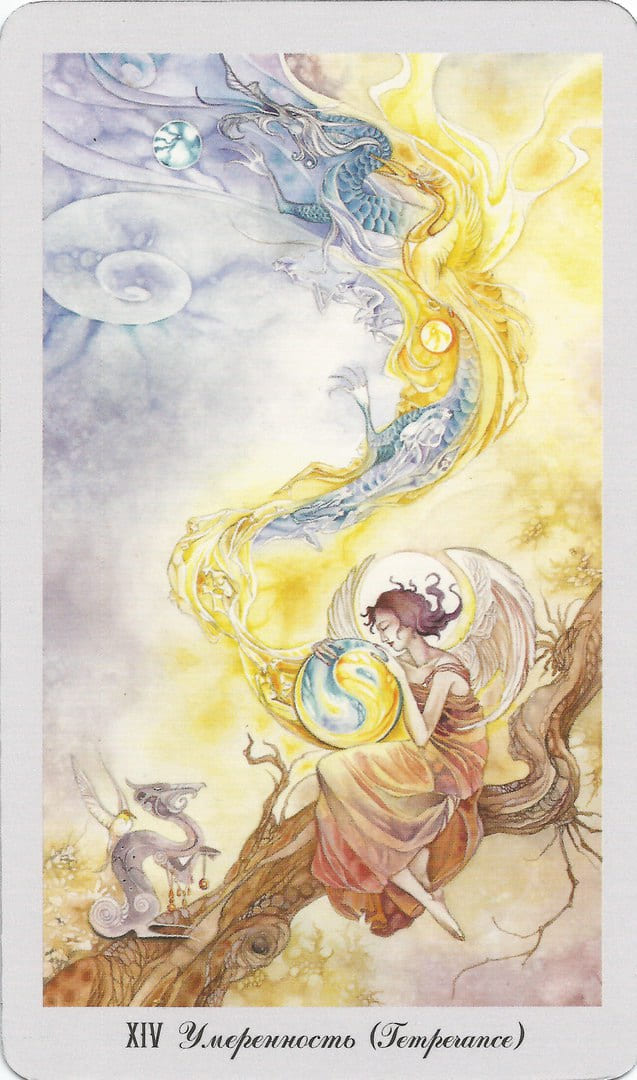
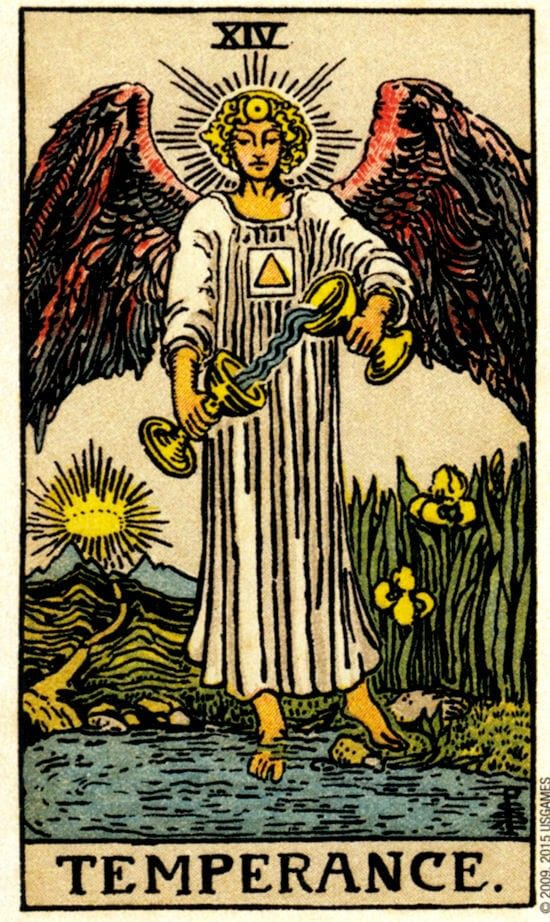
Temperance — The equinox card. Two vessels pouring between them, perfectly balanced. Temperance at Mabon says: this is the moment of perfect equilibrium. Stand in it. Feel what balance actually feels like before the scales tip.
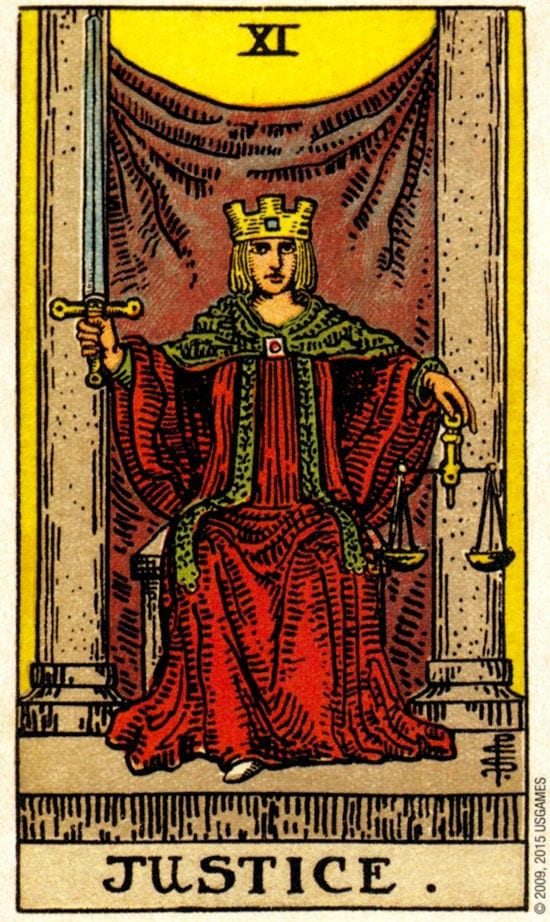
Justice — The other balance card, but sharper. Justice weighs without sentiment. At Mabon, Justice asks: what is fair? What has earned its place in your life, and what has overstayed? The equinox does not negotiate. It divides equally.
The Hanged Man — Surrender, seeing from a different angle, the voluntary pause before transformation. At Mabon, The Hanged Man represents the willingness to let the old season end. You are not being punished. You are being invited to see things from the perspective of the descending year.
Death — Transformation, endings that feed beginnings. At Mabon, the garden is dying — and that death is what creates next year’s compost, next spring’s soil, next summer’s harvest. Death at the equinox is not an ending. It is the most necessary part of the cycle.
Wheel of Fortune — The wheel is turning. Literally. The Wheel of the Year and the Wheel of Fortune are the same teaching: everything changes, every season passes, what rises will fall, and what falls will rise again. At Mabon, the Wheel says: trust the turn.
Nine of Pentacles — The full harvest, standing in your abundance, surveying what you have built. At Mabon, this card carries the weight of a year’s work — everything you planted, tended, and gathered, now visible and yours.
A simple Mabon tarot practice
On the morning of the equinox — or any day that week — find a quiet place. Hold an apple (the quintessential Mabon fruit) in one hand and your deck in the other. Take a bite. Let the taste of autumn ground you. Then shuffle and pull three cards:
- What is in balance? — The area of my life where the scales are even
- What needs to be released? — What has served its purpose and is ready to return to the earth
- What do I carry into the dark? — The strength, lesson, or resource that sustains me through winter
Sit with each card. Let the apple sit on the table between them — the harvest witness to your reading. Mabon readings are best when you can taste the season while you read it.
The scales will tip
Mabon does not ask you to be brave. It does not ask you to fight the darkness or cling to the light. It asks something harder and simpler: to stand at the exact center of the year, feel both sides equally, and choose — with open eyes and a full heart — to let the wheel turn.
The harvest is gathered. The feast is set. The light and the dark hold hands for one perfect day.
And then — gently, inevitably, beautifully — the balance shifts.
Let it.
Frequently Asked Questions
When is Mabon celebrated?
Mabon is celebrated on the Autumn Equinox, which falls between September 20-23 in the Northern Hemisphere (most commonly September 22). It is the moment when day and night are equal in length — the last point of balance before the dark half of the year begins.
What is the difference between Mabon and Thanksgiving?
Mabon is sometimes called the 'Witch's Thanksgiving' because both center on harvest gratitude. But Mabon is specifically tied to the equinox — the astronomical moment of balance — and carries a spiritual dimension of releasing, preparing for darkness, and honoring the cycle of death and rebirth that Thanksgiving does not.
What tarot cards represent Mabon energy?
Temperance (balance at the equinox), Justice (equal weight of light and dark), The Hanged Man (surrender and letting go), Death (transformation as the year turns), and the Pentacles suit (material harvest). The Wheel of Fortune is also strongly Mabon — the wheel is turning.
Can I celebrate Mabon if I live in the Southern Hemisphere?
Yes, but your Autumn Equinox falls in March (around March 20). Follow the seasons where you actually live. When the Northern Hemisphere celebrates Mabon in September, the Southern Hemisphere is honoring the Spring Equinox (Ostara), and vice versa.