What Is Yule? Tarot and the Return of Light
The shortest day carries the longest promise
There is a morning in late December when you notice it: the light lasted a minute longer than yesterday. After weeks of darkness arriving earlier and earlier, something turned. The sun stopped retreating. It’s coming back.
This is Yule — the oldest celebration of the Winter Solstice, the moment when the darkest night of the year gives birth to the returning light. For thousands of years, humans have gathered around fires on this night, not because they didn’t understand astronomy, but because they understood something deeper: darkness has a limit, and light always returns.
What Yule actually is
Yule is one of the eight sabbats on the Wheel of the Year. It falls on the Winter Solstice — December 20-23 in the Northern Hemisphere, most commonly December 21. It’s the shortest day and longest night of the year: the absolute peak of darkness.
And that’s exactly why it’s a celebration. Because from this point forward, every day gets a little longer. The sun has been born again.
The word “Yule” comes from Old Norse jól, referring to the midwinter festival celebrated by Germanic and Nordic peoples. Historical Yule celebrations lasted up to twelve days (the origin of “the Twelve Days of Christmas”) and centered around feasting, storytelling, and fire — particularly the burning of the Yule log, a massive piece of wood kept burning through the darkest nights as a symbol of the returning sun.
The Oak King and the Holly King
One of the most enduring Yule myths is the battle between the Oak King and the Holly King — two aspects of the same divine masculine that rule opposite halves of the year.
The Holly King rules the waning year, from Litha (Summer Solstice) to Yule. He is darkness, rest, introspection, the inward turn. His symbols are holly, ivy, and evergreens — plants that stay green when everything else has died.
The Oak King rules the waxing year, from Yule to Litha. He is growth, light, expansion, the outward push. His symbols are oak leaves, acorns, and the rising sun.
At Yule, the Oak King defeats the Holly King, and the light begins its return. At Litha, the Holly King defeats the Oak King, and the dark half begins. Neither is good or evil — they are the two halves of a single cycle, each necessary for the other.
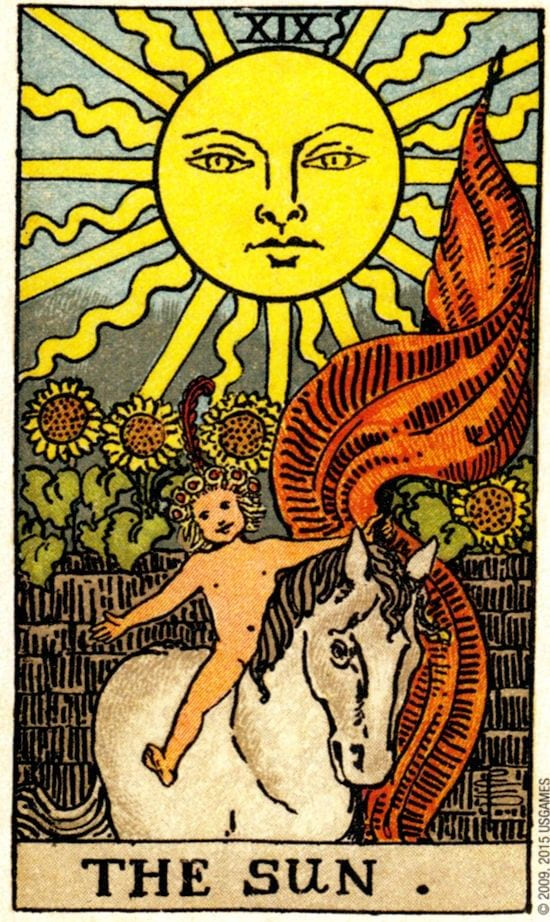
In tarot terms: the Holly King is The Hermit — withdrawn, wise, carrying his own light through the dark. The Oak King is The Sun — radiant, expansive, life-giving. At Yule, The Hermit steps aside and The Sun takes the first breath of its new reign.
The Goddess gives birth
In Wiccan mythology, Yule tells another story: the Goddess, who descended into the underworld at Samhain, gives birth to the Sun God at the Winter Solstice. The child is small and fragile — the light is barely visible — but it’s real. The wheel has turned.
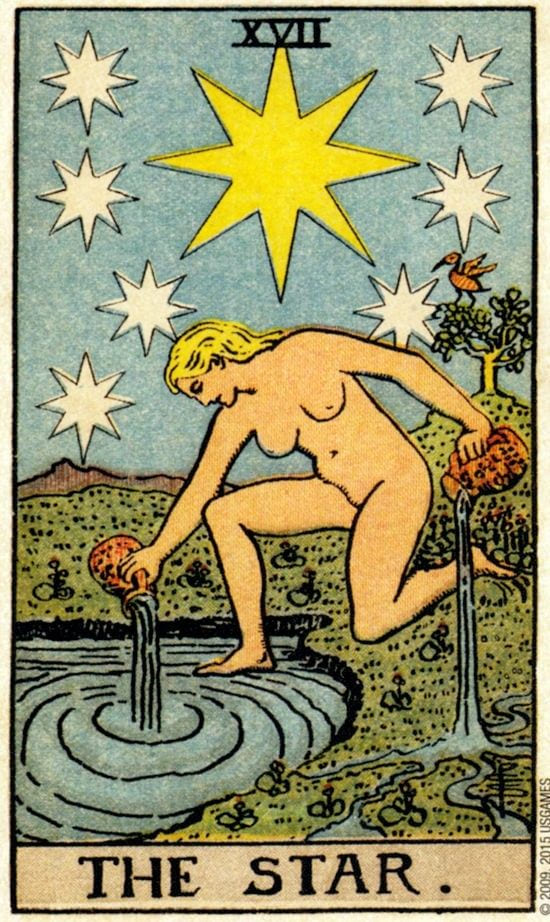
This mirrors The Star in tarot: after the destruction of The Tower (which aligns with Samhain’s energy), The Star offers the first glimmer of hope. Not a blazing triumph — just a quiet light in the darkness, saying: it’s not over. Something new is here.
What Yule means on the Wheel
Yule sits opposite Litha (Summer Solstice) on the Wheel. Where Litha is maximum light — peak power, abundance, full expression — Yule is the seed point. Everything is potential. Nothing is yet manifest.
After Yule comes Imbolc (February 1), when the first stirrings of spring become visible. Then Ostara (Spring Equinox), when light and dark balance. The arc from Yule to Litha is the arc of growth itself — from seed to full bloom.
Yule teaches: the most powerful beginnings happen in darkness. Seeds germinate underground. Ideas form in silence. The sun is reborn at midnight. If you’re in a dark season of life, Yule says: the light is already turning. You just can’t see it yet.
Yule and Christmas
Most Christmas traditions are borrowed from Yule and other solstice celebrations:
- The Christmas tree comes from the Yule tradition of bringing evergreens indoors — proof that life persists through winter
- The Yule log became the Bûche de Noël (a chocolate log cake) in France and the fireplace tradition elsewhere
- Gift-giving echoes the Norse tradition of exchanging presents during the Twelve Days of Yule
- Wreaths and garlands are Yule symbols of the eternal cycle — no beginning, no end
- December 25 was chosen as Christ’s birthday in the 4th century to coincide with existing solstice festivals (Sol Invictus, Saturnalia)
This doesn’t diminish Christmas — it deepens it. The same human impulse lives in both: to gather around light when the darkness is deepest, to celebrate hope when things seem bleakest.
Tarot cards that carry Yule energy
The Sun — the energy of what’s being born. At Yule, The Sun is an infant — small, fragile, but undeniable. The longest night is over. The light returns.
The Star — hope after darkness. The Star follows The Tower in the Major Arcana, just as Yule follows the dark descent of Samhain. Quiet, steady hope that doesn’t demand proof.
The Hermit — the wisdom of winter. The figure who carries his own lantern, who doesn’t need external light because he generates his own. Yule honors the Hermit’s season even as it begins the transition toward spring.
Ace of Pentacles — the seed in frozen ground. Material potential that hasn’t yet manifested but is absolutely real. Every Yule intention is an Ace of Pentacles: planted, waiting, germinating in the dark.
Wheel of Fortune — the turn itself. Yule is the bottom of the wheel — the nadir — and the moment of turning. From here, everything ascends.
How to honor Yule
- Light candles at sunset on the solstice. Watch the darkness come, then light against it. This is Yule in miniature.
- Bring evergreens indoors. Pine, holly, ivy, cedar — whatever grows green near you. They’re proof: life continues.
- Exchange small, meaningful gifts. Not commerce — connection. Something handmade, written, or chosen with thought.
- Pull cards. The solstice is a powerful moment for divination. The Wheel is turning — the cards reflect the shift.
- Stay up until dawn. If you can, watch the sunrise on December 22 — the first morning of the returning light. It will feel different.
A simple Yule card pull
At sunset on the solstice, light a candle and pull three cards:
- What the darkness taught me — the gift of the longest night
- What light is being born — the seed returning to the world
- What I carry into the waxing year — my offering to the growing light
Read slowly, by candlelight. Welcome whatever comes — Yule cards speak of small, true things.
Frequently Asked Questions
When is Yule celebrated?
Yule is celebrated on the Winter Solstice, which falls between December 20-23 in the Northern Hemisphere (most commonly December 21). It marks the shortest day and longest night of the year — and the moment the sun begins its return.
What is the difference between Yule and Christmas?
Christmas absorbed many Yule traditions — the tree, the wreath, gift-giving, the Yule log, even the date (December 25 was chosen to overlap with solstice celebrations). Yule predates Christmas by centuries and focuses on the rebirth of the sun rather than a specific religious narrative.
What tarot cards represent Yule energy?
The Sun (return of light), The Star (hope in darkness), The Hermit (solitary wisdom in winter), Ace of Pentacles (the seed in frozen ground), and the Wheel of Fortune (the turning point) are the cards most aligned with Yule.
Is Yule the pagan New Year?
In some traditions, yes — though most consider Samhain the New Year. Yule marks a different kind of beginning: the return of light after the longest darkness. It's less about endings and more about the first spark of what's coming.