The Alchemical Tarot: All 78 Card Meanings Explained
Every tarot deck carries a hidden lineage. The Alchemical Tarot makes that lineage visible — tracing the symbolic DNA of the cards back to the Renaissance alchemists, Hermetic philosophers, and engravers who shaped the very visual language tarot still speaks today.
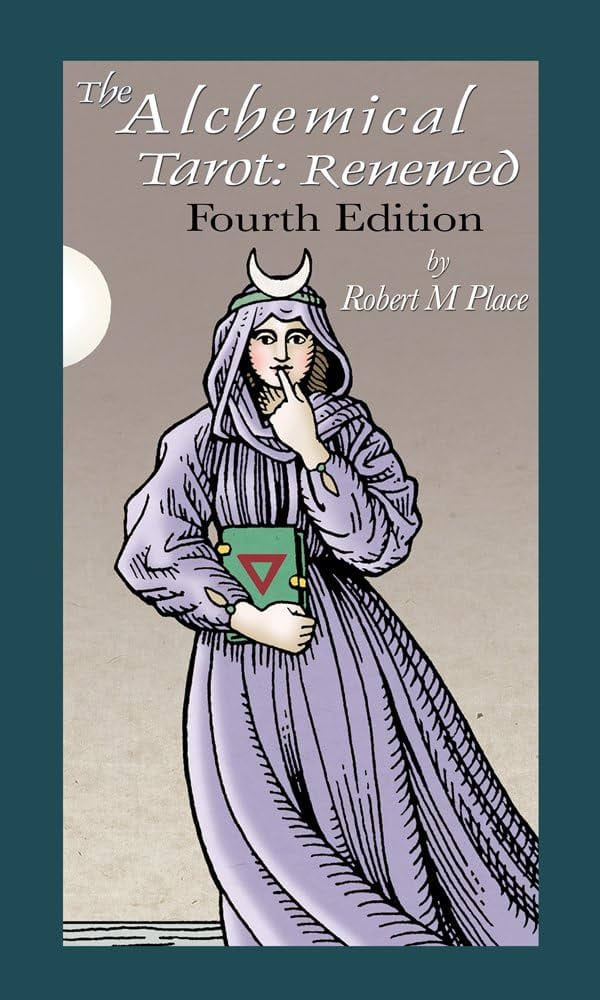
Created by Robert M. Place, artist, scholar, and one of the most respected tarot historians working today, The Alchemical Tarot is not a themed novelty. It is a thesis. Place’s central argument — developed across decades of research and several editions of this deck — is that tarot and alchemy are not separate traditions that happen to share some imagery. They are expressions of the same underlying symbolic system, one that maps the transformation of the soul through a sequence of stages the alchemists called the Magnum Opus, the Great Work. The Fool’s journey through the Major Arcana is, in this reading, the same journey as lead becoming gold: a process of dissolution, purification, and rebirth that every seeker undertakes whether they name it alchemy or not.
The artwork draws directly from Renaissance alchemical engravings and woodcuts, rendered in Place’s clean, precise illustrative style. There is nothing decorative here. Every symbol — the red king, the white queen, the ouroboros, the pelican feeding its young with its own blood — is placed with scholarly intention and artistic care.
How the Deck Is Organized
The Alchemical Tarot follows the classic 78-card tarot structure with alchemical suit names:
- Major Arcana (0–XXI): The 22 stages of the Great Work, from the raw potential of The Fool through the completed transformation of The World. Each card corresponds to a phase of alchemical transmutation — calcination, dissolution, conjunction, fermentation, and beyond.
- Staffs (traditionally Wands): The suit of fire. Will, ambition, creative force, and the primal heat that initiates every transformation in the alchemist’s athanor.
- Vessels (traditionally Cups): The suit of water. Emotion, intuition, the receptive principle, and the alchemical vessel in which raw material is dissolved and purified.
- Swords: The suit of air. Intellect, discernment, separation, and the analytical faculty that distinguishes truth from illusion — the alchemist’s capacity to cut through confusion.
- Coins (traditionally Pentacles): The suit of earth. Material reality, patience, craft, and the final stage where spiritual insight crystallizes into something tangible and enduring.
Each suit runs from Ace through Ten, followed by four court cards — Page, Knight, Queen, and King — for 14 cards per suit and 56 Minor Arcana total.
Major Arcana
The Fool
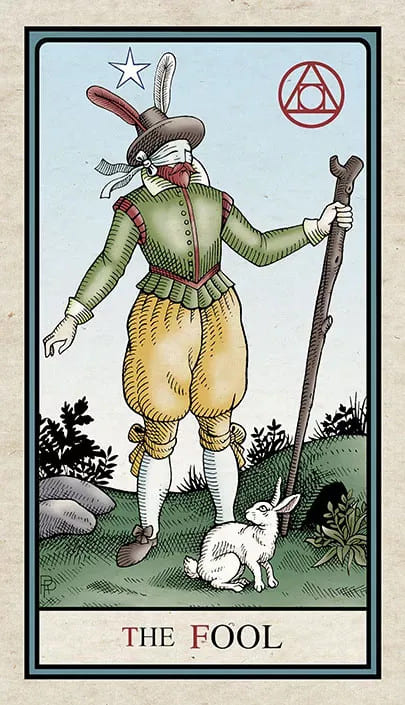
The Fool depicts the Alchemist at the outset of the Work, embodying the beginning of a transformative process. His blindfold equates to ignorance, signaling a lack of awareness as he steps forward. He is presented as a naive beginner whose guide is a rabbit, implying an instinctive or unexpected companion on the path. The card's symbol points to the squaring of the circle, a description of the Opus, tying the image to alchemical symbolism and the paradoxical aim of uniting opposites.
The Magician
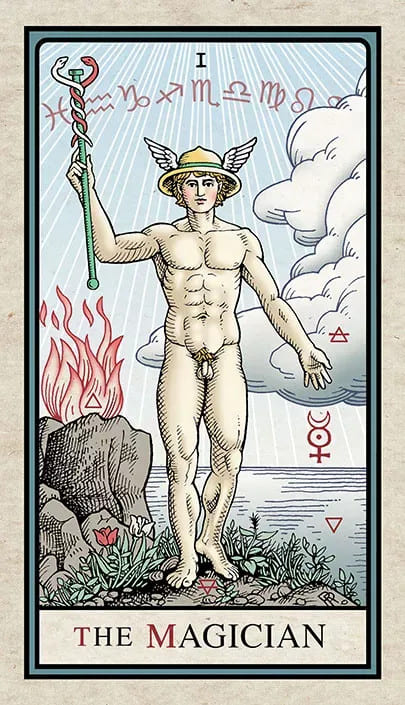
The Magician portrays Hermes, the god of alchemy and the Matter of the Work, situated among symbols of the four elements. Beneath his hand is the glyph for Mercury, composed of the Sun, the Moon, and the cross of matter, linking celestial and material forces. The zodiac signs in the sky represent the stages of the Opus, the alchemical process of transformation. As a messenger he gestures as above, so below, indicating that heavenly principles manifest on earth and that spiritual work is enacted in the material realm.
The High Priestess
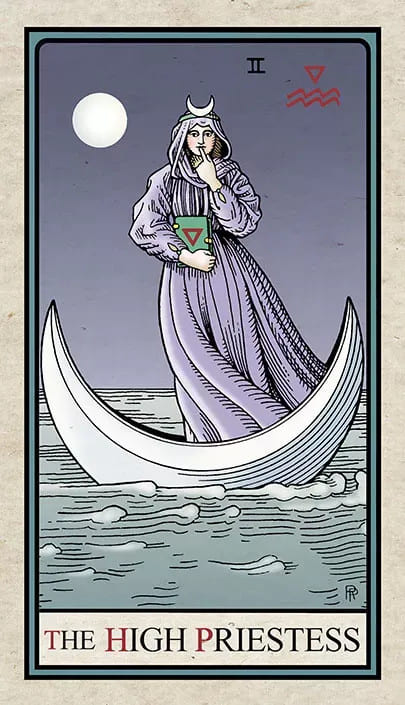
The High Priestess signifies the beginning of the separation of the elements, indicating a process of differentiation. Her book bears the triangle for Water, though it is the color of Fire, highlighting a symbolic inversion of elemental qualities. Her symbol represents Water being separated from Solution, pointing to an aspect withdrawn from obvious understanding. She embodies Water, esoteric spirituality, intuition, and a secret or something that cannot be spoken.
The Empress
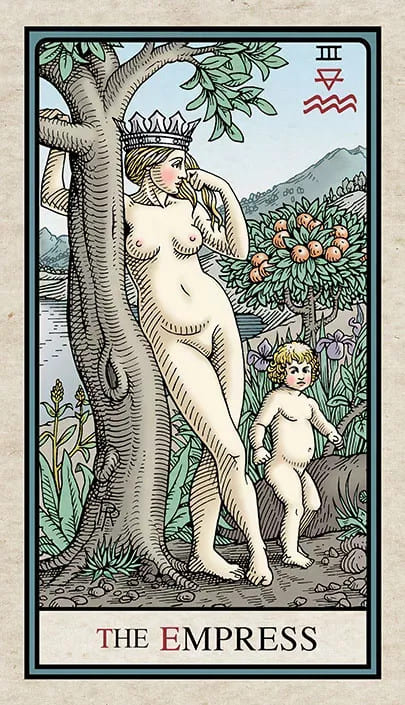
The Empress embodies the White Queen archetype and the element of Earth, representing grounded, nurturing feminine energy. Her symbol indicates Earth being separated from Solution, suggesting a contrast between material life and resolution. She signifies sensation, attraction, fertility, and the feminine, emphasizing creativity, growth, and sensual presence. In readings she encourages embracing abundance, fertility of ideas or life, and the nurturing aspects of self and relationships.
The Emperor
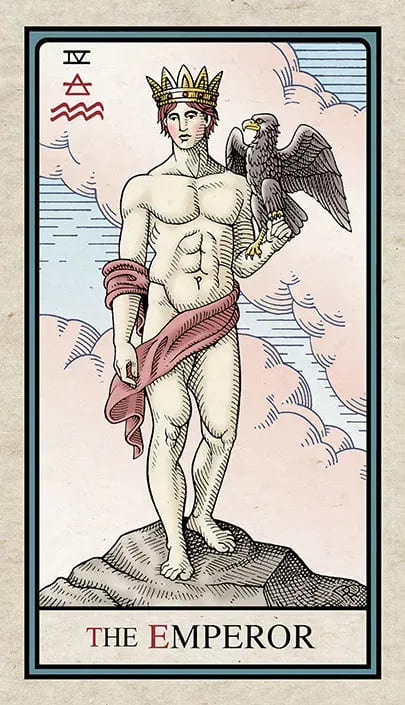
The Emperor embodies structure, rationality, and leadership, associated with the Red King and the element of Air. His symbol suggests Air being separated from Solution, highlighting analytical clarity and a degree of detachment. He signifies thinking, intelligence, authority, and the masculine principle. The card points toward the application of reason, decisive governance, and orderly control.
The Hierophant
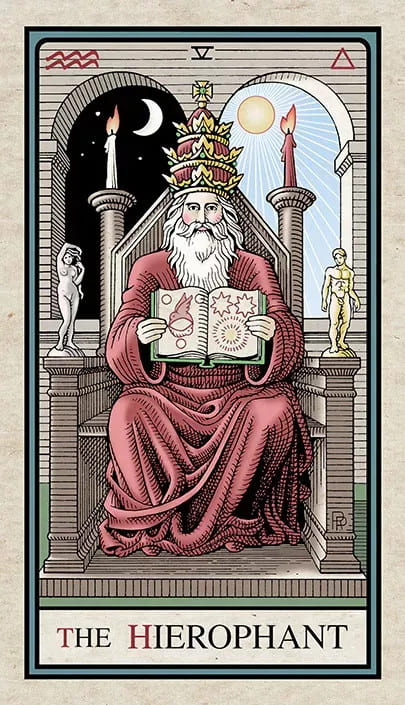
The Hierophant embodies the principle of Fire and exoteric spirituality, personified as Hermes Trismegistus holding the Emerald Tablet. The card's imagery places feminine symbols on the left and masculine symbols on the right, indicating a polarity of forces. His symbol of Fire being separated from Solution emphasizes a distinction between active principle and medium. He governs what can be spoken, taught, or published and represents communal morals and teachings.
The Lovers
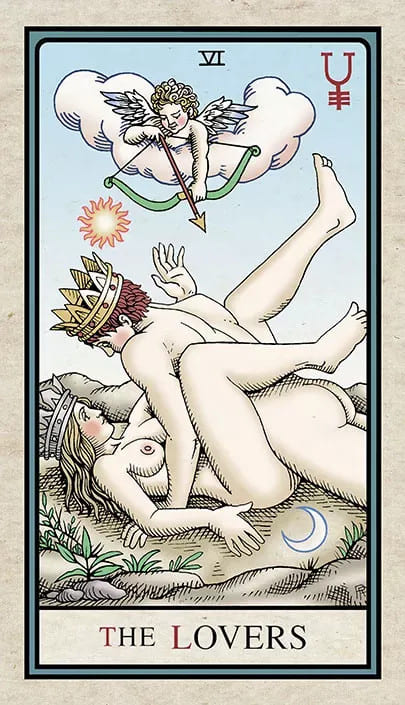
The Lovers signifies the active force of Love and the recombination of elements in a Minor Conjunction. Its symbol, Conjunction, emphasizes union and the blending of distinct forces. The card points to sex, attraction, and the coming together of individuals. It highlights partnership, intimacy, and the formation of meaningful bonds.
The Chariot
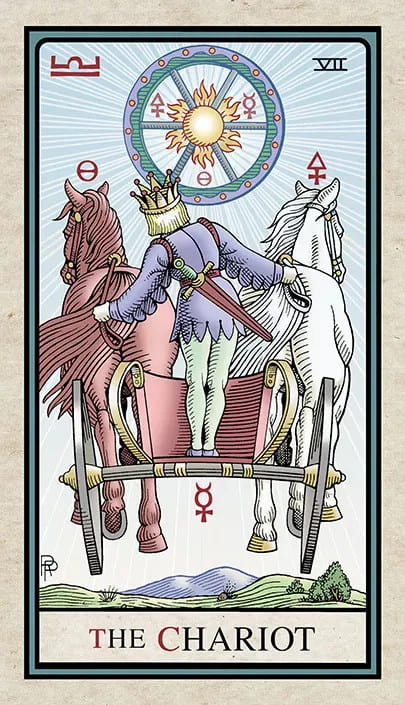
The Chariot signifies sublimation and a focused aim, with the wheel and its internal sun representing the goal toward which energy is directed. The wheel bears three glyphs—Sulphur, Salt, and Mercury—which correspond to aspects or parts of the Chariot and the alchemical essences involved in transformation. His corner symbol reinforces the theme of sublimation. The card also embodies motion and urgency, conveying speed, impatience, and travel.
Strength
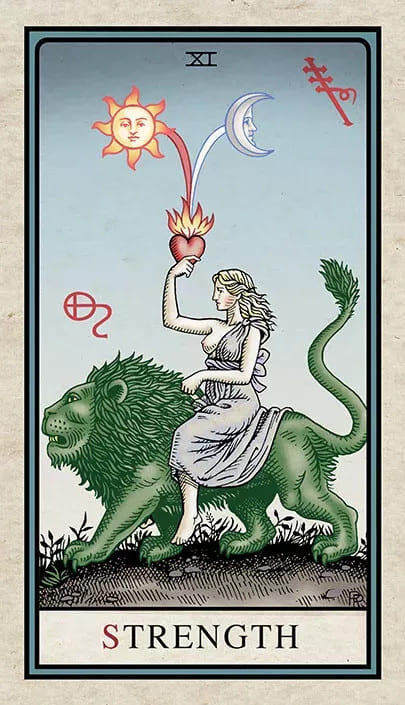
The Strength card symbolizes fermentation and the power of a guiding female virtue to control destructive forces. The destructive aspect is personified as the Green Lion, identified with Mercury. The imagery places the symbol for Fermentation at the top and the Green Lion below, emphasizing transformation. Ultimately, Strength teaches control through love and self-discipline.
The Hermit
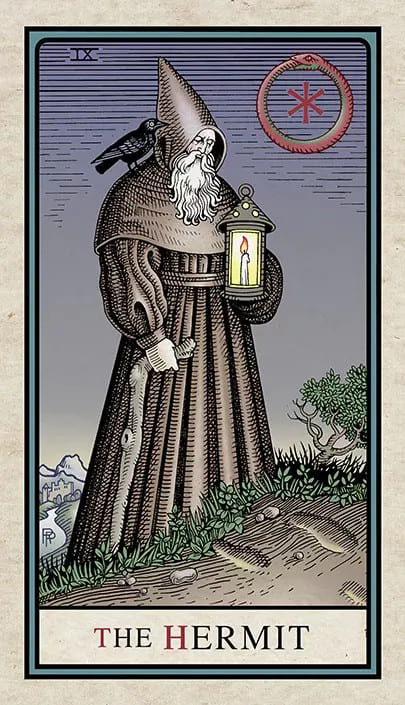
The Hermit signifies exaltation and a spiritual pursuit of transformation, with the alchemist following the footsteps of the Anima Mundi. The ouroboros in the sky represents the serpent of time and the cycle that contains the symbol for Exaltation. The raven stands for the Nigredo, the first black stage of the Opus, pointing to an initial dark phase necessary for inner work. Overall, the card emphasizes meditation, solitude, and inner guidance as the path to revelation and alchemical progress.
Wheel of Fortune
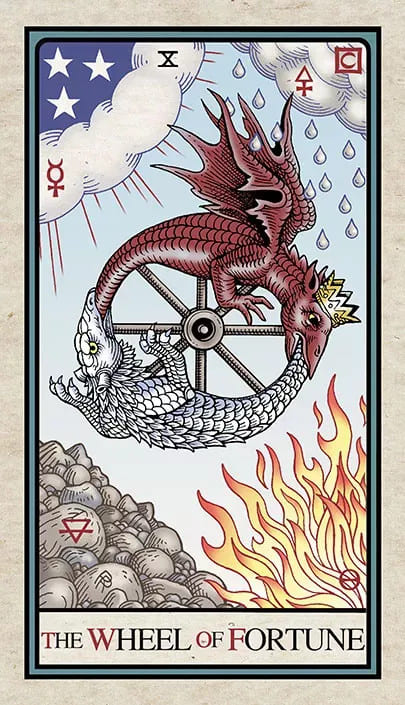
The Wheel of Fortune emphasizes the interplay between fixed and volatile forces, symbolized by red (masculine, fixed) and white (feminine, volatile). The card's imagery includes a symbol in the upper right representing Circulation and other symbols for the three essences and the matter that holds them. It represents fate, transformation, and change that move beyond individual control. The card suggests recognition of cyclical shifts and the larger forces at work in events.
Justice
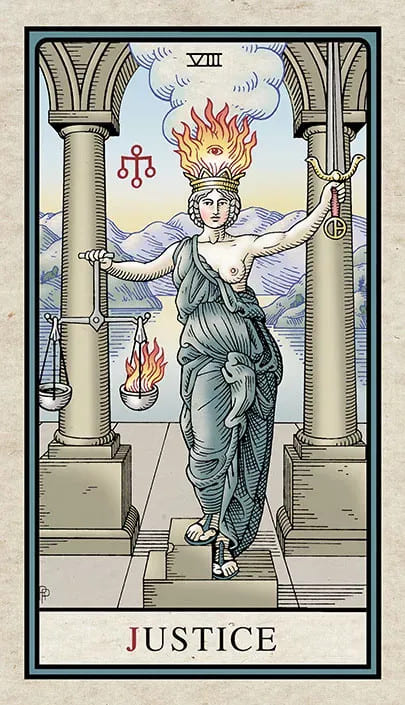
Justice centers on Disposition and the qualities of weight, truth, balance, and justice. She is depicted as a furnace connected to Heaven, indicating a link between the divine and judgment. The sword handle bears the glyph for vitriol (the secret fire), suggesting a purifying or transformative force. The symbol in the sky represents Disposition and reinforces the card's association with fair measure and truth.
The Hanged Man
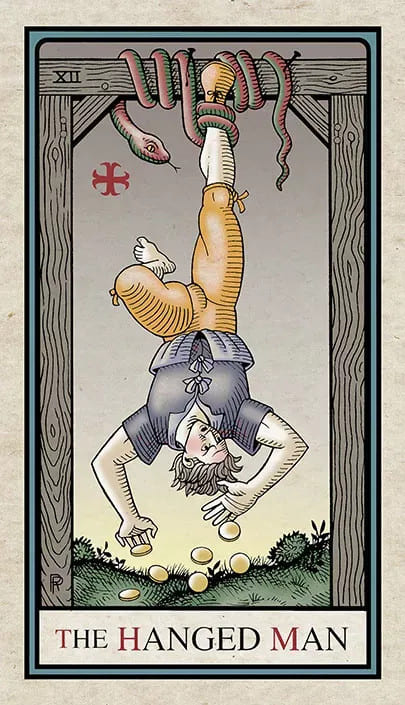
This card centers on calcination. The serpent represents Mercury, and the symbol below the serpent stands for calcination. It indicates a willing sacrifice or suffering and may signal a loss of fortune. Overall, the card emphasizes submission to a purifying or transformative process through hardship.
Death
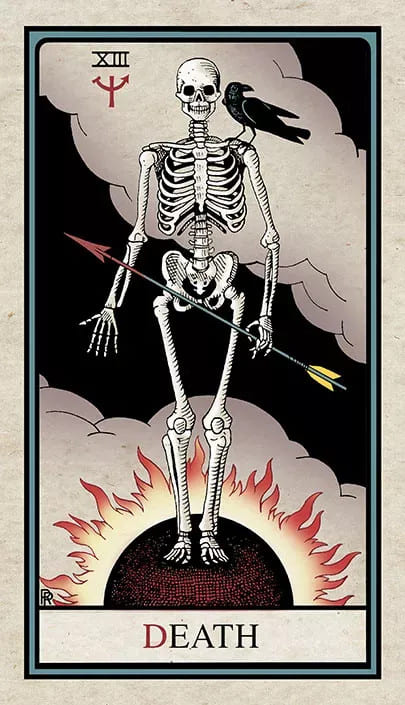
Death signifies putrefaction, evoked as the dark vessel of the Nigredo and symbolized by the raven. It represents the end of things and the process of decay. The imagery emphasizes dissolution and finality. The card points to necessary endings that clear the way for what follows.
Temperance
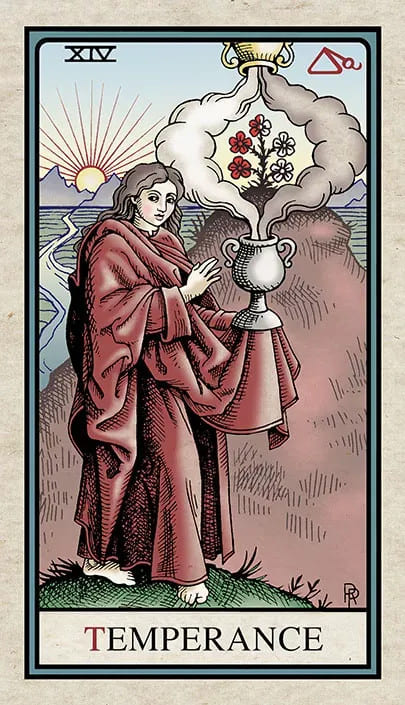
Temperance symbolizes the process of distillation and refinement, capturing evaporation and precipitation to nurture the rose of perfection. The Distillation symbol at the top of the card highlights transformation achieved through measured, alchemical processes. The figure on the card embodies health, beauty, balance, and timing, indicating harmonious moderation and graceful integration. The card encourages patience and balanced action to bring opposing forces into a refined, healthy whole.
The Devil
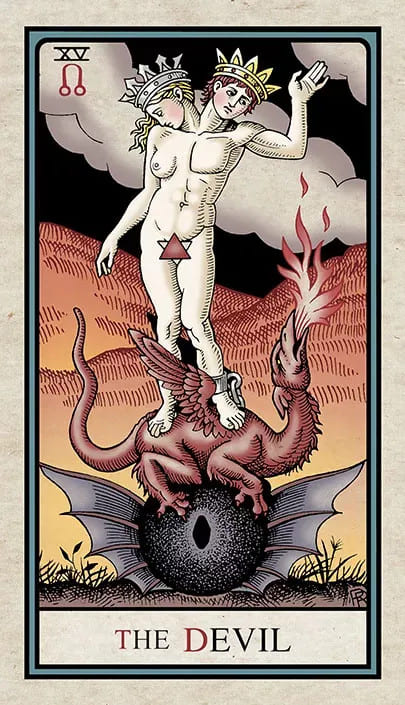
The Devil card represents coagulation and the solidifying of dark forces. The red dragon is the devil and the hermaphrodite of the King and Queen is held captive, symbolizing a trapped union. The symbol for Coagulation appears at the top, emphasizing the binding and fixed nature of this influence. The card signifies what is bad—vice, enslavement, and hell—warning of bondage to lower impulses and destructive patterns.
The Tower
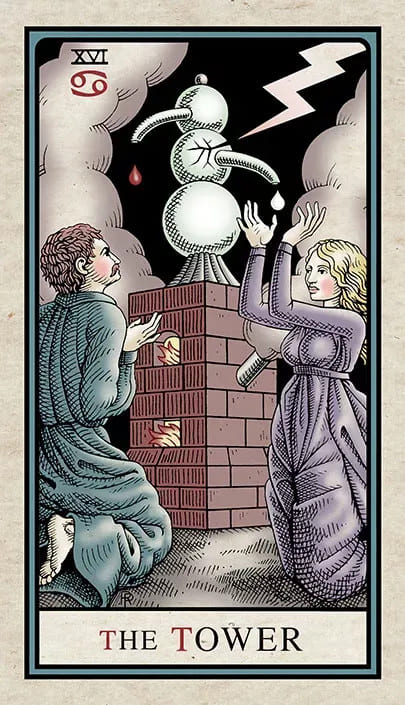
The Tower signifies a profound separation between the red and white. Its symbol for Separation is shown at the top, indicating the start of the Albedo, the second white stage. The card represents breaking and separation that lead to sudden change. It suggests events that can feel like divine intervention.
The Star
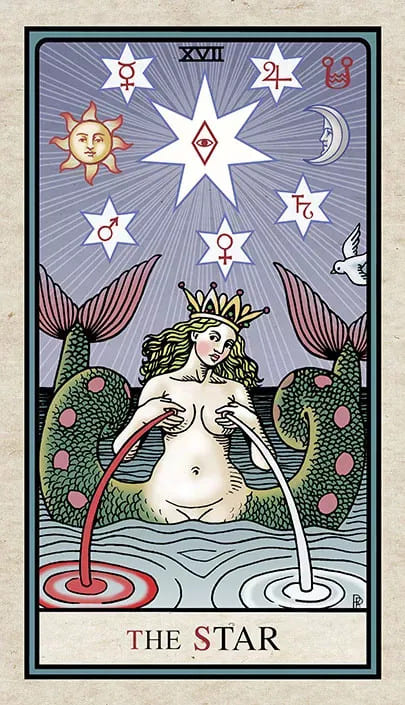
The Star signifies purification and spiritual renewal, embodied by the Siren of the Philosophers who offers both blood (suffering) and milk (nurturing). The imagery includes a ladder of the planets suggesting ascent and cosmic alignment. The large star's symbol represents the Anima Mundi, while the star in the upper corner denotes purification. Overall the card speaks of peace beyond blood-red fear and milk-white hope, inviting calm, understanding, and upward movement.
The Moon
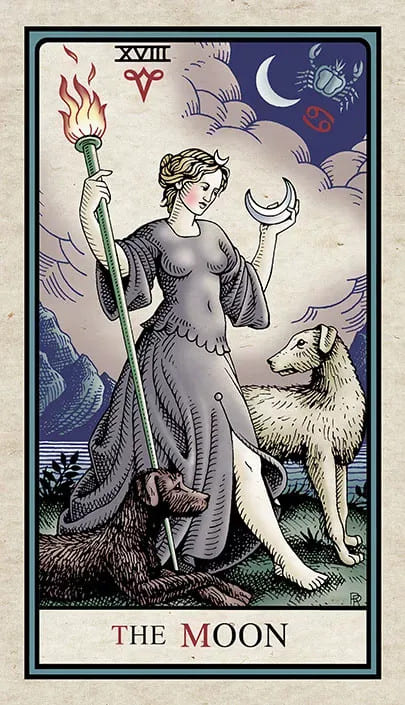
The Moon signifies a time of retreat and introspection, where intuition and dreams guide you. The imagery of Diana with her hounds and the crab labeled with the Cancer symbol underscores lunar influence and instinctual awareness. The recurring White Stone motif points to a focal symbol of hidden knowledge or inner guidance. Practically, the card encourages rest, anticipation, and preparation rather than immediate action.
The Sun
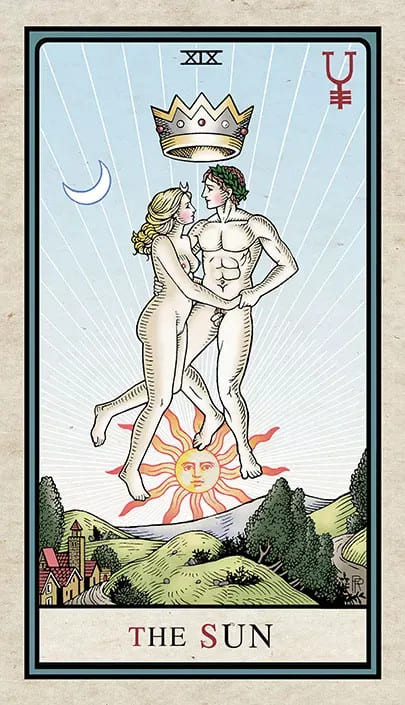
The Sun represents the Greater Conjunction and the Citrinitas (the 3rd yellow stage). The symbol for Conjunction is placed in the upper right corner of the card. It signifies spiritual love and deep partnerships such as soul mates and marriage. The card also points to enlightenment and the culmination of inner development.
Judgement
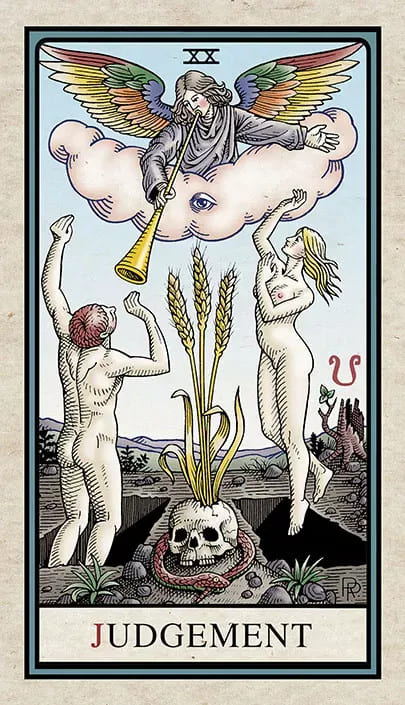
Judgement signifies resurrection and awakening, a call to be brought back to life or renewed. The imagery of a skull sprouting wheat emphasizes life emerging from death and the regenerative power found in endings. It denotes rejuvenation, healing, and the removal of blocks, often through recalling and reconciling the past. The card encourages rising to a higher level of awareness or consciousness, as suggested by the cloud with an eye.
The World
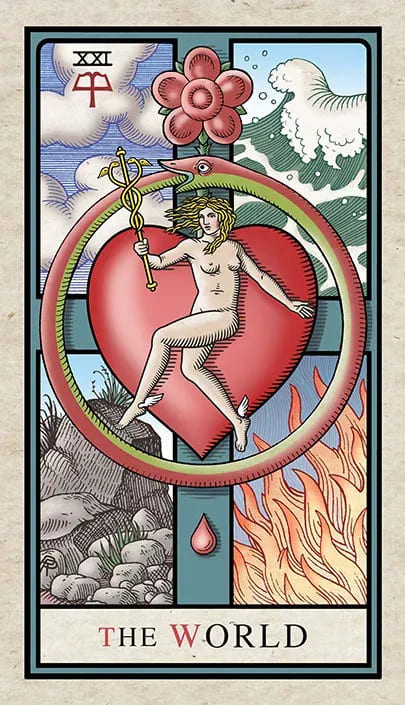
The World represents the culmination of the alchemical Opus, the final 4th red stage called the Rubedo, signifying attainment of the Philosopher's Stone and the Red Elixir. The central woman embodies the Quinta Essentia (the 5th element) and the Anima Mundi, indicating she is the matter of the Stone. The card includes the symbol of the Philosopher's Stone at the upper-left corner as an emblem of the achieved goal. Overall, it signifies the good, an inner guide that points to the object of one's goals and the completion of a transformative process.
Wands
Ace of Wands
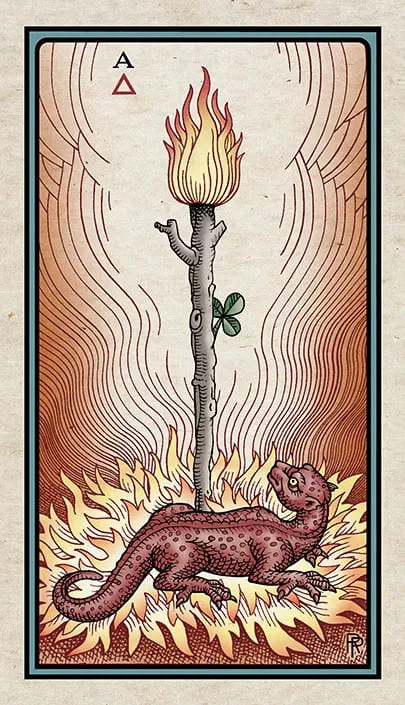
The card centers on the salamander as the Fire animal, embodying transformative, passionate energy. Its note that the salamander "mates in Fire" suggests impulses and desires are intensified and regenerated through heat. The living staff sprouting leaves signals new growth, creative beginnings, and a passion that bears fruit. Overall, the card announces the emergence of a new passion and the need for a value judgement about how to direct that energy.
Two of Wands
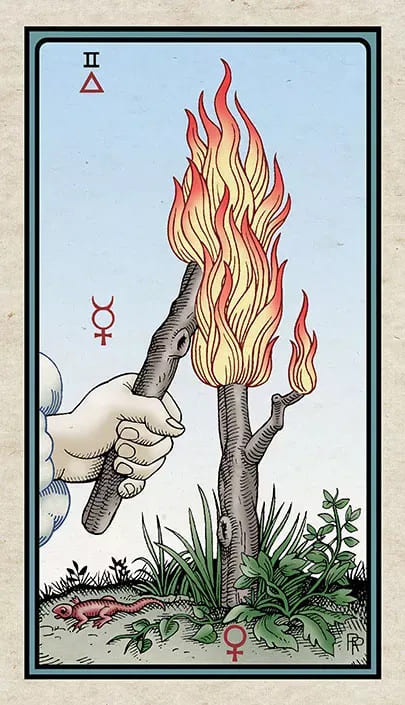
This card depicts the union of Hermes and Aphrodite, symbolizing the blending of communication and love. The joined torches and the glyphs for both deities suggest mutual passion and a meeting of complementary energies. The phrase "one lover lost in the other" emphasizes a deep, enmeshed unity and surrendered intimacy. It points to partnerships where intellect and desire are harmonized, inviting wholehearted connection and shared ardor.
Three of Wands
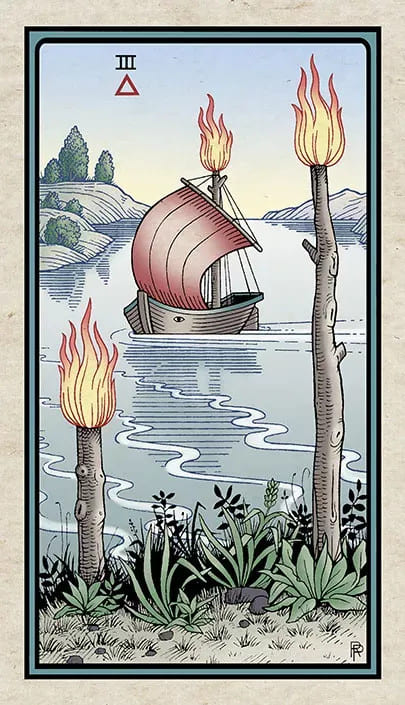
The 3 of Staffs depicts a boat guided by its eye, signaling the arrival of a new wave. It suggests reinforcements and replenishment are coming. The image emphasizes guidance and directed movement toward renewed resources. Taken together, the card points to external support and a refreshment of strength or supplies.
Four of Wands
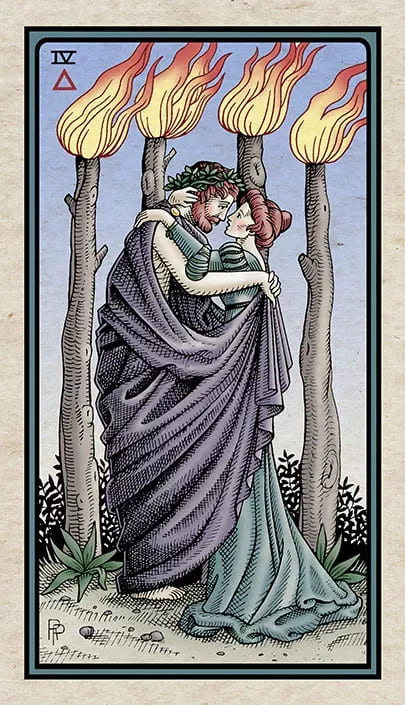
The 4 of Staffs represents union and celebration of opposites, embodied by the Bride and Groom. It signifies marriage, commitment, and the passionate merging of two forces. This card highlights harmony through partnership and the honoring of shared vows. It encourages embracing contrast as a source of strength and lasting connection.
Five of Wands
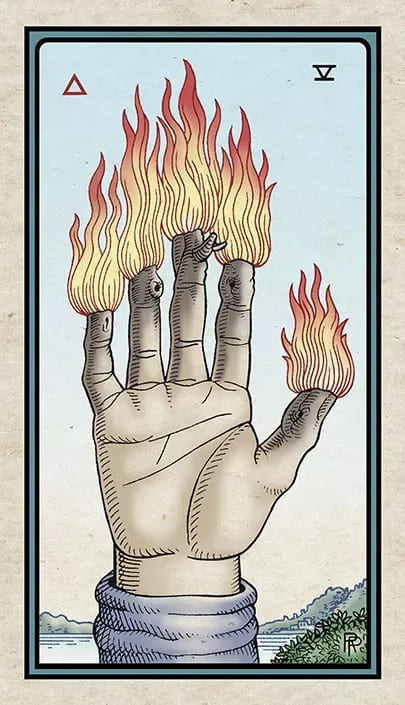
The 5 of Staffs depicts a burning hand with fingers becoming torches, symbolizing intense creative energy. It represents a flowing current of creativity that ignites and transforms ideas. This card signals the mobilization of inner fire into expressive, imaginative action. It encourages embracing that creative flow and allowing it to propel projects and self-expression.
Six of Wands
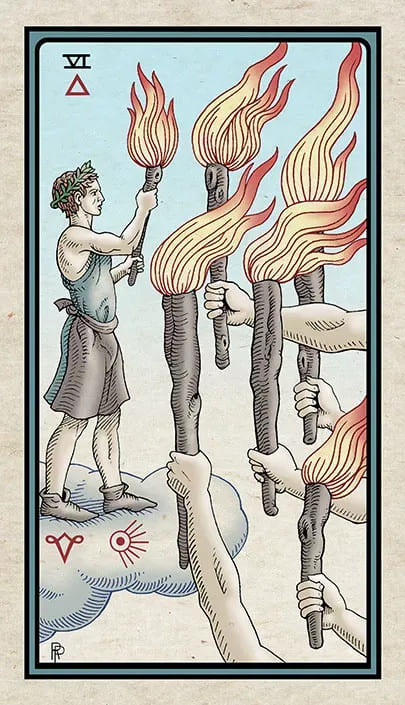
The Six of Staffs depicts the Master Craftsman, symbolizing skill, achievement, and the respect earned through competent work. The imagery of glyphs for purified silver and purified gold beneath his feet emphasizes refinement, value, and the solid foundation of ethical craft. This card signifies honor, public recognition, and the satisfaction derived from well-executed labor. It encourages taking pride in workmanship and accepting acclaim while remaining grounded in integrity.
Seven of Wands
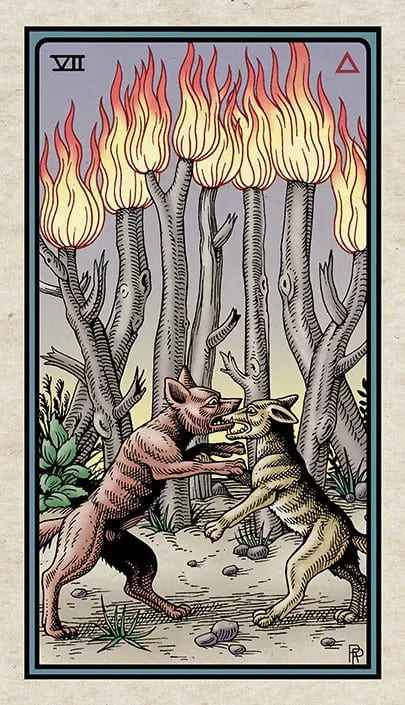
The 7 of Staffs depicts two fighting dogs, with a larger dog biting a smaller one. This violent image represents heated competition and argument. The card signals aggression and conflicts driven by unchecked passion. It warns that passions can run out of control and lead to harm if not managed.
Eight of Wands
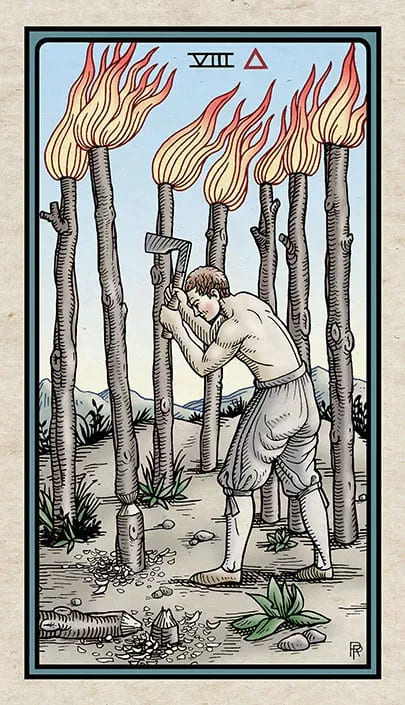
The 8 of Staffs represents decisive pruning and simplification. The Woodcutter archetype emphasizes cutting away what is unnecessary to create focus and efficiency. It encourages taking concrete actions to reduce complexity and streamline resources. This card signals a time to concentrate on essentials and move forward with clarity and intent.
Nine of Wands
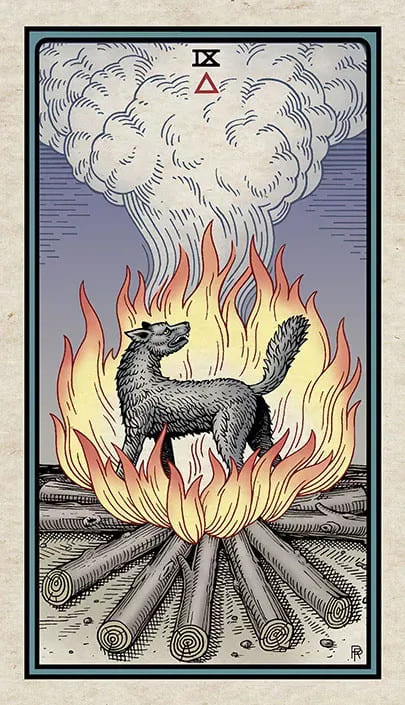
This card evokes a sacrificial transformation, where the Grey Wolf is burned in a fire to reclaim the king he swallowed. The fire symbolizes purification and the painful cost required to restore what was taken. The image suggests that passionate, overwhelming drives can compel acts of sacrifice that feel necessary. Ultimately, the card points to a difficult but essential ordeal that leads to reclamation and change.
Ten of Wands
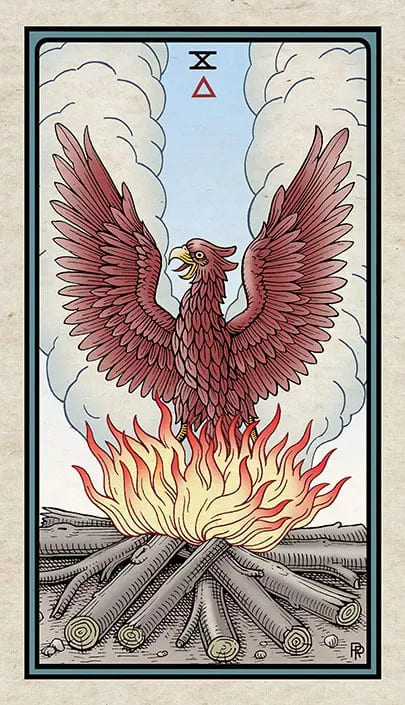
This card centers on the Phoenix as a symbol of rejuvenation and renewal. It emphasizes the restorative power attributed to the Stone, suggesting transformation after hardship. The card conveys rebirth and the idea of emerging stronger from trials. It encourages recognition that ordeals can fortify and bring renewed strength.
Page of Wands
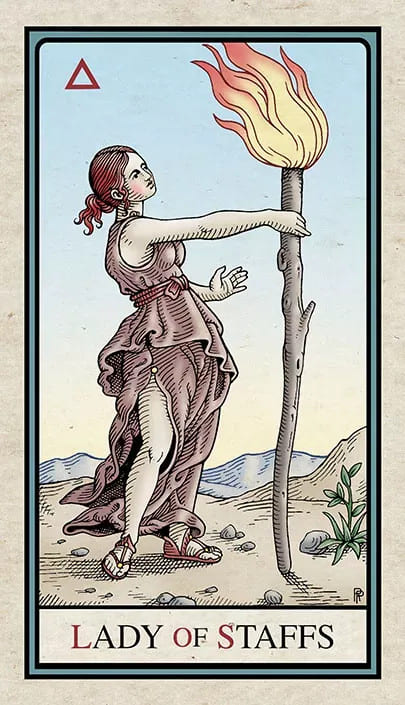
The Lady of Staffs evokes lively, passionate movement and a pioneering spirit. Imagery of dancing in a hot, dry desert suggests vitality, resilience, and joy even in sparse or challenging surroundings. This card encourages embracing newness, playfulness, and creative exploration. It signifies enthusiasm for change, a love of novelty, and the confidence to express oneself boldly.
Knight of Wands
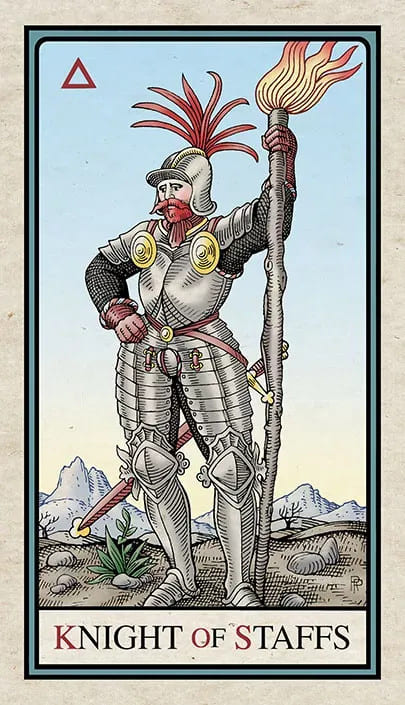
The Knight of Staffs appears in a desert landscape, portraying a journey and the search for a new place. The image emphasizes movement, relocation, and the pursuit of fresh surroundings. It conveys solitude and a sense of wandering as part of that search. The card suggests a willingness to leave familiar ground to find a more fitting location.
Queen of Wands
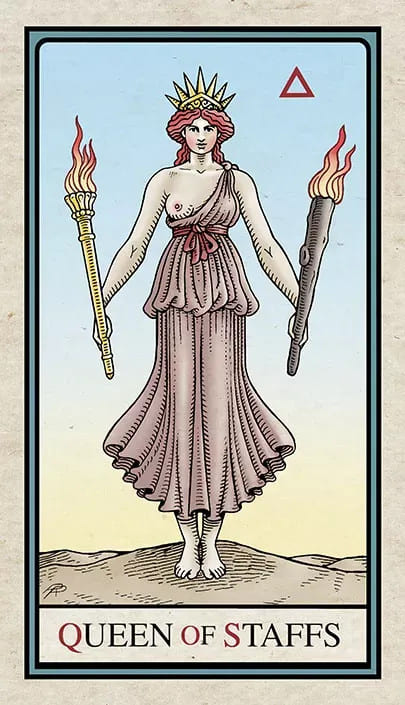
The Queen of Staffs presents a choice between raw, natural power and cultivated refinement. She literally holds both a coarse staff and a refined staff, symbolizing the contrast and coexistence of these energies. The card asks you to consider whether instinctual authenticity or polished technique better serves your present aims. It encourages deliberate selection and the possibility of integrating both qualities.
King of Wands
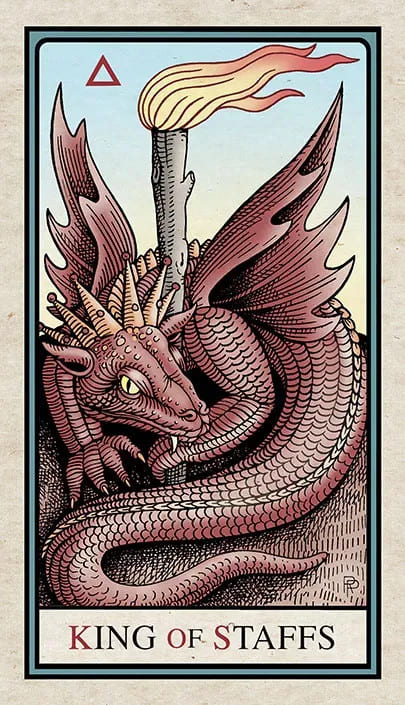
The King of Staffs embodies mastery over the fiery realm of will, passion, and emotion. The dragon clutching his staff symbolizes raw power shaped by emotional maturity and deliberate intent. This card speaks to confident, charismatic leadership and the ability to direct creative energy with purpose. It urges balancing bold action with sensitivity to feelings and suggests taking responsibility for guiding others or leading projects with both strength and heart. In readings, it can represent a mentor figure, a call to assert your creative authority, or the integration of passion and emotional wisdom.
Cups
Ace of Cups
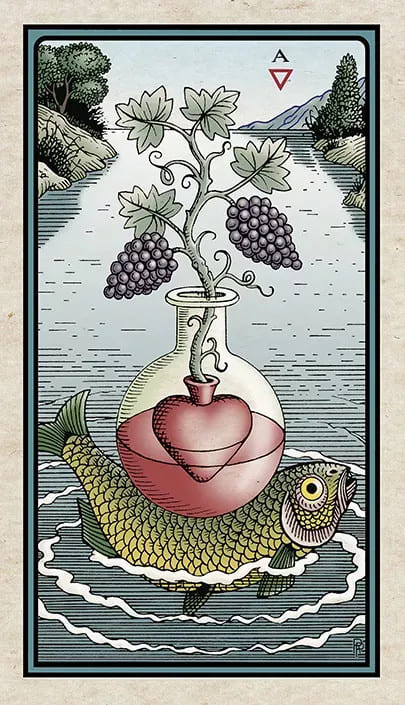
The Ace of Vessels signals the emergence of a profound emotional or spiritual potential ready to be realized. The card's imagery—the Fish and grapes that spring from seeds planted by the Anima Mundi—emphasizes a soul-originated source of nourishment and inspiration. It points to the start of a journey toward discovering one's destiny or purpose through inner cultivation and receptivity. The card encourages trust in intuitive guidance and the living spirit of the world that brings inner seeds to fruition.
Two of Cups
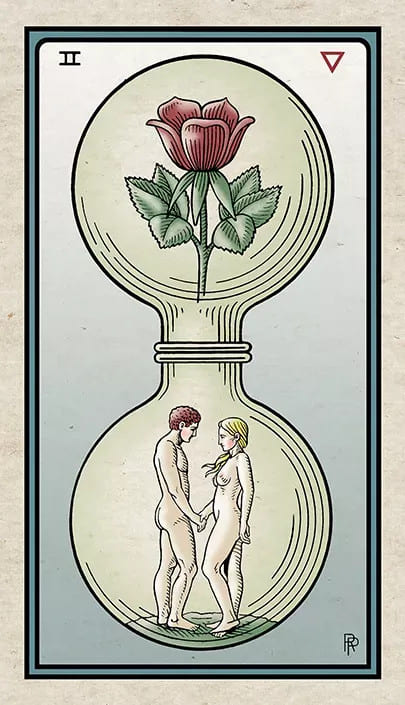
This card echoes The Lovers imagery, with the rose of perfection above. It signifies strong attraction, lust, and sexual energy between people. Alongside erotic desire, it emphasizes cooperation and mutual engagement in relationships. The card weaves sensuality and partnership together, pointing to a union shaped by both passion and collaboration.
Three of Cups
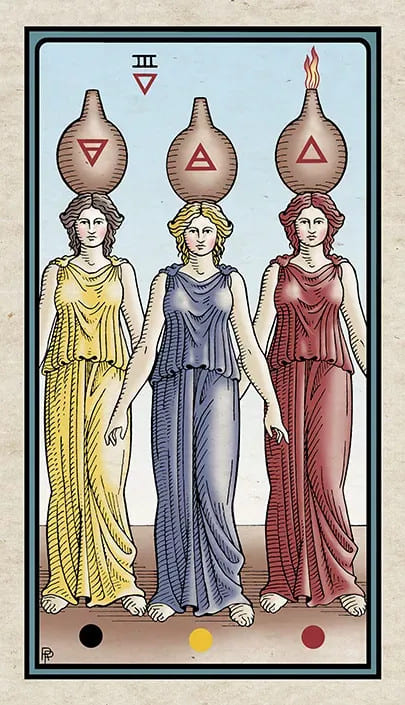
3 of Vessels represents a support group of friends gathered for mutual aid and encouragement. It depicts three women embodying the three elements not of this suit — Earth, Air, and Fire — emphasizing complementary strengths. The card signals companionship, shared resources, and emotional or practical support during times when community matters. It encourages seeking and relying on trusted friends or groups rather than facing challenges alone.
Four of Cups
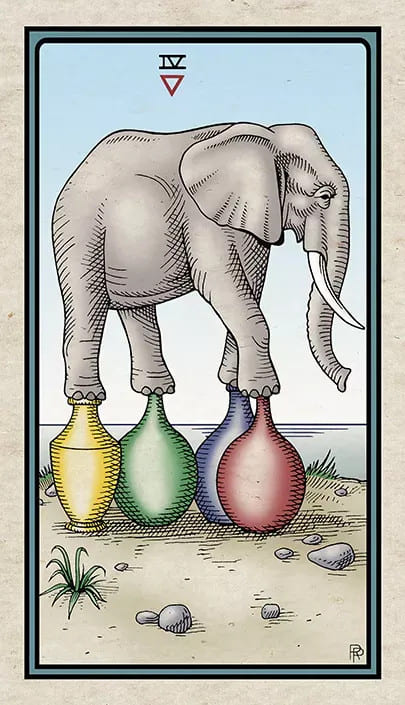
An elephant standing on vessels symbolizes a conservative, immovable stance rooted in strength and stability. The image emphasizes firmness and resistance to change, suggesting a situation that is stuck or not progressing. While power and protection are present, the card warns that rigidity can become limiting. It invites reflection on whether persistence is serving you or preventing necessary movement.
Five of Cups
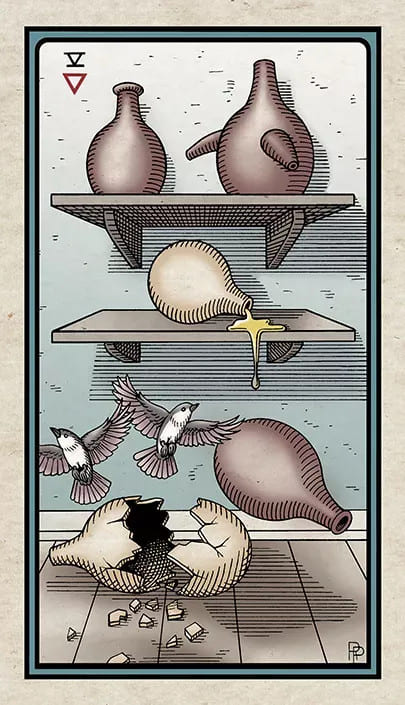
The 5 of Vessels signifies a sudden upheaval, a quake that dislodges what was once stable. It points to a breaking of position and a sudden breakthrough that can upend existing structures. This card indicates new possibilities and the potential for birth or the beginning of something new. Though disruptive, the shake-up clears the way for change and fresh opportunities.
Six of Cups
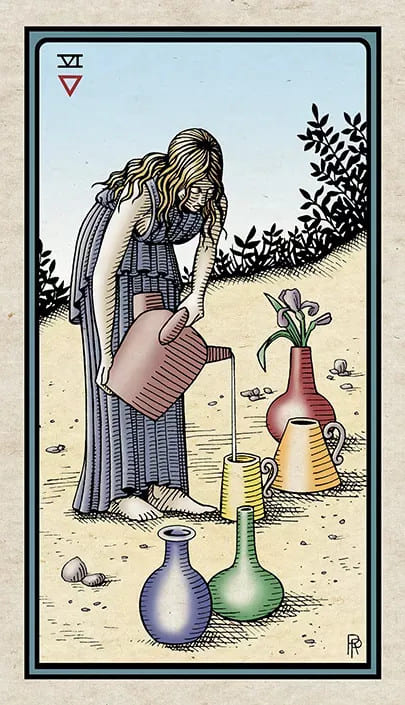
The Six of Vessels depicts a gardener filling differently shaped vessels, symbolizing careful and tailored nurturing. It emphasizes providing what each person or situation specifically needs rather than applying one approach universally. The imagery suggests balance in care—neither overdoing nor neglecting. Practically, it advises attentive, measured support that honors difference and capacity.
Seven of Cups
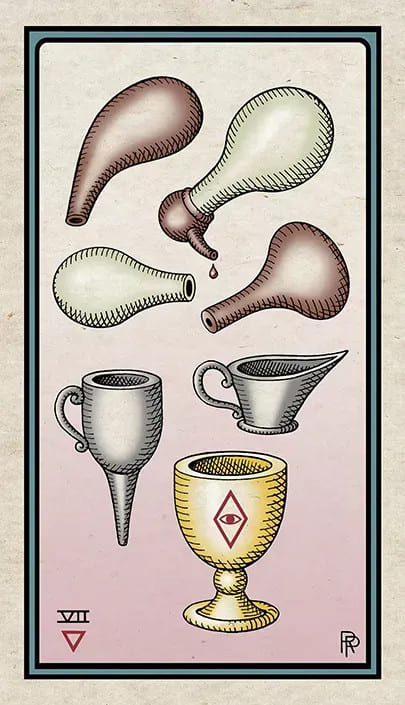
This card emphasizes tools and choice, pointing to the need to select wisely. It highlights inner guidance as the means to discern the correct path. The golden goblet bearing the glyph of the Anima Mundi symbolizes the highest or most aligned option. Choosing this option represents attunement to the world's soul and is portrayed as the best choice.
Eight of Cups
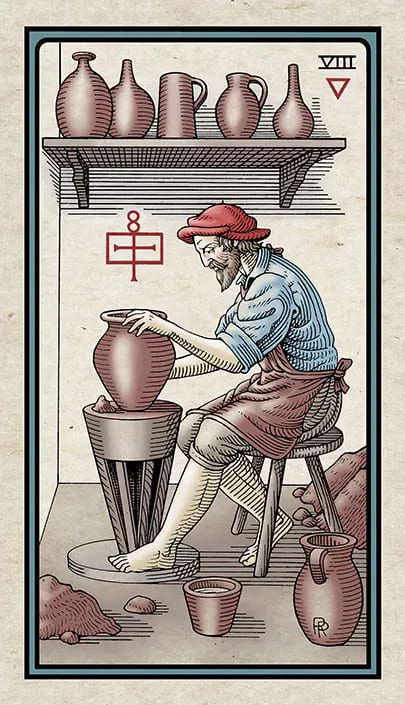
The card centers on the archetype of the potter and the glyph over the potter's wheel, linking individual craft to the Anima Mundi. It emphasizes creative work performed in the present moment as a means of expression and connection. Variation and experimentation are presented as natural parts of the crafting process. Overall, the card invites sustained, mindful practice that aligns personal creativity with a larger, world-soul force.
Nine of Cups
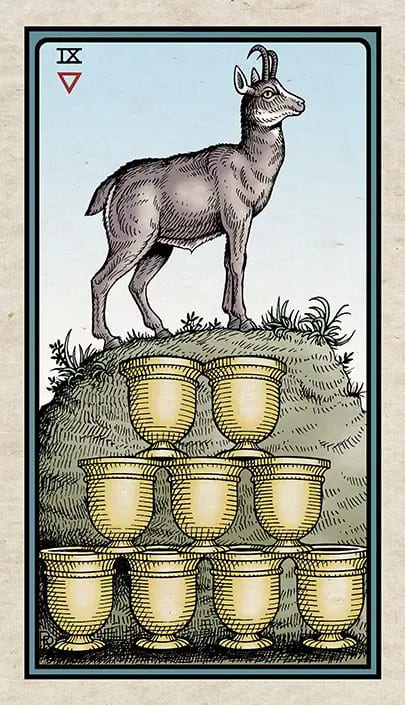
The Chamois appears atop a mound of cups, representing accumulated emotional experience and the steadiness that comes from it. The image emphasizes confidence that arises from navigating difficult terrain and the perspective gained through those journeys. This card encourages trusting your footing and relying on lessons learned rather than doubt. It signifies a period of inner assurance and an expanded viewpoint in matters of the heart.
Ten of Cups
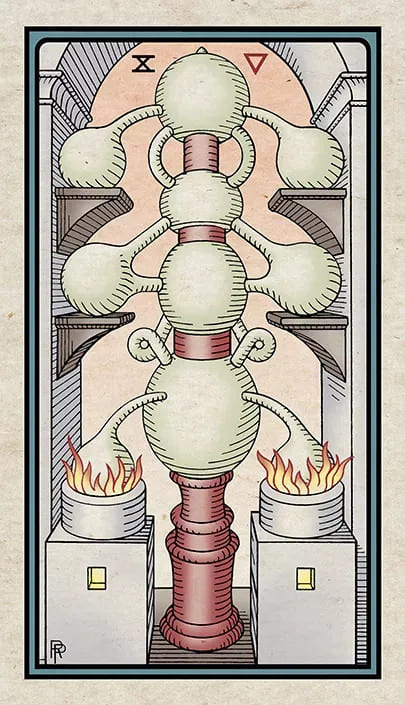
The card, titled "The Still," symbolizes the unity of the many into one and the quiet, stabilizing presence that holds such connections together. It highlights connectedness as a core theme, framing relationships and systems as parts of a larger network. The imagery explicitly points to networks like the Internet as modern manifestations of collective linkage and shared structure. As guidance, it invites awareness of your role within these networks and the power of cohesion and stillness within communal systems.
Page of Cups
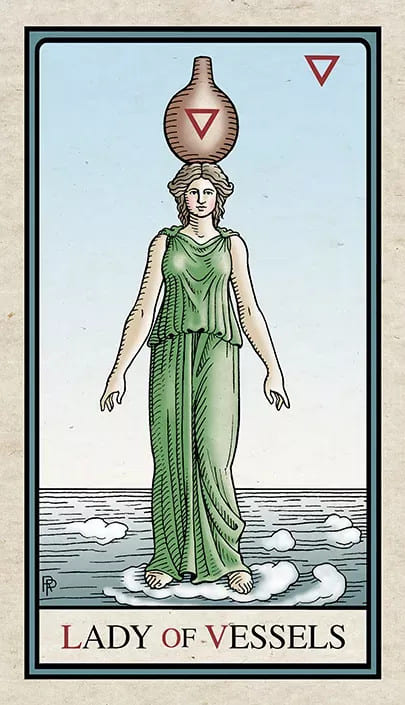
The Lady of Vessels depicts a figure walking on water, emphasizing a close relationship with the emotional and unconscious realms. The Water glyph signals intuition and the primacy of inner knowing. This card encourages trusting the unconscious and allowing intuitive insight to guide you. It suggests moving through emotional currents with calm and confidence, guided by subtle inner signals.
Knight of Cups
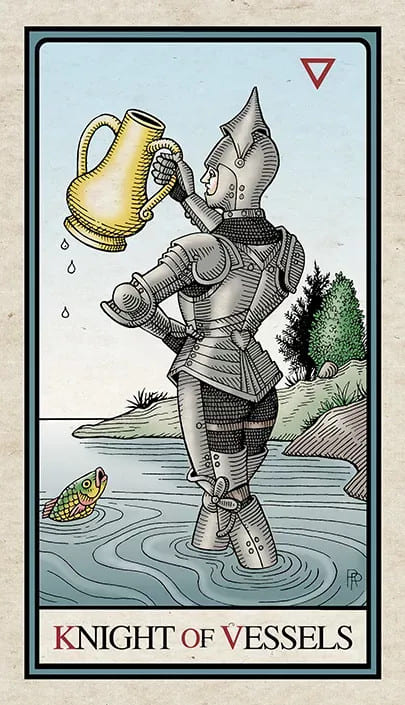
The Knight of Vessels represents a messenger from the unconscious, calling you to investigate inner material and hidden feelings. The fish symbolizes information arising from deep emotional or intuitive realms and urges a quest for understanding. This card encourages curiosity, active inquiry, and following impulses that lead to psychological or spiritual discovery. It advises listening to subtle signals and pursuing the search for inner truth.
Queen of Cups
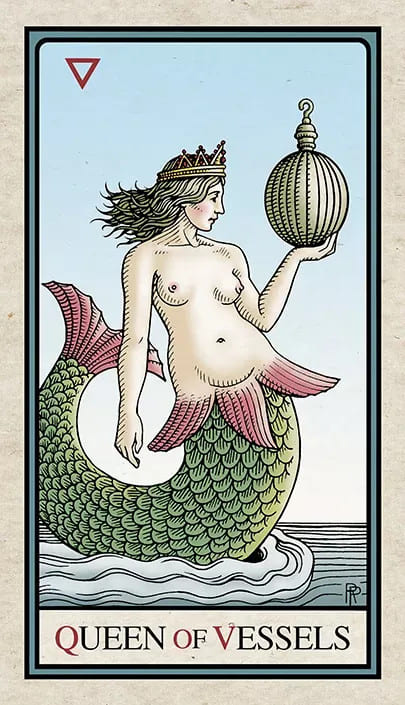
The Queen of vessels holds a sealed vessel and does not feel compelled to open it, embodying the sacredness of inner mystery. Her sealed vessel symbolizes hidden wisdom and the deliberate choice to withhold or protect spiritual knowledge. The card emphasizes patience as a spiritual virtue, suggesting that some revelations arrive in their own time. It encourages trust in inner processes and acceptance that restraint can be a form of devotion.
King of Cups
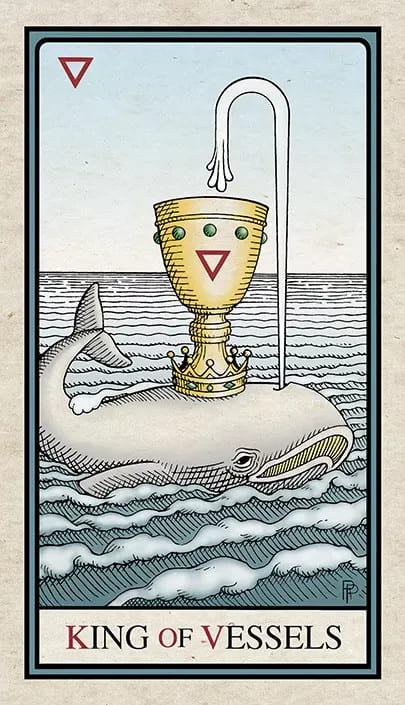
The King of Vessels portrays a whale who fills his own cup, symbolizing emotional self-sufficiency and inner fulfillment. It points to finding answers within rather than relying on external validation. The card suggests mastery of feelings and mature emotional leadership, where one’s inner resources provide guidance. It encourages trusting your intuition, nurturing your own emotional needs, and cultivating a sense of self-fulfillment.
Swords
Ace of Swords
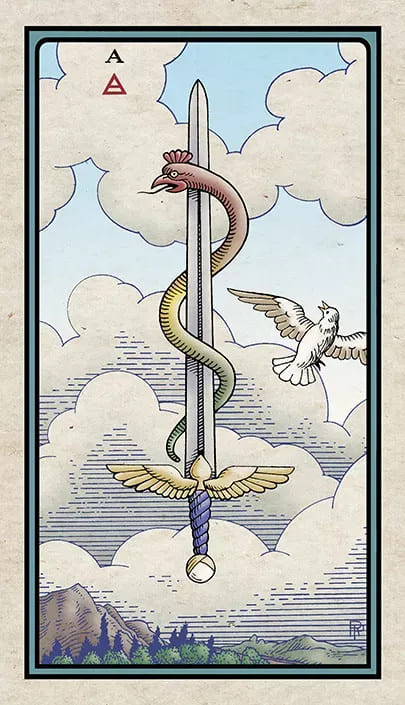
The Ace of Swords is symbolized by a Basilisk—an emerging serpent that matures from unripe green to ripe red, representing the birth and ripening of insight. It signifies positive thinking and the arrival of a good idea or mental breakthrough. The imagery points to the pursuit of wisdom and intellectual growth. This card encourages clarity of thought, decisive action, and the cultivation of understanding.
Two of Swords
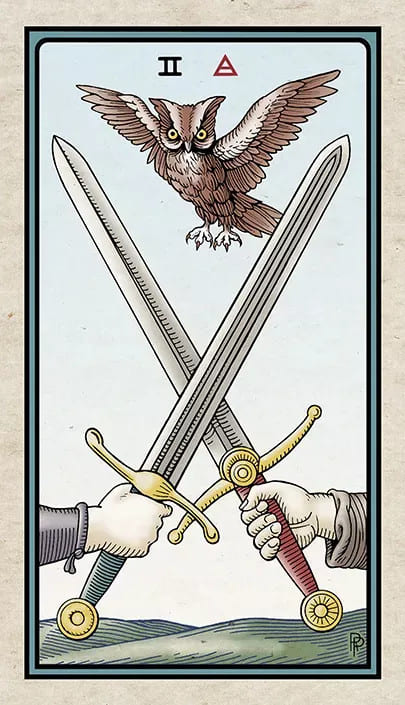
The Two of Swords depicts a duel, presented as an intellectual or verbal debate. The owl of wisdom highlights discernment and the presence of inner guidance in contentious moments. The card emphasizes active questioning and the deliberate pursuit of knowledge rather than passive acceptance. It encourages seeking clarity and wisdom through thoughtful inquiry and balanced consideration.
Three of Swords
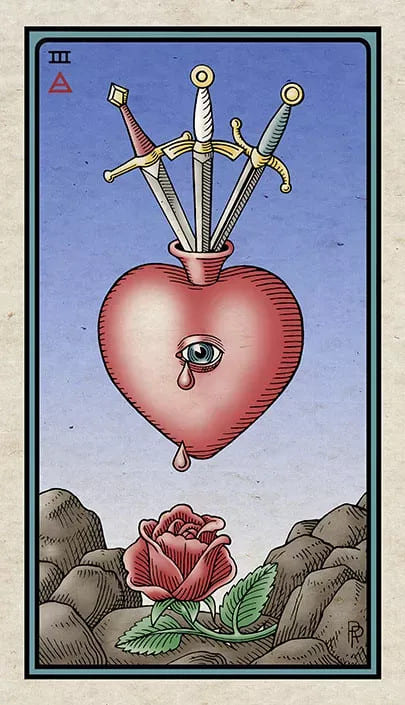
The 3 of Swords shows the Bleeding Heart, a direct symbol of pain, suffering, and heartache. The eye in the image denotes consciousness, implying an acute awareness of emotional wounds. The rose represents perfection, suggesting recognition of beauty or completeness even amid sorrow. Together, these symbols point to painful emotional clarity and the presence of both suffering and heightened awareness.
Four of Swords
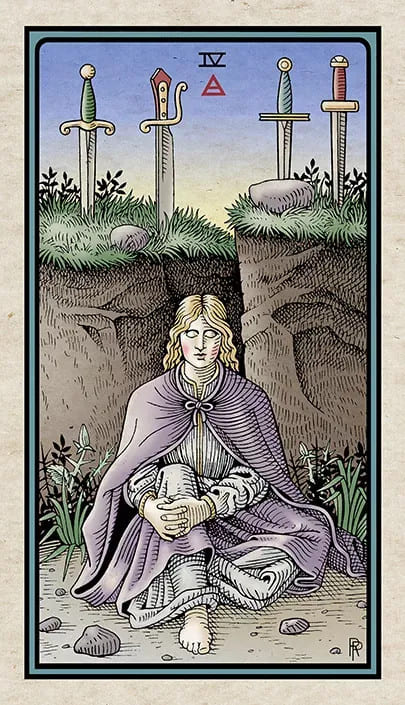
The Sage sits below the swords of troubled thoughts. This image signifies meditation. It also indicates concentration. And it centers on thought.
Five of Swords
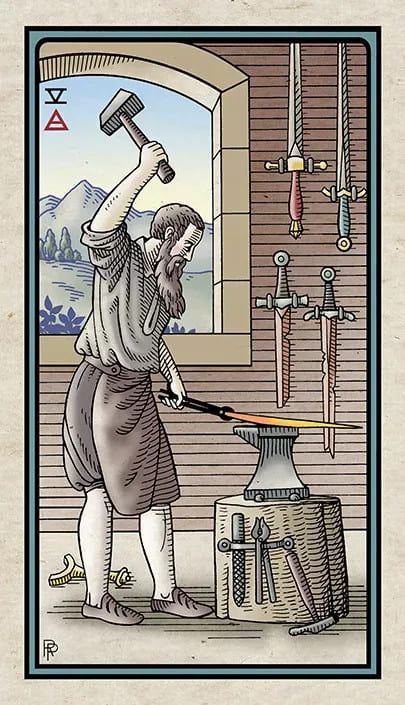
The card presents the Blacksmith hammering a blade while it is hot, symbolizing taking decisive, timely action. It emphasizes repair and transformation, shaping what is damaged into something whole or functional. It speaks to righting wrongs and restoring balance through direct, practical effort. The card encourages stepping in to fix what is broken and to act while circumstances allow to achieve justice and repair.
Six of Swords
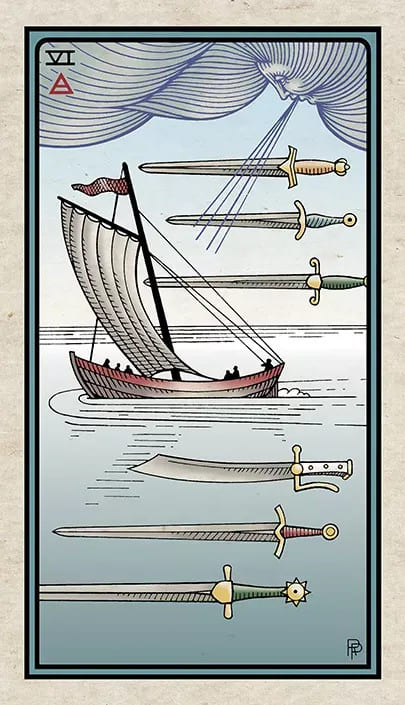
The Six of Swords symbolizes gentle transition and the presence of a supportive force guiding movement. The image of a loving breeze filling the sail of the boat evokes ease and forward momentum toward calmer circumstances. It encourages going with the flow and trusting that a higher power or benevolent influence is assisting the journey. This card advises surrendering resistance and allowing compassionate forces to carry you through change.
Seven of Swords
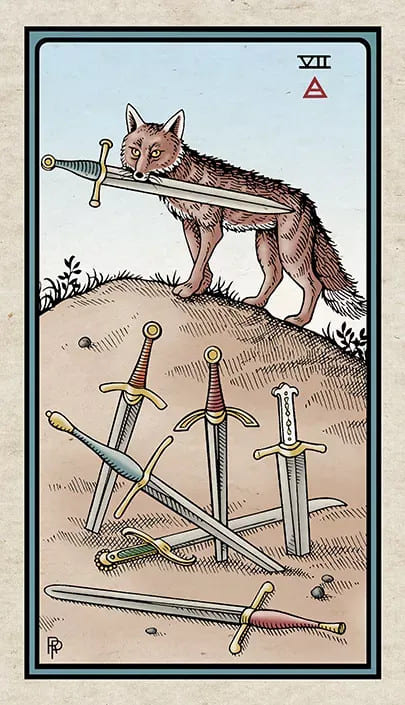
The card depicts a fox carrying a jumble of swords, symbolizing cleverness used in questionable ways. It highlights themes of dishonesty and amorality, suggesting actions taken without ethical judgment. The image conveys stealth and cunning, focusing on self-interest rather than responsibility. The card warns that clever tactics absent moral consideration can lead to problematic outcomes.
Eight of Swords
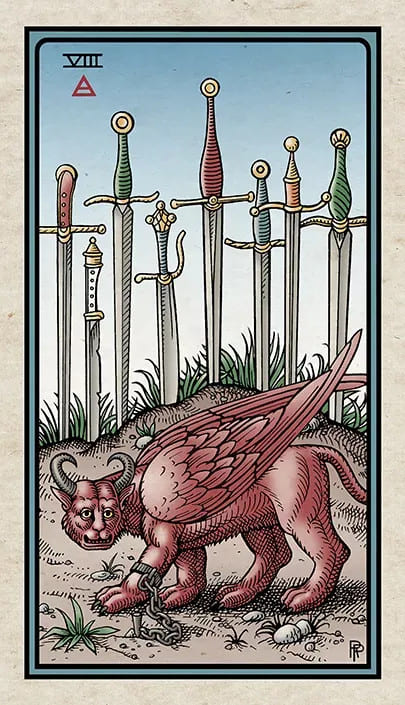
The card presents the Beast — a composite of the four evangelists — depicted bound and confined by swords. The imagery emphasizes confinement, with the swords forming a cage that prevents movement. This signifies a state of being trapped and blocked, constrained by sharp or restrictive forces. It points to an overwhelming sense of immobilization and lack of freedom.
Nine of Swords
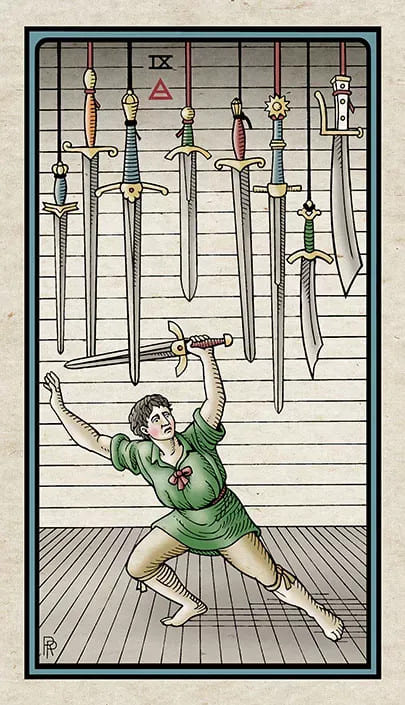
The Nine of Swords shows a hero confronting swords hung by threads, highlighting feelings of fear and vulnerability. It signifies the experience of fear itself and the challenge of facing that fear directly. Despite the threatening imagery, the card emphasizes courage and the act of moving forward in spite of fear. Its guidance is to acknowledge fear, stand before it, and choose action rather than paralysis.
Ten of Swords
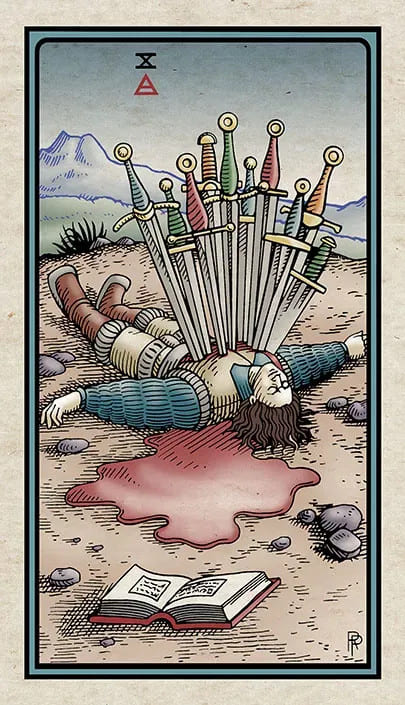
10 of Swords signifies a painful ending marked by betrayal, severe criticism, or emotional devastation. It depicts the archetypal victim struck down and wounded, indicating that a situation has reached its lowest point. Though the image is stark, it also signals the finality necessary for recovery and the possibility of release from suffering once the nadir is acknowledged. The card urges acceptance of the truth so healing and new beginnings can follow.
Page of Swords
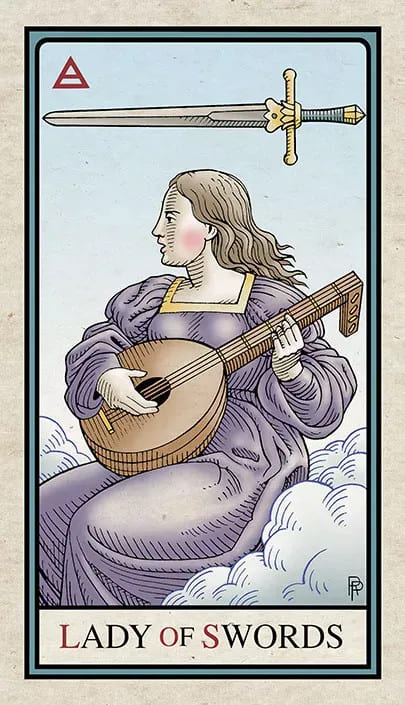
The Lady of Swords embodies eloquence, poetry, and song, depicted as playing her lute on a cloud. She represents inspired, lyrical communication and the power of artistic expression. The cloud suggests an elevated, ethereal quality to her words and music, conveying ideas with lightness and grace. When this card appears it encourages embracing poetic or musical forms of expression and speaking with clarity and beauty.
Knight of Swords
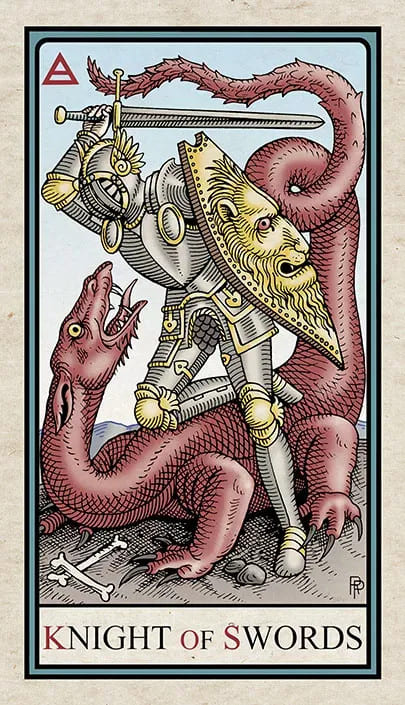
The Knight of Swords represents swift, decisive action taken to confront injustice or evil. The image of slaying a dragon emphasizes courage, righteousness, and the determination to right wrongs. There is a caution about being judgmental or acting hastily without full consideration. The saying that a hero is judged by the size of his foe highlights how the scale of a challenge frames our perception of valor and motive.
Queen of Swords
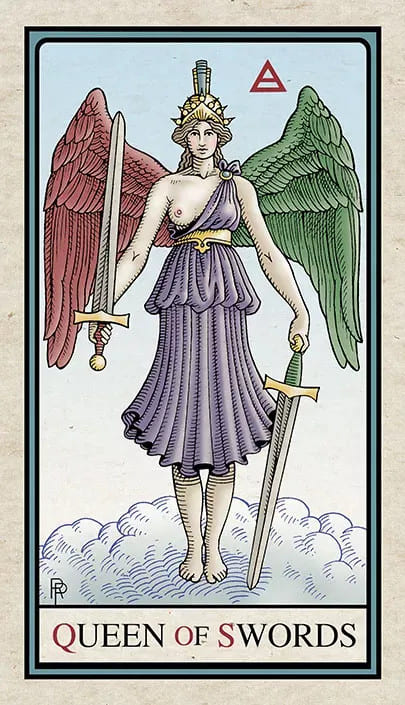
The Queen of swords is depicted with wings and two swords, symbolizing a pivotal decision. The imagery presents a clear contrast between a red, mature, positive side and a green, unripe, negative side. This card emphasizes the need to recognize the difference between developed, constructive qualities and immature, detrimental tendencies. It urges careful discernment and choosing the ripeness and positivity represented by the red side.
King of Swords
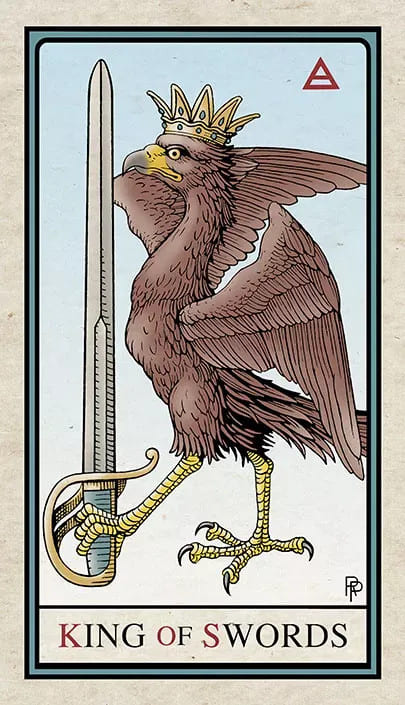
The King of Swords embodies clear intellect, authority, and direct communication. Symbolized by an eagle and an upright sword, he represents keen perception and decisive judgment. He brings confidence and a rational approach to problems, favoring truth and fairness. When this card appears, it encourages you to act with clarity, speak plainly, and rely on reason over emotion.
Pentacles
Ace of Pentacles
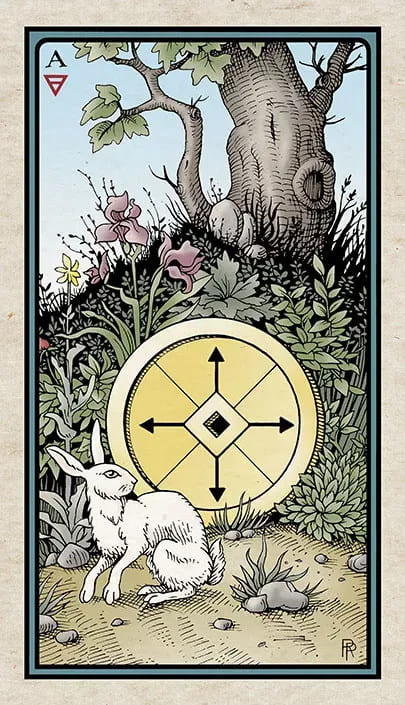
The Ace of Coins symbolizes the beginning of material manifestation, embodied by the Rabbit and the hole in the coin representing the unseen Anima Mundi. The arrows indicate the four directions and elements, pointing to a balanced engagement with earthly forces. This card heralds the arrival of a tangible opportunity—often a new source of health or wealth. It invites practical steps to bring nascent potential into visible, sustained form.
Two of Pentacles
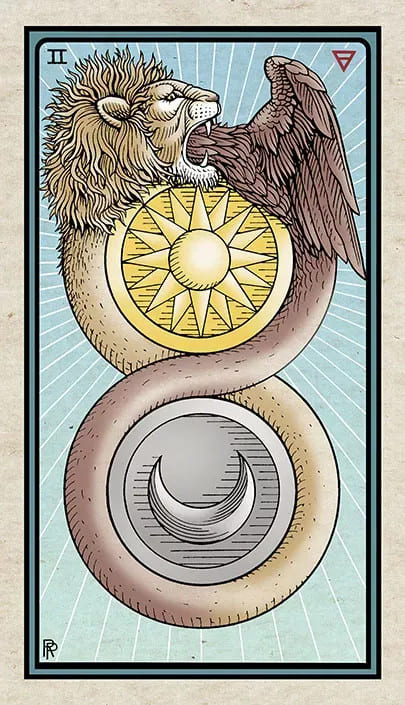
The card emphasizes the fixation of the volatile, where a fixed element (the lion) is opposed by a volatile element (the eagle). This contrast creates a polarity that can indicate something that is stuck or blocked. It signals a situation of polarization between opposing forces or qualities rather than integration. As guidance, it warns that rigidity in the face of change can produce stagnation and calls attention to the stuck dynamic.
Three of Pentacles
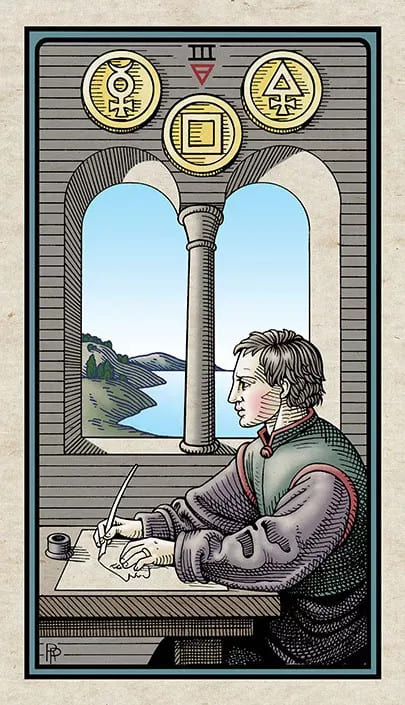
The 3 of Coins depicts the Artist and emphasizes craftsmanship and vocation. The coins bear glyphs representing the three essences — Mercury, Salt, and Sulphur — pointing to alchemical balances of spirit, form, and process. It signifies creative work that can earn a living and highlights the importance of close observation. The card encourages integrating skill, materials, and attentive practice to produce valuable results.
Four of Pentacles
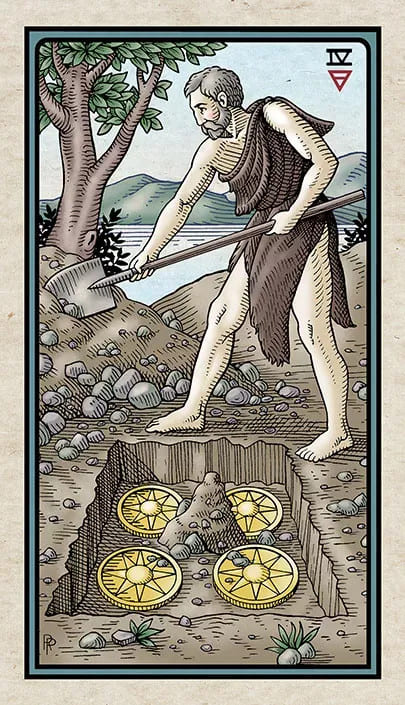
The Four of Coins centers on a fear of loss and an urge to tightly control material assets, embodied by the figure of the Miser. The image of planting gold in the ground suggests attempts to secure or hide wealth, signaling cautious investment or protective saving. This energy can tip into hoarding and stinginess, restricting the flow of resources and generosity. As guidance, the card asks you to examine whether your need for security serves you or keeps you stuck in scarcity fears.
Five of Pentacles
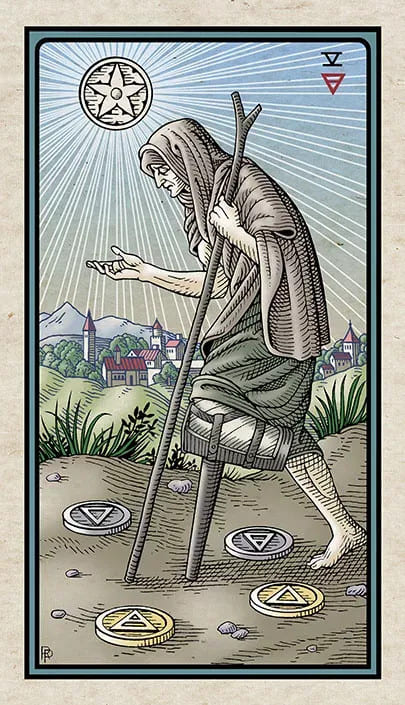
The 5 of Coins portrays the Beggar and conveys material lack and hardship. The fallen coins on the ground represent the four elements, while the solitary coin in the sky signifies the Quinta Essentia. The card points to sickness, poverty, and the sense that something essential is missing. It calls attention to deprivation, both physical and spiritual, and asks the querent to notice what is lacking.
Six of Pentacles
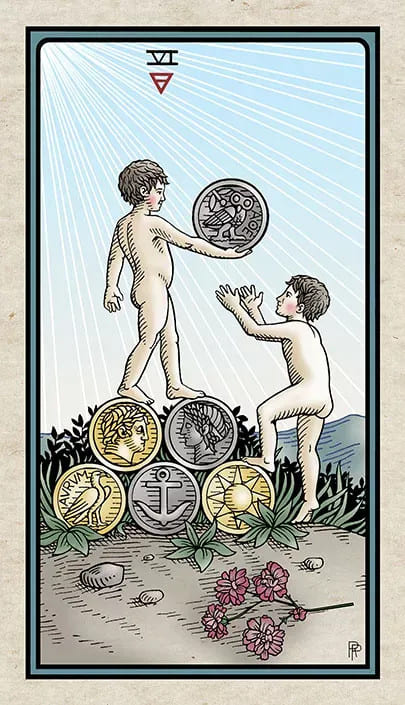
The Six of Coins centers on youthfulness and the symbolic presence of Athena's owl on the coin, linking generosity with wisdom. It highlights acts of sharing and giving that come from a place of innocence and trust. The card encourages balanced reciprocity—both offering help and accepting support—with discernment. Overall it calls for open-hearted generosity guided by thoughtful consideration.
Seven of Pentacles
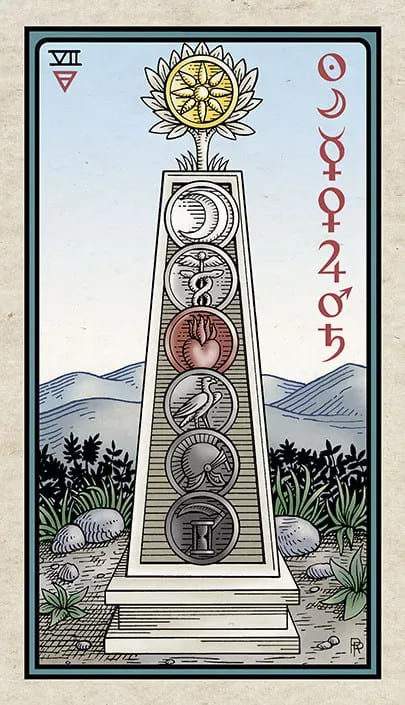
The Obelisk is central to the card and the coins represent the seven metals arranged from the bottom upward. From the bottom they are lead, iron, tin, copper, mercury, silver, and gold, and their symbols appear on the right. Together these elements indicate a process of transformation through stages. The card emphasizes gradual, staged progression rather than sudden change.
Eight of Pentacles
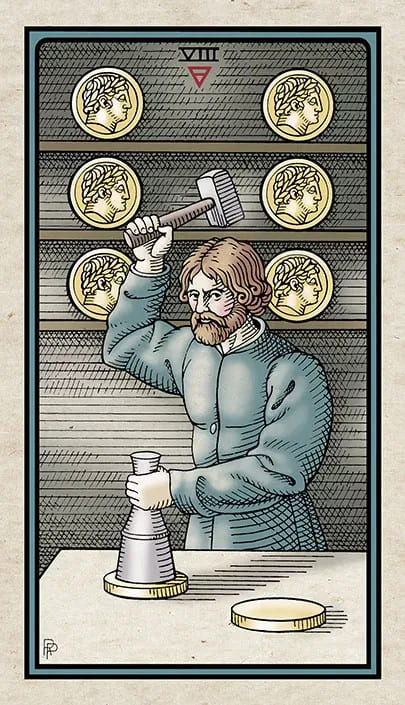
The 8 of Coins emphasizes steady, repetitive effort and the development of skill through practice. The image of the coin stamper suggests careful craftsmanship and attention to detail. It points to habits and routines that produce material results and reliable income. This card encourages disciplined work and patience, showing that mastery and reward come from consistent labor.
Nine of Pentacles
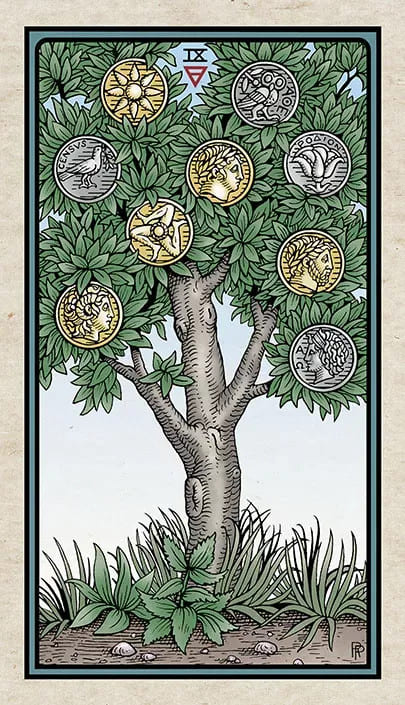
The card depicts the Money Tree, its branches bearing growing coins as a clear symbol of flourishing wealth. It signifies prosperity and the fruitful outcome of careful cultivation and stewardship. The imagery also highlights health and overall well-being alongside material abundance. The 9 of Coins points to a period of stability where resources and vitality are in balance.
Ten of Pentacles
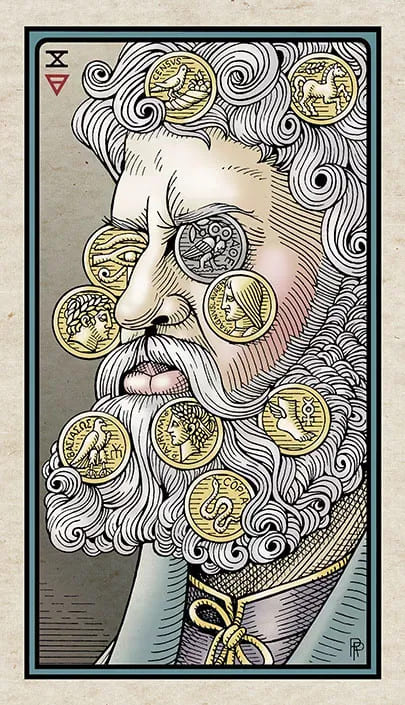
The 10 of Coins warns of materialism and possessiveness, symbolized by coins covering the figure's eyes. It points to drawing possessions to oneself and a narrowed focus on physical wealth at the expense of other values. This card highlights selfishness and a blindness to emotional or spiritual matters. It advises recognizing this imbalance and opening to broader perspectives beyond material gain.
Page of Pentacles
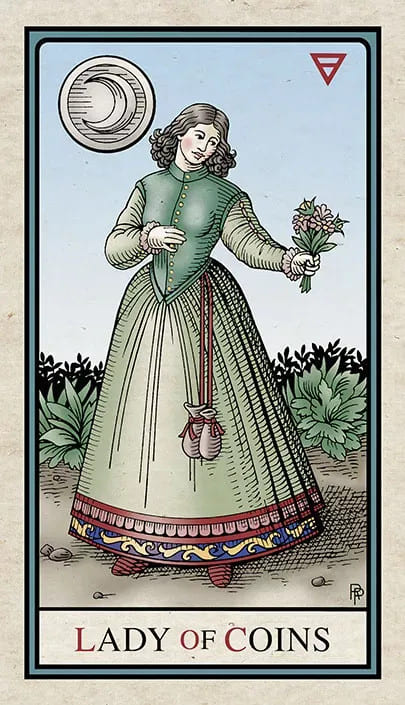
The Lady of Coins represents material abundance and artistic patronage. The silver lunar coin symbolizes wealth conferred through refined taste and supportive patrons. She points to prosperity that fosters aesthetics, creativity, and the maintenance of beauty. This card suggests resources and backing that enable artistic endeavors and comfort.
Knight of Pentacles
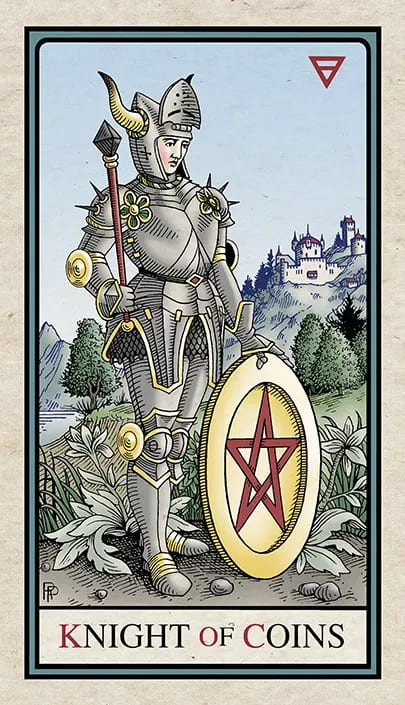
The Knight of Coins embodies steady protection and guardianship over material matters. Represented by a protective pentacle, this figure stands as a guardian of both health and wealth. His energy is cautious, reliable, and focused on maintaining stability and security. In readings he signals practical support, sensible stewardship, and long-term preservation of resources.
Queen of Pentacles
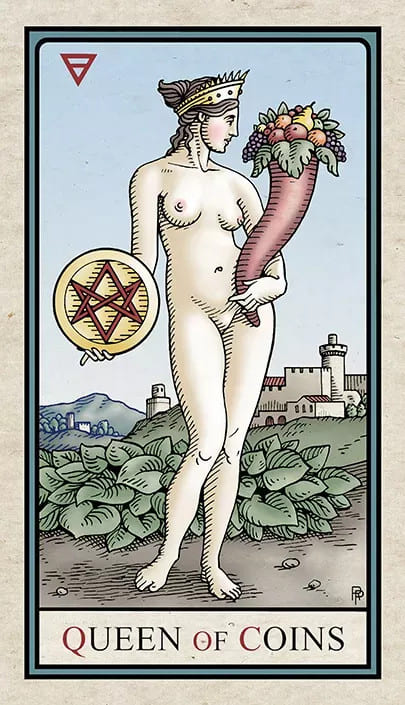
The Queen of Coins embodies material abundance, comfort, and balanced well-being. Her six-pointed star symbolizes harmony and centeredness, while the cornucopia represents sensuality and overflowing prosperity. The imagery emphasizes health, physical pleasure, and the secure enjoyment of life's comforts. This card points to a stable, nurturing environment where bodily needs and material resources are well cared for.
King of Pentacles
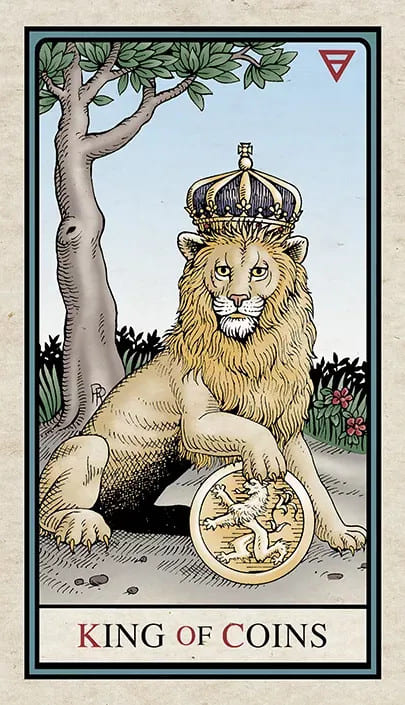
The King of Coins centers on a lion depicted on a coin, representing mastery and sovereign authority over the material realm. It signifies mastery of one's environment and occupation, pointing to competence and reliable stewardship in work and practical affairs. The card encourages responsible management of resources and shaping circumstances through grounded leadership. It emphasizes stability, practical wisdom, and confident control in professional and domestic spheres.
Reading Tips for The Alchemical Tarot
The Alchemical Tarot reads best when you treat it as a mirror of inner process rather than a predictor of outer events. The alchemists were never really trying to turn lead into gold — they were describing the transformation of the self. Read these cards the same way.
Follow the stages of the Great Work. Alchemy describes transformation as a sequence: nigredo (blackening, breakdown), albedo (whitening, purification), citrinitas (yellowing, awakening), and rubedo (reddening, completion). When multiple cards in a spread echo the same stage, the reading is telling you where you are in your own process of change — and what comes next.
Read the symbols literally before you read them intuitively. Place chose every alchemical image for a reason. The lion devouring the sun, the eagle ascending, the hermaphrodite joining opposites — these are not arbitrary. If a symbol catches your attention, look up its alchemical meaning before defaulting to pure intuition. The tradition itself will deepen your reading.
Pay attention to the elements in conversation. The four suits map directly to the four classical elements, and alchemy is fundamentally about how those elements interact — fire transforming earth, water dissolving form, air carrying essence upward. When cards from different suits appear together, read the elemental relationship between them. Are they cooperating or conflicting? That dynamic is often the heart of the spread.
Let the deck teach you slowly. This is not a deck you master in a weekend. The Alchemical Tarot reveals its depth over months and years of use, as your understanding of the alchemical tradition grows alongside your reading practice. Be patient with cards that feel opaque — they are often the ones with the most to teach you.
Frequently Asked Questions
How many cards are in The Alchemical Tarot?
The Alchemical Tarot contains 78 cards: 22 Major Arcana depicting the stages of the alchemical Great Work, and 56 Minor Arcana divided into four suits — Staffs (Wands), Vessels (Cups), Swords, and Coins (Pentacles). The structure follows the traditional tarot framework while reinterpreting every image through alchemical symbolism.
What makes The Alchemical Tarot unique?
Created by artist and tarot historian Robert M. Place, this deck is built on the premise that tarot and alchemy share a common symbolic root. Rather than decorating standard tarot imagery with alchemical motifs, Place redesigned every card from the ground up using authentic Renaissance-era alchemical engravings, Hermetic philosophy, and the stages of the Magnum Opus as the organizing principle.
Is The Alchemical Tarot good for beginners?
It works for beginners who enjoy depth. The deck follows the standard 78-card structure, so fundamental tarot knowledge applies directly. However, the imagery draws heavily on alchemical symbolism — lions, eagles, the philosopher's stone, the chemical wedding — which rewards readers willing to study the tradition behind the art.
What are the renamed suits in The Alchemical Tarot?
Wands are renamed to Staffs and Cups are renamed to Vessels, reflecting alchemical laboratory language. Swords and Coins retain their traditional names. The suit meanings correspond to the four classical elements — fire, water, air, and earth — as understood through the alchemical tradition.