Ancestor Work with Tarot: Connecting with Those Who Came Before
The people who made you possible
Before you were born, there was someone who carried you in the womb. Before her, another. Before him, another. An unbroken chain of human beings — living, struggling, loving, grieving, surviving — stretching back through centuries and continents and catastrophes.
Every one of them made a choice that eventually led to you. Every one of them carried something — a talent, a trauma, a way of seeing the world — that lives in you now, whether you know it or not.
This is the foundation of ancestor work: the recognition that you are not a single, isolated individual. You are the current expression of a long lineage. And that lineage has things to tell you.
Tarot is one of the most beautiful tools for listening.
What ancestor work actually is
Ancestor work is the practice of consciously engaging with the wisdom, patterns, and unfinished business of those who came before you. It exists in some form in nearly every culture on earth — from Dia de los Muertos in Mexico to Obon in Japan, from the veneration practices of West Africa to the household altars of ancient Rome.
At its simplest, ancestor work is about three things:
- Honoring — acknowledging that you exist because of others, and expressing gratitude for the life that was passed to you
- Healing — recognizing inherited patterns (trauma, beliefs, behaviors) and consciously choosing which to carry forward and which to release
- Receiving — opening to guidance from the accumulated wisdom of your lineage
You don’t need to be religious to do this. You don’t need to believe in ghosts or spirits. You can approach ancestor work through a purely psychological lens — the recognition that generational patterns are real, that inherited trauma is well-documented, and that consciously engaging with your lineage can transform how you live.
Why tarot works for ancestor connection
Tarot is fundamentally a language of archetypes — universal patterns of human experience that transcend individual lifetimes. When you lay out cards for ancestor work, you’re using symbols that speak to experiences your ancestors knew intimately, even if they never touched a tarot deck.
The Empress knew what your grandmother knew about nurturing. The Tower captures the same upheaval your great-grandparents survived during the war. The Eight of Cups mirrors the same walking away that your ancestor did when they left their homeland.
The cards bridge the gap between your modern consciousness and the timeless patterns that flow through your blood. They give you a shared symbolic language for a conversation that would otherwise have no words.
Preparing for ancestor work
Create sacred space
Ancestor work deserves intentional space. This doesn’t need to be elaborate:
- Clear your reading area. Clean surfaces, fresh air.
- Light a candle — fire has been used to honor the dead across every culture.
- Place a glass of water on the table. In many traditions, water is an offering and a conduit.
- If you have photos or objects from ancestors, place them nearby.
- If you don’t have physical mementos, a simple intention to connect is enough.
Set your intention
Be clear about what you’re seeking:
- “I want to understand what my maternal line is trying to teach me”
- “I’m looking for guidance on this specific situation from those who came before”
- “I want to identify and heal an inherited pattern I’ve been carrying”
- “I want to honor my ancestors and receive whatever message they have for me”
Open with respect
Before you begin shuffling, take a moment to acknowledge your ancestors. You can say something simple:
“I honor those who came before me. I am here because of you. I open this reading with respect and gratitude, and I ask for your wisdom and guidance.”
This sets the tone. You’re not demanding answers — you’re asking for a conversation.
Spreads for ancestor work
The Ancestral Message (3 cards)
- What my ancestors want me to know — The primary message from your lineage
- What inherited pattern needs attention — Something passed down that’s actively affecting your life
- How to honor this wisdom — How to integrate the message into your present
The Lineage Spread (5 cards)
- Maternal line gift — A strength or talent passed through your mother’s lineage
- Maternal line wound — An unhealed pattern from the maternal side
- Paternal line gift — A strength or talent passed through your father’s lineage
- Paternal line wound — An unhealed pattern from the paternal side
- Your role in the lineage — How you’re meant to work with these gifts and wounds
The Generational Healing Spread (7 cards)
- The inherited pattern — What was passed down that needs healing
- Where it originated — The ancestral circumstances that created this pattern
- How it served your ancestors — Why this pattern was necessary for survival
- How it manifests in you — How you carry this pattern today
- What’s ready to be released — The aspect of this pattern you can let go of now
- What’s worth keeping — The kernel of wisdom within the pattern
- The healed expression — What this energy looks like when transformed
The Ancestor Portrait (single card)
Sometimes the simplest approach is the most powerful. Shuffle while thinking of a specific ancestor — by name if you know them, or by position (“my mother’s mother’s mother”). Pull a single card. This card represents their energy, their message, or their presence in your life right now.
Sit with it. What do you see? What do you feel? What story does the card tell about this person?
Interpreting cards in ancestor work
When reading for ancestor connection, certain cards carry additional layers of meaning:
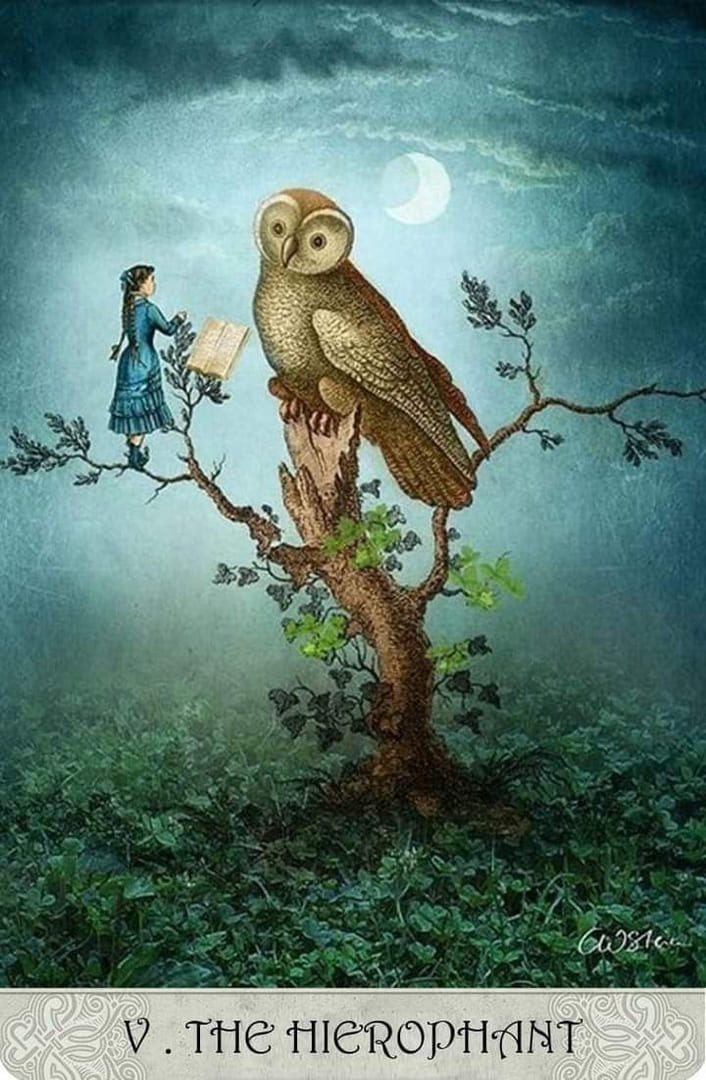
The Hierophant
Tradition, inherited wisdom, spiritual lineage. When the Hierophant appears in ancestor work, it often points to spiritual or religious traditions in your lineage — practices that were important to your ancestors and may hold value for you, even in modified form.
The Six of Cups
Memory, childhood, inheritance. This card often represents the emotional legacy of your family — the feelings, reactions, and relational patterns that were modeled for you before you were old enough to question them.
The Ten of Pentacles
Family legacy, generational wealth (and generational debt). This card speaks to what was built and what was lost across generations — property, status, community ties, cultural identity.
Judgement
Ancestral calling. This card in ancestor work often signals that something buried in your lineage is rising to the surface, asking to be acknowledged and transformed. It’s the ancestors calling you to wake up to something they couldn’t resolve in their lifetimes.
The Empress and Emperor
These often represent specific maternal and paternal ancestors, or the broader energies of the maternal and paternal lines. Pay attention to which one appears — it may point you toward the side of your lineage that needs attention.
Court cards
In ancestor readings, court cards frequently represent specific ancestor figures. Notice which suit appears — Cups ancestors carried emotional wisdom, Pentacles ancestors built material foundations, Swords ancestors navigated intellectual or communicative challenges, Wands ancestors held creative or spiritual fire.
Healing inherited patterns
One of the most powerful applications of ancestor work is identifying and healing patterns that have been passed down through generations. These might include:
- Relationship patterns — Codependency, emotional unavailability, or conflict styles that repeat generation after generation
- Money patterns — Scarcity mentality, financial anxiety, or the inability to hold onto wealth
- Emotional patterns — Unexpressed grief, suppressed anger, chronic anxiety that seems to have no personal origin
- Identity patterns — Beliefs about who you’re allowed to be, what’s possible for you, what you deserve
The tarot can help identify these patterns and illuminate the path toward healing. But healing generational patterns is deep work. The cards can show you the pattern — actually transforming it often requires therapy, somatic work, or other healing modalities alongside your tarot practice.
The healing isn’t just for you
Here’s the beautiful thing about generational healing: when you heal a pattern in yourself, you heal it in both directions. You release the grip it has on future generations (your children, their children), and you bring peace to the ancestors who carried it before you.
You are the one in your lineage who has the awareness, the tools, and the privilege to do this work. That’s not a burden — it’s a gift.
Working with unknown ancestors
Many people feel drawn to ancestor work but face a barrier: they don’t know their ancestors. Adoption, family estrangement, migration, slavery, colonialism, war — there are countless reasons someone might not have access to their family history.
This doesn’t prevent ancestor work. Consider:
- Your body is ancestral evidence. Your bone structure, your coloring, your hands — these are your ancestors made visible. You carry their DNA.
- Your tendencies are ancestral. That inexplicable draw to certain music, certain places, certain foods — these may be ancestral echoes.
- You can work with archetypes. Instead of specific people, connect with the Grandmother, the Warrior, the Healer, the Builder — the archetypal roles your ancestors certainly filled.
- The cards will show you. When you read with the intention of connecting with your lineage, the cards will reveal patterns and energies even without names or faces.
Closing the reading
Ancestor work opens a channel. It’s important to close it consciously:
- Thank your ancestors for their presence and guidance
- Blow out the candle (if you lit one) as a symbolic closing
- Ground yourself — feet on the floor, deep breath, return to present awareness
- Journal about what came through while it’s fresh
- Follow through — if a message came with an action, take it. The ancestors appreciate when their guidance is honored with action.
A living practice
Ancestor work isn’t a one-time reading. It’s a relationship that deepens over time. You might:
- Pull a card for your ancestors on the first of each month
- Create a small ancestor altar and refresh it seasonally
- Read for your lineage on significant dates — anniversaries, birthdays of those who’ve passed, cultural holidays that honor the dead
- Pay attention to which ancestors come through most frequently in readings — they have the most to tell you
The dead are patient, but they are not silent. They speak through dreams, through patterns, through the strange way certain cards keep appearing in your readings.
Listen. They’ve been waiting.
Frequently Asked Questions
What is ancestor work in tarot?
Ancestor work in tarot uses the cards as a bridge between you and the wisdom of those who came before you. This can mean connecting with known family members who've passed, with ancestral lineages you may not know personally, or with the broader concept of inherited patterns and wisdom. The cards serve as a symbolic language through which ancestral messages can be received, interpreted, and integrated into your present life.
Do I need to know my ancestors to do ancestor work with tarot?
No. Many people are adopted, have fragmented family histories, or come from lineages that were disrupted by migration, war, or systemic oppression. Ancestor work doesn't require genealogical knowledge — it works with the energy and patterns you carry in your body, your habits, and your unconscious tendencies. You are the living evidence of your ancestors. The cards can help you connect with what they passed down, even if you don't know their names.
What tarot cards represent ancestors?
Several cards naturally resonate with ancestor work: The Hierophant (tradition, inherited wisdom, spiritual lineage), The Empress and Emperor (maternal and paternal lines), the Six of Cups (memories, childhood, inherited emotional patterns), the Ten of Pentacles (family legacy, generational wealth and wounds), Judgement (ancestral calling, awakening to inherited purpose), and The World (completing ancestral cycles). Court cards often appear as specific ancestor figures in readings.
Is ancestor work with tarot cultural appropriation?
Ancestor work exists across virtually every human culture — it's not exclusive to any single tradition. Honoring your own ancestors is your birthright regardless of your background. The key is to engage with YOUR lineage respectfully and authentically rather than adopting specific rituals from traditions that aren't yours. If you're drawn to a specific cultural framework for ancestor work, learn about it deeply and respectfully rather than borrowing surface-level practices.