Tarot Court Cards Explained: Kings, Queens, Knights & Pages
The 16 cards everyone struggles with
If you’ve ever pulled a court card and thought “okay, but what does this actually mean?” — you’re not alone. Court cards are the single most confusing group in the tarot deck. Ask ten readers how they interpret them and you’ll get ten different answers.
The confusion makes sense. Major Arcana cards carry big, unmistakable energy. Numbered cards describe situations and emotions with relative clarity. But court cards? They sit in an ambiguous space between person and energy, between someone in your life and an aspect of yourself. That ambiguity is what makes them hard — and powerful.
This guide breaks down all 16 court cards by rank and suit, gives you multiple ways to interpret them, and helps you figure out which approach works for your reading style.
The four ranks: a maturity spectrum
Think of the four court card ranks as a spectrum from raw potential to full mastery:
Pages — the student
Pages represent beginnings, curiosity, messages, and youthful energy. They’re the youngest court card — eager but inexperienced, excited but naive.
As a person: A young person, a student, a beginner, someone new to a situation. Not necessarily young in age — a 50-year-old starting a new career is very much Page energy.
As energy: Learning mode. Openness to new experiences. Beginner’s mind. The excitement (and clumsiness) of doing something for the first time.
As advice: Stay curious. Be willing to learn. Don’t pretend to know more than you do. Start small and build.
As a message: Pages often literally represent messages or news. A Page in a reading can mean information is coming — an email, a conversation, an invitation, a revelation.
Knights — the quester
Knights represent action, pursuit, movement, and sometimes obsession. They’re the teenagers of the court — energetic, driven, but not always wise about when to stop.
As a person: Someone on a mission. Someone pursuing a goal with intensity. A suitor, a competitor, a crusader for a cause.
As energy: Active pursuit. Forward momentum. The kind of energy that can be inspiring or exhausting depending on whether it’s balanced. Knights don’t sit still.
As advice: Take action. Stop planning and start doing. But watch for the Knight’s shadow — going so hard after one thing that you neglect everything else.
As timing: Knights suggest things happening quickly. When a Knight appears, movement is imminent or already underway.
Queens — the inner master
Queens represent inner mastery of their suit’s element. They’ve internalized the lessons and express the energy with depth, nuance, and emotional intelligence. Queens hold space.
As a person: Someone with deep expertise expressed through receptivity rather than force. Someone who leads by understanding, not by commanding. A counselor, a mentor, a deeply skilled practitioner.
As energy: Mature, integrated expression of the suit’s qualities. The Queen doesn’t just use the element — she embodies it. She is the element.
As advice: Go inward. Master this energy within yourself before trying to project it outward. Hold space rather than forcing outcomes. Lead with empathy.
Kings — the outer master
Kings represent external mastery — authority, structure, and the ability to govern their suit’s element in the world. Where Queens embody, Kings command.
As a person: Someone in a position of authority or expertise. A boss, a father, a leader, an expert whose mastery is visible and recognized by others.
As energy: Structured, established, sometimes rigid. The King has built something and now maintains it. His power comes from experience, but his shadow is inflexibility.
As advice: Take charge. Use your expertise. Make decisions from a position of authority and experience. But watch for the King’s shadow — being so attached to control that you can’t adapt.
The four suits: what kind of energy
Each suit colors the court cards with a specific element and domain:
Wands — fire, creativity, passion
Page of Wands: A spark of creative inspiration. An exciting idea. A young person full of enthusiasm and big plans. The student who can’t wait to start.
Knight of Wands: Action on creative impulse. Someone who charges ahead with confidence and charisma. Fast-moving, adventurous, sometimes reckless. “Let’s do it now and figure out the details later.”
Queen of Wands: Creative confidence mastered. She walks into a room and the energy shifts. Warm, magnetic, creative, fiercely independent. She inspires others simply by being fully herself.
King of Wands: The visionary leader. Big-picture thinking, entrepreneurial energy, someone who turns creative ideas into empires. Charismatic authority with natural leadership.
Cups — water, emotions, relationships
Page of Cups: Emotional openness. A sensitive, dreamy nature. Creative intuition. Sometimes a message about love or an emotional revelation. The child who talks to imaginary friends — and they answer.
Knight of Cups: The romantic pursuer. Idealistic love, artistic passion, following the heart without much concern for practicality. A proposal, an invitation, a grand romantic gesture.
Queen of Cups: Emotional depth mastered. Intuitive, empathic, nurturing without losing herself. She feels everything but isn’t overwhelmed by it. The counselor who knows what you need before you say it.
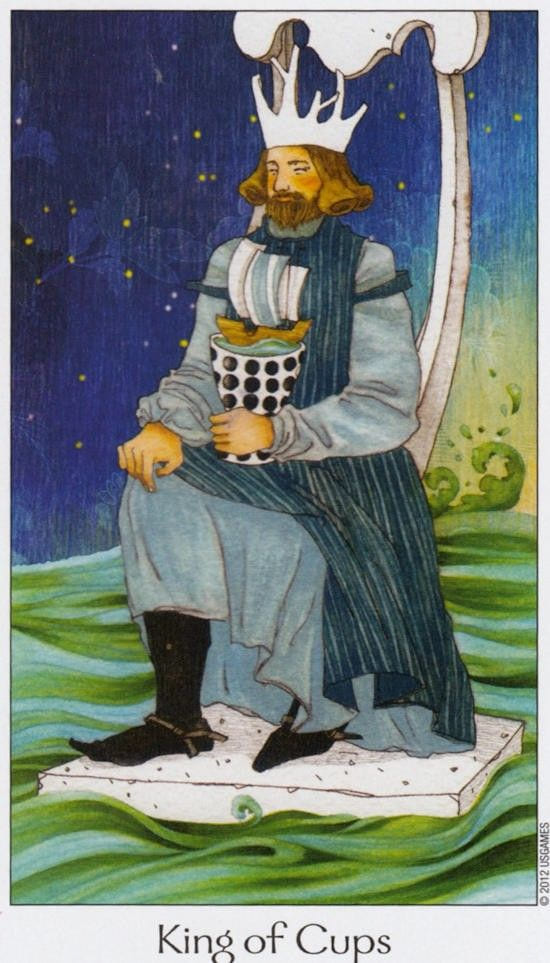
King of Cups: Emotional maturity in action. He has seen everything — heartbreak, joy, loss, love — and responds with calm compassion. Not cold, not detached. Present and stable.
Swords — air, intellect, truth
Page of Swords: Curious mind, sharp observations. Someone asking questions, researching, investigating. Can also mean gossip or surveillance — the Page who sees and reports what others miss.
Knight of Swords: Intellectual aggression. Charging into debates, cutting through lies, demanding truth at any cost. Fast, direct, sometimes cutting. The person who says exactly what they think without filtering.
Queen of Swords: Intellectual clarity mastered. She sees through pretense instantly. Honest to the point of bluntness, independent, emotionally self-sufficient. Often represents someone who has survived loss and emerged sharper for it.
King of Swords: Analytical authority. Decisions made with logic, fairness, and precision. A judge, a lawyer, a leader who governs with intellect. Fair but sometimes cold.
Pentacles — earth, material world, stability
Page of Pentacles: A student of practical skills. Someone beginning to build something tangible — a career, a savings plan, a craft. Diligent, focused, methodical. The person who actually does their homework.
Knight of Pentacles: Slow, steady, reliable progress. The opposite of the Knight of Swords — this Knight doesn’t rush. He shows up every day, does the work, and builds brick by brick. Not exciting, but effective.
Queen of Pentacles: Practical nurturing mastered. She creates beautiful, comfortable, abundant spaces. A provider who makes security feel warm rather than boring. Good with money, good with people, good with physical reality.
King of Pentacles: Material success established. Wealth, stability, a business or empire built through patience and skill. Generous with resources, reliable, sometimes overly focused on the material at the expense of the spiritual.
Three ways to read court cards
When a court card appears in a reading, it can mean different things depending on context. Here are three approaches:
1. As a person in your life
The most traditional interpretation. Court cards can represent specific people connected to the question. The suit often indicates their personality type, and the rank suggests their role or maturity.
Clues it’s a person: The question is about relationships, the card is in a position representing “another person,” or the card’s energy strongly reminds you of someone specific.
2. As an aspect of yourself
Court cards can represent an energy you’re currently embodying — or one you need to embody. The Queen of Pentacles might mean you need to tap into your practical, nurturing side. The Knight of Swords might mean you need to be more direct and assertive.
Clues it’s about you: The question is about personal growth, the card is in a position about your behavior or attitude, or the energy doesn’t match anyone you know.
3. As advice for how to approach the situation
This is my favorite interpretation. Read the court card as a suggestion: “Handle this situation the way this court card would.”
The King of Cups says: approach this with emotional maturity and calm. The Page of Wands says: approach this with enthusiasm and willingness to experiment. The Queen of Swords says: approach this with clear-eyed honesty and cut through the nonsense.
Court cards reversed
Reversed court cards typically show the shadow side of the personality:
- Reversed Pages: Immaturity, naivety, being too scattered to learn anything properly
- Reversed Knights: Obsession, recklessness, stagnation (too much or too little action)
- Reversed Queens: Manipulation, emotional withholding, using mastery for selfish ends
- Reversed Kings: Tyranny, rigidity, abuse of authority, stubbornness disguised as leadership
The reversed court card asks: where is this energy going wrong? Where has a strength become a liability?
The trick that unlocks court cards
Here’s what changed everything for me: stop trying to figure out what a court card means in isolation. Read it in the context of the cards around it.
A King of Swords next to the Three of Cups is a very different energy than a King of Swords next to the Five of Swords. The first might be a wise leader at a celebration. The second might be someone using intellect as a weapon.
Court cards are relational. They come alive in combination. If you’ve been staring at a court card feeling stuck, look at its neighbors. The story will emerge.
Frequently Asked Questions
Do court cards always represent actual people?
No. Court cards can represent people, but they also commonly represent energies, personality traits, roles, or stages of development. A Queen of Swords in a reading might mean a specific sharp-witted woman in your life, or it might mean you need to embody that energy yourself — clear thinking, emotional detachment, honest communication. Context and position determine which interpretation fits.
What's the difference between a Knight and a King in tarot?
Knights are active, in-motion energy — they pursue, quest, and sometimes obsess. Kings are mature, stable energy — they've mastered the suit's element and govern it wisely (or rigidly). Think of Knights as someone chasing a goal and Kings as someone who has already achieved authority. A Knight of Cups is falling in love. A King of Cups has learned emotional mastery.
Can court cards represent someone of a different gender?
Absolutely. Despite the gendered titles, court cards are not limited by gender. A Queen of Wands can represent a man who embodies creative leadership and charisma, and a King of Pentacles can represent a woman who has built financial stability. Many modern readers interpret court cards purely by energy and maturity level, not by gender.
Why are court cards so hard to read?
Court cards are harder because they're more ambiguous than other cards. A numbered card usually describes a situation or emotion. A court card can be a person, an aspect of yourself, an energy to embody, or advice about how to approach something. That flexibility makes them powerful but also confusing for beginners who want one clear answer.