The Dark Side of Manifestation Culture: What TikTok Won't Tell You
The algorithm that sells you your own desire
Open TikTok right now and search “manifestation.” You’ll find millions of videos promising that if you think hard enough, believe deeply enough, and repeat the right affirmations at 3:33 AM, the universe will deliver your dream job, your soulmate, your six-figure income.
The comments are full of people typing “claiming this” and “this is my sign.”
I’m not here to mock them. I understand the appeal. When life feels chaotic and uncontrollable, the idea that your thoughts can shape reality is profoundly comforting. It gives you a sense of agency in a world that often feels like it has none.
But I am here to talk about what happens when that comfort becomes a cage. Because manifestation culture — as it exists on social media in 2026 — has a dark side that nobody making money from it wants to discuss.
The billion-dollar thought industry
Let’s start with the money, because someone is always making money.
Manifestation has become a market. There are manifestation coaches charging hundreds per session. Manifestation journals ($30-50 each, new editions every season). Manifestation courses ($197 to $2,000+). Manifestation apps with subscription models. Manifestation retreats. Manifestation certifications.
The global “personal development” market is valued at over $40 billion. A significant slice of that comes from manifestation-adjacent content. This isn’t a grassroots spiritual movement anymore. It’s an industry.
And like any industry, it needs you to keep buying.
Here’s the mechanism: you try to manifest something. It doesn’t work. The coach or course or book tells you the problem is your “blocks,” your “vibration,” your “limiting beliefs.” The solution? Buy the next course. Hire the next coach. Get the upgraded journal.
Notice the structure: the system never fails. YOU fail. And the cure for your failure is always more product.
”You attracted this”: the cruelest idea in spirituality
This is where manifestation culture goes from misguided to genuinely harmful.
If your thoughts create your reality, then logically, everything bad that happens to you is something you attracted. Lost your job? Your vibration was off. Got sick? You manifested it with negative thinking. Experienced abuse? On some level, you drew it to you.
I want to be very clear: this is victim-blaming wearing a spiritual costume.
No child “attracts” abuse. No person in poverty “manifests” systemic inequality. No one with cancer thought their way into it. The idea that suffering is a product of wrong thinking is not just incorrect — it’s cruel. And it’s being sold to millions of people as enlightenment.
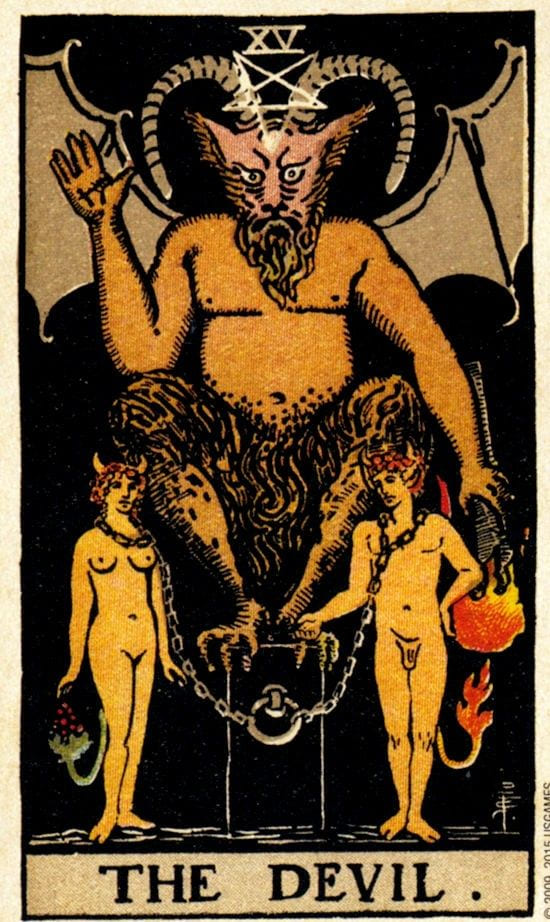
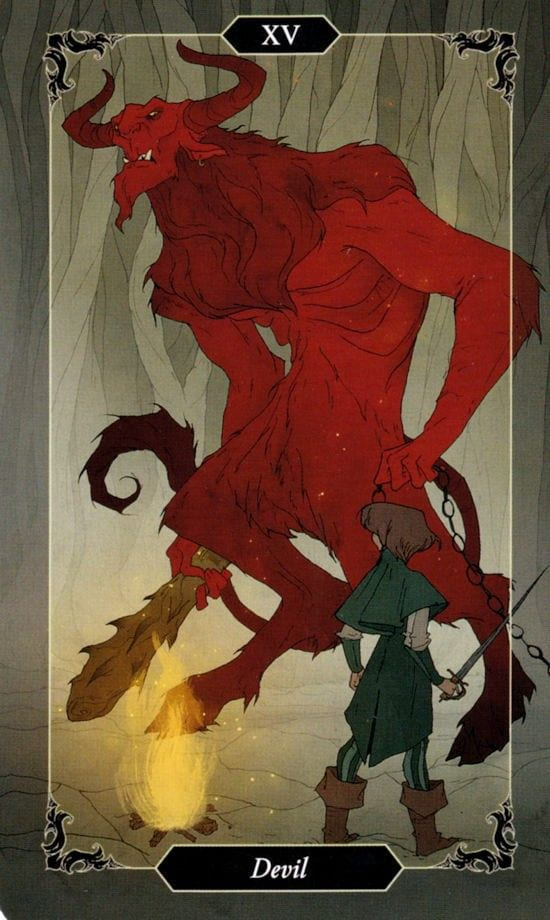
The Devil card in tarot shows two figures chained loosely to a pedestal. The chains are loose enough to remove — but the figures don’t seem to notice. That’s what manifestation culture does: it makes you believe the chains are your choice, that your bondage is a mindset problem rather than a structural one.
The privilege nobody talks about
Manifestation culture works best for people who already have advantages. If you have a stable income, a support system, good health, and access to education, then “setting intentions” and “taking aligned action” can genuinely help you focus and achieve goals. Not because the universe is responding to your vibration — but because you have the resources to act on your intentions.
For someone working three jobs, navigating systemic racism, managing a chronic illness, or surviving domestic violence, “just manifest it” isn’t inspiring. It’s insulting. It erases the structural barriers that no amount of positive thinking can dissolve.
The most popular manifestation influencers tend to be young, attractive, able-bodied, and at least middle-class. Their “proof that manifestation works” is usually correlation dressed as causation. They attribute their success to mindset while ignoring the material advantages that made that success possible.
The anxiety of monitored thoughts
Here’s something that doesn’t get discussed enough: manifestation culture creates a new form of anxiety.
If your thoughts create your reality, then every negative thought becomes dangerous. Worried about losing your job? You’re manifesting it. Scared about your health? You’re attracting illness. Feeling hopeless about a relationship? You’re pushing love away.
This creates a state of hypervigilance — constantly monitoring your own thoughts, suppressing “negative” ones, forcing positive replacements. It’s exhausting. And ironically, the stress of trying to control your thoughts is worse for your health and wellbeing than the original thoughts ever were.
Therapists have a name for this pattern: thought suppression. Research consistently shows that trying to suppress thoughts makes them more frequent and more distressing. Manifestation culture has essentially turned a well-documented psychological problem into a spiritual practice.
What tarot does differently
I spend my life working with tarot, so I’m biased. But here’s what I genuinely believe makes tarot a more honest framework than manifestation culture:
Tarot shows you the whole picture. When you pull the Tower, it doesn’t say “think more positively about this collapsing situation.” It says: “Something is falling apart. Here’s what it means. Here’s how to move through it.” Tarot acknowledges that life includes destruction, loss, grief, and stagnation. It doesn’t pretend these can be vibration-ed away.
Tarot doesn’t promise outcomes. A reading shows you patterns, possibilities, and things you might not be seeing. It doesn’t guarantee that your ex will come back or that you’ll get the promotion. That honesty is uncomfortable but far more useful than a false promise.
Tarot invites action, not wishful thinking. The Eight of Pentacles doesn’t say “manifest mastery.” It says: “Sit down and do the work. Put in the hours. Build the skill.” The Chariot doesn’t say “visualize success.” It says: “Grab the reins and steer. This requires your active effort.”
Tarot normalizes difficulty. A deck with no Tower, no Death, no Three of Swords would be dishonest. These cards exist because hardship exists. Tarot doesn’t pathologize struggle — it contextualizes it. “You’re going through the Tower” is a more compassionate framework than “you attracted this with your energy.”
Tarot honors complexity. Manifestation culture deals in simple formulas: think positive → get results. Tarot operates in paradox: the Death card means transformation AND loss. The Devil means bondage AND self-awareness. The Moon means intuition AND deception. This complexity mirrors real life better than any affirmation ever could.
The cards manifestation culture doesn’t want you to pull
If manifestation culture were a tarot reading, it would only show you the Sun, the Star, and the Ace of Pentacles. Sunny, abundant, hopeful.
But an honest reading includes these too:
The Tower (XVI) — Sometimes things fall apart and it’s not because you thought wrong. Sometimes systems fail. Sometimes life is just chaotic. The Tower teaches that destruction can be necessary for growth, but it doesn’t pretend destruction is pleasant or chosen.
The Five of Pentacles — Financial hardship. Being outside in the cold. Manifestation culture would say you vibrated yourself into this. The Five of Pentacles says: this is real suffering, and there’s help available if you can see it (notice the lit church window in the background).
The Ten of Swords — Rock bottom. Betrayal. An ending you didn’t choose. No amount of affirmations prevented this. But the dawn on the horizon says: this is the end, and something new will begin. Not because you manifested it, but because that’s how cycles work.
The Wheel of Fortune — This card is the real “law of attraction.” Things go up. Things come down. You’re not controlling the wheel. You’re riding it. Sometimes you’re on top; sometimes you’re not. Acceptance of this cycle is more liberating than the illusion of total control.
How to reclaim your spiritual practice
If you’re reading this and recognizing some of these patterns in your own life, here’s what I’d suggest:
Detox your feed. Unfollow accounts that make you feel anxious about your thoughts or guilty about negative emotions. If a spiritual teacher’s primary message is “buy my course to unlock abundance,” they’re selling product, not wisdom.
Separate intention-setting from magical thinking. Setting clear goals, visualizing what you want, and taking action toward it — that’s healthy and useful. Believing that your thoughts alone will change external reality without action — that’s magical thinking.
Allow yourself to feel bad. Grief, anger, fear, sadness — these are information. They’re telling you something about your life that deserves attention, not suppression. Pulling the Three of Swords doesn’t mean you’ve failed at positivity. It means something hurts, and acknowledging that hurt is the beginning of healing.
Ask better questions. Instead of “how do I manifest what I want?” try “what’s actually within my control here?” Instead of “why am I attracting bad things?” try “what circumstances am I dealing with, and what support do I need?”
Use tarot for honesty, not reassurance. Don’t pull cards hoping for the Star. Pull cards asking: “What do I need to see right now?” The answer might be uncomfortable. That discomfort is the whole point.
The card I’d give manifestation culture
If I could assign one tarot card to manifestation culture, it would be The Devil reversed.
The Devil upright is about chains — beliefs, addictions, patterns that keep you stuck while you think you’re choosing them. Manifestation culture upright IS The Devil: it convinces you that you’re empowered while actually keeping you in a cycle of self-blame and consumption.
The Devil reversed is breaking free. Seeing the chains. Realizing the pattern. Walking away from the thing that promised liberation but delivered dependency.
That’s the invitation. Not to abandon hope or stop dreaming. But to dream with your eyes open. To pursue what you want with action, honesty, and an acknowledgment that the world is more complex than any affirmation can capture.
The cards will always tell you the truth. The question is whether you’re ready to hear it.
Frequently Asked Questions
Is manifestation culture harmful?
It can be. When manifestation culture tells people that their thoughts create their reality, it implies that poverty, illness, and trauma are the result of wrong thinking. This is victim-blaming dressed as empowerment. The culture also creates anxiety about 'negative thoughts' and funds a billion-dollar coaching industry that profits from people's insecurities.
What's wrong with the law of attraction?
The law of attraction ignores systemic barriers like poverty, racism, and disability. It implies that people who suffer simply didn't think positively enough. It also creates a feedback loop: if manifestation didn't work, you must not have believed hard enough — which keeps you buying more courses and journals instead of addressing real obstacles.
How is tarot different from manifestation culture?
Tarot shows you the full picture — including the uncomfortable parts. When the Tower appears, it doesn't say 'just think positive.' It says 'something is collapsing, and here's how to survive it.' Tarot acknowledges difficulty, encourages honest reflection, and doesn't promise that your thoughts alone can change external reality.
Can you manifest things with tarot cards?
Tarot can help you clarify intentions and identify blocks, which supports goal-setting. But it doesn't claim to bend reality through positive thinking. A tarot reading might reveal that your career goal requires a difficult conversation or a new skill — real actions, not just visualization. That honesty is what makes tarot useful.