Death Tarot as Feelings: The Love That Had to End So the Real One Could Begin
The most feared card. The most misunderstood feeling.
Everyone is afraid of Death.
Not the card — though that too. Everyone is afraid of the feeling Death represents: the recognition that something you loved, something you built, something you were sure would last, has reached the end of its natural life. Not because it was destroyed. Not because someone ruined it. Because it grew as far as it could in its current form, and continuing to force it to stay alive would be crueler than letting it go.
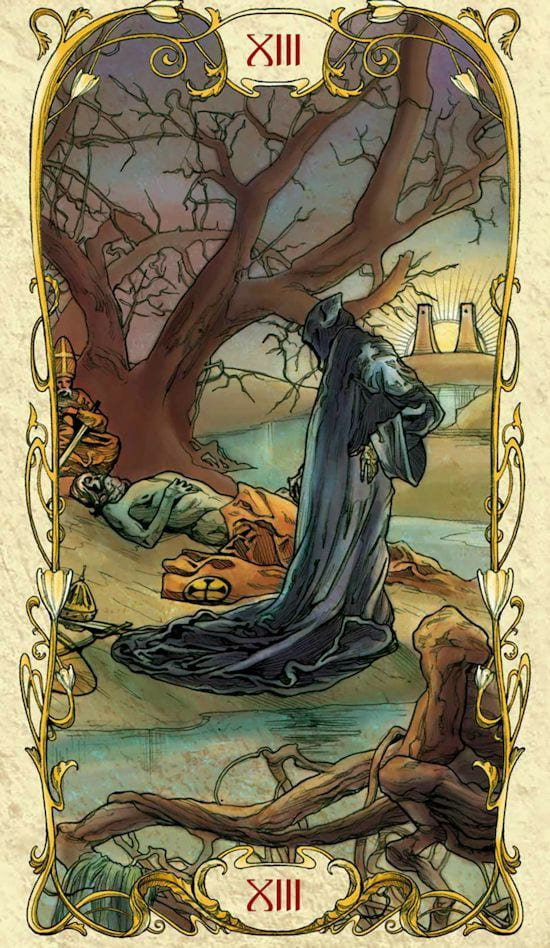
That’s what most people don’t understand about Death as feelings. It’s not murder. It’s harvest. The skeleton on the pale horse isn’t killing things — he’s collecting what has already died. The bodies on the ground? They were dead before he arrived. He’s just the one who makes it official.
Look at the white rose on his banner. Five petals. Purity. Life. In the middle of all this ending — a beginning. Death carries new life with him everywhere he goes. He can’t help it. That’s his actual function: not to destroy, but to clear the field so something can grow that couldn’t grow before.
When someone feels Death toward you, they are not feeling nothing. They are feeling everything change at once — and they may not have words for it yet because the old words don’t fit anymore and the new ones haven’t arrived.
Upright: as feelings for you
When Death appears upright in the feelings position, the person feels:
The end of one way of loving you. This is critical: Death as feelings rarely means “I stopped loving you.” It usually means “the way I loved you before is over.” Maybe they loved you as an idea and now see you as a person. Maybe they loved you from obligation and now it’s transforming into choice. Maybe they loved you casually and something happened that made the casual version impossible — now it’s either real or nothing. The old love died. What’s replacing it is more honest.
Acceptance of an irreversible change. Something shifted and it can’t shift back. A conversation. A betrayal. A revelation. A moment of clarity that cut through every comfortable lie. Death as feelings is the person who looked at the relationship — at you, at themselves, at the dynamic between you — and saw clearly, maybe for the first time, what was alive and what was already gone. And they accepted it. That acceptance is the transformation.
Release of what they were holding onto. Every relationship accumulates dead weight — expectations that were never realistic, versions of each other that no longer exist, promises made by people you both used to be. Death as feelings is the moment someone stops carrying all of that and sets it down. Not with resentment. With the quiet exhaustion of someone who has been gripping a rope that’s no longer attached to anything.
Grief that is also relief. This is the part nobody talks about. Death as feelings often carries both sadness and liberation simultaneously. They’re grieving the loss of what was — and breathing easier because of it. These two things are not contradictions. They’re what transformation actually feels like: the ache of the ending and the oxygen of the opening, at the same time, in the same breath.
The recognition that staying would be a kind of death too. Sometimes the deepest expression of Death as feelings is this: they realized that NOT changing — staying in the old dynamic, maintaining the old pretenses, keeping the dead thing alive through sheer effort — would kill something more important than the relationship. Their authenticity. Their growth. Their ability to love honestly. Death chose the living thing over the dead one.
Reversed: as feelings for you
When Death appears reversed in the feelings position:
Refusing to let go. They know something has ended. They can feel it — the emptiness where the connection used to be warm, the scripts that don’t work anymore, the motions they go through without feeling. But they won’t release it. They keep watering the dead plant. They keep setting the table for a guest who left. The reversed Death as feelings is the most exhausting position in tarot — the energy of maintaining something that has already stopped breathing.
Clinging to an old version of you. They love who you were, not who you are. The reversed Death person is in a relationship with a memory — the version of you from six months ago, two years ago, the beginning. Every time present-you fails to match past-you, they feel betrayed. They don’t understand that you changed because people change. They want the original model back. It’s gone.
Fear that transformation means total loss. “If I let this change, I’ll lose everything.” That’s the core terror of reversed Death as feelings. They believe — incorrectly — that allowing the relationship to transform means watching it disappear. They can’t see that the caterpillar doesn’t die when it becomes a butterfly. It just stops being recognizable. And that loss of recognition is what they can’t bear.
Stagnation disguised as loyalty. “I’m staying because I committed to this.” But commitment to something dead isn’t loyalty — it’s denial. The reversed Death as feelings can mean someone who wears their refusal to change as a virtue, when it’s actually preventing both of you from growing. Their grip on the old form isn’t love. It’s rigor mortis.
Context: Death as feelings in different situations
As someone you’re dating
Upright: Something fundamental is shifting. The honeymoon phase is ending — not the relationship, but the version of it that was based on projection, fantasy, and best-behavior performance. What’s emerging is rawer, more real, and potentially more lasting. Death in early dating isn’t a breakup card. It’s a “this just got serious” card. The question is whether both of you are ready for the real version of each other.
Reversed: They’re holding onto the early magic and refusing to let the relationship deepen into something messier and more honest. Every relationship eventually passes through Death — the point where two people stop performing and start being. The reversed Death person is trying to keep the performance going. It can’t last.
As an ex’s feelings
Upright: They’ve let you go. Not with anger, not with indifference — with the mature, painful acceptance that what you were has completed its cycle. This is the ex who can see you at a party and feel both sadness and peace simultaneously. They’re not pretending it didn’t matter. They’re acknowledging that it mattered enough to deserve a proper ending instead of being dragged along half-alive.
Reversed: They haven’t let go. The relationship ended officially but not emotionally. They’re carrying the corpse of what you were and refusing to put it down. This can look like obsession, like nostalgia, like those late-night texts that seem to come from another era. The reversed Death as an ex’s feelings is the inability to accept that the story is finished.
As a new connection
Upright: Meeting you is ending something in their life — an old pattern, a self-concept, a way of being in relationships. You represent the new thing that grows in the cleared field. They may feel simultaneously excited and grieving — thrilled by what you offer, mourning what they have to release to receive it. You are their autumn. What grows after you will be different from everything that came before.
Reversed: They want you but can’t let go of the old story enough to make room. Previous relationship, previous identity, previous way of loving — it’s all still taking up space. The reversed Death for a new connection is the person who shows up with too much luggage and no willingness to unpack it.
Death vs. other “ending” cards as feelings
Death vs. The Tower: The Tower is lightning — sudden, shocking, destructive without warning. Death is autumn — gradual, inevitable, organic. The Tower as feelings is “everything I believed about us just shattered.” Death as feelings is “I’ve slowly come to accept that this chapter is complete.” One is trauma. The other is maturity.
Death vs. Eight of Cups: The Eight of Cups walks away from what no longer fulfills — a conscious, somewhat melancholy departure. Death doesn’t walk away. Death transforms in place. The Eight as feelings is “I’m leaving.” Death as feelings is “I’m changing, and the old me — the one who loved you that way — no longer exists.”
Death vs. Ten of Swords: The Ten of Swords is overkill — the dramatic, painful, definitive end. It’s theatrical in its finality. Death is quiet. Natural. Almost gentle. The Ten of Swords as feelings is “this destroyed me.” Death as feelings is “this completed itself.”
What Death as feelings is really telling you
Here’s the truth about Death that nobody in the feelings position wants to hear:
If someone feels Death toward you, the version of love you had is over. But “over” and “gone” are not the same word.
The white rose on Death’s banner says it clearly: life follows death. Not despite death. Through death. The composting is the beginning. The clearing is the planting. The ending is the seed.
Whatever this person felt for you in its old form has completed its cycle. What emerges from that completion — if anything emerges — will be unrecognizable compared to what was. And that’s the point. Transformation isn’t renovation. You don’t get back a prettier version of the same house. You get a completely different structure built on the same ground.
The skeleton rides forward. He never looks back. And in his hand, the white rose blooms.
Not despite the ending. Because of it.
Try it yourself
Pull a card with this question: “What in my emotional life has already died but I’m still carrying?”
Because Death isn’t just about how someone else feels about you. It’s about the terrifying, liberating possibility that some of the feelings you’re holding onto — about yourself, about a person, about a future you planned — have already completed their cycle. And the most loving thing you can do is set them down, gently, with the white rose, and see what grows in the space they leave behind.
The field isn’t empty after the harvest. It’s ready.
Frequently Asked Questions
What does the Death card mean as someone's feelings for me?
When Death appears as feelings, the person's emotions about you are undergoing fundamental transformation. Something in how they feel is ending — not necessarily the feeling itself, but the old form it took. They may be releasing an outdated version of the relationship, shedding old expectations, or accepting that what you are to each other has permanently changed. The white rose says: something is already growing.
Does Death as feelings mean the relationship is over?
Not always — and this is the most misread card in tarot. Death means an ending, yes, but endings create space for beginnings. If the relationship was built on pretense, obligation, or an old dynamic that stopped working, Death is clearing that away. What remains — if anything remains — will be more real than what was lost.
What does Death reversed mean as feelings?
Reversed, Death as feelings means the person is resisting a transformation they know needs to happen. They're clinging to an old version of their feelings, an old dynamic, an old story about you — because letting go feels like losing you entirely. They don't understand yet that what they're holding onto is already dead, and their grip is what's preventing the new thing from being born.
How is Death different from The Tower as feelings?
The Tower is sudden, violent, involuntary destruction — lightning that strikes without warning. Death is organic, inevitable, natural transition — the autumn that follows summer whether you're ready or not. The Tower as feelings is shock. Death as feelings is acceptance. The Tower destroys illusion. Death composts reality.