Eight of Cups Meaning: Walking Away & the Courage to Leave What's 'Fine'
First impression
This is the quietest card in the deck.
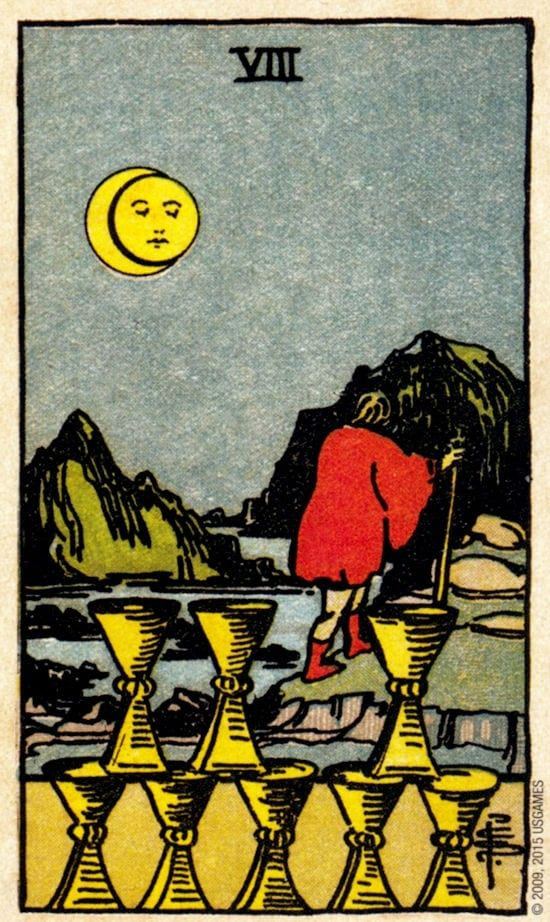
No swords. No conflict. No tower crumbling, no wheel turning, no lightning bolt splitting the sky. Just a figure in a red cloak, walking away from eight golden cups arranged neatly on the ground, heading toward a gap in the mountains under a half-hidden moon.
Nobody is chasing him. Nobody wronged him. The cups aren’t cracked or empty — they’re whole, standing upright, perfectly fine. And he’s leaving them anyway.
That’s what makes the Eight of Cups so deeply uncomfortable. It’s not a card about escaping something terrible. It’s a card about leaving something that’s fine. Something that’s okay, adequate, not bad enough to justify the drama of departure — but not good enough to make you feel alive.
The first time I pulled this card, I was in a job I didn’t hate. Not toxic, not abusive, not even particularly stressful. Just… hollow. Like eating food that fills your stomach but has no flavor. The Eight of Cups appeared and I felt my chest tighten — not because the card was scary, but because it was true. I already knew I was leaving. I just hadn’t admitted it yet.
This is the card that shows up when you’ve known for months what you need to do and have been pretending you don’t.
Symbolism
The eight cups are arranged in two rows — five on the bottom, three on the top, with a gap where a fourth cup should be. Something is already missing. The arrangement looks complete from a distance, but up close, there’s an absence. That missing space is the whole story: you can have almost everything and still feel the gap.
The cups aren’t broken. They’re not spilling. They represent real things — relationships, achievements, comforts, connections — that once brought happiness. The Eight of Cups doesn’t ask you to dismiss what you had. It asks you to be honest that it’s no longer enough.
The figure walks away from the viewer — turned away, face hidden. This is private grief. Not the public drama of the Tower or the visible despair of the Five of Cups. This is someone who has quietly decided, probably after a long time of trying to make it work, that staying would cost more than leaving.
The red cloak and red boots connect him to passion, physical reality, and life force. This person isn’t numb. They feel everything. The departure isn’t cold — it’s an act of deep feeling, the painful acknowledgment that emotion alone can’t make a wrong situation right.
The mountains ahead represent the unknown — difficult terrain, challenges, uncertainty. He’s walking toward hard things on purpose. The Eight of Cups doesn’t promise the next chapter will be easier. It promises it will be more honest.
The moon is the card’s most haunting detail. It’s an eclipse — a waning crescent overlapping a full circle, the emotional self (moon) covering the conscious self (sun). This departure is guided by feeling, not logic. You can’t explain this decision on a spreadsheet. You know it in your bones.
The water between the cups and the mountains represents the emotional threshold he has to cross. There’s no going back dry. Leaving means getting wet — going through the feelings, not around them.
Upright meaning
The Eight of Cups upright is deceptively simple in its message: leave.
But the word “leave” doesn’t capture the nuance. This isn’t the Tower’s forced exit or the Death card’s transformation. This is a chosen departure from something that still functions. And that’s exactly why it’s so hard.
The necessary departure. Something in your life — a relationship, a job, a belief, a city, a friendship, a version of yourself — has run its course. Not with a bang, but with the slow, creeping realization that you’ve been performing contentment rather than experiencing it. The Eight of Cups shows up when the gap between “this is fine” and “this is what I want” has become impossible to ignore.
Emotional courage. It takes almost no courage to leave a burning building. It takes enormous courage to leave a comfortable room. The Eight of Cups is about the second kind — walking away from what works well enough because you know you’re capable of more, or different, or simply something that actually fits.
The search for meaning. Behind every departure is a question: what am I actually looking for? The Eight of Cups doesn’t always know the answer. It just knows it’s not here. Sometimes you have to leave the known to discover what’s been missing. The figure walks toward mountains, not toward a visible destination. The point isn’t where he’s going. The point is that staying stopped being an option.
Disillusionment. Not cynicism — there’s an important difference. The Eight of Cups isn’t bitter about what it’s leaving. It’s just no longer under the illusion that it’s enough. The cups were real. The joy was real. But something shifted, and now the same cups that once felt like abundance feel like a ceiling.
Doing the right thing for the wrong-feeling reasons. Nobody will congratulate you for this departure. Your friends might not understand. Your family might think you’re ungrateful. The Eight of Cups is the hardest kind of right decision — the one that looks, from the outside, like a mistake.
Reversed meaning
The Eight of Cups reversed is the departure you can’t quite make — either because you’re not ready or because you’ve realized you don’t actually need to go.
Staying when you should leave. You know the situation has expired. You feel it every day. But fear of the unknown, guilt about hurting someone, or the comfort of the familiar keeps you locked in place. The reversed Eight says: the cost of staying is higher than you think. It’s just harder to see because it’s paid in small daily installments of aliveness you don’t experience.
Coming back. Sometimes the reversed Eight means you tried to leave and returned. Not necessarily because you were wrong to go, but because you weren’t done yet — or the situation has genuinely changed enough to deserve another try. The question is whether you’re returning from strength or from fear.
Aimless wandering. You left, but you didn’t walk toward anything — you just walked away from something. Now you’re drifting, unmoored, nostalgic for what you abandoned but not committed to anything new. The reversed Eight says: leaving was the first step. The second step — committing to what comes next — is the harder one.
Choosing to stay — and meaning it. This is the most positive reading of the reversed Eight. After seriously considering departure, you choose to stay — not from fear or obligation, but from genuine recommitment. You looked at the cups, looked at the mountains, and decided the cups still have something to teach you. This is rare but real.
Fear of loss disguised as loyalty. You call it commitment, but it’s actually fear. You call it patience, but it’s actually avoidance. The reversed Eight asks you to be painfully honest about which one it is.
In love and relationships
Upright: The Eight of Cups in love readings is the card nobody wants to see, because it asks the question everyone is afraid to ask: am I staying because I want to, or because leaving is too scary to consider?
In existing relationships, this card often appears when the love is still there but the fulfillment isn’t. You’re not fighting constantly. There’s no cheating, no abuse, no obvious reason to leave. Just a growing silence where enthusiasm used to be. A partner you love but are no longer in love with. A life that looks perfect from the outside and feels hollow from the inside.
The Eight of Cups doesn’t tell you to break up. It tells you to stop pretending you haven’t noticed the gap.
For singles, this card can mean finally letting go of someone who’s been taking up space in your heart — an ex, a what-if, a fantasy relationship with someone who was never actually available. The Eight of Cups says: put them down. You can’t pick up something new while your hands are full of something old.
Reversed in love: Staying in a relationship you know you’ve outgrown. Or coming back to someone after a period of distance and discovering whether the love has truly renewed or whether you’re just lonely. The reversed Eight in love asks: if fear disappeared completely, would you still be here?
In career and finances
Upright: The Eight of Cups at work is the resignation letter you’ve been writing in your head. The career pivot you keep researching at 2 AM. The business that succeeded financially but failed to mean anything to you.
This card says: it’s okay to leave a good job for a better life. Professional success that costs you your sense of purpose isn’t success — it’s a decorated cage.
Financially, the Eight of Cups can mean walking away from a steady income to pursue something aligned with your values. It’s not reckless — it’s honest. But it requires faith in what you can’t yet see.
Reversed: Staying in a soul-crushing job because the paycheck is reliable. Turning down opportunities because they feel too uncertain. The reversed Eight in career asks: how much of your aliveness are you willing to trade for stability?
In health and wellbeing
Upright: The Eight of Cups in health readings often points to burnout — not the dramatic kind, but the chronic low-grade exhaustion of living a life that doesn’t energize you. Your body is telling you what your mind won’t admit: something needs to change. It can also indicate choosing to leave behind unhealthy habits, toxic environments, or treatment approaches that aren’t working.
Reversed: Refusing to acknowledge how depleted you are. Continuing routines that drain you because changing them feels overwhelming. The reversed Eight in health says: the first step toward feeling better is admitting how bad you actually feel.
Key combinations
Eight of Cups + The Star: Walking away leads to healing. You leave the old behind and find something luminous waiting. This is one of the most hopeful combinations in the deck — the departure is worth it.
Eight of Cups + Death: Profound transformation. You’re not just leaving a situation — you’re leaving a version of yourself. This combination marks a point of no return, and that’s the point.
Eight of Cups + The Moon: Leaving driven by intuition you can’t explain. The departure doesn’t make logical sense, but something deep inside says go. Trust it — the Moon sees what daylight can’t.
Eight of Cups + Six of Cups: Nostalgia is the trap. You’re romanticizing what you’re leaving, remembering the golden moments and forgetting why you decided to go. This combination warns: don’t let memory edit out the reality.
Eight of Cups + Four of Wands: Walking away from something to walk toward celebration. The departure leads to genuine joy. The new home, the new community, the new sense of belonging that was waiting on the other side.
Eight of Cups + Ten of Cups: The emptiness you felt was real, and what you’re walking toward is the fulfillment you’ve been missing. This powerful combination says: the cups you left behind weren’t your cups. The right ones are ahead.
Eight of Cups + Seven of Swords: Leaving without being fully honest about why. Sneaking away instead of having the conversation. This combination asks: are you departing with integrity, or are you just disappearing?
The card’s advice
The Eight of Cups doesn’t give you permission to leave. It tells you something harder: you already left.
Emotionally, you departed a while ago. Your body is still going through the motions — showing up, smiling, saying the right things — but the essential you has already walked toward the mountains. The gap in the cups isn’t new. You’ve been staring at it for months, maybe years, hoping it would fill itself.
It won’t.
Here’s what I want you to hear, because I’ve sat with this card in readings more times than I can count: leaving something that isn’t terrible is not the same as being ungrateful. You can honor what the cups gave you — the love, the security, the lessons — and still acknowledge that your time with them is done. Gratitude and departure can exist in the same breath.
Nobody talks about this kind of leaving because it doesn’t make a good story. There’s no villain. There’s no dramatic exit. There’s just a person in a red cloak, walking quietly into the dark, guided by a half-hidden moon and the ache of knowing that staying would have been the real loss.
The mountains are hard. The crossing is wet and cold. But the alternative — standing among cups that no longer fill you, performing a life you’ve already outgrown — is harder.
Go.
Try it yourself
Don’t pull cards for this one. Instead, sit with this question for five minutes in silence: “If I knew nobody would be hurt and nothing would fall apart, what would I walk away from?”
Don’t answer out loud. Don’t write it down. Just let the answer surface.
If something came up — something specific, immediate, undeniable — then you’ve already met the Eight of Cups. The card just hasn’t appeared in your readings yet because you’ve been asking the wrong questions.
The right question isn’t “should I stay?” The right question is: “have I already gone?”
Frequently Asked Questions
Does the Eight of Cups mean a breakup?
Not always, but often. The Eight of Cups signals emotional departure — choosing to leave something that no longer fulfills you. In relationships, this can mean an actual breakup, but it can also mean emotionally withdrawing while physically staying, or leaving behind a pattern within the relationship rather than the person themselves.
Is the Eight of Cups a yes or no card?
The Eight of Cups leans toward no — or more accurately, 'not this.' It suggests what you're asking about isn't where your fulfillment lies. The answer isn't in the thing you're holding onto; it's in what you haven't found yet. If you're asking whether to stay, the card says it might be time to go.
What does the Eight of Cups mean as feelings?
As feelings, the Eight of Cups indicates emotional exhaustion, disillusionment, or quiet withdrawal. The person may still care about you but feels something essential is missing. They're not angry — they're tired. This card as feelings often means someone is in the painful process of accepting that love alone isn't enough.
What's the difference between the Eight of Cups and the Five of Cups?
The Five of Cups is about grief — mourning what you've already lost while three cups remain behind you. The Eight of Cups is about choice — the cups are still there, still full, but you're choosing to walk away because they don't fill you anymore. The Five is loss. The Eight is departure. One happens to you; the other you do to yourself.