Eight of Swords Meaning: The Prison You Built Yourself (And How to Leave)
First impression
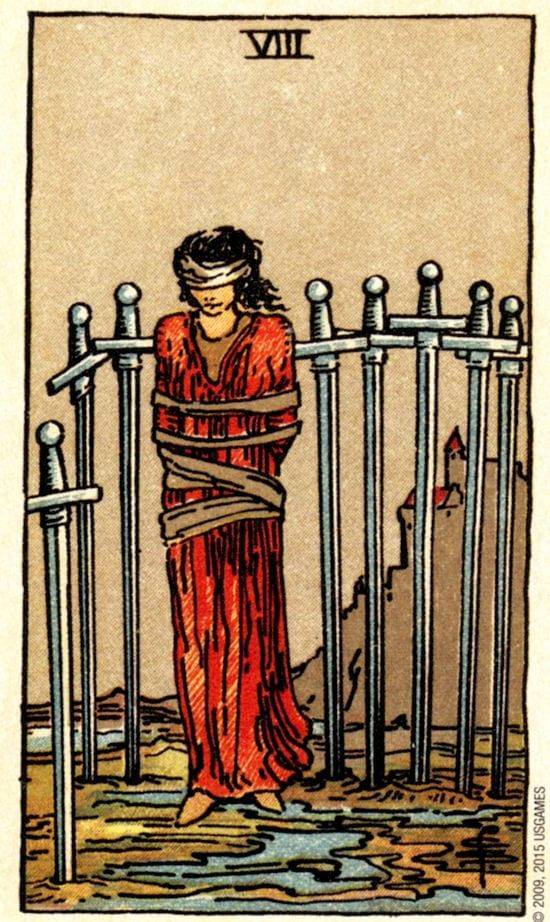
She can’t see. That’s the first thing. A blindfold covers her eyes, and she stands surrounded by eight swords planted in the mud like a fence. Her arms are loosely bound. Water pools at her feet. In the distance, a castle sits on a hill — far away, unreachable, or so it seems.
This is the card that makes people uncomfortable, and not for the reasons they expect. The Eight of Swords isn’t painful because the woman is trapped. It’s painful because she could leave — and doesn’t know it.
Look at the image closely. The bindings around her arms are loose. Not locked, not chained — wrapped. She could shake them off with effort. The swords surround her, but they don’t form a complete circle. There are gaps wide enough to walk through. The ground is muddy but solid. The castle — help, safety, another life — is visible from where she stands, if only she could see it.
But she can’t. Because of the blindfold. Because of what she believes.
The first time I pulled this card, I was convinced I had no options in a situation that, looking back, had at least four. I couldn’t see them — not because they didn’t exist, but because my fear was louder than my logic. The Eight of Swords appeared and said something I didn’t want to hear: the cage is real, but you built it. And that means you can take it apart.
That’s both the devastation and the gift of this card. The prison is yours. So are the keys.
Symbolism
The blindfold is the card’s most critical symbol. It represents the beliefs, fears, and thought patterns that prevent you from seeing your situation clearly. Not deception from outside — deception from within. You’ve convinced yourself the walls are closer than they are, the options fewer, the danger greater. The blindfold isn’t tied tightly. It could be removed. But removing it means seeing things you’ve been avoiding.
The loose bindings around her arms are the second key detail. They’re not chains. They’re not ropes pulled taut. They’re wrappings that constrain but don’t imprison — the kind you could struggle free from if you tried. They represent the habits, excuses, and self-limiting beliefs that keep you immobilized. “I can’t because…” “I’m not good enough to…” “There’s no point in trying because…”
The eight swords planted in the ground form an incomplete barrier. Count the gaps. Look at the spacing. A person could walk between them. The swords represent mental obstacles — fears, anxieties, worst-case scenarios — that feel like a cage but function more like a warning fence. They look dangerous. They may even be dangerous. But they’re not a wall.
The water at her feet represents emotions — specifically, the emotional overwhelm that makes clear thinking impossible. She’s standing in her feelings, literally. When you’re ankle-deep in anxiety, everything looks like a threat.
The castle in the background is help, safety, home — the resources and support that exist but feel impossibly far away. They’re not. The distance is an illusion created by the blindfold.
The red dress connects her to passion, life force, and the physical body. She’s not a ghost or a spirit. She’s flesh and blood, vital and alive — temporarily blinded, not permanently broken.
Upright meaning
The Eight of Swords upright is the card of the mental trap — the situation that feels inescapable but isn’t. It’s the most important distinction in tarot: feeling trapped and being trapped are not the same thing.
Self-imposed restriction. The limitations you’re experiencing are real in their effect but not in their structure. You feel stuck, but the stuckness comes from your thinking, not from your circumstances. This isn’t minimizing your pain — the pain is genuine. But the cause isn’t an unbreakable cage. It’s a blindfold you haven’t tried removing yet.
Victim mentality. This is a tender subject, and I want to handle it carefully. The Eight of Swords doesn’t call you a victim to shame you. It calls you a victim to wake you up. There’s a difference between being victimized (which is real and not your fault) and living in a victim identity (which keeps you powerless even after the victimization has ended). The card asks: are you in danger, or are you in the memory of danger?
Overthinking paralysis. You’ve analyzed the situation from every angle. You’ve imagined every possible outcome. You’ve gamed out every scenario, and they all end badly — in your head. The Eight of Swords is the card of someone who has thought themselves into immobility. The mind, meant to be a tool for solving problems, has become the problem itself.
Fear as a cage. Not rational caution — the kind of fear that says “stay still, don’t move, don’t try, don’t hope.” The Eight of Swords fear isn’t based on current evidence. It’s based on old experiences projected onto new situations. You were burned once, so now every stove is dangerous. You were rejected once, so now every attempt is futile.
Helplessness that’s learned, not inherent. Psychology calls this “learned helplessness” — the state where you’ve experienced enough failure or lack of control that you stop trying, even when the circumstances have changed. The Eight of Swords is learned helplessness in card form. The cage that was once real is now only remembered — but the memory is doing the work the cage used to do.
Reversed meaning
The Eight of Swords reversed is the blindfold slipping. The moment you see the gaps between the swords.
Breaking free. You’re removing the blindfold — not all at once, maybe just enough to peek. And what you see is different from what you feared. The walls aren’t as close. The options aren’t as few. The danger isn’t as absolute. The reversed Eight is the first breath of clarity after a long fog of anxiety.
New perspective. Someone says something, or you read something, or you wake up one morning and suddenly see your situation from a different angle. The problem hasn’t changed, but your relationship to it has. That shift — from “I’m trapped” to “I can work with this” — is everything.
Self-acceptance. Sometimes the prison is built from self-hatred. “I can’t do X because I’m not Y enough.” The reversed Eight can mean you’re beginning to accept yourself — flaws, limitations, imperfections — and discovering that acceptance itself creates space to move.
Empowerment after helplessness. You spent weeks, months, maybe years believing you couldn’t. The reversed Eight is the moment you try — and it works. Or even the moment you try and it doesn’t work, but you realize that trying didn’t kill you, and that changes everything.
Getting help. Removing the blindfold sometimes requires hands that aren’t your own. The reversed Eight can mean finally asking for help — therapy, a friend, a mentor, anyone who can say “I see what you can’t see, and there’s a door right there.”
In love and relationships
Upright: The Eight of Swords in love readings reveals relationships held together or apart by fear rather than choice. You might be staying in a relationship because you’re afraid of being alone — not because you’re happy. Or avoiding a relationship because you’re afraid of being hurt — not because you don’t want love.
The card asks: if fear disappeared completely, what would you actually choose? The answer might be different from what you’re currently doing.
For singles, the Eight of Swords often points to mental barriers to love: “I’m too old,” “I’m not attractive enough,” “all the good ones are taken,” “I’ll just get hurt again.” These aren’t facts. They’re the swords in the mud, forming a fence around your heart.
Reversed in love: Seeing your relationship clearly for the first time. Recognizing the patterns. Realizing you have more options than you thought — whether that means rebuilding, renegotiating, or leaving. The reversed Eight in love is the beginning of honest assessment, which is the prerequisite for genuine change.
In career and finances
Upright: Feeling trapped at work. Imposter syndrome. The conviction that you can’t leave because you won’t find anything better, you’re not qualified, or the job market is too competitive. The Eight of Swords at work is the golden cage or the invisible walls — you stay not because the job is good but because the alternatives feel impossible.
Financially, the Eight of Swords can represent a scarcity mindset — the belief that there’s never enough, that money is always a problem, that financial freedom is for other people. These beliefs create the reality they describe.
Reversed in career: The moment you update your resume. The moment you apply for the job you thought was out of reach. The moment you realize your skills are worth more than you’ve been charging. The reversed Eight in career is the blindfold falling from your professional eyes.
In health and wellbeing
Upright: The Eight of Swords in health is anxiety. Not the useful kind that alerts you to real danger, but the chronic kind that creates danger where none exists. Health anxiety, panic attacks, psychosomatic symptoms, the way your body manifests what your mind refuses to process. The card says: your body believes the cage is real, even if it isn’t.
Reversed: Therapy working. Anxiety loosening its grip. The realization that the physical symptoms were connected to the mental prison — and as the prison dissolves, so do the symptoms. The reversed Eight in health is the exhale that’s been held for months.
Key combinations
Eight of Swords + The Star: Freedom leads to healing. Once the blindfold is removed, hope floods in. This is one of the most beautiful combinations for recovery from anxiety, depression, or any form of mental imprisonment.
Eight of Swords + The Tower: The cage is destroyed by force. You didn’t remove the blindfold — something ripped it off. Shocking but liberating. The illusion shatters.
Eight of Swords + The Magician: You have every tool needed to free yourself. The resources, the skills, the power — they’re all there. The only thing missing is the belief that you can use them. This combination says: you can. You always could.
Eight of Swords + Knight of Swords: Someone or something cuts through your mental fog with decisive action. The rescue you couldn’t give yourself arrives from outside — a conversation, a decision, a sudden clarity.
Eight of Swords + Four of Swords: The way out is rest, not action. Stop thinking. Stop analyzing. The answer will come when your mind is quiet enough to hear it.
Eight of Swords + The Devil: The cage and the chains. Two cards of bondage, one mental, one material. Together, they point to a pattern of self-imprisonment so deep that external help may be needed to break it. This combination often points to therapy as the answer.
The card’s advice
The Eight of Swords asks you to do the scariest thing possible: question the story you’ve been telling yourself.
The story that says you can’t. The story that says there’s no way out. The story that says you tried once and it didn’t work, so it will never work. The story that has become so familiar it feels like truth — because you’ve been repeating it so long you forgot it was just a story.
Here’s what I know from sitting with this card again and again: the cage is almost never as complete as it feels. There are always gaps. There are always options you haven’t considered — not because you’re not smart enough, but because the blindfold prevents you from looking in the right direction.
The bindings are loose. You can feel it if you move your arms. The swords have gaps. You can sense it if you turn your head. The ground is solid. You can tell if you shift your weight.
The only thing stopping you is the blindfold. And the blindfold is just a piece of cloth you’ve been choosing not to remove because seeing clearly means having to act — and acting means risking.
But here’s the truth the Eight of Swords eventually teaches everyone who sits with it long enough: staying blindfolded is also a risk. You just can’t see what it’s costing you.
Take it off.
Try it yourself
Pull one card with this question: “What would I see if I removed my blindfold right now?”
Whatever card appears — that’s what you’re not looking at. Not because you can’t. Because you’re choosing not to.
The Eight of Swords says: you have that choice. You’ve always had it. Now use it.
Frequently Asked Questions
Is the Eight of Swords a yes or no card?
The Eight of Swords is a no — but not because the situation is hopeless. It's a no because you can't see clearly right now. The blindfold needs to come off before you can make a real decision. Wait until you have a fuller picture, then ask again.
What does the Eight of Swords mean as feelings?
As feelings, the Eight of Swords represents someone who feels trapped, helpless, or unable to act — not because of external circumstances, but because of their own fear, overthinking, or belief that they have no options. They may care about you but feel paralyzed by anxiety, self-doubt, or a conviction that nothing they do will work.
Does the Eight of Swords mean I'm stuck forever?
No — and that's the whole point of this card. The bindings are loose. The swords form a cage, but there are gaps. The ground beneath her feet is solid. The Eight of Swords says you feel trapped, not that you are trapped. The prison is mental, and mental prisons have mental keys.
What does the Eight of Swords reversed mean?
Reversed, the Eight of Swords is one of the most empowering cards in the deck. It means the blindfold is coming off, the bindings are loosening, and you're beginning to see that the cage was never as solid as it felt. You're reclaiming your power, seeing new options, and taking the first steps toward freedom.