The Emperor Tarot as Feelings: Walls of Protection
He will never say it first
Let’s start with the thing nobody tells you about The Emperor as feelings:
He will show you what he feels by what he builds for you. Not by what he says.
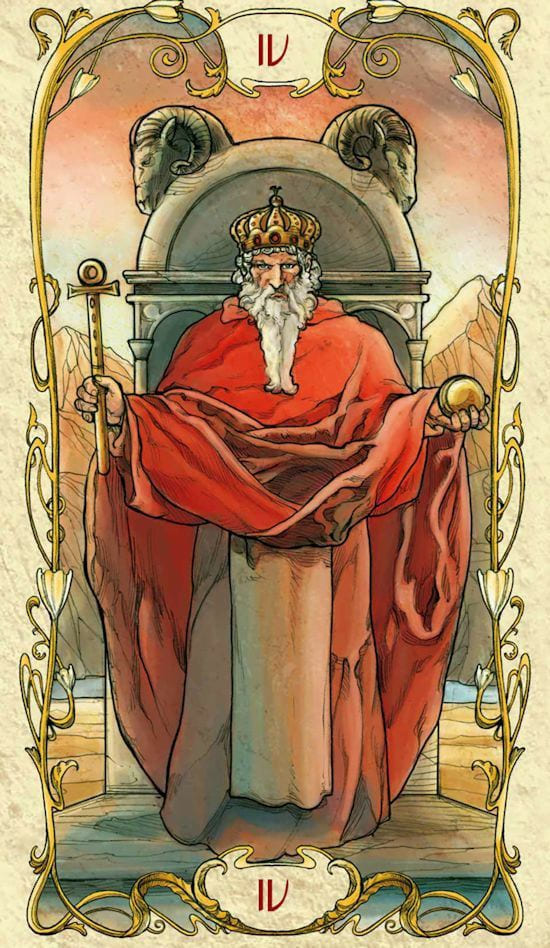
Look at the card. A man on a stone throne. Armor beneath his robes. Mountains behind him — stark, cold, immovable. A scepter in one hand, an orb in the other. Ram heads on the throne, Aries symbols, all fire directed into form. Nothing on this card is soft. Nothing is uncertain. Nothing is ambiguous.
And that’s exactly the problem — and the gift — of the Emperor as feelings.
When someone feels the Emperor toward you, they don’t feel butterflies. They feel responsibility. Not the tedious kind. The foundational kind. The kind that says: this person matters, and because they matter, I will make their world more solid. I will provide. I will protect. I will build walls around what we have so that nothing from the outside can break it.
The question the Emperor never asks out loud — the question that defines every relationship he enters — is: are these walls protecting you, or trapping you?
Because the Emperor doesn’t know the difference from the inside. He builds because he loves. He structures because he cares. He controls the environment because that’s how he was taught to keep things safe. Whether the person inside the fortress feels safe or suffocated — that depends on how much awareness he brings to his own power.
Upright: as feelings for you
When The Emperor appears upright in the feelings position, the person feels:
Serious, committed, non-negotiable attachment. This isn’t someone who’s testing the waters. He decided. The Emperor doesn’t wonder. He assesses, concludes, and acts. His feelings for you aren’t a question he’s still answering — they’re a fact he’s already building on. If the Emperor shows up in the feelings position, this person is past the deliberation phase. He’s in the construction phase.
The drive to provide and protect. He wants to make things better for you — concretely, not abstractly. Not “I hope you’re okay.” Rather: “What do you need? I’ll get it.” The Emperor as feelings is the person who fixes your leaky faucet before you ask, who researches health insurance options because you mentioned yours is expiring, who shows love in spreadsheets and problem-solving. It’s not romantic in the traditional sense. It’s romantic in the way foundations are romantic — invisible, unglamorous, and the reason the house still stands.
Respect that looks like formality. The Emperor’s feelings are dignified. He won’t love-bomb you. He won’t flood you with compliments or grand gestures. He’ll be consistent. Present. Reliable. He’ll show up when he says he will. He’ll follow through. And if you’re used to love that’s dramatic and chaotic, his steadiness might feel like distance. It isn’t. It’s the Emperor’s version of devotion — so certain it doesn’t need to prove itself.
A desire for legacy. The Emperor doesn’t think in terms of moments. He thinks in terms of years. His feelings for you include a vision of the future — a shared structure, a family, a life built together on solid ground. He’s not asking “do I enjoy this?” He’s asking “can I build on this?” That question reveals what he values most: not the spark, but the scaffolding.
Authority offered, not imposed. At his best, the Emperor as feelings is someone who offers their strength without requiring you to be weak. He holds the space, creates the structure, provides the stability — and leaves you free to grow inside it. His throne is a platform, not a cage. His walls have doors. His armor comes off when you’re close enough.
Reversed: as feelings for you
When The Emperor appears reversed in the feelings position:
Control disguised as love. The shadow Emperor. He tells you what to do and calls it caring. He monitors your choices and calls it protection. He decides what’s best for you without consulting you and calls it leadership. The reversed Emperor as feelings is someone whose love has become indistinguishable from management — and he doesn’t see the difference because in his mind, keeping you close IS love.
Rigidity where there should be flexibility. He can’t adapt. His vision of the relationship is a blueprint, and any deviation from that blueprint feels like betrayal. The reversed Emperor struggles with partners who have their own plans, their own ambitions, their own version of what the future should look like. He doesn’t want a collaborator. He wants someone to live in the structure he designed.
Emotional unavailability framed as strength. “I’m not good at talking about feelings.” Translated: “I’ve built so many walls around my emotions that I can’t get to them either.” The reversed Emperor may feel deeply about you but be constitutionally unable to express it in any language other than action — and when action isn’t enough (and it never is, forever), the relationship starves emotionally while looking materially fine.
Loss of power turned inward. Sometimes the reversed Emperor isn’t controlling — he’s collapsing. Something has undermined his sense of authority — a job loss, a failure, a betrayal of trust — and without his structure, he doesn’t know who he is. His feelings for you may be tangled in his feelings about himself: “I can’t provide for you, so I don’t deserve you.” The reversed Emperor who has lost his throne is the most vulnerable and least visible version of himself.
Paternalism. The uncomfortable truth: the reversed Emperor as feelings can mean someone who loves you the way a father loves a child — protectively, decisively, with an assumption that he knows best. This can feel wonderful if you want to be cared for. It becomes stifling when you want to be treated as an equal. The question the reversed Emperor needs to answer: are you his partner, or his dependent?
Context: The Emperor as feelings in different situations
As someone you’re dating
Upright: He takes this seriously. More seriously than you might realize. His texts may be brief, his compliments rare, his romantic gestures practical rather than poetic — but his consistency is the message. He shows up. He follows through. He’s already thinking about where this goes. If you’re looking for someone who says “I feel so much about you” — that’s not the Emperor. If you’re looking for someone who proves it through action — this is your card.
Reversed: Warning signs. Is he deciding where you eat, who you see, how you spend your time — not through conversation but through assumption? Does his “taking charge” extend to areas of your life that should be yours? The reversed Emperor in early dating can feel like attentiveness. Over time, it reveals itself as control. Watch for the pattern: does he include you in decisions, or inform you of them?
As an ex’s feelings
Upright: He still thinks about the structure you had together. Not the romance — the life. The routines, the plans, the shared foundation that took years to build. He may feel that losing you means losing something he can’t reconstruct. His grief isn’t emotional — it’s architectural. He’s mourning the blueprint, not just the builder.
Reversed: He feels the loss of control more than the loss of connection. The breakup challenged his authority over his own life, and that wound may be deeper than the romantic one. He might try to reestablish power — through manipulation, through anger, through attempts to “win” the breakup. Or he’s collapsed under the weight of a structure that was built for two but now houses one.
As a new connection
Upright: He’s evaluating you. Not coldly — strategically. The Emperor doesn’t fall. He assesses and then commits. If he’s spending time with you, asking about your goals, your values, your plans — he’s running the numbers. Not in a calculated way, but in the way someone does when they’re deciding whether to invest their entire self. His interest may feel measured. It’s actually enormous — so enormous that it requires measurement.
Reversed: He’s attracted to you but already trying to shape the connection into something he can control. First-date suggestions that feel more like instructions. Opinions about your life that arrive uninvited. A pace he sets without checking if you agree. The reversed Emperor as a new connection can look like confidence. Make sure it’s not just dominance in a flattering light.
The Emperor vs. other “strong” cards as feelings
The Emperor vs. Strength: Strength controls through gentleness — open hands, patience, the ability to hold the lion’s mouth without force. The Emperor controls through structure — walls, rules, hierarchies, systems. Strength as feelings says “I’ll hold space for your wildness.” The Emperor as feelings says “I’ll build something strong enough to contain us both.” One trusts the process. The other engineers it.
The Emperor vs. The Empress: The Empress nurtures. She grows things. Her love is generative, embodied, sensory. The Emperor protects. He builds things. His love is structural, practical, architectural. The Empress says “let me feed you.” The Emperor says “let me build you a table.” She’s the garden. He’s the wall. Together: a home. Apart, she’s abundance without boundary. He’s boundary without warmth.
The Emperor vs. The Chariot: The Chariot is willpower in motion — focused, driven, heading somewhere at speed. The Emperor is willpower at rest — settled, established, ruling from a fixed position. The Chariot as feelings is “I’m coming for you.” The Emperor as feelings is “I’ve already decided — now I’m building.”
What The Emperor as feelings is really telling you
Here’s the truth about The Emperor that nobody in the feelings position wants to hear:
If someone feels The Emperor toward you, they love you like an architect loves a building — completely, seriously, with a plan for every load-bearing wall.
That kind of love is rare. It’s reliable. It’s the kind that shows up at 6 AM to fix the thing that broke at midnight. It’s the kind that plans, provides, protects without asking for applause.
But it’s also the kind that can forget there’s a person living inside the structure. That the walls he built to protect you can also block your view. That providing stability isn’t the same as providing intimacy, and one can starve while the other thrives.
The Emperor’s great lesson — in feelings, in love, in every relationship he enters — is that the strongest thing a fortress can do is have an open door.
He sits on his throne. Armored. Certain. Immovable. But if you look carefully at the card, there’s no wall behind him. Only mountains. Open sky.
Even the Emperor, in the end, can’t control the horizon.
Try it yourself
Pull a card with this question: “Where in my life am I building walls that were meant to protect but have become prisons?”
Because The Emperor isn’t just about how someone else feels about you. It’s about the uncomfortable possibility that some of the structures you’ve built — in your relationships, your career, your self-image — were designed to keep you safe and have quietly become the thing keeping you stuck.
The best Emperor knows when to put down the scepter. When the fortress has done its job. When the person inside the walls is ready to walk through the open door.
His strength was never in the throne. It was in knowing when to leave it.
Frequently Asked Questions
What does The Emperor mean as someone's feelings for me?
When The Emperor appears as feelings, the person feels protective, responsible, and deeply serious about you. This isn't casual. He doesn't do casual. His love expresses through action — providing stability, creating structure, building something tangible for you. He may struggle to say how he feels, but he'll show it by making your world more secure.
Is The Emperor as feelings controlling or loving?
Both are possible — and the line between them is the most important thing to read. Upright, his structure comes from care: he wants to protect what matters. Reversed, it can tip into control: deciding what's best for you without asking. The difference is whether you have the key to the fortress he built, or he locked the gate from the outside.
What does The Emperor reversed mean as feelings?
Reversed, The Emperor as feelings means someone whose protective instinct has curdled into control, rigidity, or emotional unavailability. He may feel strongly about you but express it through dominance rather than devotion — micromanaging, withholding affection as punishment, or needing to be in charge at all times. Or he's lost his authority internally and feels powerless, which makes him either withdraw or overcompensate.
How is The Emperor different from The Empress as feelings?
The Empress feels through the body — nurturing, sensual, generative. The Emperor feels through action — building, protecting, structuring. The Empress says 'let me hold you.' The Emperor says 'let me build you something to stand on.' She creates the garden. He builds the wall around it. Together they make a home. Apart, one is wilderness and the other is a fortress.