Five of Swords Tarot Meaning: Conflict & the Cost of Winning
First impression
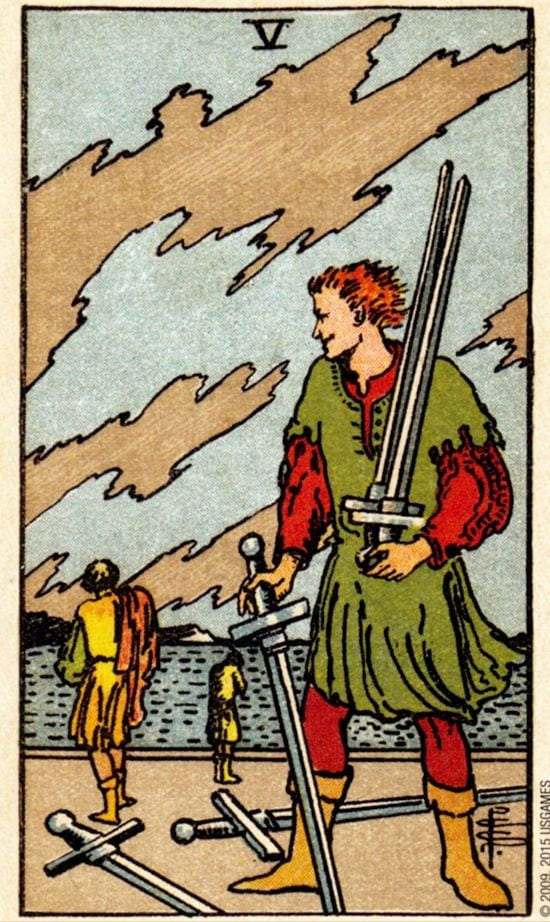
Look at his face.
That’s the most important thing about this card, and most interpretations miss it. The figure in the foreground has won. He holds three swords — his own and two he took from the defeated opponents walking away in the background. Two more swords lie at his feet. He has all the weapons. He has the field. The battle is over, and he is the last one standing.
And he doesn’t look happy.
That expression — study it. It’s not satisfaction. It’s not relief. It’s the particular, hollow look of someone who got what they wanted and discovered, in the moment of getting it, that it wasn’t worth what it cost. The smirk of a man who won the argument and lost the friendship. Who proved his point and emptied the room.
The first time I pulled this card, I had just “won” a disagreement with someone I cared about. I was technically right. I had the better argument, the sharper words, the facts on my side. And the other person stopped calling. The Five of Swords appeared and I understood immediately: congratulations. You were right. Was it worth it?
This is the card of the pyrrhic victory — the win that costs more than the loss would have.
Symbolism
The three figures tell the entire story. The foreground figure holds three swords and looks back toward the two defeated figures walking away. He has the weapons. They have nothing. But notice: they’re walking together. He’s alone. The “winner” won the swords but lost the people. That’s the Five of Swords in one image.
The sky is torn, jagged, turbulent — not the storm clouds of the Tower, but the aftermath sky, the weather after the fight. The air hasn’t cleared. The tension hasn’t resolved. It’s just moved from active conflict to a cold, uncomfortable silence.
The two swords on the ground represent what was dropped in the fight — arguments abandoned, principles compromised, things said that can’t be unsaid. These swords aren’t being carried by anyone. They belong to the conflict itself, and they’ll stay on the field long after everyone has left.
The defeated figures walk away with their heads bowed. They lost, but they’re leaving together. There’s something in their departure that the winner doesn’t have: companionship. Even in defeat, they have each other. The winner has swords.
The red and green of the winner’s clothing connect him to passion (red) and ambition (green). His fight wasn’t cold or calculated — it was fueled by desire to win. That’s the dangerous part: the Five of Swords isn’t about fighting for survival. It’s about fighting for dominance. And dominance, the card shows, is a lonely throne.
Upright meaning
The Five of Swords upright is the card nobody wants to see, because it forces you to answer an uncomfortable question: what are you willing to destroy in order to win?
The pyrrhic victory. You win the argument but lose the relationship. You get the promotion but burn every bridge. You prove your point so thoroughly that nobody wants to be in the room with you anymore. The Five of Swords says: being right and being wise are not the same thing. Sometimes the wisest move is to lose on purpose.
Conflict with no good outcome. Not every battle can be won cleanly. The Five of Swords often appears in situations where every possible outcome leaves damage — staying means accepting mistreatment, fighting means escalation, leaving means admitting defeat. The card doesn’t pretend there’s a happy ending. It asks you to choose the least destructive option.
Bullying and power imbalance. In its darkest expression, the Five of Swords represents situations where someone uses power unfairly — a boss who intimidates, a partner who manipulates, a colleague who takes credit and shifts blame. If you’re the person being walked away from in this card, the message isn’t “fight harder.” It’s “stop engaging with someone who fights without rules.”
Winning that feels like losing. You got what you wanted. The deal closed, the argument ended in your favor, the competition was won. But something essential was sacrificed along the way — trust, respect, a relationship, your own integrity. The Five of Swords is the hollow victory that teaches you what actually matters by showing you what you lost to get what you thought you wanted.
Choosing your battles. Not every fight deserves your energy. The Five of Swords can simply be asking: is this worth it? Is this the hill you want to die on? Is winning this particular argument going to make your life better or just make you temporarily right?
Reversed meaning
The Five of Swords reversed is the morning after the battle — the reckoning, the repair, or the refusal to repair.
Reconciliation. The weapons are being put down. Someone is reaching out — an apology, a conversation, a genuine attempt to rebuild what the conflict destroyed. The reversed Five says: peace is possible, but only if both sides are willing to stop keeping score.
Choosing peace over being right. You had more to say. You had more ammunition. You could have destroyed them in that argument. But you chose not to. The reversed Five of Swords is the moment you decide that the relationship matters more than the victory — and that letting go of the need to win is itself a form of strength.
Lingering resentment. The fight ended, but you’re still replaying it. Still composing the perfect comeback. Still angry about what was said. The reversed Five can indicate resentment that hasn’t been processed — the emotional shrapnel still lodged in you from a battle that technically ended but never really resolved.
Shame after conflict. You were the winner in the upright version, and now you’re realizing what it cost. The reversed Five can bring guilt — the recognition that you went too far, said things you can’t take back, or used your advantage to hurt someone who didn’t deserve it.
Walking away from a fight you could win. Not because you’re weak, but because you’re wise. The reversed Five of Swords can represent the strategic retreat — disengaging from a toxic dynamic not because you can’t fight but because you’ve decided the fight isn’t worth your peace.
In love and relationships
Upright: The Five of Swords in love is the card of destructive arguments. Not the healthy kind of conflict that clears the air — the toxic kind that leaves wounds. One partner dominates while the other retreats. Winning becomes more important than understanding. The same fight happens again and again because nobody actually listens; they just reload.
If this card appears in a love reading, ask yourself: are we fighting about the issue, or are we fighting about power? In relationships governed by the Five of Swords, the real battle isn’t about dishes or money or time. It’s about who controls the narrative. And in that fight, both people lose.
Reversed in love: The aftermath. Either the couple is beginning to heal — apologizing, setting new ground rules, choosing gentleness over score-keeping — or they’re realizing that the damage is too deep and the pattern too entrenched. The reversed Five in love asks: can this be repaired? And more importantly: do both people want it to be?
In career and finances
Upright: Office politics at their ugliest. The Five of Swords at work is the colleague who throws you under the bus, the meeting where credit is stolen, the environment where survival means watching your back. It can also represent you — are you the one wielding the swords? Are you winning at work in ways that are costing you professionally or personally?
Financially, the Five of Swords warns against deals where someone gets hurt. Negotiations that create enemies. Short-term gains that damage long-term relationships or reputation.
Reversed in career: The toxic situation is resolving — either through reconciliation, departure, or the natural consequences catching up with whoever was fighting dirty. The reversed Five in career can also mean you’re choosing to leave a hostile environment rather than continue fighting a battle that’s damaging you more than losing ever would.
In health and wellbeing
Upright: The Five of Swords in health readings points directly to stress-related symptoms caused by conflict. Tension headaches, jaw clenching, insomnia from replaying arguments, elevated cortisol from living in a state of constant alertness. Your body is keeping score even when your mind tries to move on. The card says: the fight is making you sick, and no amount of winning will fix what the fighting is breaking.
Reversed: Beginning to release the physical tension of ongoing conflict. The headaches ease. The jaw unclenches. The sleep improves. But only if you actually stop engaging in the conflict — the body won’t heal while the mind is still at war.
Key combinations
Five of Swords + The Tower: Complete collapse of a conflict situation. The power dynamics that sustained the fight are obliterated. Painful but ultimately liberating — what was built on manipulation or dominance cannot stand.
Five of Swords + Justice: Consequences arrive. The person who fought unfairly faces accountability. Karma in action. This combination says truth will prevail, even if it takes time.
Five of Swords + The Lovers: A relationship torn apart by conflict. The choice isn’t between two loves — it’s between love and the need to be right. This combination asks: which do you want more?
Five of Swords + Six of Swords: Leaving the battlefield. Moving away from a toxic situation toward calmer waters. The fight is over — not because you won, but because you stopped participating.
Five of Swords + Three of Cups (reversed): Social conflict — friend group drama, backstabbing, alliances forming against someone. The reversed Three turns community into battleground.
Five of Swords + Strength: You have the power to fight, but this combination asks you to use your power differently. Strength says: the lion can be tamed. Not every show of force requires force. Sometimes restraint is the fiercer act.
Five of Swords + Ten of Swords: Total defeat. The conflict didn’t just damage — it devastated. But the Ten of Swords is also an ending, which means: the worst is done. From here, the only direction is healing.
The card’s advice
The Five of Swords asks the question most people avoid until the damage is done: is winning this worth what you’re losing?
Look at the figure in the card one more time. He has five swords. Five. More than he can even carry. And the people who used to stand beside him are walking away. He won everything and has no one to celebrate with.
Here’s what I’ve learned from sitting with this card in hundreds of readings: the Five of Swords almost never appears in situations where one person is purely right and the other is purely wrong. It appears in situations where everyone has a point but someone decided that having a point was more important than having a relationship. More important than having peace. More important than having their own integrity intact.
The card’s advice isn’t “don’t fight.” Sometimes you must fight. Sometimes the conflict is necessary and the battle is just. But the Five of Swords asks you to check, before you draw your sword, whether this particular fight will leave you holding weapons in an empty field — victorious, alone, and wondering if the swords were worth the people.
Most of the time, they aren’t.
Try it yourself
Pull one card with this question: “Where in my life am I fighting to win when I should be fighting to understand?”
If the answer stings — good. That’s the Five of Swords doing its job. It doesn’t comfort. It clarifies. And clarity, even when it’s uncomfortable, is how you stop losing the things that actually matter.
Frequently Asked Questions
Is the Five of Swords a yes or no card?
The Five of Swords is a no — or at best, a 'yes but you won't like how you get it.' Even if the outcome goes your way, the cost will be higher than expected. This card says winning isn't worth it if winning means destroying what matters. Step back and reconsider whether the fight itself is the problem.
What does the Five of Swords mean in love?
In love, the Five of Swords signals destructive conflict — arguments where winning matters more than understanding, power imbalances, or a relationship where one person consistently steamrolls the other. It asks: would you rather be right, or would you rather be together? Sometimes the answer is that being right costs you the relationship.
Does the Five of Swords mean someone is bullying me?
It can. The Five of Swords represents situations where power is used unfairly — bullying, intimidation, manipulation, or someone who fights dirty. If this card appears and you feel unsafe or consistently overpowered, it may be confirming what you already sense. The card's advice in these cases isn't 'fight harder' — it's 'get out.'
What does the Five of Swords reversed mean?
Reversed, the Five of Swords points to the aftermath of conflict — either reconciliation and choosing peace over being right, or lingering resentment that hasn't been fully processed. It can mean you're ready to lay down your weapons and make amends, or that you're still replaying old fights in your head and need to actively choose to let them go.