Five of Wands Tarot Card Meaning: The Fight That Nobody Wins (and Why That's the Point)
First impression
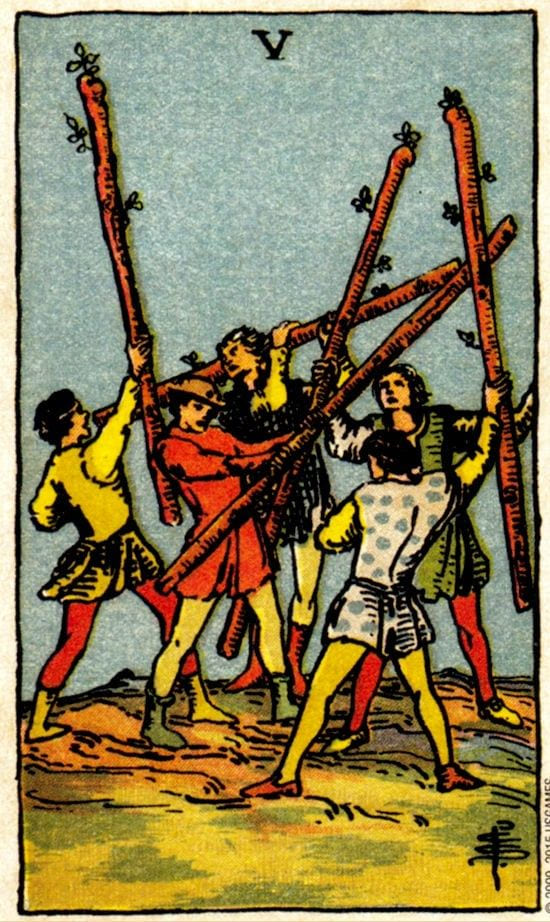
Five young men swing their wands at each other in what looks like absolute chaos. Everyone’s fighting, nobody’s winning. The wands crash into each other mid-air, missing bodies entirely. Look closer: no one is bleeding. No one is even particularly angry. Their faces show effort, not rage. Their clothes are all different — different colors, different styles, five completely separate people who apparently can’t agree on a single thing.
That’s the Five of Wands. And the first thing most people get wrong about it is assuming someone has to lose.
After the celebration of the Four — the garlands, the dancing, the solid foundation — the Five arrives like a cold splash of reality. Because nothing stays stable forever. Fours build structures. Fives shake them. And shaking, uncomfortable as it is, is how you find out which structures are actually strong and which ones were held together by avoidance.
This isn’t the Tower. Nobody’s life is collapsing. This is the argument at the team meeting. The tension in the group chat. The moment five different people realize they all want something slightly different and nobody planned for that. It’s messy. It’s loud. And it’s often exactly what needs to happen.
Card symbolism
The five figures. Each dressed differently — different backgrounds, different perspectives, different agendas. They’re not a unified army; they’re five individuals who happen to be in the same space. The Five of Wands is almost never about a clear villain versus hero. It’s about the chaos that erupts when multiple valid perspectives collide.
The raised wands. Wands are fire — passion, ambition, creativity, ego. When five fire-fueled people swing their passions at each other, you get noise. But look carefully: the wands are crossing in the air, not striking bodies. This is posturing. Debate. Competition. Not violence. The energy is aggressive but the damage is minimal.
No clear winner. This is the card’s most important detail. Nobody is winning this fight. Nobody is on top. The battle is chaotic, equal, unresolved. And that’s the message: the Five of Wands isn’t about who wins. It’s about what happens during the struggle — what you learn, what you sharpen, what falls away.
The bare ground. No castle in the background (that was the Four). No ocean on the horizon (that was the Two and Three). Just flat ground and fighting. The environment is neutral — the conflict isn’t caused by circumstances. It’s caused by people. Specifically, by people who care enough to fight about something.
The different outfits. Diversity of thought. These aren’t clones disagreeing — they’re genuinely different people with genuinely different views. The Five of Wands often shows up when you’re in a group where everyone brings something valuable but nobody wants to compromise their piece to fit the whole.
Upright meaning
The Five of Wands upright means conflict, competition, creative friction, and the growing pains that come from having to share space with people who see the world differently than you do.
Healthy competition. Not all conflict is bad. The Five of Wands often shows up during healthy rivalry — job interviews where you’re one of several strong candidates, creative projects where multiple ideas compete for adoption, sports where the challenge makes you better. The key word is challenge, not threat.
Disagreements and tension. Small conflicts that feel bigger than they are. Arguments at dinner. Miscommunications at work. The group project where everyone has a different vision. The Five of Wands rarely points to a serious, relationship-ending fight. It points to the ordinary, exhausting friction of trying to coexist with people who think differently.
Growing pains. After the stability of the Four, the Five disrupts. And disruption hurts — not because something is breaking, but because something is outgrowing its container. The Five of Wands often appears when you’re in a phase of growth that requires friction: entering a new field, joining a challenging group, starting something where failure is part of the learning.
Ego at play. Let’s be honest: a lot of Five of Wands energy is about ego. Wanting to be right. Wanting your idea to win. Needing to be heard louder than the person next to you. The card doesn’t judge this — ego can be useful fuel — but it asks you to notice when your fight is about the idea and when it’s about being the one who had it.
Creative brainstorming. In its best expression, the Five of Wands is a room full of passionate people throwing ideas at the wall. Nothing sticks yet. Everything clashes. But from that chaos, something brilliant eventually emerges — usually once everyone stops trying to win and starts trying to build.
Reversed meaning
The Five of Wands reversed flips the conflict inward — or resolves it outward. It depends on where you are.
Conflict resolving. The wands are lowering. The arguing is winding down. People are finding common ground, compromising, or simply deciding this fight isn’t worth having. If you’ve been going through a turbulent period, the reversed Five says: the storm is passing. Breathe.
Conflict avoidance. The darker side: you’re not resolving the conflict — you’re swallowing it. Smiling when you want to argue. Agreeing when you disagree. The Five reversed can mean fake peace — the kind where everyone’s polite but nobody’s honest, and the real issues are festering under the surface.
Inner conflict. The battle moved inside. You’re not arguing with other people — you’re arguing with yourself. Competing desires, conflicting values, the voice that says “go” versus the voice that says “stay.” The Five reversed often shows up during decision paralysis: not because you don’t know what you want, but because you want several things that contradict each other.
Picking your battles. Maturity. Realizing that not every hill is worth dying on. The reversed Five sometimes means you’ve learned something the upright Five was teaching: that some fights drain you more than they teach you, and walking away is a form of winning.
Fear of confrontation. Avoiding a difficult conversation because you’re afraid of what happens if you actually say what you think. The Five reversed asks: is the peace you’re protecting real, or is it just silence where honesty should be?
In love and relationships
Upright. The Five of Wands in love means friction — and friction in relationships can be anything from healthy debate to exhausting bickering. For couples, this card often shows up during phases where you’re discovering your real differences. The honeymoon ended, and now you’re navigating competing needs, communication styles, and priorities. It’s not a breakup card — it’s a growing-up card. The question is whether you fight with each other or against each other. For singles, the Five can mean a competitive dating landscape: multiple options, none clearly winning, or literally competing with other people for someone’s attention.
Reversed. Either the arguments are settling down and you’re finding your rhythm again, or you’re keeping the peace by staying quiet about something important. In relationships, the reversed Five often appears when one person has stopped fighting — not because they’ve resolved the issue, but because they’ve given up on being heard. That’s not peace. That’s withdrawal.
In career and finances
Upright. Office politics. Team conflicts. Competition for a promotion, a project, a client. The Five of Wands in career readings is the card of competitive environments — and sometimes that competition makes you sharper, and sometimes it just makes you tired. Financially, it can mean disputes about money: negotiations that feel adversarial, budgets that don’t accommodate everyone’s needs, or the stress of competing financial priorities. The Five doesn’t predict you’ll lose — it predicts you’ll have to fight for what you want.
Reversed. The competition is easing. A resolution to a workplace conflict. Finding your niche where you don’t have to constantly prove yourself. Or: avoiding necessary professional confrontation — not pushing back on unfair assignments, not negotiating your worth, choosing comfort over the discomfort of advocacy. In finances: letting someone else control money decisions to avoid an argument.
In health and well-being
Upright. Stress from external conflicts affecting your body. Tension headaches, jaw clenching, disrupted sleep from unresolved disagreements. The Five of Wands in health doesn’t usually point to a specific illness — it points to the toll that constant friction takes. Also: competing health advice. Five different doctors, five different opinions. Five wellness influencers, five contradictory diets. The card says: the noise is the problem, not any single piece of advice.
Reversed. Stress is easing. Your body is recovering from a high-tension period. Or: you’re ignoring physical signals because addressing them would mean admitting something is wrong, and that feels like another fight you don’t want to have.
Key combinations
Five of Wands + The Chariot. You win the fight. The Chariot brings focused willpower to the Five’s chaos — you cut through the competition and come out on top. Winning a contested promotion, outperforming rivals, succeeding through sheer determination.
Five of Wands + The Lovers. A choice must be made between competing options — likely in relationships. Two (or more) people, two paths, two versions of love. The conflict isn’t hostile; it’s the painful clarity of realizing you can’t choose everything.
Five of Wands + Ten of Wands. The fighting has exhausted you. You carried the conflict too long. Burnout from competition, overwork from trying to prove yourself in a hostile environment, the weight of too many battles fought simultaneously.
Five of Wands + Six of Wands. Conflict followed by victory. The struggle of the Five leads directly to the triumph of the Six. You fought, it was hard, and you came out the other side holding the laurel. This combination says: the fight is worth having.
Five of Wands + The Hermit. Withdraw from the fight to think. The noise is too loud for wisdom. Step back, go inward, and return when you’re clear about which battle actually matters.
Five of Wands + Four of Swords. The fight has paused — take this rest seriously. Your mind and body need recovery from the tension. Don’t jump back into conflict before you’ve processed it.
Five of Wands + Temperance. Find the middle ground. Temperance offers what the Five lacks: patience, balance, the ability to blend opposing forces into something workable. Compromise isn’t defeat — it’s alchemy.
The card’s advice
The Five of Wands says: not all conflict is a problem to solve. Some of it is a process to go through.
The instinct when you see five wands clashing is to ask “how do I make it stop?” But sometimes the answer is: you don’t. You stay in the ring, swing your wand, say what you actually think instead of what keeps the peace, and trust that the friction is shaping you into someone sharper.
The trap is believing that good relationships, good jobs, and good lives are conflict-free. They’re not. They’re conflict-skilled. The Five of Wands isn’t asking you to enjoy the fight. It’s asking you to stop running from it — because the things most worth having are usually on the other side of a difficult conversation you’ve been avoiding.
Stand your ground. Swing honestly. And remember: in this card, nobody gets hurt. The wands crash in the air, not into people. The conflict is real, but the danger is mostly in your head.
Try it yourself
Pull a card with this question: “What conflict in my life right now am I treating as a problem when it’s actually a growing pain?”
Because the Five of Wands doesn’t just represent the fights that drain you — it also represents the fights that make you. The brainstorm that produces the breakthrough. The argument that finally surfaces what you both actually need. The competition that reveals what you’re truly capable of.
Not every clash is a sign something’s wrong. Sometimes it’s a sign something’s becoming.
Frequently Asked Questions
Is the Five of Wands a yes or no card?
The Five of Wands is generally a no — or at least a 'not yet.' There's too much friction, too many competing forces, and no clear path forward right now. It doesn't mean the answer will always be no, but it means the situation needs to settle before you can move cleanly in any direction.
What does the Five of Wands mean in love?
In love, the Five of Wands means friction — arguments about small things, competing priorities, or multiple people interested in the same person. For couples, it's the phase where you discover you disagree about things that matter. For singles, it can mean navigating a competitive dating scene or competing for someone's attention.
What does the Five of Wands reversed mean?
Reversed, the Five of Wands can go two ways: either conflict is resolving and tensions are easing, or you're avoiding necessary confrontation. The difference matters. Resolution feels lighter. Avoidance feels like pressure building under a lid. Check which one matches your situation.
Is the Five of Wands always negative?
No. The Five of Wands often represents healthy competition, creative brainstorming where ideas clash productively, or growing pains that lead to something stronger. Nobody gets hurt in this card — it's sparring, not war. The friction is uncomfortable but often necessary.