Four of Pentacles Tarot Meaning: Control & Fear Behind the Grip
First impression
He holds everything. And he looks like it’s killing him.
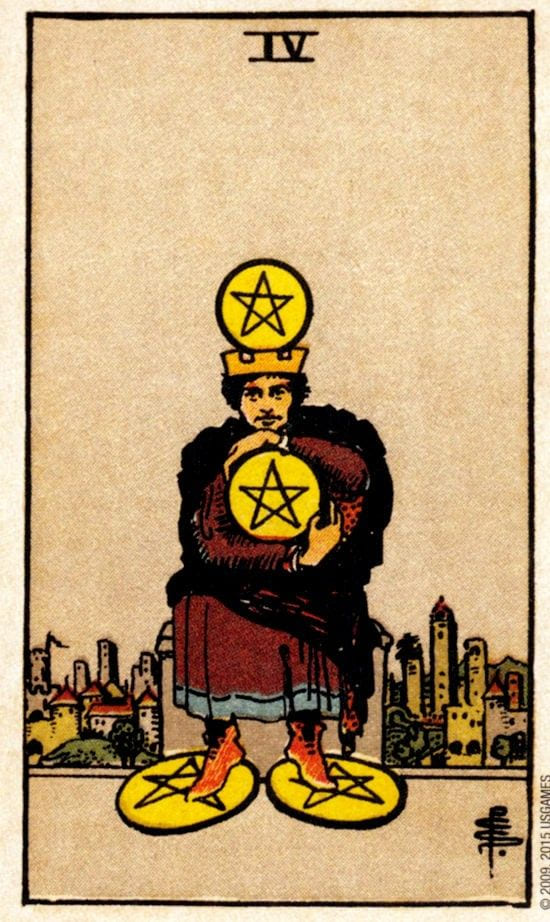
In the Rider-Waite-Smith image, a man sits with a pentacle balanced on his head, one clutched to his chest, and two planted firmly under his feet. He owns four coins and he’s touching all of them. Not one is loose, free, or available. His arms wrap around the chest pentacle like a child holding a toy they think someone is about to take. His face shows no pleasure — only vigilance.
Behind him, a city. Life happening. People moving. But he’s apart from it, alone on his perch, guarding what’s his with every limb he has.
The first time I pulled this card, I recognized the posture immediately. Not from greed — from anxiety. I’d been holding onto a situation so tightly that my actual shoulders were sore. The Four of Pentacles looked at me and said: you’re not protecting something. You’re suffocating it. And you. At the same time.
That’s the card’s real lesson. It’s not about greed. It’s about the fear that makes you grip.
Symbolism
The four pentacles are positioned to cover the man completely. One on the head — controlling thoughts, ideas, beliefs. He holds his worldview tightly, unwilling to consider alternatives. One on the chest — guarding the heart, keeping emotions contained, refusing vulnerability. Two under the feet — standing on his resources, unwilling to share the ground he’s claimed.
The posture is the message. Every pentacle is held, touched, covered. There’s no flow. Nothing comes in, nothing goes out. It’s a closed system — and closed systems eventually stagnate.
The city behind him represents community, exchange, the living world where resources circulate and relationships breathe. He’s turned away from it. His security has become his isolation. The very thing he’s protecting himself with is cutting him off from the life the protection was supposed to enable.
His crown suggests status — he has position, authority, accomplishment. But he wears the pentacle on his head like a crown, suggesting his identity has fused with his possessions. He doesn’t have wealth. He is his wealth. And that makes losing any of it feel like losing himself.
The red and blue clothing — passion restricted by melancholy, desire constrained by fear. He wants things. He feels things. But the grip prevents him from acting on either.
Upright meaning
The Four of Pentacles upright sits on the line between prudence and paralysis. On the healthy side, it represents wise saving, financial stability, and the discipline to protect what you’ve earned. On the unhealthy side, it represents hoarding, emotional unavailability, and the fear-based refusal to let anything go — ever.
Security as cage. You’ve built walls to protect yourself, and now you’re living inside them wondering why you feel so alone. The savings account is healthy but you can’t enjoy spending. The boundaries are firm but nobody can get close. The routine is stable but nothing ever changes. The Four of Pentacles asks: at what point does protection become imprisonment?
Fear of loss. This is the card’s engine. Not greed — fear. The grip isn’t about wanting more. It’s about being terrified of having less. Somewhere, sometime, you learned that resources — money, love, stability, safety — could disappear without warning. And that lesson made you hold on so tight that your hands aren’t free to receive anything new.
Control. Micromanaging. Needing to know where every penny goes, what every person is doing, how every plan unfolds. The Four of Pentacles isn’t controlling because it wants power — it’s controlling because uncertainty feels like danger. If I can control everything, nothing can hurt me. Except the controlling itself.
Healthy boundaries (positive reading). Not every expression of this card is negative. Sometimes the Four of Pentacles means: set a budget and stick to it. Protect your energy. Don’t give away what you can’t afford to lose. Say no to the request that would overextend you. Boundaries aren’t walls unless they have no doors.
Material stability. In practical financial readings, the Four of Pentacles can simply mean: your finances are stable. You’re saving well. Your resources are protected. Don’t panic. The practical message before the psychological one.
Reversed meaning
The Four of Pentacles reversed is the grip loosening — and the complicated feelings that come with it.
Letting go. The hands open. The pentacle falls from the chest. The feet lift from the ground. You’re releasing something you’ve been holding too tightly — money, control, a relationship, a belief, an identity. It’s terrifying and necessary. The reversed Four says: the thing you couldn’t imagine releasing? It wasn’t keeping you safe. It was keeping you small.
Generosity returning. After a period of hoarding — emotional or financial — you’re beginning to share again. Giving without keeping score. Spending without panic. Opening without armor. The reversed Four can be the thaw after a long emotional winter.
Overspending or carelessness. The shadow of letting go is dropping things that matter. The reversed Four can mean financial recklessness, giving too much away, or abandoning healthy boundaries in the rush to be “free.” Letting go is wisdom. Letting go of everything is chaos.
Financial instability. The savings deplete. The security unravels. The reversed Four can mean a period of genuine financial uncertainty — not because you’re being careless, but because the structures you relied on are shifting beneath you.
Releasing control in relationships. Choosing to trust. Choosing to stop monitoring, managing, gripping. The reversed Four in emotional contexts can be the moment you decide that being loved requires letting yourself be seen — which requires putting down the armor, even though it scares you half to death.
In love and relationships
Upright: The Four of Pentacles in love is the relationship where safety has replaced aliveness. You’re together because it’s stable, not because it’s growing. One partner may be emotionally withdrawn — present in body but locked away in heart. The card can also represent a controlling partner — someone who tracks movements, monitors messages, needs to know everything because not knowing feels like losing.
For singles, the Four of Pentacles often means emotional unavailability. You’ve been hurt before, so you’ve built walls so high that love can’t get in. The card says: the walls protected you once. They’re hurting you now.
Reversed in love: Opening up after a period of emotional shutdown. Taking the risk of vulnerability. Or, on the shadow side, someone who was once stable becoming erratic, or letting go of healthy relationship standards because holding boundaries felt too “controlling.”
In career and finances
Upright: The Four of Pentacles at work is the manager who can’t delegate, the employee who hoards information, the department that protects its budget by refusing to invest. It’s financial conservatism taken to the point where the company — or the career — stops growing because nobody will spend anything.
In personal finance, the Four can mean healthy saving habits or unhealthy penny-pinching. The line between the two is how it makes you feel. Are you saving because you have a plan, or because spending anything triggers panic?
Reversed in career: Finally investing in growth — hiring, spending on marketing, taking the course, upgrading the equipment. Or: reckless spending, depleting reserves, making financial decisions from emotional reaction rather than strategy. The reversed Four asks whether you’re letting go wisely or just letting go.
In health and wellbeing
Upright: The Four of Pentacles in health is the body holding on. Clenched jaw. Tight shoulders. Shallow breathing. Digestive tension. Chronic muscle tightness that massage helps temporarily but returns because the source — the fear, the control, the inability to relax — hasn’t been addressed. This card is the physical cost of emotional holding.
Reversed: The body beginning to release. Deep breaths. Shoulders dropping. The exhale you’ve been holding for months. Or: health issues from suddenly releasing long-held tension — the flu that hits the moment you stop working, the emotional crash that follows the end of a crisis. Sometimes the body waits until it’s safe to fall apart.
Key combinations
Four of Pentacles + The Emperor: Control squared. Structure becomes rigidity. Authority becomes authoritarianism. This combination asks whether your need for order has crossed into a need for dominance.
Four of Pentacles + The Star: Hope begins to soften the grip. You’re starting to imagine what life would look like with open hands — and it’s more beautiful than what you’re holding.
Four of Pentacles + Death: Transformation forces the release. You can’t hold onto what’s dying. The grip becomes irrelevant because the thing you were gripping has changed shape.
Four of Pentacles + Ace of Cups: A new emotional beginning is being blocked by fear. Love is offering itself, and your hands are too full to receive it. This combination says: put something down.
Four of Pentacles + The Tower: What you gripped is torn away by force. Not gently, not negotiably — torn. This is what happens when you refuse to let go voluntarily: the universe does it for you.
Four of Pentacles + Six of Pentacles: The contrast between hoarding and sharing. Someone is being asked to give, and they’re struggling with it. Or the dynamic in a relationship where one gives freely and the other holds back.
Four of Pentacles + Ten of Cups: Family security versus emotional freedom. The desire for a perfect family life is creating control that undermines the happiness it’s trying to protect.
The card’s advice
The Four of Pentacles asks one question: what are you so afraid of losing that you’ve stopped living?
Look at the man in the card. He has four coins. He’s touching all four. He’s not hungry. He’s not in danger. He’s not poor. He’s surrounded by resources and still acting like he’s one moment away from having nothing.
That’s the cruelty of this card. The fear of loss doesn’t match the reality of abundance. He has enough. But “enough” doesn’t feel like enough when fear is doing the math.
Here’s what I’ve learned from reading this card: the Four of Pentacles almost never appears for people who are actually in financial danger. It appears for people who feel like they’re in danger — even when the bank account says otherwise. The grip isn’t proportional to the threat. It’s proportional to the wound that taught you to grip in the first place.
Something happened that made you believe resources could vanish. That love could be withdrawn. That stability was one misstep away from collapse. And that belief — which may have been true once — became the cage you carry everywhere.
The card doesn’t tell you to let go of everything. It tells you to notice the grip. To ask yourself: is this protecting me, or is this the fear? Is this boundary, or is this prison?
And then — gently, terrifyingly — to loosen. Just a little. And see what happens when your hands are finally free.
Try it yourself
Pull one card with this question: “What am I holding so tightly that it’s hurting me to hold?”
Whatever appears — that’s the pentacle pressed against your chest. The one you think is keeping you safe but is actually keeping you stuck.
What would happen if you set it down?
Frequently Asked Questions
Is the Four of Pentacles a yes or no card?
The Four of Pentacles is a cautious yes for questions about saving, protecting, and maintaining what you have — but a no for questions about growth, risk, or new beginnings. It says: what you're holding onto is safe, but holding too tightly prevents anything new from arriving. The answer depends on whether your question is about keeping or growing.
What does the Four of Pentacles mean in love?
In love, the Four of Pentacles often signals emotional withholding, fear of vulnerability, or a controlling dynamic. One partner may be holding the relationship so tightly that the other can't breathe. It can also mean staying in a safe but stagnant relationship because the alternative — being open, being vulnerable, risking loss — feels too dangerous.
Does the Four of Pentacles mean I'm being greedy?
Not necessarily greedy — but possibly afraid. The Four of Pentacles is less about wanting too much and more about being terrified of losing what you have. The grip isn't driven by excess — it's driven by fear. The card asks what you're so afraid of losing that you've stopped allowing anything new in.
What does the Four of Pentacles reversed mean?
Reversed, the Four of Pentacles can mean finally letting go — releasing control, spending freely, opening up emotionally, or accepting that some things can't be held forever. It can also warn about the opposite extreme: overspending, carelessness with resources, or letting go of things you actually need to protect.