Four of Swords Meaning: Rest, Recovery & the Wisdom of Retreat
First impression
Silence. That’s the first thing you feel when this card appears. Not the tense silence before a storm, but the deep, restorative quiet of a room where someone is finally sleeping after days of not being able to.
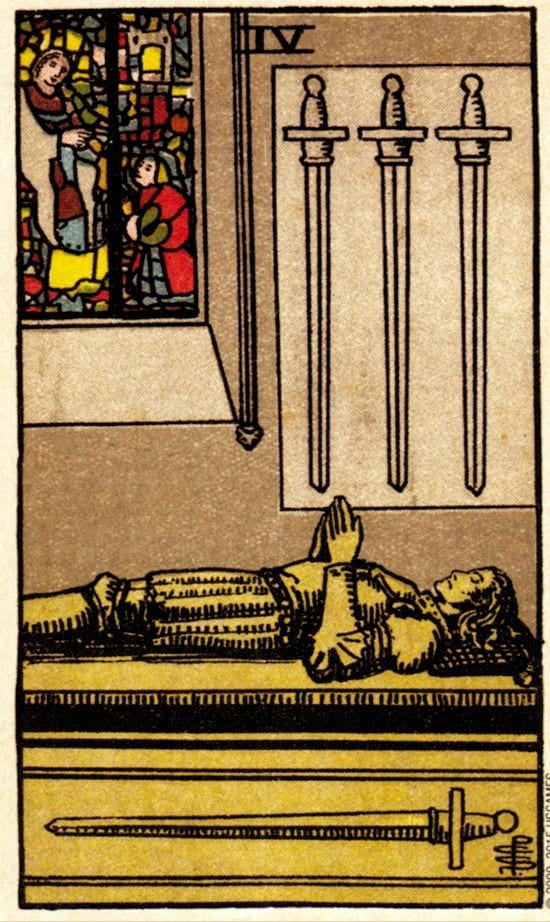
In the Rider-Waite-Smith image, a knight lies on a stone slab in what appears to be a church or tomb. His hands are pressed together in prayer. Three swords hang on the wall above him, and one lies beneath his resting place. A stained-glass window glows with soft color in the background — a scene of someone giving and receiving, even in stillness.
The first time this card showed up for me, I had been running on fumes for weeks. Not in crisis — just in that low-grade state of exhaustion where you’re technically functioning but nothing feels right. The Four of Swords didn’t ask me to fix anything. It told me to lie down. That was the whole message.
This is the card that says: you have done enough. Stop.
Symbolism
The knight is in full armor but lying down — battle-ready, yet choosing rest. This is important. The Four of Swords isn’t about weakness or defeat. It’s about a warrior who knows that rest is part of the strategy. You don’t remove the armor because the fight is over. You rest because the next fight requires you at full strength.
Three swords hang on the wall — parallel, organized, contained. The thoughts haven’t disappeared. The problems are still there. But they’ve been set aside, put on pause, given a temporary ceasefire. The fourth sword lies beneath the knight, close to the body, pointing downward. Some readers interpret this as the one truth or concern the knight carries even in sleep — the issue that runs beneath everything else.
The stained-glass window is the only source of warmth and color. It depicts a figure offering something to a kneeling person — blessing, healing, grace. Even in rest, something sacred is happening. Recovery isn’t empty time. It’s transformation in stillness.
The stone slab itself suggests permanence and solidity. This isn’t a nap on a couch. It’s deliberate, structured rest — the kind that requires you to stop, lie flat, and surrender to not doing for a while.
In the suit of Swords — the suit of air, mind, truth, and conflict — the Four represents the moment when the mind finally quiets. After the heartbreak of the Three of Swords, the Four is the exhale. The mind goes from pain to pause.
Upright meaning
The Four of Swords upright is the clearest “rest” card in the tarot. When it appears, the message is unambiguous: you need to stop, and you need to do it now. Not after this project. Not when the weekend comes. Now.
This card often appears when:
You’ve been pushing too hard. Mentally, physically, emotionally — you’re running on reserves that ran out a while ago. The Four of Swords says the hustle isn’t working anymore. What’s needed is the opposite of effort.
Recovery is the productive choice. In a culture that glorifies busyness, this card is radical. It says that doing nothing is sometimes the most strategic thing you can do. Rest isn’t laziness. It’s preparation.
You need time alone to think. Not to plan or problem-solve — to let your mind go blank and trust that clarity will come from stillness rather than from more analysis.
A situation requires patience. Not every problem can be solved by action. Some need time. The Four of Swords says: wait. Not passively, but consciously. The answer will arrive when you stop chasing it.
You’re recovering from something difficult. Illness, a breakup, a loss, a conflict, a career setback. The Four of Swords shows up to say: healing is happening, even if you can’t see it yet. Give it time.
Reversed meaning
The Four of Swords reversed is rest denied — either because you won’t take it or because you can’t.
Burnout. This is the emergency version of this card. You’ve pushed past exhaustion into a state where your body and mind are forcing the break you refused to take voluntarily. Insomnia despite being exhausted. Getting sick the moment you slow down. Mental fog so thick you can’t form a clear thought.
Restlessness. You’ve had enough of resting and you’re ready to move again — but are you really recovered, or just impatient? The reversed Four asks you to check honestly. There’s a difference between genuine readiness and restlessness disguised as energy.
Forced withdrawal. Sometimes life imposes the pause — a layoff, an illness, a cancellation that clears your schedule whether you wanted it or not. The reversed Four of Swords in this context asks you to use the imposed stillness rather than fight it.
Isolation turning unhealthy. The retreat that started as necessary self-care has gone on too long. You’ve been alone with your thoughts so much that the thoughts are getting louder, darker, more circular. The reversed Four says: it’s time to re-enter the world, even if it feels uncomfortable.
Refusing to process. Staying busy specifically to avoid sitting with difficult emotions. Filling every hour so there’s no space for grief, regret, or fear to surface. The reversed Four warns that what you avoid in waking hours will find you in dreams.
In love and relationships
Upright: The Four of Swords in love readings signals a need for space. This doesn’t mean the relationship is failing — it means one or both partners need time to breathe. After a conflict, the Four says: don’t try to resolve everything right now. Sleep on it. Give each other room.
For singles, this card often appears when you need to take a break from dating. The constant swiping, texting, hoping, and being disappointed is draining you. The Four of Swords says: step back, recover your sense of self, and let the next connection come to you when you’re whole rather than when you’re hungry.
Reversed: A relationship issue you’ve been avoiding is about to force itself into the open. The break you took — from the conversation, from the effort, from your own feelings — wasn’t long enough, or you used it to avoid rather than to process. Alternatively, you’re finally ready to reconnect after a period of distance, and the healing is genuinely underway.
In career and finances
Upright: Burnout is real, and this card names it. The Four of Swords in career readings says: take the vacation day. Call in sick if you need to. Step back from the project that’s consuming you and trust that it will still be there when you return. In financial contexts, it advises against making major money moves right now — pause, review your position, and wait for clarity before investing or spending.
Reversed: You’ve been on the sidelines too long and it’s time to get back in the game. Or you’re about to crash because you ignored every warning sign your body and mind gave you. The reversed Four in career is either a green light (if you’ve genuinely rested) or a red alarm (if you haven’t).
In health and wellbeing
Upright: The Four of Swords is one of the strongest cards for rest and recovery in the entire deck. In health readings, it’s straightforward: rest is medicine. Sleep more. Cancel commitments. Let your body heal without demanding it perform at the same time. This card often appears during recovery from illness, surgery, or mental health episodes — and it says the recovery is working, but don’t rush it.
Reversed: Ignoring physical or mental health signals. Refusing to slow down despite symptoms. The reversed Four in health is a warning: the body will enforce the rest you won’t take. It can also indicate difficulty sleeping — a mind that won’t turn off even when the body is screaming for rest.
Key combinations
Four of Swords + The Star: Beautiful healing combination. Deep rest that leads to genuine renewal. You’re not just recovering — you’re emerging transformed. Hope returns.
Four of Swords + The Tower: Forced rest after upheaval. The Tower knocked you down; the Four says stay down for a while. Don’t rush to rebuild. Let the dust settle.
Four of Swords + Ten of Wands: Burnout is the entire story. You’ve been carrying too much for too long, and this combination is the collapse point. Drop the load. It’s not optional anymore.
Four of Swords + Ace of Swords: Clarity emerging from stillness. After your rest, a breakthrough idea or insight arrives — the kind that only comes when the mind is quiet enough to hear it.
Four of Swords + Two of Cups: A relationship that needs breathing room. Taking space from each other — not because love is gone, but because love needs room to grow. Healthy distance.
Four of Swords + Nine of Swords: Anxiety preventing rest. You know you need to stop, but worry keeps you wired. This combination asks: what are you afraid will happen if you actually let go?
The card’s advice
The Four of Swords doesn’t negotiate. It doesn’t say “try to rest when you can” or “consider slowing down.” It says: lie down. Close your eyes. Stop talking, stop planning, stop scrolling, stop fixing. Let the swords hang on the wall. Let your thoughts wait.
This is one of the most countercultural cards in the tarot. In a world that treats rest as something you earn rather than something you need, the Four of Swords is permission you didn’t know you were waiting for. You don’t have to justify being tired. You don’t have to deserve the break. You just have to take it.
The knight in the image didn’t remove his armor. He knows the battle continues. But he also knows this: a warrior who never rests is not strong. A warrior who never rests is reckless.
Try it yourself
Put your deck away for 24 hours. No readings. No pulling cards. No checking in with the universe.
Then, after the 24 hours, pull a single card with this question: “What becomes clear when I stop trying to figure everything out?”
The answer might surprise you. Stillness has a voice. You just have to be quiet enough to hear it.
Frequently Asked Questions
Is the Four of Swords a yes or no card?
The Four of Swords is generally a 'not yet' rather than a hard no. It says the outcome you want is possible, but now is not the time to push for it. Rest first, gather your strength, then act. Timing matters more than effort with this card.
Does the Four of Swords mean a breakup?
Not necessarily. The Four of Swords in love more often indicates a need for space — a pause, not an ending. It suggests that one or both partners need time to process, recover from conflict, or simply recharge. A break is not a breakup unless the underlying issues go unaddressed.
What does the Four of Swords reversed mean?
Reversed, the Four of Swords warns of burnout, restlessness, or refusing to take the rest you desperately need. It can also mean you're finally ready to re-enter life after a period of withdrawal — but make sure you're genuinely recovered, not just impatient.
Is the Four of Swords about depression?
The Four of Swords can appear during periods of mental exhaustion that resemble depression, but it's important to distinguish between chosen rest and involuntary withdrawal. Upright, this card is about deliberate recovery — choosing to pause. If the retreat feels involuntary or prolonged, the card may be signaling that professional support would help.