From Church to Tarot: Why Gen Z Is Choosing Spirituality Over Religion
The empty pews and the full feeds
Here’s a number that tells a story: 41% of Gen Z identifies as religiously unaffiliated. That’s compared to 29% of all U.S. adults. Meanwhile, interest in tarot has grown 30% year-over-year among the same generation, and #WitchTok has accumulated over 30 billion views.
Something is happening. It’s not that young people stopped being spiritual — 79% of Gen Z still identify as at least somewhat spiritual. It’s that they’re finding that spirituality in different places than their parents and grandparents did.
I’ve watched this shift unfold in real time. My readership has gotten younger every year, and the questions they bring to tarot are the same questions people used to bring to confession or pastoral counseling: Am I on the right path? How do I deal with this grief? What should I do about this relationship?
The seekers haven’t disappeared. They’ve just changed where they seek.
What they’re leaving (and why)
Let’s be honest about what’s pushing young people away from organized religion, because it’s not laziness or moral decline — the two explanations churches tend to offer.
The inclusion problem. 60% of Gen Z say religious organizations are not accepting of LGBTQ+ individuals. For a generation where nearly 1 in 5 identifies as queer, being told that a core part of who you are is sinful isn’t just uncomfortable — it’s a dealbreaker. When the institution says “you’re welcome here” but means “you’re welcome here if you change,” people stop coming.
The trust problem. Institutional scandals — abuse coverups, financial corruption, political manipulation — have eroded the moral authority that organized religion once held. Gen Z grew up with this information freely available online. They didn’t hear about it decades later; they watched it unfold in real time.
The rigidity problem. 49% of Gen Z say they mix beliefs from different traditions rather than adhering to one doctrine. This isn’t spiritual confusion — it’s intellectual honesty. When you’ve been exposed to Buddhism, Christianity, Indigenous practices, and secular philosophy all through the same phone, demanding exclusive loyalty to one framework feels arbitrary.
The accessibility problem. Church requires showing up at a specific time, in a specific place, wearing specific things, following specific scripts. Tarot requires a deck and ten minutes of quiet. For a generation working gig jobs, dealing with student debt, and managing anxiety, the barrier to entry matters.
What they’re finding
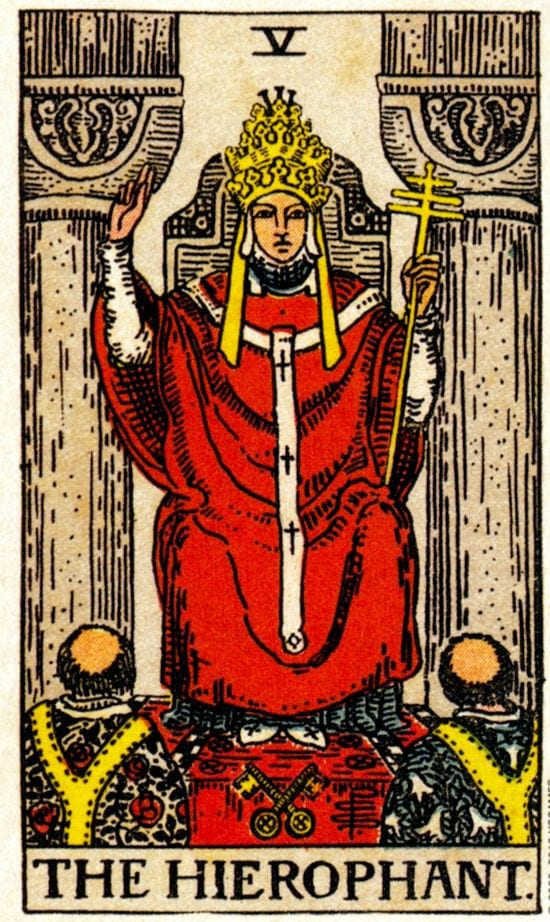
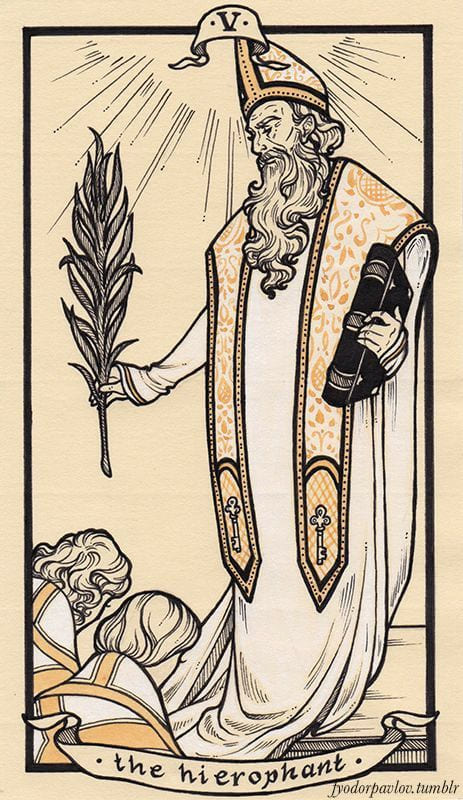
The Hierophant in tarot represents organized religion, tradition, established doctrine. In a reading, he’s the card of learning from institutions, following established paths, receiving teaching from authorities.
But here’s what’s interesting: The Hierophant reversed — which is increasingly how Gen Z encounters spirituality — means questioning doctrine, finding your own path, being your own spiritual authority.
What Gen Z is building isn’t anti-spiritual. It’s deeply spiritual. It just looks different from what came before.
Personal agency over institutional authority. 87% of Gen Z trust their own inner guidance over religious authorities for spiritual truth. Tarot fits this perfectly. Nobody tells you what the cards mean for your life — you sit with them, you feel into them, you decide. The reader (or the app) offers interpretation, but the final authority is always you.
Customizable practice. 33% of Gen Z believe in reincarnation. 37% find astrology meaningful. 30% believe in spiritual energy in physical objects. 22% incorporate pagan or Wiccan elements. They’re not following a pre-made spiritual package — they’re building their own from components that resonate. Some call this “cafeteria spirituality” dismissively. I call it honest.
Accessible community. Spiritual TikTok has over 12 billion views under #Spiritual alone. These aren’t just passive viewers — they’re sharing experiences, debating interpretations, teaching each other. The community that churches provided now exists in Discord servers, Reddit threads, and TikTok comment sections. Is it the same? No. But it’s real, and it’s available at 2 AM when you can’t sleep and need someone who understands.
Mental health integration. Young people aren’t separating spiritual practice from emotional wellbeing the way previous generations often did. They’re using tarot and astrology as self-reflection tools — not to predict the future, but to process the present. When a Gen Z person pulls the Three of Swords, they’re not asking “will something bad happen?” They’re asking “what grief am I carrying that I haven’t acknowledged?”
The cards they’re pulling
Certain cards resonate with this generation in ways that feel almost uncanny:
The Tower (XVI) — Systems collapsing, structures failing, forced transformation. For a generation that grew up during financial crises, a pandemic, and accelerating climate change, the Tower isn’t abstract symbolism. It’s Tuesday. And the Tower’s message — that destruction can precede rebuilding — is more comforting than “God has a plan” when the plan seems to involve a lot of suffering.
The Star (XVII) — Hope after devastation. Healing. The quiet that comes after the storm. Gen Z isn’t nihilistic, despite the reputation. They’re looking for genuine hope — not the performative optimism of “thoughts and prayers” but the quiet, honest hope of someone sitting by the water, slowly recovering.
Death (XIII) — Not physical death but transformation. Endings that make space for beginnings. A generation that’s watched industries die, norms shift, and institutions crumble understands death-as-transformation intuitively. The card says what many churches won’t: sometimes things need to end completely before something better can begin.
The Hermit (IX) — Solitary spiritual seeking. Finding your own light. Withdrawing from noise to hear your own truth. This card is essentially the “spiritual but not religious” archetype — the seeker who steps away from the congregation to find something more personal.
What tarot offers that church doesn’t (and vice versa)
I want to be fair here, because I’m not arguing that tarot should replace religion. I’m trying to understand why it is for many people.
What tarot offers:
- No gatekeeping — you don’t need ordination, membership, or approval to practice
- No moral judgment — the cards show patterns, not sins
- Personal authority — you interpret meaning for yourself
- Flexibility — use it daily, weekly, or when you need it
- Integration — works alongside any belief system, or none at all
What organized religion offers that tarot doesn’t:
- Established community with physical gathering
- Rites of passage (weddings, funerals, baptisms)
- Institutional support (food banks, counseling, shelters)
- Theological depth built over centuries
- Accountability structures and ethical frameworks
The honest answer is that both have value, and they serve different needs. The problem isn’t that organized religion exists. The problem is when it demands exclusivity while failing to earn it.
The generation that reads differently
Here’s something I’ve noticed in my practice: Gen Z reads tarot differently than older generations.
Older clients tend to come with specific questions: “Will I get the job?” “Is he cheating?” “When will things get better?” They want predictions.
Younger clients come with process questions: “What am I not seeing about this situation?” “What pattern am I repeating?” “What does this relationship mirror in me?” They want insight.
This isn’t better or worse — it’s just different. And it reflects a fundamental shift in how this generation approaches the unknown. They’re not looking for someone to tell them the future. They’re looking for tools to understand the present.
That’s why the Hierophant reversed resonates so strongly. Not rejection of wisdom, but rejection of the idea that wisdom only flows one way — from authority to individual. Gen Z wants wisdom to be a conversation, not a sermon.
Building something real
If you’re part of this shift — if you left church, or never went, or still go but also read tarot in your bedroom afterward — here’s what I want you to know:
Your spiritual practice is valid even if it doesn’t have a name. You don’t need to identify as pagan, Wiccan, or anything else to pull cards, meditate, or connect with something larger than yourself. “I’m figuring it out” is a perfectly legitimate spiritual position.
Solitary practice is real practice. You don’t need a congregation to have a meaningful spiritual life. The Hermit walks alone with his lantern, and his light is just as bright as the stained glass window.
Depth takes time. The accessibility of spiritual content on social media is wonderful, but a 60-second TikTok about the Death card can’t replace sitting with that card for an hour when it shows up in your actual life. Scroll less, sit more. The cards reward patience.
Community still matters. Even if institutional community isn’t for you, find your people. Study groups, reading circles, online communities where you can discuss what you’re learning. The Hermit eventually comes back from the mountain.
Keep questioning. The moment any spiritual practice — tarot included — asks you to stop thinking critically, walk away. The best cards are the ones that make you uncomfortable enough to grow. The Hierophant reversed doesn’t mean “reject all teaching.” It means “choose your teachers wisely.”
The card I’d give this generation
If I could assign Gen Z one tarot card, it would be the Star.
Not because everything is fine — this generation knows it isn’t. But because the Star comes after the Tower. After the collapse. After the old structure falls. The Star is naked and vulnerable, pouring water onto both land and sea, working at the intersection of the conscious and unconscious.
The Star says: the old structure fell, and you survived. Now begin building something that’s actually yours.
That’s what I see happening. Not a generation abandoning the sacred, but a generation reclaiming it. Not loss of faith, but a redistribution of it — away from institutions that didn’t earn it and toward practices that prove their worth every time you sit down with the cards.
The pews might be emptier. But the seeking hasn’t stopped. It’s just gone somewhere more honest.
Frequently Asked Questions
Why are young people leaving organized religion?
Multiple factors drive the shift: 60% of Gen Z cite religious organizations' rejection of LGBTQ+ individuals. Many also feel that rigid doctrine doesn't match their lived experience, that institutional scandals have eroded trust, and that they can find community and meaning through personal spiritual practice without a church.
Is tarot a religion?
No. Tarot is a tool for self-reflection, not a belief system. You don't need to believe in anything specific to use it. Many people use tarot alongside their religious practice — Catholic, Jewish, Muslim, Buddhist — while others use it as a secular mindfulness tool. The cards prompt questions, not doctrine.
Can you be Christian and read tarot?
Many people do. Tarot originated in Christian Europe, and its imagery draws heavily from Christian symbolism — the Pope (Hierophant), Judgement, the Devil, Temperance. Whether it conflicts with your faith depends on your denomination and personal theology. Some Christians use tarot as a contemplative tool alongside prayer.
Why is Gen Z interested in tarot and astrology?
Gen Z uses tarot and astrology primarily as self-reflection tools, not fortune-telling. 87% of Gen Z trust their own inner guidance over religious authorities. These practices offer personal agency, don't require institutional membership, are accessible through social media, and can be combined with any belief system.