Ghosts & Spirits Tarot: All 78 Card Meanings Explained
Some tarot decks whisper. This one haunts.
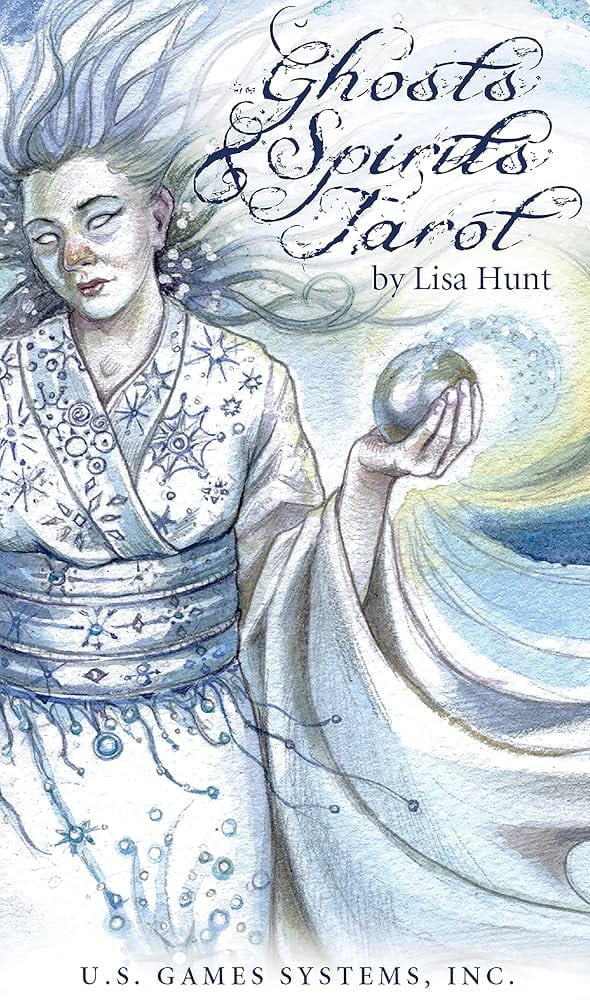
The Ghosts & Spirits Tarot by Lisa Hunt is a 78-card journey through the world’s most compelling ghost stories, spectral legends, and supernatural folklore. Every card pairs a traditional tarot archetype with a specific ghost or spirit drawn from mythology, literature, and cultural tradition — from the shape-shifting Leshy of Baltic forests to the wailing La Llorona of Mexican legend, from Shakespeare’s tortured Hamlet to Poe’s crumbling House of Usher.
Lisa Hunt’s watercolor-and-ink artwork is dense, layered, and alive with hidden detail. Faces peer from tree bark. Spirits dissolve into mist. Bones surface from dark water. The visual language is intentionally unsettling and deeply beautiful, creating a deck that doesn’t just illustrate tarot meanings — it embodies them through the raw, primal power of ghost stories that humanity has told for millennia.
What makes this deck remarkable is how precisely each spirit matches its tarot archetype. The Hungry Ghosts, forever starving and wandering, become the Wheel of Fortune’s lesson about karma. Jacob Marley’s chains become the Devil’s warning about material obsession. The Danse Macabre — death’s great equalizer — becomes the World card’s message of wholeness and completion. These aren’t random pairings; they’re revelations that deepen both the ghost story and the tarot meaning simultaneously.
How the Deck Is Organized
The Ghosts & Spirits Tarot follows the classic 78-card tarot structure:
- Major Arcana (0–XXI): 22 cards representing life’s great turning points, each paired with a major supernatural figure or folklore tradition — psychopomps, enchantresses, revenants, and forces that shape the soul’s journey between worlds.
- Wands: The suit of fire. Passion, will, creative drive, and the restless energy of spirits who refuse to stay still — from battlefield ghosts to the warriors of Valhalla.
- Cups: The suit of water. Emotion, love, intuition, and the deep undercurrents of grief and devotion that bind the living to the dead.
- Swords: The suit of air. Thought, conflict, truth, and the sharp clarity that comes from confronting what lurks in the shadows of the mind.
- Pentacles: The suit of earth. Material reality, stewardship, craft, and the guardian spirits who protect the land and its resources.
Each suit runs from Ace through Ten, followed by four court cards — Page, Knight, Queen, and King — for 14 cards per suit and 56 Minor Arcana total.
Major Arcana
The Fool

The Fool (Leshy) uses the image of a Baltic wood spirit to represent stepping into the unknown and the unconscious. The forest's tangled branches and hidden faces symbolize emotional lessons and challenges that will appear on a new path. The dog suggests an intuitive guide that can help the carefree traveler navigate shape-shifting situations and potential deception. Divinatory advice emphasizes maintaining a child-like optimism and sense of adventure while remaining aware that unexpected events can occur.
The Magician
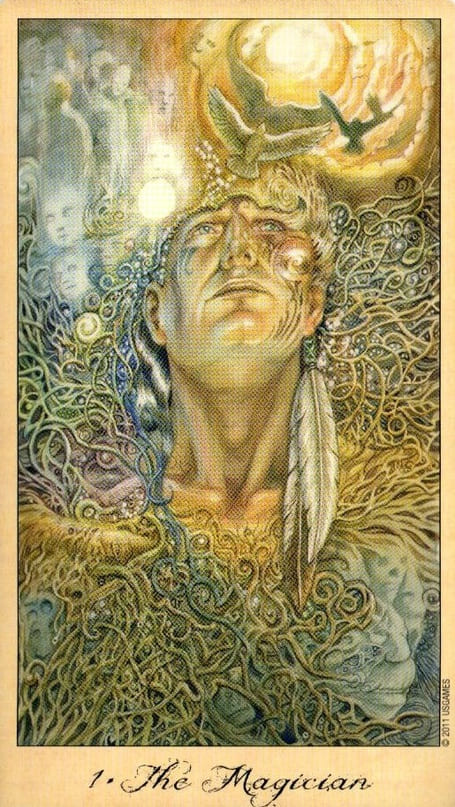
The Magician (Psychopomp) symbolizes a guide between life and death and between conscious and unconscious realms, offering comfort and connection. Its imagery of spirals and merging layers represents the transference of energy, the cyclical nature of existence, and the integration of all layers of consciousness into wholeness and self-awareness. The card emphasizes that the human psyche hosts limitless knowledge and that omnipresent energies can be accessed when channels of perception are opened. It advises opening communication with the mysteries beyond immediate recognition to receive messages and guidance during transitions.
The High Priestess

The High Priestess appears as the Sibyl, an oracle who weaves past lives and future events to illuminate hidden realms. She guides you along a pathway toward clarity and higher understanding, where dream-like specters and relics of the past mingle. The card urges you to listen to your inner voice and let intuition be your compass. Its sparkles suggest a divine presence supporting access to inner wisdom.
The Empress

The Empress (Guardian Spirit) represents a protective, nurturing presence that offers guidance and occasionally prescient messages. This guardian can appear in animal form—here as a bird shape-shifter—symbolizing soul-messages, hope, and well-being. The card emphasizes maternal nurturing that empowers creativity and inner strength. By connecting with the anima or feminine attributes, you become more open to possibilities and receptive to guidance.
The Emperor

This card evokes the mo-o, Dragon Ghost-Gods of Hawaiian lore: water-dwelling, shape-shifting creatures rising from a magical pool and tied to fertility and the environment. The imagery emphasizes connection with place, adaptability, and the need to respect the natural world and its inhabitants. In divinatory terms, it can signal the arrival of a powerful, influential figure who embodies the animus and brings conscious reasoning, experience, and authority. Together the symbolism cautions to honor both leadership and the ecosystems that sustain power.
The Hierophant

This card depicts an apparition acting as a spirit messenger, arriving briefly to convey an important message. Orbs of light suggest souls moving to higher planes of consciousness while the open book stands for knowledge, wisdom, and open-mindedness. Its appearance signals that guidance or information may be available now, and you should pay attention to subtle signs or communications. Before making crucial decisions, seek counsel and consider the message it brings, as it can herald either good fortune or impending crises.
The Lovers

This card depicts love entwined with desire, devotion, betrayal, loss, and grief as exemplified by the specter bridegroom. Water on the card serves as a mirror that reveals truth and dissolves illusions about the relationship. The imagery warns that successful partnerships depend on mutual give-and-take and a balanced anima/animus. If one partner's energy overwhelms the other, the relationship can become troubled or tragic.
The Chariot

This card calls for decisive action and forward movement amid turmoil. It urges you to embrace challenges with calm control so you can steer your fate. By recognizing the dark that lurks beyond the horizon and taking steps to assure a successful journey, you can determine your destiny. The wild hunt imagery and the contrast between volatile skies and placid valleys emphasize polarities—life and death, light and shadow, the conscious and unconscious. Move confidently through uncertainty, balancing inner and outer forces to reach your goal.
Strength

Strength (Mummy/Ka) emphasizes inner, spiritual strength represented by the Egyptian Ka—the eternal life force that exists apart from the physical body. The imagery of the mummy and the glowing chest symbolizes the soul essence and the dualistic relationship between body and spirit. The card underscores preservation of the inner self and the sustaining practices (offerings, mummification) that honor that life force. In divinatory terms it counsels embracing courage and inner will rather than succumbing to fear.
The Hermit
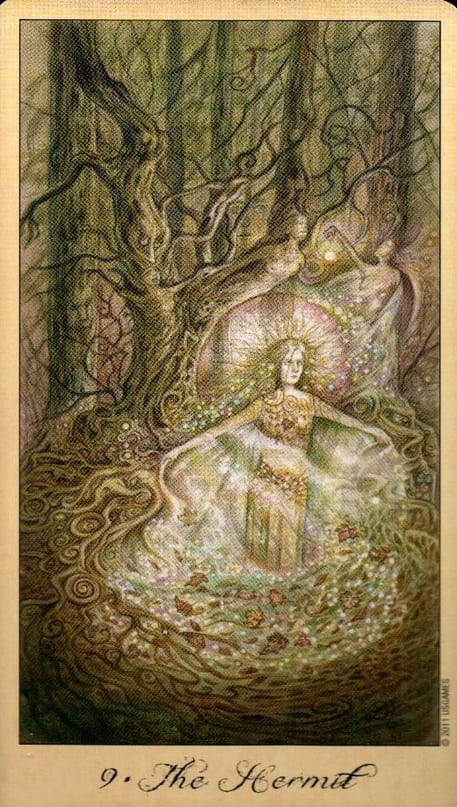
Dryads are depicted as ancient Greek nymphs who dwell in trees and act as fierce guardians of the environment, embodying a deep unity with the trees and elements. They participate in the mysteries of the forest and feel connected to the organic matter that swirls with magical energy, exemplifying the sacred nature of isolated woodland. As The Hermit variant, the card advises seeking out a sacred, secluded space to relieve the mind of external noise and restore clarity. It emphasizes unplugging and releasing mental debris; a deliberate time-out may be necessary to recover inspiration and reduce fatigue.
Wheel of Fortune
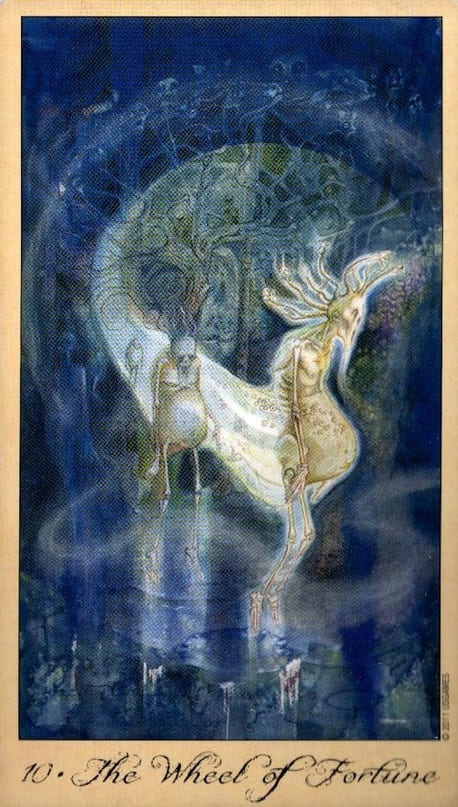
The Wheel of Fortune (Hungry Ghosts) speaks to karmic cycles and the consequences of actions, illustrated by the emaciated "Hungry Ghosts" who wander until balance is restored. Their imagery—burnt skeletal trees, descended bellies, haggard limbs, and shrunken skin—symbolizes insatiable lack and the emotional void left by past deeds. The swirling convection around them signals that change is imminent and inevitable. Divinatory guidance emphasizes recognizing action and reaction, preparing for shifts in fortune, and appreciating the gifts encountered during transitions.
Justice

The Justice (Snow Ghost) card depicts a Japanese snow spirit who embodies conscience and moral balance, holding two spheres that denote equilibrium. Her cold, virtuous presence and flowing drapery contrast with misdeeds that originate from a repressed shadow, indicating inner moral conflict. Divinatory meaning warns that a bad conscience brings bad karma and consequences may appear when you least expect them. The card advises being just and fair and thinking about the ripple effects your decisions will have on others.
The Hanged Man

This card depicts a vampire-like figure ensnared in a tree, suspended between conscious thought and the unconscious realm of shadows and dreams. It warns of stagnation and being trapped in soul-draining situations where complacency perpetuates a destructive cycle. You may be at a crossroads or feeling immobilized by patterns that sap your vitality and growth. The guidance is to discern what lurks beneath the surface and seek the perspective shift necessary to break free from these draining dynamics.
Death

Death, depicted as the Grim Reaper, symbolizes the fragility and sacredness of life and the inevitability of endings. The scythe represents linear time while the orb suggests sacred time, and the setting sun signals that an end is drawing near. Rather than an absolute termination, death signifies a transference of energy from one form to another and a necessary transformation. This card points to endings that clear the way for fresh beginnings and encourages awareness of life's tenuous, sacred nature.
Temperance

The Temperance (Swan Maiden) card symbolizes reconciliation between conscious awareness and primal, unconscious instincts, embodied by the swan maiden standing between land and water. It urges balance and harmony, guiding you to temper rational deliberation with emotional depth and intuition. The image suggests letting go of egoic control—like the maidens who change form when their feathers are found—and embracing deeper insights through inner reflection. Overall, it calls for integration of opposing aspects of the self so that stability and flow may coexist.
The Devil

The chained ghost of Jacob Marley embodies the consequences of a life bound to materialism and obsessive desire, showing how attachments weigh the spirit down. His visit to Scrooge warns of a bleak fate of limbo and stasis caused by living an illusionary, materially driven life. The card urges recognition of what truly matters and an opening of the eyes to deeper truth. It counsels releasing empty obsessions and embracing genuine priorities to avoid spiritual stagnation.
The Tower

This card symbolizes sudden, catastrophic collapse of structure and illusion, forcing unavoidable change. It portrays a breakdown of the psyche, where hidden truths violently erupt and reveal grim realities. The image warns of disaster and the necessity of confronting abrupt upheaval rather than clinging to denial. In a reading it indicates shocking events that compel rapid adaptation and the loss of false stability.
The Star

The Star evokes Pueblo cosmology of the Cloud People (Shiwana), supernatural weather spirits who bring nourishing rains. They travel accompanied by magical nimbi whose radiance and life-giving rains sustain the land, while swirling souls connect conscious desires with unconscious dreams. The imagery suggests a link between visible guidance and hidden longings, pointing to renewal and a larger, animating life force. In readings, it signals a newfound freedom to move through unfamiliar terrain without being held back by fear or resistance, encouraging openness and trust.
The Moon

The Moon recounts Aeneas' prophetic descent into the underworld, a journey that mixes hope and horror as he witnesses both suffering and reward and receives his destiny from Anchises. The underworld stands as a symbol of the unconscious, housing our deepest dreams and greatest fears and populated by both tortured and enlightened faces. The card urges you to decipher the hidden messages of this inner landscape and to let intuition guide you through uncertain passages. Confronting the shadows within your psyche is necessary for insight and the fulfillment of a larger fate or purpose.
The Sun

The Sun (Grateful Dead) tells of a benevolent act repaid when a hero’s kindness is returned by a rescued spirit, embodying the cycle of good karma. It signals abundance, joy, and life-affirming energy as the rewards of hard work and generosity. The card emphasizes that small pleasures and consistent goodwill accumulate into deep happiness and continued vitality. Embrace sunny optimism and recognize that goodwill creates a confluence of positive outcomes.
Judgement
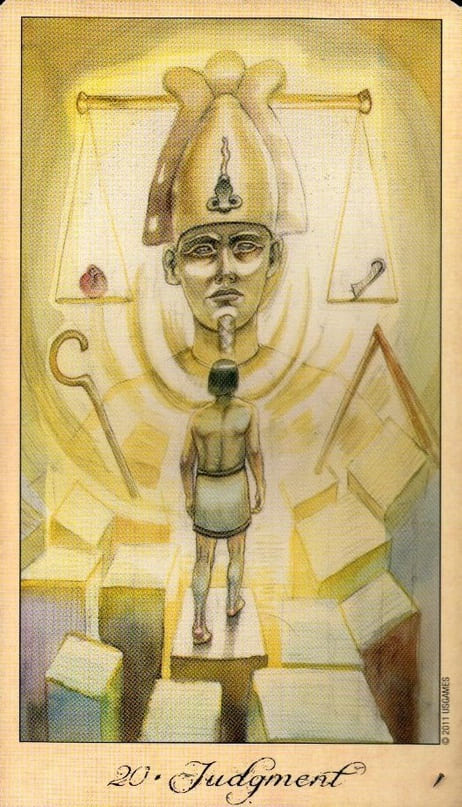
Judgment recalls the Egyptian rite of weighing the heart against the feather of Maat, symbolizing truth, evaluation, and consequence. It points to a portal to higher consciousness where hidden aspects of the psyche are revealed and must be assessed. The card advises listening to your inner voice and following your heart when confronting decisions that will have lasting impact. Ultimately, it calls for honest self-examination and readiness to accept the consequences of one’s actions.
The World

The World (La Danse Macabre) depicts death as the great equalizer that unites humanity and awakens the dead from unconscious chaos into epiphany. The imagery of birds signals the spirit's ascent into higher planes, while silhouetted figures merge shadow and light to suggest renewal and wholeness. As a divinatory message, it indicates that many facets of the self have been integrated, allowing you to perceive light within shadow. This integration opens new opportunities and freedoms that accompany increased self-awareness.
Wands
Ace of Wands

This card presents mysterious marsh lights—illusory flickers that nevertheless symbolize sudden inspiration and the presence of a higher spirit guiding through darkness. The lights and orbs illuminate dark passages and offer clarity, while the marsh water reflects the deep reservoirs of the mind. Flickers of wisdom and creative insight arise from these inner depths, inviting new beginnings. You may "see the light" as a harbinger for change, but remain discerning because the initial allure can be deceptive.
Two of Wands
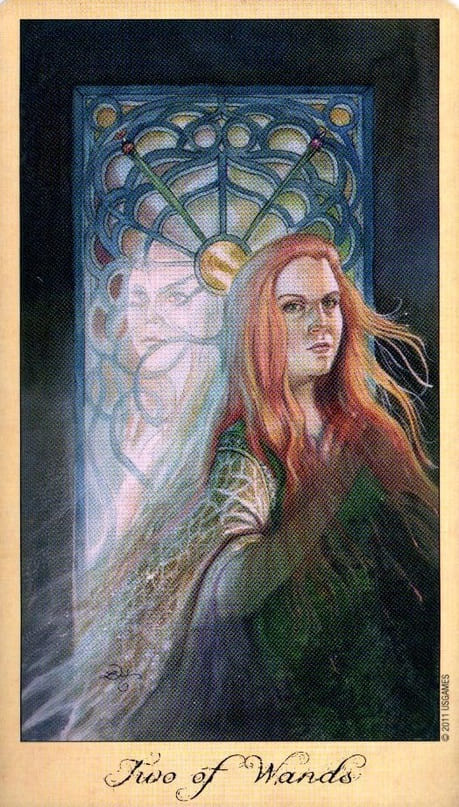
The Two of Wands (Doppelgänger) presents a ghostly double whose presence can presage ill tidings or death and who casts no shadow or reflection. The doppelgänger signifies an evil twin or the emergence of one's dark side or inner shadow. The girl's red hair symbolizes fiery ambition that can be embraced to bring focus and energy, or it can be undermined by self-imposed fears as represented by her colorless counterpart. Divinatory guidance urges you not to be your own worst enemy and to take action to make your dreams come true.
Three of Wands

The Three of Wands (Fair Brow) tells of generosity rewarded and the fruits of cooperative action, as shown by the tale of Fair Brow whose kindness led to unexpected riches. It highlights communication, partnership, and openness to new ideas as catalysts for new enterprises. Symbolic details—the shaking of hands, circling birds, and a treasure chest—point to unity, cooperation between spirit and matter, and karmic reward. Practically, the card advises embracing collaboration and new perspectives to make this a productive period.
Four of Wands

This card evokes the Shellycoat's playful, mischievous spirit and a lightness of being that invites spontaneity and joy. Its imagery—skipping across moving waters and three stones representing past, present, and future—points to movement, continuity, and renewed creative inspiration. The sparkles of energy signal rejuvenation and the return of creative vitality. In readings it advises you to relax, celebrate accomplishments, let go of accumulated stresses, and refuel your spirit before returning to work.
Five of Wands

This card recounts the tale of Lemon, who poisoned his wife Oiwa and was later haunted by her vengeful spirit, leading to a tragic misjudgment that cost an innocent life. The imagery stresses that unresolved wrongdoing can grow into a larger, unavoidable problem, symbolized by Oiwa's large head and the shadow representing the unrestrained ego. The sword, unusual in a Wands card, becomes the instrument of tragedy and highlights impulsive action and regret. In readings it warns of unexpected obstacles that cloud judgment, potential relationship strife, and the need to prepare for struggle and remorse.
Six of Wands

The Six of Wands (Valhalla) heralds recognition, victory, and the rewards of perseverance. Like fallen Viking heroes carried to Valhalla by Valkyries, this card symbolizes being honored, uplifted, and celebrated for courage and hard work. It invites you to bask in your achievements while preparing to step through a door to new heights of awareness and further opportunities for expansion. Expect a triumphant period following good news, with acknowledgment and tangible rewards for determination.
Seven of Wands

Seven of Wands depicts the Ghost of Samuel confronting Saul, symbolizing fierce defiance and the consequences of disobedience and chaos. The imagery of tormented faces and blazing contention highlights the sorrow and cost of conflict. As a divinatory message, the card urges you to stand firm for your beliefs and not flinch in the face of adversity. It calls for focused, persistent action to prevail and to preserve what is right despite turmoil.
Eight of Wands
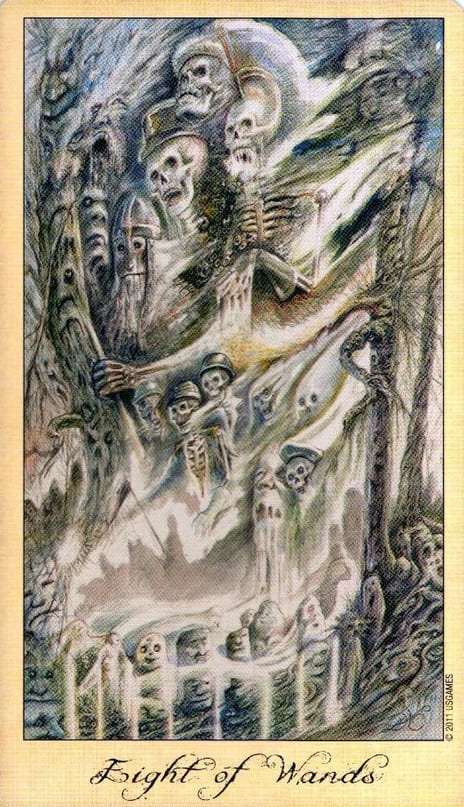
The Eight of Wands (Battlefield Ghosts) depicts lingering energies from violent past events that hover between the material and ethereal worlds. It suggests sudden illumination that reveals what has been hidden in the shadows and urges swift movement when appropriate. The card advises combining rapid response with methodical, focused intent rather than rushing blindly. Its imagery of marching skeletons and fog symbolizes unresolved impressions that influence present actions and collective consciousness.
Nine of Wands

The Nine of Wands (Story of Glam) depicts a battle between a haunted, vampiric force and a hero whose victory leaves him scarred and fearful. The wands and circulating debris symbolize the multiple energies and tactical strength summoned in the struggle, and the hero's final push represents the use of inner resources and sheer will. The lingering curse and the hero's withering underscore themes of lingering trauma and the cost of endurance. Divinatory guidance urges you to push harder, draw on your inner strength, and persist to complete your goals despite fear or fatigue.
Ten of Wands
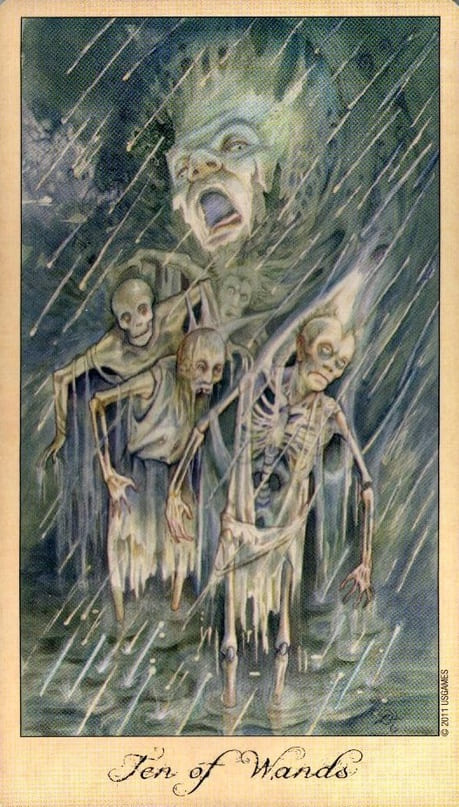
This card portrays overwhelming burden and oppression, using zombies, floodwaters, and heavy wands to symbolize being weighed down and losing individuality. The imagery emphasizes exhaustion and extinguished energy as figures struggle to remain above water and tie up loose ends. In a reading it indicates mental overload, unfinished business, and goals muddled under excessive responsibilities. The guidance is to release unnecessary burdens and let some things go to lighten your load.
Page of Wands
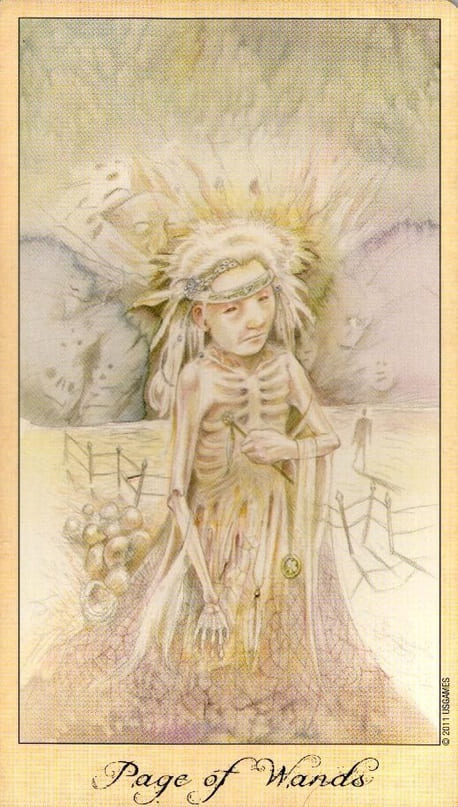
Page of Wands (Acheri) evokes a liminal messenger standing between life and death, embodied by the ghostly Acheri and her trail of skulls. The card signals the arrival of important, possibly unsettling communications that demand careful attention. It advises listening closely to messages that may come from the spirit realm or unexpected sources and preparing for a creative, decisive response. At once a warning and a guide, the card balances caution with openness to guidance.
Knight of Wands

The Knight of Wands (Hiku) depicts a daring descent into the unconscious to reclaim what has been lost, emphasizing bold action and transformative courage. It highlights creative exploration and the willingness to move beyond restrictive, surface-level thinking. The card signals impending adventure, travel, or a change of scene that will invite you to use your creative potential in unexpected ways. Embrace the plunge into deeper imagination and be ready for renewal through decisive, inspired effort.
Queen of Wands
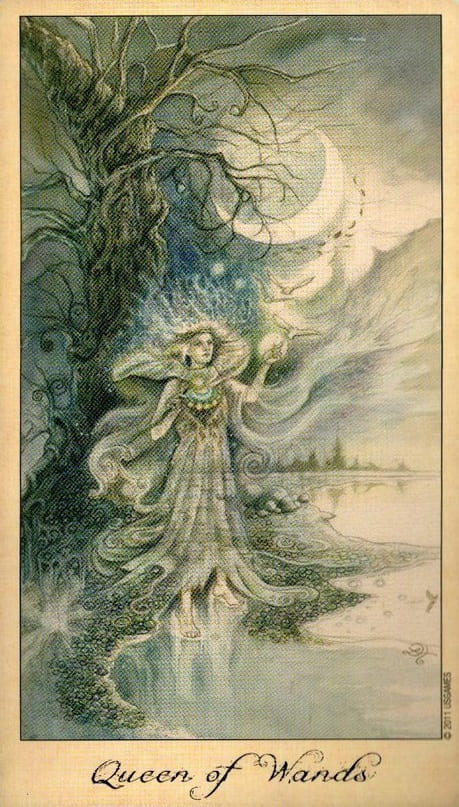
The Queen of Wands (White Ladies) appear as diaphanous ghosts dancing near moonlit ravines, bridges, and narrow passageways, responding to a passer-by's behavior with kindness or punishment. They can be helpful to travelers, women in childbirth, and miners, and their transparent dress suggests a deeper connection with the non-material world. The presence of all the elements—water, earth, air, and fire—indicates limitless possibilities and a blending of forces. In divination, the card advises openness to female influences and signals that social opportunities may present themselves.
King of Wands
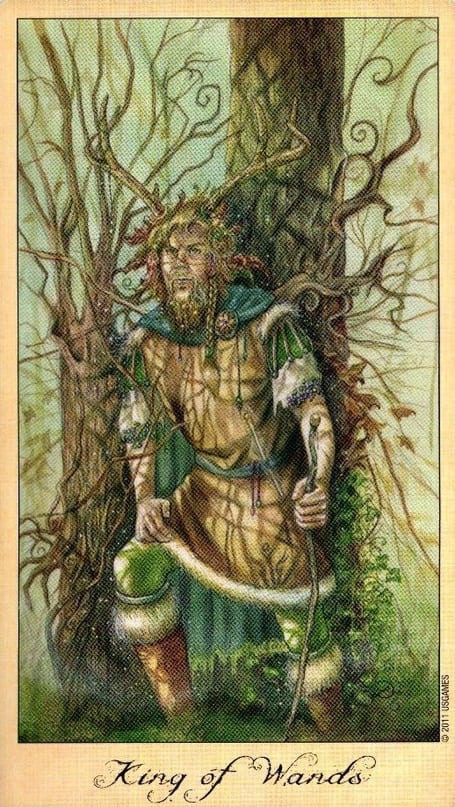
The King of Wands as Herne the Hunter represents an imposing, transformative leader bound to primal and supernatural forces. His legend—wounded huntsman saved with sacred antlers—connects him to the strength and rootedness of trees, which symbolize the three levels of the psyche. Sensing spirits suggests the dissolution of rigid rational barriers and the rising influence of innate senses on perception. Practically, the card indicates that someone in authority may offer advice or that you may need to assume leadership and be willing to take risks to make things happen.
Cups
Ace of Cups
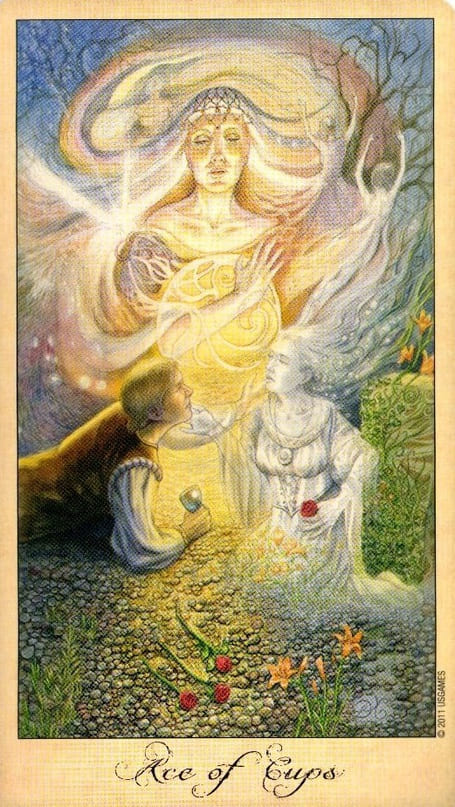
Giselle depicts a love that endures beyond betrayal, madness, and death, with forgiveness as the force that redeems both parties. As a ghost among the Wilis she protects a remorseful lover from a fatal supernatural punishment, preserving him until dawn. Her reaching gesture and the red rose symbolize a love that transcends the material and persists eternally. In divinatory terms, this card indicates that love energy will guide and direct your desires, inviting forgiveness, compassion, and emotional courage.
Two of Cups

This card tells of Isabella’s devoted, tragic love that endures beyond loss and even death, symbolized by the pot of basil she tends to. It emphasizes that love is a powerful force that nourishes and requires mutual giving and taking. The imagery highlights nurturance, mourning, and the persistence of affection despite painful circumstances. In readings it denotes deep emotional bonds, devotion, and the potential for both comfort and sorrow within intimate relationships. It advises tending relationships with care while acknowledging that love can bring both joy and grief.
Three of Cups
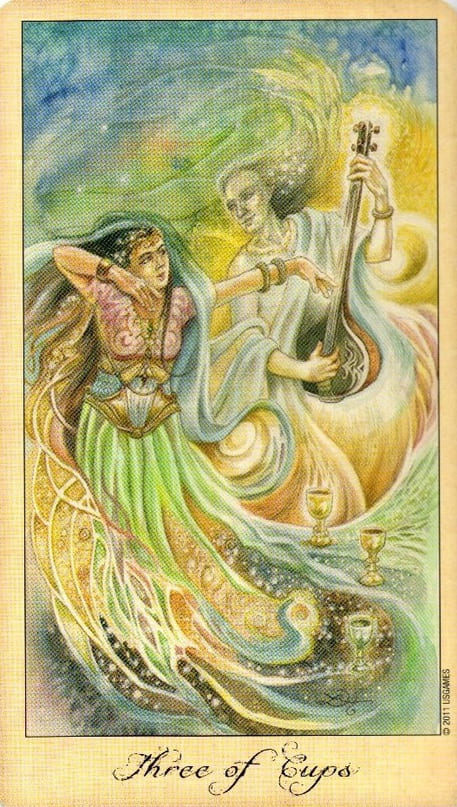
This card depicts Apsaras and Gandharvas—spirits of beauty, music, and natural phenomena—celebrating with dance and song. It signals harmony, abundance, healing, and creative fecundity as elements like fire and water blend in a balanced, rhythmic display. Emotional connection and mutual feeling are emphasized through eye contact and flowing imagery, urging you to go with the flow. Embrace nurturing love, friendships, and the surrounding energy to let creativity and abundance emerge in your life.
Four of Cups

This card depicts sailors trapped in Davy Jones' Locker, symbolizing emotional stagnation, entrapment, and mourning. The cool, void-like imagery emphasizes isolation and the immobilizing pull of indifference. Its guidance warns against succumbing to complacency and urges the seeker to seek stimulation and break free from apathy. Rising above the stagnant waters requires conscious effort and active engagement to avoid being consumed by passivity.
Five of Cups

A tragic legend of seduction, betrayal, and a deathly curse warns of the dangers of becoming entangled in destructive situations. The ghostly bride and her mist bind the living to the underworld, symbolizing loss, regret, and the emotional cost of ill-fated choices. The card cautions against reckless or tempting situations that may lead to sorrow and spiritual peril. If you do fall into folly, seek a way to recover and realign with what is true and life-affirming.
Six of Cups

The Six of Cups (Revenants) depicts revenants—restless ghosts who return to the living to tie up loose ends and sometimes assume mortal or animal forms. They seek assistance to complete their missions and find closure, and the imagery—red roses, ivy, a full moon, and faces embedded in rock—illustrates persistent energy, lingering memories, supernatural influence, and echoes of past lives. The card invites gentle reflection and reconnection with the past but warns against becoming trapped by nostalgia. It encourages cherishing memories while celebrating the present and using closure to move forward peacefully.
Seven of Cups

This card warns against chasing illusory promises of wealth or perfection, symbolized by the knight's futile search for Eldorado. It highlights delusional thinking, abandoned ideas, and dreams that crumble like a precipice. The imagery equates the pursuit with a metaphorical death or an ending, urging recognition of reality over fantasy. Practically, it advises choosing a solid, grounded path rather than following pipe dreams.
Eight of Cups
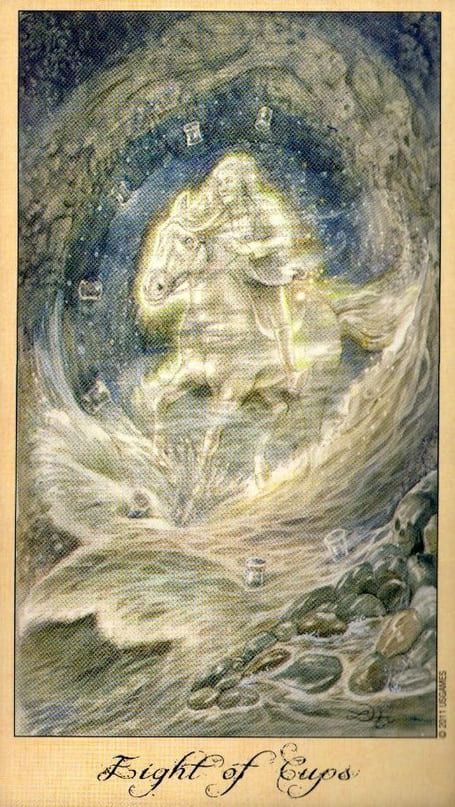
This card tells the tragic tale of Hauke Haien, a dyke builder whose refusal to participate in a sacrificial tradition led to communal resentment and a catastrophic flood. During the storm his family is swept away and Hauke plunges into the sea on his horse, and though no remains were found his ghost and spectral horse are said to appear guarding the dyke. The imagery evokes persistent loss, the restless presence of the past, and the unstoppable force of nature. In divinatory terms it urges you to stop treading water, move on from entrapment, and allow yourself the freedom to leave what no longer serves you.
Nine of Cups

This card depicts a transcendent journey taken by a boy named Diamond with a supernatural spirit called the Northwind, carrying him to an idyllic, heaven-like place. Flying through a bright night sky filled with orbs and stars symbolizes heightened awareness, divine presence, and a magical energy of peace and wonderment. The imagery and story emphasize that wishes can come true and celebrate the joy of overcoming obstacles that previously kept you from soaring. Ultimately, the card highlights spiritual lessons learned through adventure and a contented acceptance of the soul's journey.
Ten of Cups

This card depicts communal celebration honoring ancestors, uniting the living and the dead through feasts, rituals, and joy. The glowing cups symbolize luminous life and shared happiness that presides over the celebratory scene. The three skeletons pointing to past, present, and future remind us of the life cycle and continuity across generations. In divination it signals joy, familial love, and an invitation to celebrate life while honoring those who have been part of your journey.
Page of Cups

The Page of Cups (Encantado — Dolphin Shapeshifters) draws on Brazilian legend of shapeshifting dolphin spirits who can be both alluring and dangerous. The card emphasizes themes of transformation, romance, and the thin line between charm and deceit. It advises openness to emotional offers and gifts while urging cautious discernment for hidden motives or risks. The imagery of turbulent water and shifting forms symbolizes inspiration tempered by the need for careful exploration of feelings and attractions.
Knight of Cups

The Knight of Cups (Undine) embodies emotional allure, the pull of the unconscious, and the merging of human passion with watery mystery. The tale of Undine and Huldbrand highlights themes of desire, the quest for a soul, and the consequences of fidelity and betrayal. Symbolism such as swirling energy, fish, and lilies points to deep unconscious influences and a bridge between the earthly and emotional realms. In divinatory terms, the card signals the arrival of romantic or emotional offers and urges openness to feelings while warning against being blinded by infatuation.
Queen of Cups

This card depicts Groa, a maternal spirit summoned from the underworld to provide wise counsel and protective magic. Her nine charms and assistance enable Svipdag to overcome dangerous trials, symbolizing guidance through peril with maternal support. The oversized cup held close to her heart represents abundant love, devotion, and deep intuitive connection. In readings, the Queen of Cups signifies a loving, protective female presence who helps you access your intuition and clear obstacles.
King of Cups
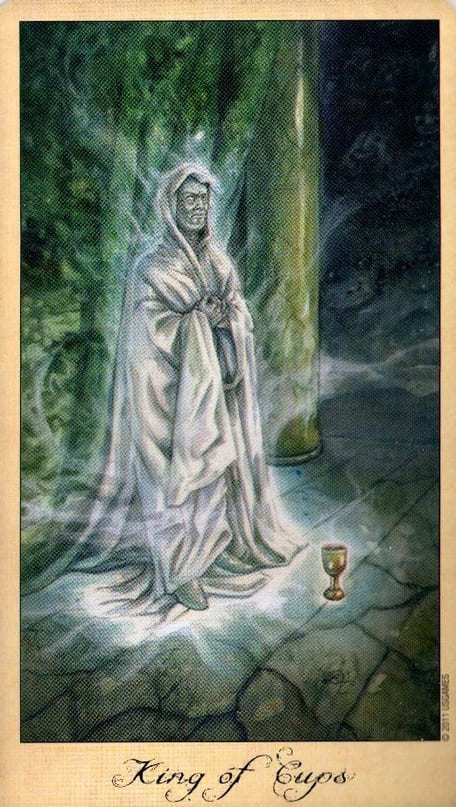
The King of Cups (Ghost of Hamlet) evokes a spectral, fatherly presence that reveals hidden truths and the consequences of betrayal. As the ghost exposes Claudius's murder and instructs Hamlet to seek justice while sparing his mother’s judgment to God, the card balances vengeance with mercy. Visual elements—the bluish cast, the hands clasped in compassion, and jagged floor cracks—signal peace and equilibrium amid deceit, with the ghost's light assuring ultimate justice. In divination, it indicates that a paternal figure or conscience may bring insight into buried emotions or guilt and serves as a reminder to respond with compassion.
Swords
Ace of Swords
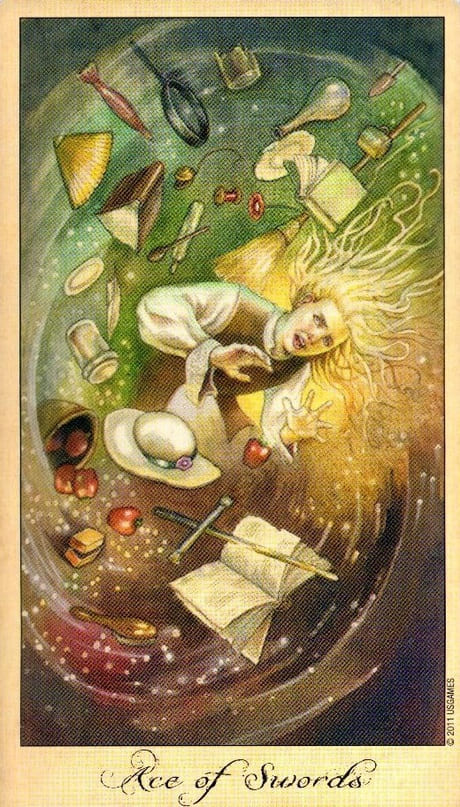
The Ace of Swords (Poltergeist) depicts an unseen, disruptive force manifesting as flung objects and sparks of displaced energy. It emphasizes how unconscious forces can visibly affect everyday life, with mundane items symbolizing that influence. In a reading, the card signals the beginning of a cycle of intense activity and urges you to focus on channeling your energy in creative, productive ways. It encourages recognizing restless or chaotic energy and directing it constructively to prevent destructive manifestations.
Two of Swords

The card evokes a haunting stalemate: unresolved guilt and memory manifest as a ghostly presence that freezes action. The mirrored swords symbolize opposing forces or choices that leave the querent emotionally blocked and morally troubled. Images of cold tears and a polluted conscience suggest inner turmoil and distorted perception that impede clear judgment. Divinatory meaning cautions that you may be stuck in an impasse until the underlying conflict is acknowledged and addressed.
Three of Swords
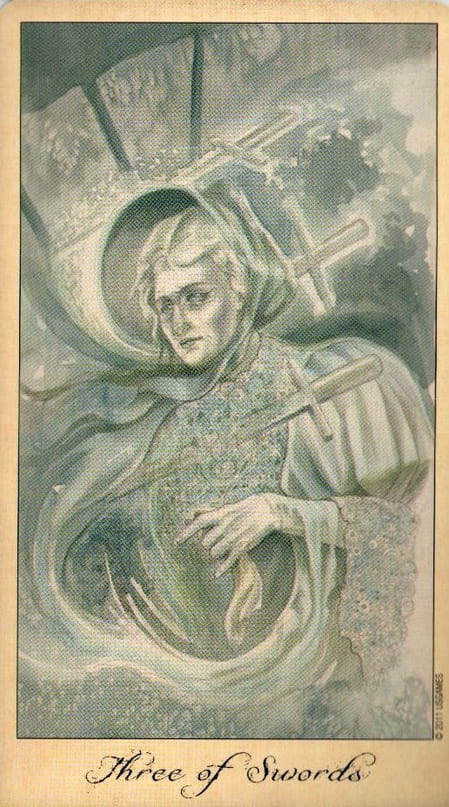
This card depicts lingering anguish from a failed relationship and the haunting persistence of unresolved attachment. Its imagery — three angled swords and a kerchief — points to acute emotional pain, broken promises, and tension. It warns of impending heartache, rejection, and the risk of isolation or separation anxiety. The guidance is to remain alert for signs of trouble, prepare emotionally, and acknowledge wounds so they can be addressed rather than allowed to fester.
Four of Swords

The card portrays Kuei, restless Chinese demon-ghosts denied entry to the spirit realm, representing lingering disturbance and the need for protective measures. The ghost's camouflage in frosty surroundings and the snow-dusted trees evoke a quiet, enforced stillness on the physical plane. Illuminated swords beneath the surface warn that this stasis is temporary and that underlying tensions persist. Divinitorily, the card signals a period of rest and recovery after turbulence, advising guarded recuperation while remaining aware that action may be required once the pause ends.
Five of Swords
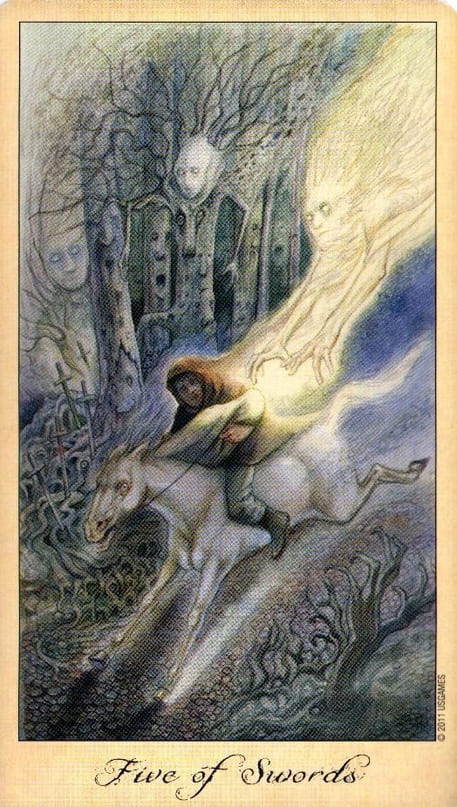
This card evokes Goethe's Erlkönig myth—a sudden, tragic visitation that symbolizes loss, helplessness, and the feeling of being overtaken. It conveys desperation, a collapse of control, and the presence of unseen forces or witnesses to suffering. In divinatory terms it warns of betrayal, backstabbing, and the disillusionment and defeat that can follow. It also cautions that cruelty begets consequence: if you inflict harm, expect backlash.
Six of Swords
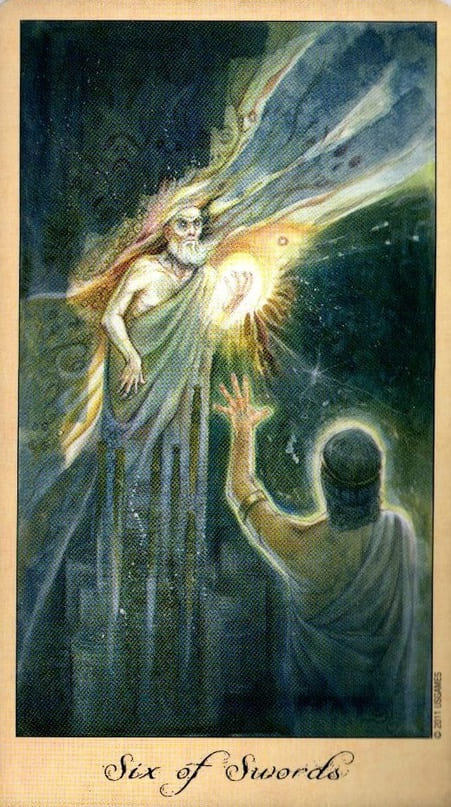
This card draws on the myth of Gilgamesh and Enkidu to represent grief, memories rising from the unconscious, and a yearning to reconnect with what was lost. The image of a figure surfacing and spirits in the background symbolizes neglected memories and material emerging from the unconscious. The extended hand reaching out for a lost friend emphasizes attempts at closure or reaching for past connections. Divinatory guidance advises stepping back, reflecting objectively on your journey, and considering travel or transition as part of moving forward.
Seven of Swords

The Seven of Swords (Duppy) evokes a dual-soul folklore motif in which an earth-bound spirit breaks through the ground, symbolizing unconscious material rising to the surface. The stormy sky, silhouetted spirits, and scattered rocks suggest potential confrontation and the haunting presence of past lives or lost souls. As a divinatory message, it warns that an enemy or difficult situation may demand quick thinking and reliance on intuition. The card advises caution, encouraging you to trust your instincts and avoid unsavory situations when possible.
Eight of Swords
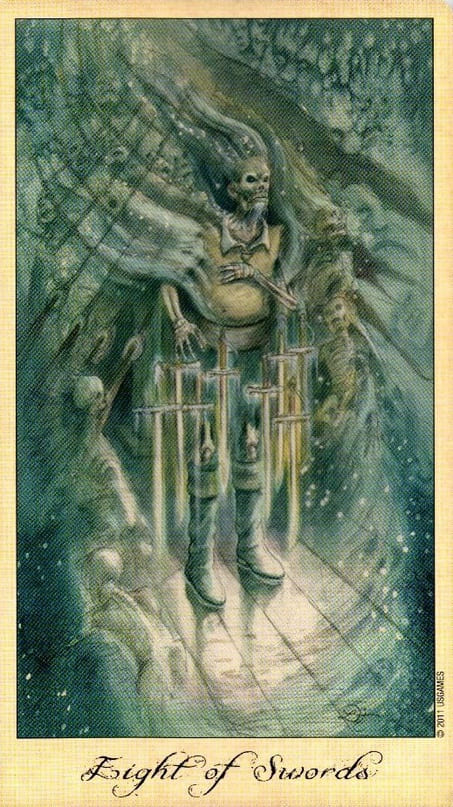
This card depicts a sense of being trapped and a loss of control in a difficult situation. It evokes the legend of a cursed phantom ship whose crew is stuck in futile circumstances, indifferent to surrounding chaos. The immovable swords symbolize restrictive thinking that prevents movement or solutions, while the ghosts and skeletons reflect the paralysis of hopelessness. The card serves as a reminder to listen to what others have to say as a possible way out of that stuckness.
Nine of Swords
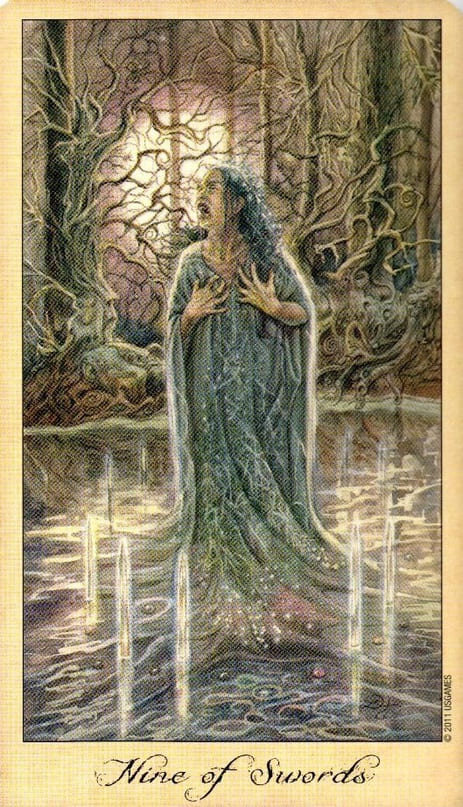
This card invokes the legend of La Llorona, a mourning spirit whose story embodies profound grief, guilt, and remorse. The swords around her and the frenetic designs of her dress symbolize lingering pain and a fragmented soul. The image of water-saturated garments conveys the sensation of being weighed down by a heavy heart and overwhelmed by sorrow. Divinatory meaning warns of absorbing despair from a stagnant pool of hopelessness and prompts recognition of the need to confront and release that pain.
Ten of Swords

The Ten of Swords (Ghoul) depicts a predatory, vampiric spirit stalking lonely deserts and graveyards, symbolizing overwhelming danger and betrayal. Skulls, bones, and a field of swords illustrate lingering past mistakes and the many forms darkness can take. The imagery urges recognition that harm may be unavoidable in the short term, and that endurance is required. Ultimately the spirits on the horizon suggest the possibility of liberation if you move beyond the current collapse and regroup to recover.
Page of Swords
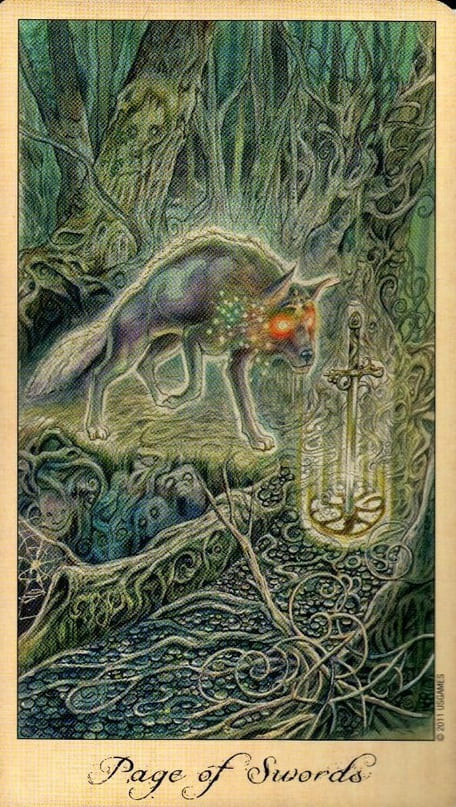
The card warns of ominous signs along solitary paths, embodied by black dogs that can herald danger or, occasionally, aid. A sword blocks a narrow pass at a turning point, its energetic emissions suggesting the obstruction may be illusory. Roots and mischievous spirits emphasize the unpredictable and potentially treacherous nature of the road ahead. Practical guidance is to examine your current path carefully and be wary of opportunities that seem too good to be true, preparing for possible trouble around the next bend.
Knight of Swords

The Knight of Swords (Ekimmu) draws on the ancient Babylonian Ekimmu, a malignant vampire-ghost associated with unquiet dead and pestilence. Its forceful winds and inability to fully materialize symbolize urgent, driven energy and the tragic remnants of a past demise. The card's merging with elemental forces suggests creative perseverance despite a haunted or haggard presence. In readings it advises assertive communication—share your ideas—but warns against forcing yourself on others.
Queen of Swords

The Queen of Swords (Banshee) embodies a harbinger of inevitable change, whose piercing cry warns of approaching endings. She appears as both a beautiful maiden and an ugly old hag, reflecting the dual nature of transition and elemental forces. As the messenger of truth, she communicates clearly and may provide a jarring but necessary wake-up call through a strong female influence. Her role is practical and preparatory: delivering hard information so others can accept and ready themselves for what must come.
King of Swords
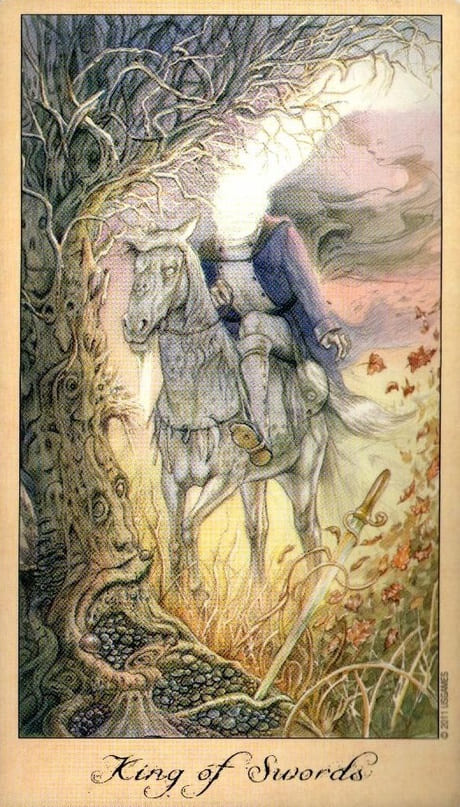
The King of Swords (Headless Horseman) warns that mental agility and clear thinking are essential when confronting hidden dangers and new ventures. This spirit crosses from vaporous illusion to physical predator, reminding you to stay grounded and attentive rather than lost in daydreams. A powerful, possibly masculine, presence may appear to jolt you from complacency and offer sharp insight and necessary clarity. Use your intellect and focus to navigate potential perils and make decisive, well-reasoned choices.
Pentacles
Ace of Pentacles
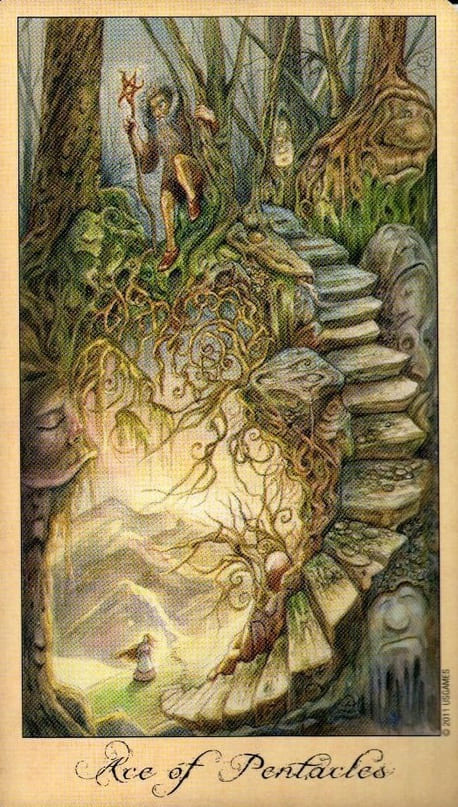
This Ace of Pentacles card features Rübezahl, a German forest spirit whose wild, untamed nature and mischievous acts set the scene. The story of his abducted princess and her clever escape—asking him to count turnips—emphasizes deception, distraction, and the possibility of liberation. Visually the placid background contrasts with the intemperate wilderness, and the steps on the card suggest ascension and unexpected opportunities. Divinatory advice urges you not to refrain from venturing into new terrain and to allow ideas to manifest into material gains.
Two of Pentacles

This card presents the tension between auspicious Lares and malevolent Lemures, embodying a confluence of order and chaos. The two pentacles symbolize opposing forces—light and dark, conscious and unconscious, yin and yang—and imply that our behavior influences which spirit will emerge. Practically, it advises juggling responsibilities and making compromises while being careful not to take on too much. Initial enthusiasm may be incongruent with what is realistically possible, so balance and realistic assessment are essential.
Three of Pentacles

This card emphasizes collaborative craftsmanship and the generative power of creative ideas. The Manes—guardian spirits of burial sites—invoke ancestral care and ritual reverence, while the three figures balancing decorative disks highlight distinct individual contributions within a group. It urges you to take practical steps on a project by revisiting past skills or cultivating new ones. The card advises combining focused effort with shared talents to produce lasting, well-crafted results.
Four of Pentacles

The Four of Pentacles (Wanjina) symbolizes guardian spirits of the land who can transform into rocks and dwell in waterholes and mountains. Depicted as mouthless beings whose mouths would unleash storms if present, they embody control over weather and the flow between inner resources and outward abundance. They are recipients of offerings and act as a bridge between internal, water-like resources and the rain-filled skies of conscious delivery. In readings, this card advises accepting gifts graciously and warns against allowing greed to distort financial choices, emphasizing balanced stewardship of resources.
Five of Pentacles

The Five of Pentacles (The Unquiet Grave) depicts consuming grief that prevents rest for both the living and the dead; imagery such as the rebuffed lover, spirals in hair, a red rose among dead leaves, and ivy clinging to a dying tree illustrates the tension between holding on and release. The card emphasizes how clinging to loss keeps you stuck and prevents closure. It advises recognizing when mourning becomes unproductive and choosing to let go so life can continue. Ultimately, it calls for moving forward rather than preserving grief as proof of devotion.
Six of Pentacles
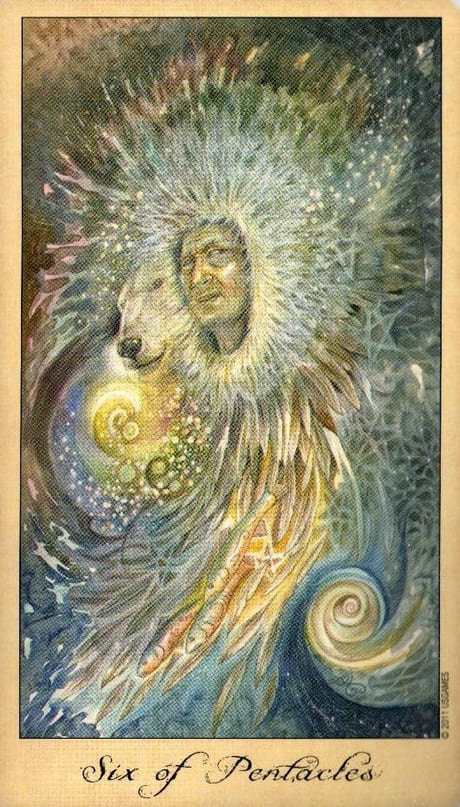
The Six of Pentacles (Tornak) depicts an animistic guardian spirit that can manifest as a human, stones, or a bear, with the angakok acting as a bridge between people and the Tornak. It gathers earth energies into centers of abundance and uses symbols—bear for protection and the cycle of life, fish for fertility, feathers for connection with spirit, and radiating sparkles for expansiveness. The card emphasizes ceremonial exchange, procurement of medicines, advice, and atonement to avert misfortune. In readings it indicates a time of peace and prosperity that brings increased flexibility and freedom and advises generosity and the spreading of positive energy to others.
Seven of Pentacles
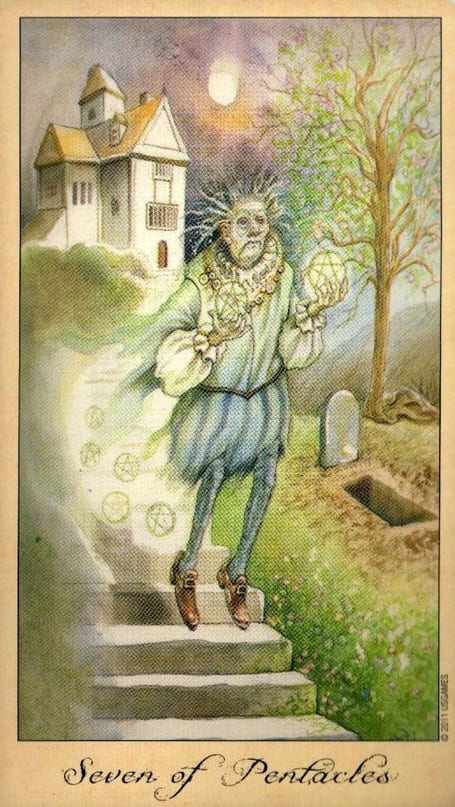
This card depicts a restless spirit caught between worlds, symbolizing the tension between attachment and the possibility of release. The house represents burdens of conscious attachments while the empty grave offers a portal to freedom, and the ghost's shadow and glowing eyes show residual humanity and enduring spirit. It indicates a period after much work when results seem distant, advising patience and continued perseverance. Rewards are likely if you wait and allow the process to complete.
Eight of Pentacles

This card evokes the kobold, a household spirit preserved in carved puppets and kept in trunks, symbolizing the careful maintenance of tradition and craft. Kobolds will perform helpful tasks when treated with respect but can be mischievous tricksters, reminding you to honor boundaries and responsibilities. The tiny kobold standing in the forest among integrated fauna emphasizes a sacred, fertile environment full of possibilities and an omnipresent spiritual force. Practically, the card advises diligent work, saving money, and using your skills wisely.
Nine of Pentacles

This card evokes comfort, abundance, and stability, drawing on the Menehune's resourcefulness and the cave's treasure trove. It reassures you that stability and confidence will supplant financial worries, allowing you to relax. The stalagmites linking floor to ceiling symbolize the merging of the three levels of the psyche into wholeness. The Menehune's mischievous yet helpful nature points to small pleasures and inner resources that support material and psychological well-being.
Ten of Pentacles

This card emphasizes animism—the belief that natural phenomena are infused with spirit—and the ways people communicate with those spirits through shamans, amulets, representative objects, or dreams. The forest is portrayed as teeming with life, where all elements merge to display the verdant wealth of collective effort. The stream symbolizes an active unconscious that brings burgeoning ideas to the surface, while spirits in rocks and trees absorb surrounding energy and thrive into conscious awareness. As a divinatory message, it indicates that after a cycle of accomplishment, it is time to sit back, enjoy the rewards of hard work, and relish what is truly important.
Page of Pentacles

The Page of Pentacles as Jack Frost symbolizes the awakening of creative and practical potential through keen observation and delicate transformation. It advises paying attention to subtle messages and studying opportunities closely to gain clarity and insight. The imagery of snowflakes and transparent glass highlights uniqueness, revelation, and the possibility of growth on the horizon. This card encourages engaging your inner child, exploring talents, and approaching financial and creative matters with curiosity and care.
Knight of Pentacles
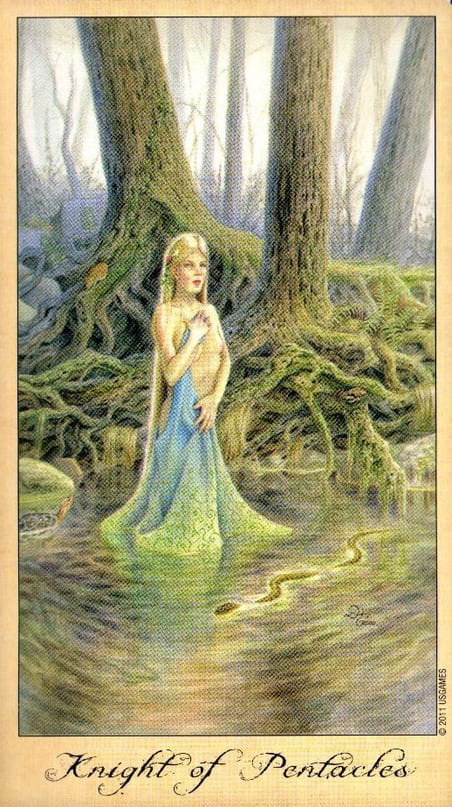
The Knight of Pentacles (Moss Maidens) evokes guardianship of the natural world, embodied by a moss-covered maiden who blends with trees, roots, and forest floors. She symbolizes protection and healing, using delicate craftwork to tend the land while reacting fiercely against disrespect or harm. The card urges trust in your instincts and emphasizes loyalty, dependability, and steadfastness when facing setbacks. It calls for committed stewardship and practical action to safeguard the environment and what you cherish.
Queen of Pentacles
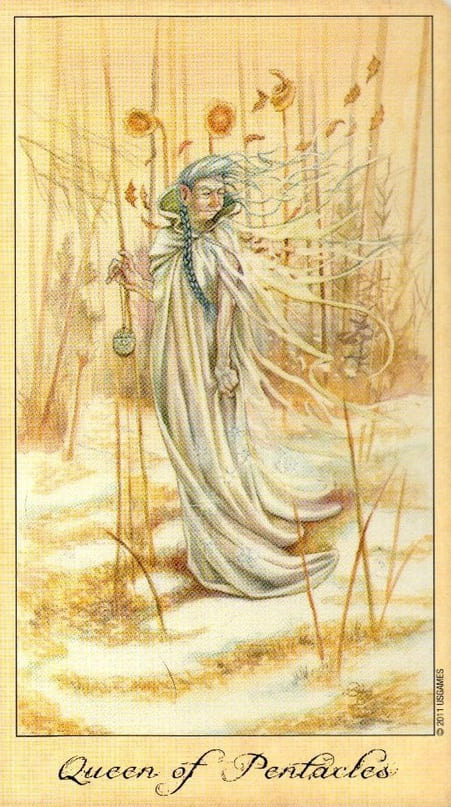
The Queen of Pentacles (Cailleach Bheur) embodies a winteral, grounding force: a wise, elderly spirit who enforces necessary seasonal rest to allow future growth. Her imagery—icy grip, golden/earthy hues, and three withered sunflowers—symbolizes the cycles of birth, death, and rebirth and the warm resilience beneath hardship. In readings she advises pragmatic stewardship, planning, and practical resource management as paths to prosperity. Seek counsel from experienced financial managers and make concrete plans for the future to manifest abundance.
King of Pentacles

The King of Pentacles (Ankou) embodies a psychopomp figure whose presence — the horse-drawn death cart and black cloak — is a stark reminder of mortality and the impermanence of life. Entwined in the roots of the unconscious, Ankou points toward the mysteries of the collective past that illuminate our brief time on the mortal plane. The card symbolizes guidance through endings and transitions, emphasizing perspective and the necessity of expiration rather than fear. In a reading, it can indicate that someone may enter your life to offer comfort and stability as you move through a possible transition.
Reading Tips for the Ghosts & Spirits Tarot
Lisa Hunt designed this deck to be read as much through its stories as through traditional tarot symbolism. The folklore associations give each card a narrative depth that rewards study and contemplation.
Learn the ghost stories. Each card is paired with a specific spirit or legend from world mythology and literature. Knowing the story behind the card — why Oiwa haunts, what Marley’s chains mean, where the Wild Hunt rides — gives you layers of meaning that go far beyond standard keyword lists. The companion book is worth reading in full.
Pay attention to the space between worlds. This deck lives in liminal territory: between life and death, conscious and unconscious, the seen and the unseen. When reading, notice which cards seem to pull you into that threshold space. Those are often the cards carrying the most important messages.
Work with the darkness, not against it. The Ghosts & Spirits Tarot does not shy away from difficult imagery — vampires, ghouls, wailing spirits, and restless dead are woven throughout. Rather than softening these images, lean into what they reveal about your own shadow material. The deck is built for honest confrontation, not comfortable reassurance.
Let cultural context enrich your readings. The spirits in this deck span continents and centuries — Hawaiian dragon gods, Japanese snow ghosts, Celtic banshees, Babylonian demons, Norse Valkyries. This diversity is a strength. Each tradition brings its own understanding of the relationship between the living and the dead, and those perspectives can open unexpected doors in a reading.
Frequently Asked Questions
How many cards are in the Ghosts & Spirits Tarot?
The Ghosts & Spirits Tarot contains the standard 78 cards: 22 Major Arcana and 56 Minor Arcana divided into four suits — Wands, Cups, Swords, and Pentacles. Each card is paired with a ghost, spirit, or supernatural entity drawn from world mythology and literature.
What makes the Ghosts & Spirits Tarot different from other decks?
Created by Lisa Hunt, this deck reimagines every tarot archetype through the lens of global ghost folklore, literary hauntings, and supernatural traditions. From the Leshy of Baltic forests to the Egyptian Ka, from Shakespeare's Banquo to Poe's House of Usher, each card tells a spectral story that deepens the traditional meaning with layers of myth and mystery.
Is the Ghosts & Spirits Tarot suitable for beginners?
It works well for readers who enjoy rich symbolism and storytelling. The folklore associations give each card a vivid narrative anchor that can make meanings easier to remember. However, the dark, detailed artwork may feel intense for those who prefer simpler imagery, so it pairs best with some foundational tarot knowledge.
Can I use the Ghosts & Spirits Tarot for shadow work?
Absolutely. The deck's entire foundation rests on the liminal space between life and death, conscious and unconscious. Its ghostly imagery naturally invites exploration of hidden fears, unresolved grief, and repressed aspects of the psyche, making it one of the most effective decks for shadow work and psychological self-inquiry.