Hanged Man & Death Together in Tarot: Surrender to Transform
The quietest revolution in the deck
Most tarot combinations announce themselves. Lovers and Devil: dramatic tension. Tower and Star: crisis and hope. Even Death and Tower together hits like a collision.
But the Hanged Man and Death? They arrive quietly. Like a decision that forms in the stillness before anyone says it out loud.
These are cards XII and XIII — sequential in the Major Arcana, and that’s not an accident. The Hanged Man suspends. Death completes. One teaches you to let go. The other shows you what happens when you actually do.
If you’ve pulled these two together, you’re at the threshold of something irreversible. Not violent, not sudden — but total. The kind of change that happens when you stop resisting and the world rearranges itself around your surrender.
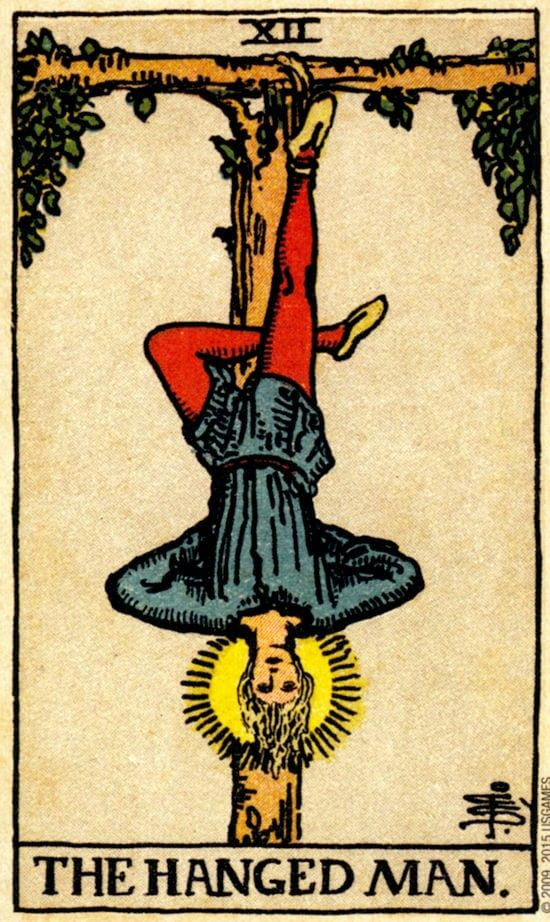
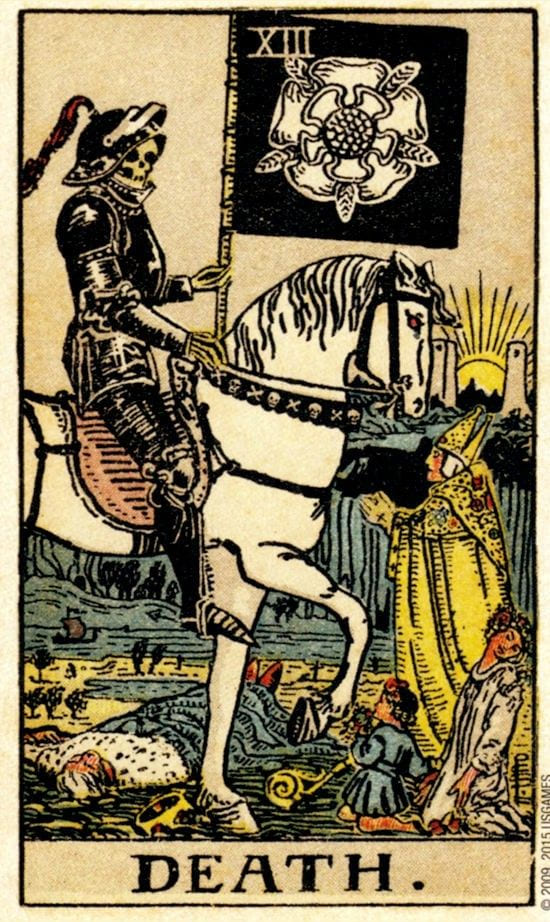
The Hanged Man: the choice to stop fighting
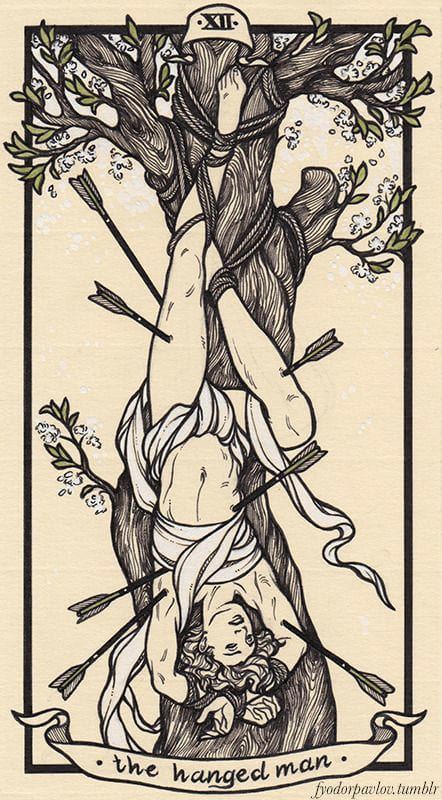
The Hanged Man (XII) hangs upside down from a living tree, one leg crossed behind the other, a halo of golden light around his head. He’s not in pain. He’s not struggling. He chose this.
This is the card of voluntary suspension — the moment when you realize that the way you’ve been seeing things isn’t working and the only solution is to stop, flip your perspective entirely, and wait. Not passive waiting, but the active, deliberate kind — the stillness of a diver in midair, the pause before a pianist’s hands descend on the keys.
The Hanged Man understands something most people resist: that sometimes the most powerful thing you can do is nothing. Stop pushing. Stop fixing. Stop running. Hang upside down and let the blood rush to your head until everything looks different.
Key qualities: surrender, suspension, new perspective, voluntary sacrifice, patience, letting go of control, seeing through the illusion of action.
Death: the change that doesn’t negotiate
Death (XIII) rides forward on a pale horse. A king lies fallen, a bishop pleads, a child offers flowers, a maiden turns away. Death comes for all of them equally.
This isn’t physical death — in tarot, it almost never is. This is the end of something that was. A relationship dynamic, a self-image, a career, a belief system, a way of being in the world. Death says: this is complete. Not broken, not fixable, not on pause. Complete. Done. And from the completion, something new will grow — but only after you accept that the old form is gone.
The key to Death is that it’s not cruel. It’s natural. Like the season that strips the tree bare. The leaves don’t fall because the tree is dying. They fall because the tree is making room.
Key qualities: endings, transformation, transition, release, natural cycles, the compost that feeds new growth, change that can’t be reversed.
Together: the art of letting go completely
Here’s what makes this combination so profound — and so uncomfortable: it describes the full arc of genuine surrender.
The Hanged Man is the decision. Death is the consequence.
Most people are willing to consider letting go. They’ll think about it. They’ll journal about it. They’ll tell their therapist they’re “working on releasing attachment.” But actually releasing — actually allowing something to die — that’s different. That’s terrifying. Because you can’t control what grows in the space that’s left.
The Hanged Man says: stop fighting. Death says: now let it end.
This isn’t the universe doing something to you. This is you allowing the universe to do what it was going to do anyway — but with consciousness instead of resistance. That’s the difference between this combination and, say, Death + Tower (which forces the change on you whether you cooperate or not).
Hanged Man + Death is transformation you participate in. The end of something, entered willingly. The surrender that becomes the transformation.
In love and relationships
This combination in a love reading is quiet but devastating in the best sense of the word. It asks you to release the version of love you’ve been clinging to so something realer can take its place.
If you’re in a relationship: Something about the way you and your partner relate needs to die. Not the relationship itself, necessarily — but a pattern within it. Maybe it’s the role you’ve been playing (the caretaker, the peacekeeper, the one who always compromises). Maybe it’s an expectation you’ve held since the beginning that no longer fits who you’ve both become. The Hanged Man asks you to see the relationship from a completely different angle. Death asks you to let go of what that new perspective reveals is dead. This is how couples who’ve been together for years suddenly deepen — they let an old version of the relationship end so a new one can begin.
If you’re going through a breakup: These cards validate the grieving process and ask you to fully surrender to it. The Hanged Man says: stop trying to fix it, win them back, or figure out what you could have done differently. Hang in the stillness. Death says: this ending is real, and the person you were inside this relationship is ending too. Let both die. Who you become after will be more fully yourself than the person who needed that relationship to feel whole.
If you’re single: You’re being asked to release an outdated story about love. Maybe it’s “I’m not the kind of person who finds lasting love.” Maybe it’s “I need someone to complete me.” Maybe it’s an attachment to a specific person who isn’t coming back. The Hanged Man pauses the pursuit. Death ends the story. And in the silence between the old narrative and the new one, your actual relationship with love — honest, unscripted, yours — has room to form.
If you’re asking about someone’s feelings: This person is going through their own internal revolution. They’re in a process of releasing old beliefs about relationships, about you, or about themselves. Don’t expect quick answers or decisive action — they’re still hanging upside down, seeing everything differently. When they come through the other side (and they will), they’ll be a different person than the one who went in. Whether that’s good for you depends on whether you’re willing to meet the new version.
In career and finances
Career surrender: You’ve been pushing against something that isn’t moving — a promotion that won’t come, a business that won’t grow, a creative vision that won’t take shape. The Hanged Man says: stop pushing. Death says: the version of this career you’ve been chasing is done. Not failed — completed. The new iteration requires you to release the strategy, the timeline, or the definition of success you’ve been gripping. When you let go of how you thought it should look, you’ll see how it actually wants to grow.
Leaving a job: If you’ve been contemplating leaving but can’t pull the trigger, this combination says: the internal shift has already happened. The Hanged Man has already shown you the truth — you’ve been seeing it upside down for weeks or months. Death is coming to formalize what you already know. Stop waiting for the perfect moment. The perfect moment is when you stop resisting.
Financial patterns: Old money beliefs are dying. The scarcity mindset, the guilty relationship with spending, the belief that financial security requires sacrificing your values — the Hanged Man has been quietly showing you that these beliefs are upside down. Death will complete the release. The new financial relationship won’t look like the old one, and that’s the point.
In personal growth and spirituality
This is where the Hanged Man and Death combination becomes transcendent.
In every spiritual tradition, there’s a concept of ego death — the moment when the constructed self dissolves and something truer emerges. The Hanged Man is the willingness to dissolve. Death is the actual dissolution.
This isn’t casual inner work. This is the deep end. The kind of transformation where you look back and can’t fully recognize who you were before — not because you’ve improved, but because you’ve been replaced. The self that emerges after this combination isn’t an upgraded version of the old self. It’s someone new.
If you’re in therapy, this might be the session where something truly shifts — not the intellectual understanding, but the felt release. If you’re in a spiritual practice, this might be the meditation where the barriers actually come down. If you’re in recovery, this might be the moment of true surrender — not the words, but the experience behind the words.
The Hanged Man whispers: let go. Death whispers: it’s safe. And in the space between those two whispers, something ancient and new takes root.
The order matters
Hanged Man first, Death second: The surrender precedes the transformation. You’ve already entered the state of letting go — the pause, the reflection, the willingness to see differently — and now Death arrives to complete what you started. This is the gentler sequence, because you’ve had time to prepare. The ending still hurts, but you’ve already accepted its necessity. You’re not fighting the river; you’re floating with it.
Death first, Hanged Man second: The transformation happens first, then the surrender. Something has already ended — a relationship, a career, an identity — and now you’re being asked to hang in the aftermath. Don’t rush to the next thing. Don’t try to make meaning of the loss too quickly. The Hanged Man after Death says: stay suspended. The understanding will come, but only if you’re patient enough to let it arrive.
Both reversed: Reversed, this combination speaks to resistance at every stage. The Hanged Man reversed refuses to surrender — you’re fighting the stillness, filling every pause with action, refusing to see from the new angle. Death reversed refuses to complete the cycle — something needs to end but you’re keeping it on life support. Together reversed, you’re stuck in a loop: aware that something needs to change, but unable to let it. The exit from this loop is always the same: one genuine act of release. Just one. The rest follows.
The space between suspension and ending
There’s a moment — just a moment — between the Hanged Man’s surrender and Death’s arrival. A breath. The point where you’ve let go but nothing has changed yet. Where the old is still visible but no longer held.
That moment is the most vulnerable point in any transformation. And it’s where everything actually happens.
Not in the dramatic death. Not in the peaceful surrender. In the almost-invisible instant between them — when you’re holding nothing and nothing is holding you, and the world hasn’t yet responded to your release.
This is faith. Not religious faith, necessarily. Just the willingness to be empty for one breath and trust that the exhale will bring something new.
The Hanged Man and Death together are the tarot’s most elegant description of how real change works. Not through force. Not through willpower. Through the strange, counter-intuitive act of giving up — and discovering that what you gave up was the only thing standing between you and who you’re becoming.
Let go. The rest takes care of itself.
Frequently Asked Questions
What does The Hanged Man and Death mean together in a tarot reading?
This combination means that a period of waiting, reflection, or voluntary sacrifice is about to transition into permanent, irreversible change. The Hanged Man pauses and sees differently; Death transforms what was seen. Together they describe the moment when letting go stops being a concept and becomes something you actually do.
Is the Hanged Man and Death a negative combination?
It's a serious combination but not a negative one. It signals deep, meaningful change — the kind that requires you to first stop fighting and then allow something to end completely. The pain isn't from the cards being harsh; it's from the truth being honest. What's on the other side of this process is genuine renewal.
What does the Hanged Man and Death mean in a love reading?
In love, this combination shows a relationship where one or both partners need to surrender old expectations before the relationship can truly transform. It can mean the end of how you loved before — not necessarily the end of the person, but the death of an outdated dynamic. The love that survives this becomes radically more honest.
How do the Hanged Man and Death relate in the Major Arcana sequence?
They're cards XII and XIII — literally back to back. The Hanged Man's lesson of surrender and new perspective directly precedes Death's lesson of irreversible transformation. The tarot is showing that true change requires surrender first. You can't transform what you're still clinging to.