Hanged Man Tarot as Feelings: Love That Surrendered
He chose to hang
This is the thing everyone misses about The Hanged Man: nobody put him there.
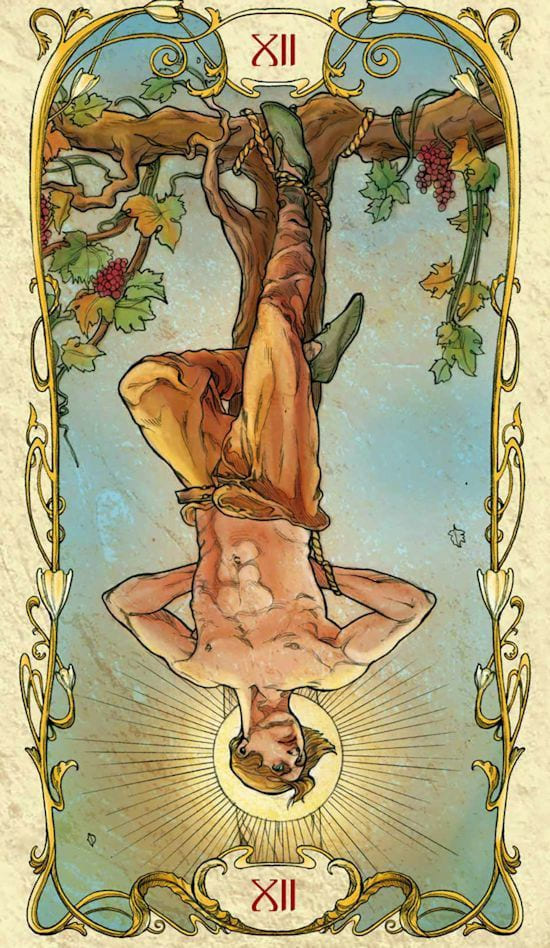
Look at the card. A man hangs upside down from a living tree — a T-shaped cross made of growing wood, not dead timber. His right foot is tied to the branch. His left leg crosses behind, forming a figure four. His hands are behind his back. And his face? Peaceful. Haloed in golden light. Not struggling. Not suffering. Not trapped.
He chose this.
That’s what separates The Hanged Man from every other card that suggests waiting or stalling. The Four of Swords rests because it’s exhausted. The Two of Swords freezes because it can’t decide. The Eight of Swords believes she’s trapped. The Hanged Man isn’t exhausted, indecisive, or trapped. He’s surrendered — deliberately, voluntarily, with the radical understanding that sometimes the most powerful thing you can do is stop doing anything at all.
When someone feels The Hanged Man toward you, they’ve reached the end of what effort can accomplish. They’ve tried the right-side-up approaches — pursuing, analyzing, strategizing, performing — and none of them worked. So they did the one thing left: they flipped their entire perspective. They stopped trying to have you and started trying to understand what having you would mean. They stopped fighting for the relationship and started surrendering to it.
And in that surrender, everything looks different.
Upright: as feelings for you
When The Hanged Man appears upright in the feelings position, the person feels:
Voluntary suspension. They’ve chosen to wait — not from helplessness but from wisdom. Their feelings for you have reached a complexity that action can’t resolve. More texts won’t help. More grand gestures won’t help. More analysis won’t help. The only thing that helps is hanging here, upside down, letting the blood rush to the head, and seeing what looks different from this angle. They’re not giving up on you. They’re giving up on the version of trying that wasn’t working.
A perspective shift they didn’t expect. Something about you — or about how they feel about you — only makes sense when viewed from an inverted position. The Hanged Man as feelings is the person who realized that what they thought was weakness was actually strength, that what they thought was failure was actually surrender, that what they thought was losing you was actually the only way to find you. The upside-down view changed everything.
Sacrifice as devotion. He’s giving something up. Maybe it’s control. Maybe it’s the timeline they had in mind. Maybe it’s the version of the relationship they planned. The Hanged Man as feelings always involves a sacrifice — something the person releases in order to receive something they couldn’t have while they were holding on. What they’re releasing might look like everything. What they’re receiving might not be visible yet. But they trust the exchange.
The peace of not knowing. This is radical. Most people can’t stand not knowing where they stand with someone. The Hanged Man has made peace with exactly that uncertainty. He doesn’t know if you’ll wait for him. He doesn’t know if the suspension will end in union or separation. He doesn’t know what the upside-down view will reveal when he’s finally ready to come down. And he’s okay with that. Because he learned — maybe from you, maybe because of you — that certainty was the cage, and not-knowing is the freedom.
Love experienced as meditation, not action. The Hanged Man doesn’t do love. He is love. He’s stopped performing feelings and started simply existing inside them. His love for you isn’t something he gives you or shows you or proves to you. It’s something he hangs inside of, the way a person hangs inside a prayer — not asking for an answer, just being present to the question.
Reversed: as feelings for you
When The Hanged Man appears reversed in the feelings position:
Refusing to surrender. They know they need to let go of something — control, expectations, a timeline, an outcome — but they can’t make themselves do it. The reversed Hanged Man is the person who has tried everything right-side-up and it hasn’t worked, but they keep trying anyway because the alternative — stopping, surrendering, hanging — feels too much like defeat.
Martyrdom without meaning. “I’ve sacrificed everything for this.” But was the sacrifice asked for? The reversed Hanged Man as feelings can mean someone who is suffering for the relationship voluntarily but without purpose — not the sacred suspension that leads to insight, but the stubborn suffering that leads to resentment. They’re hanging, but they forgot why.
Stalling disguised as spiritual growth. “I’m not avoiding — I’m surrendering.” But are they? The reversed Hanged Man can use the language of patience and trust as an excuse for inaction. They claim they’re waiting for divine timing when really they’re afraid to make a move. The suspension has become comfortable. The upside-down view has become the only view. And they’ve stopped planning to come back down.
Indecision that has calcified. What started as healthy pause has become permanent paralysis. They can’t move forward with you and can’t walk away. The reversed Hanged Man as feelings is the person who has been hanging so long that the rope has become part of them — and they can’t remember what it felt like to stand.
Context: The Hanged Man as feelings in different situations
As someone you’re dating
Upright: They’ve stopped playing the dating game and entered something more honest — a willingness to simply be with their feelings about you without rushing toward definition. This can feel frustrating if you want momentum. But the Hanged Man’s stillness isn’t stagnation. It’s gestation. Something is developing that can only develop in suspension.
Reversed: They’re stuck in analysis paralysis. Want you but can’t commit. Can’t leave but can’t arrive. If the Hanged Man stays reversed too long in dating, the suspension becomes avoidance — and you deserve to know the difference.
As an ex’s feelings
Upright: They’ve surrendered the fight. Not the fight to get you back — the fight to understand what happened. They’ve stopped trying to assign blame, figure out timelines, reconstruct the narrative. They’re just sitting with it, upside down, letting the meaning arrive on its own schedule. This is healing. Quiet, non-dramatic, genuinely transformative healing.
Reversed: They’re stuck between letting go and holding on, unable to commit to either. The ex who keeps your number but never calls. Who unfollows but keeps checking. Who says they’ve moved on but hasn’t actually released the rope.
As a new connection
Upright: They’re approaching you differently than they’ve approached anyone before. Something about you made them realize that their usual methods — charm, pursuit, strategy — aren’t going to work. Not because you’re difficult, but because you’re the kind of person who requires authenticity, and authenticity requires the surrender of performance. They’re learning to be still around you. That’s rare. And it’s beautiful.
Reversed: Interested but paralyzed. They want to approach you but the old patterns won’t let them try something new, and the new approach hasn’t formed yet. They’re hanging between the person they’ve been in relationships and the person they’d need to become for you.
The Hanged Man vs. other “waiting” cards as feelings
Hanged Man vs. The Hermit: The Hermit goes up the mountain to think. The Hanged Man hangs from the tree to stop thinking. The Hermit seeks answers through solitude. The Hanged Man seeks answers through surrender. The Hermit as feelings is active introspection. The Hanged Man as feelings is active stillness.
Hanged Man vs. Four of Swords: The Four rests because it’s depleted. The Hanged Man hangs because it’s choosing. One is recovery. The other is revelation. The Four as feelings is “I’m too tired to feel.” The Hanged Man as feelings is “I’m too wise to force.”
Hanged Man vs. Two of Swords: The Two is paralyzed by equally weighted options — blindfolded, swords crossed, unable to choose. The Hanged Man has transcended the need to choose. He’s found a position above the binary. The Two as feelings is “I can’t decide.” The Hanged Man as feelings is “I’ve decided to stop deciding and let the answer come.”
What The Hanged Man as feelings is really telling you
Here’s the truth nobody in the feelings position wants to hear:
If someone feels The Hanged Man toward you, they love you enough to stop trying to love you in the way that wasn’t working.
That’s the most counterintuitive love there is. The love that surrenders. That stops fighting. That hangs upside down in the space between wanting and having, between trying and trusting, between the old way that failed and the new way that hasn’t arrived yet.
He hangs by one foot. The tree is alive. The halo glows. And his face — the face of a man who has given up every tool except presence — is the most peaceful face in the entire Major Arcana.
Not because things are resolved. Because resolution stopped being the point.
Try it yourself
Pull a card with this question: “What would happen if I stopped trying to make this work and simply let it be?”
Because The Hanged Man isn’t just about how someone else feels about you. It’s about the terrifying possibility that the most powerful move in your current situation is no move at all. That the answer you’ve been chasing will only arrive when you stop running. That the perspective you need is literally the opposite of the one you have.
Turn it upside down. Everything changes.
Frequently Asked Questions
What does The Hanged Man mean as someone's feelings for me?
When The Hanged Man appears as feelings, the person has reached a point of voluntary surrender about you. They've stopped trying to control the outcome, stopped fighting their feelings, and allowed themselves to simply hang — suspended between wanting and waiting, between action and acceptance. It's not passive. It's the most active stillness a person can choose.
Does The Hanged Man as feelings mean they're stuck on me?
Not stuck — suspended. There's a crucial difference. Stuck implies helplessness. The Hanged Man chose this position. He tied the rope himself. His feelings for you have reached a point where the only thing left to do is stop doing — stop analyzing, stop strategizing, stop trying to make it work through force — and let the perspective shift happen naturally.
What does The Hanged Man reversed mean as feelings?
Reversed, The Hanged Man as feelings means the person is refusing to surrender — fighting the suspension, struggling against the rope, demanding an answer the universe hasn't given yet. They may be stuck in indecision, martyring themselves in the relationship, or delaying a necessary sacrifice because they're afraid of what letting go would reveal.
How is The Hanged Man different from The Hermit as feelings?
The Hermit retreats to think — he climbs the mountain to find answers through solitude. The Hanged Man stops thinking and starts surrendering — he hangs upside down because the right-side-up answers weren't working. The Hermit as feelings is 'I need to figure this out alone.' The Hanged Man as feelings is 'I've stopped figuring and started trusting.'