Harry Potter Tarot: All 78 Card Meanings Explained
Some tarot decks teach through symbols. Others teach through stories you already know by heart. The Harry Potter Tarot does the latter — and for readers who grew up with the Wizarding World, the result is a deck that makes tarot feel less like memorization and more like meeting old friends in new roles.
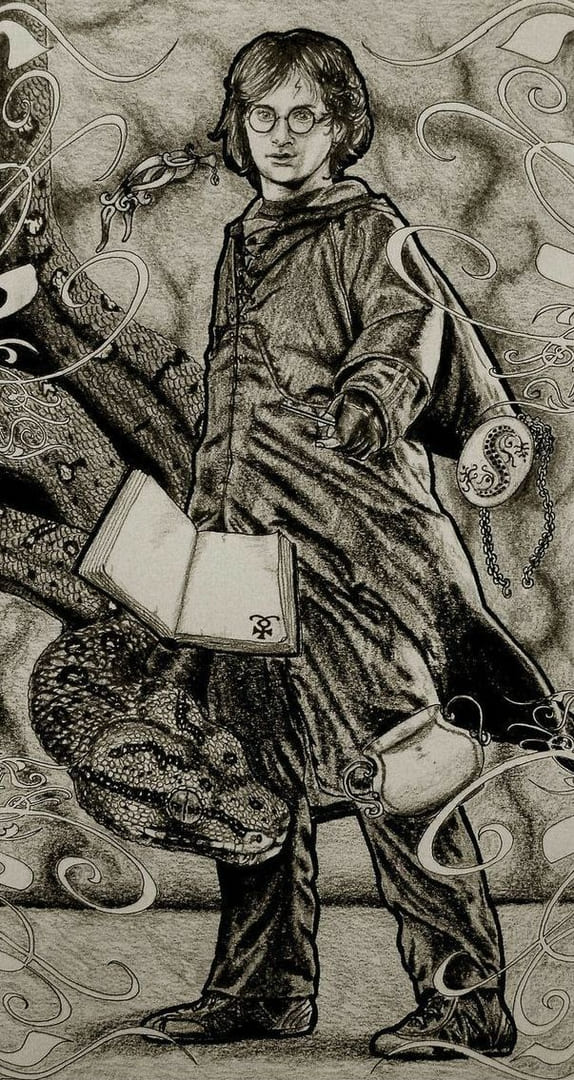
Created by Eleonore F. Pieper, this fan-made 78-card deck maps the full tarot structure onto the Harry Potter universe with remarkable thoughtfulness. Colin Creevey becomes The Fool, camera in hand, stumbling innocently into danger. Minerva McGonagall guards hidden knowledge as The High Priestess. Voldemort, Bellatrix, and Wormtail embody the chains of The Devil. Each assignment isn’t arbitrary — it’s a reading lesson in itself, showing how deeply the archetypes of tarot run through the stories we love.
The deck uses Thoth-influenced naming: The Magus rather than The Magician, Princesses and Princes rather than Pages and Knights, and Disks rather than Pentacles. The four suits align with the Hogwarts houses — Wands with Gryffindor’s fire, Cups with Slytherin’s water, Swords with Ravenclaw’s air, and Disks with Hufflepuff’s earth — creating a layer of house symbolism that enriches every reading.
How the Deck Is Organized
The Harry Potter Tarot follows the classic 78-card tarot structure:
- Major Arcana (0–XXI): The 22 cards of life’s great turning points — soul lessons, archetypal energies, and transformative moments, each mapped to a key character or scene from the series.
- Wands (Gryffindor / Fire): Passion, courage, ambition, and the spark of will. The Weasley family features prominently in the court cards.
- Cups (Slytherin / Water): Emotions, intuition, love, and the depths of the soul. Ambition as emotional hunger runs through this suit.
- Swords (Ravenclaw / Air): Thought, truth, conflict, and the clarity that comes from honest examination.
- Disks (Hufflepuff / Earth): Material reality, work, health, and the patient building of something that lasts.
Each suit runs from Ace through Ten, followed by four court cards — Princess, Prince, Queen, and King — for 14 cards per suit and 56 Minor Arcana total.
Major Arcana
The Fool

The Fool marks beginnings, curiosity, and a childlike openness to experience, inviting a fresh, unbiased look at the world and new projects. It connotes excitement and exploration but also warns of recklessness and lack of caution, even as a protective influence often seems present. Traditional imagery— a young man stepping toward an abyss with a dog and a threatening animal—captures the tension between innocence and danger. In this deck the Fool is Colin Creevy: his camera-knapsack stores experiences and, through his innocence, both exposes him to risks and somehow protects him.
The Magician

The Magus represents the conscious, individual human taking control of their environment through will, intellect, and the four elements. It spans a spectrum from deceptive trickery to potent, alchemical transformation, reflecting Mercury's influence. The card marks the hero at the outset of a quest, ready to take charge and turn ideas into action. In readings it emphasizes individuality, creativity, rationally directed thought, and the ability to manifest change.
The High Priestess
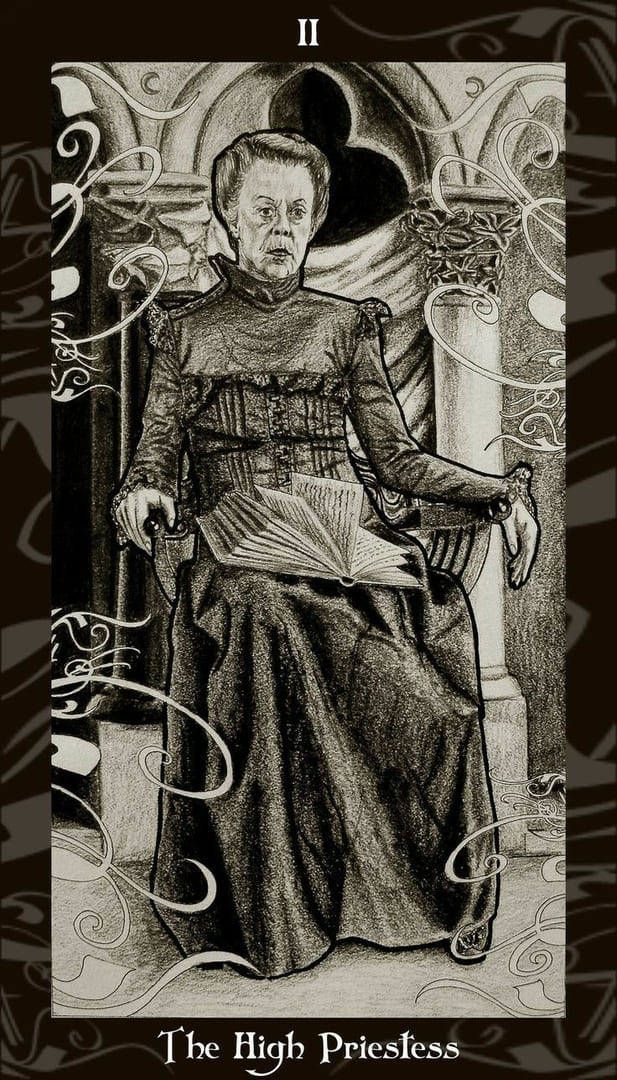
The High Priestess represents inner wisdom, intuition, and access to hidden knowledge, urging patience and introspection rather than force. She signals readiness to connect with the subconscious, to rely on intuition, or to discover one's inner feminine side. The card warns that unseen forces may be at work and that retreat into dreams or seclusion can be necessary. In this deck she is associated with Minerva McGonagall, whose secretive influence and animagus form as a cat echo the card's lunar and guardian qualities.
The Empress

The Empress represents the creative female principle, motherhood, and the joy of physical life, embodying fertility, abundance, beauty, and sensuality. She signifies growth, natural cycles, creative potential, and the nurturing power that brings bounty and harvest. In readings she can indicate deepening relationships, intensified love, and the possibility of pregnancy, or prompt a female querent to take joy in her womanhood. The card urges embracing creativity, harmony, and the life-giving energies of nature.
The Emperor

The Emperor represents male order, civilization, law, and the application of reason and structure to master the world. He signifies leadership, responsibility, and the drive to provide and protect, often privileging intellect over emotion. In a spread, the card indicates readiness to assume authority or to lead new projects while remaining cautious about feelings. When balanced with the Empress, they complement each other; unbalanced, each can produce destructive extremes—from natural catastrophe to technological abuse.
The Hierophant
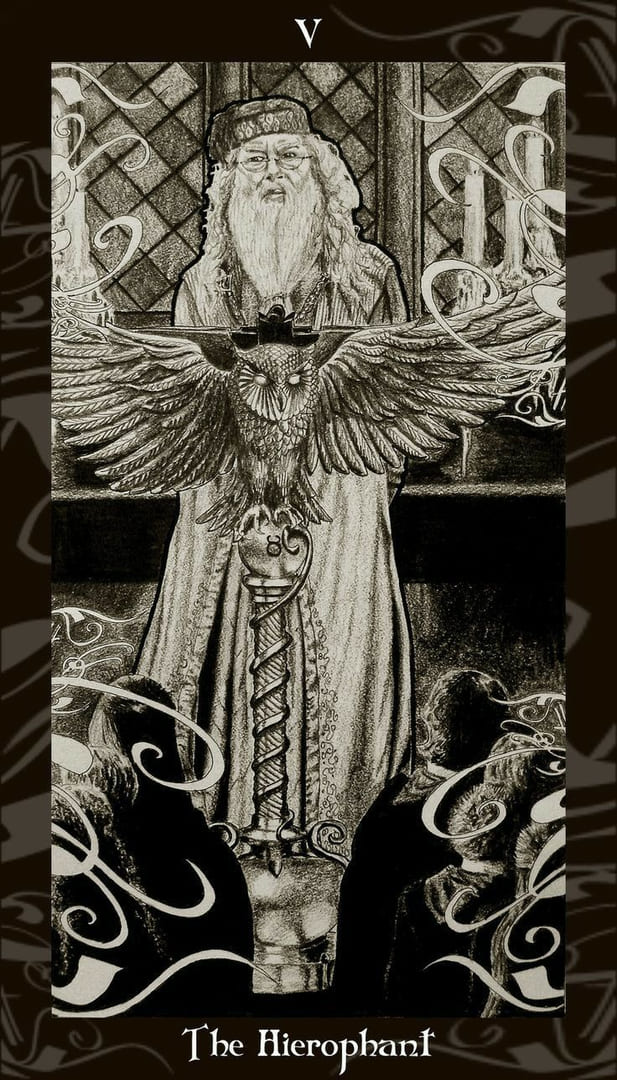
The Hierophant represents communal belief systems, tradition, and the socialization of the individual into a group. It embodies teaching, mentorship, and the transmission of skills, norms, and ethics necessary to fit into society. Drawing this card can signal the need to examine your beliefs in relation to others, to seek guidance from a teacher, or to serve as a mentor. It also suggests the possibility of revelation or spiritual insight that goes beyond rational explanation, and advises listening to one's conscience.
The Lovers

The Lovers represents both union and choice, encompassing romantic partnership and the inner reconciliation of masculine and feminine elements. It carries a dual tradition: a depiction of lovers and the allegory of moral choice (as in Hercules at the crossroads). In a reading it can signal finding a soul-mate, readiness to open to another, or an internal conflict requiring a decision between competing attractions or values. The card emphasizes that true unity emerges from inner completeness and urges choosing what one truly needs rather than what one merely wants.
The Chariot
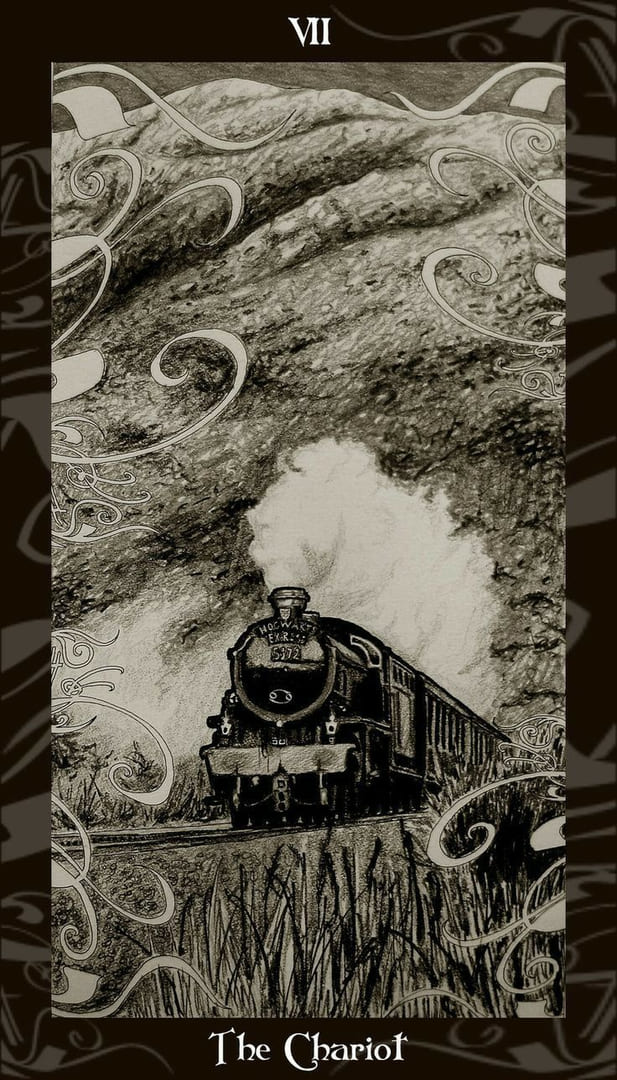
The Chariot depicts the hero setting out on a disciplined quest, symbolized by a figure in armor atop a chariot drawn by sphinxes. It signifies an intense inner drive and focused purpose to move forward and accomplish a goal, often with little openness to deviation. The card warns of defensiveness and hiding one's true self, urging mastery and control while cautioning against riding roughshod over obstacles or fearing failure. Ultimately it reminds the querent that the hero will face challenges that require pausing, opening up, and learning, even if that time has not yet arrived.
Strength

Strength depicts a woman calming a fierce lion, representing the harnessing of wild, animalistic instincts through will and intuition. It urges facing threats with determination and trusting innate abilities rather than relying on physical force alone. The card emphasizes self-mastery: not allowing others to push your buttons, rising above provocation, and using instinct and the senses as sources of power. The Exploring the Card example (Hermione and Buckbeak) highlights attributes such as willpower, determination, leadership, and intelligence while reminding us that part of strength is not letting others push you past your limits.
The Hermit

The Hermit represents introspection, solitude, and inner illumination, urging withdrawal for self-awareness rather than social achievement. He appears as a wise counselor or guardian who shines a light on truths we may resist, guiding through dark passages. The card can also indicate intentional isolation or marching to one’s own beat without necessarily feeling lonely. Ultimately it encourages honest self-examination, integrity, and finding peace in solitary reflection.
Wheel of Fortune

Fortune (the Wheel) represents the changing course of life, alternating between what is perceived as luck and misfortune, and invites awareness of the interplay between instinct, intellect and spirit. It encourages using opportunities, taking risks, seeing the bigger picture, and attempting to shape one’s own fate. The card stresses acceptance of change, flexibility, and optimism while acknowledging that some aspects of life feel fixed by circumstance. Ultimately it suggests that fate is partly given and partly created through effort and choice.
Justice

The Justice card represents balance, fairness, and the weighing of actions, embodied by the Egyptian goddess Maat. It emphasizes that choices have consequences and that one may be confronted with outcomes that require restoring balance or making amends. The card also warns against being overly rule-bound, highlighting the need for mercy and consideration of emotions. In contemporary terms it can illustrate distorted or punitive forms of justice as a cautionary example of bad karma.
The Hanged Man
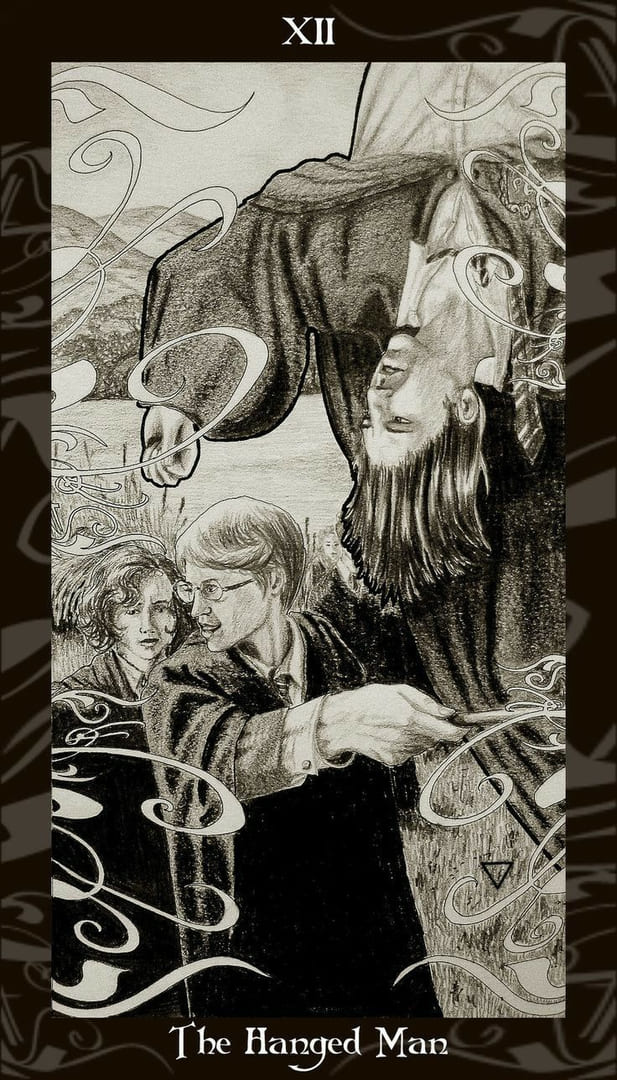
The Hanged Man represents a crisis of suspension in which old habits and viewpoints lose their significance, leaving one exposed, helpless, or stuck. Insight and new perspective may come through surrender, patience, and letting go rather than through action or control. The card often requires sacrifice, endurance, and acceptance of humiliation to move through the crisis. It warns against reacting with pride or wrath and suggests adopting a sin-eater/sacrifice archetype to bear the necessary letting-go.
Death

Death signifies a natural transformation and the end of a development that requires letting go of an old identity or worldview. Unlike sudden catastrophe, it tends to change you from the inside out, often painfully and with fear, but organically. The card evokes the image of shedding old layers—like a sloughing snake—so something newly ready can emerge. Visually and symbolically it represents a passage to a new phase, illustrated here by an arch and a curtain suggesting disorientation and another dimension beyond the doorway. Ultimately, Death points to change and grief as the gateway to something new.
Temperance

Temperance represents moderation, balance, and the deliberate scaling back of excess in all forms. It calls you to identify imbalances in your life and restore equilibrium by reducing extremes such as anger, impatience, spending, speed, or greed. The card highlights that unchecked excess fuels larger problems—social conflict, climate strain, and overcrowding—and that tempering these tendencies is a moral and practical necessity. The Weasley twins are used as an example: though they appear excessive, they often create or exploit imbalance only to redress it, offering antidotes and practical remedies.
The Devil

The Devil card calls attention to shadow aspects of the self, indicating the querent may be acting as the oppressor or as someone bound by fear and obsession. It asks you to examine motivations, treatment of others, and where you demand sacrifices for power, pleasure, or status. If you are the victim it points to fears and obsessions that keep you chained and challenges you to find ways to break those chains. The card forces hidden or suppressed truths to the surface, illustrated by the figures of Voldemort, Bellatrix, and Wormtail as embodiments of obsession, fear, and the destructive cost of allegiance.
The Tower

The Tower represents sudden, violent upheaval that destroys safety structures, habits, and material security, often through catastrophic events. Though traumatic and disorienting, this destruction can break the prisons we build for ourselves and relieve long-standing burdens. After the initial shock and loss, the collapse can create space for liberation, growth, and the possibility of rebuilding on truer foundations. The card therefore contains both the harsh pain of annihilation and the potential mercy of release, as illustrated by the Dumbledore/Snape example.
The Star
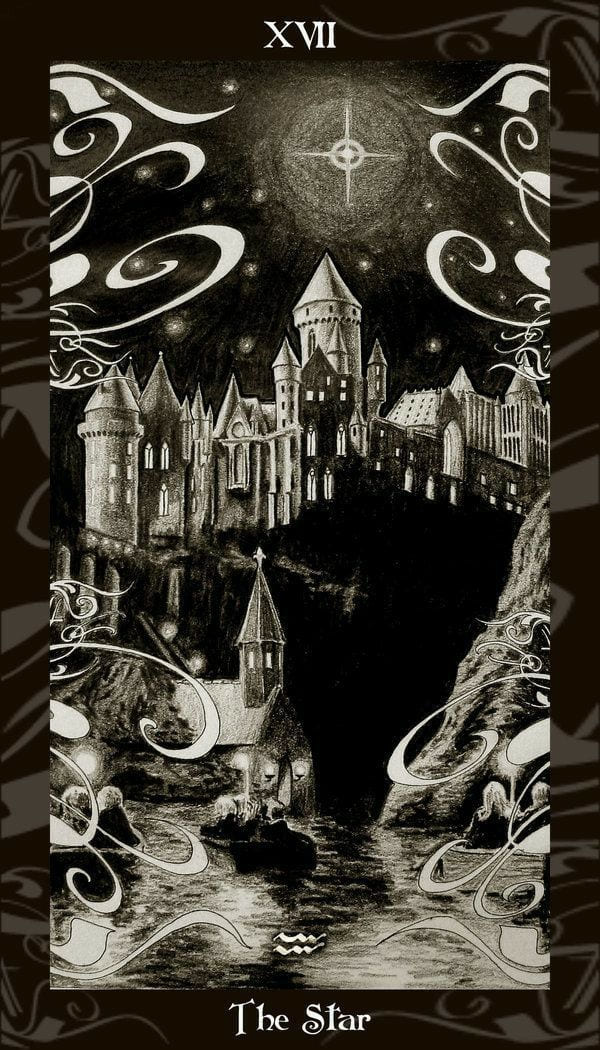
The Star represents unspoiled hope and a guiding light that appears at the darkest hour, encouraging you to let your own light shine and to trust your abilities. It points to renewal, inspiration, and a natural flow of intuition that leads toward happiness and success. The card can symbolize a journey from fear and uncertainty toward welcoming warmth, community, and the discovery of personal talents. It invites faith in the order of the universe and suggests ease of mind and moments of utter joy as outcomes of trusting that guidance.
The Moon
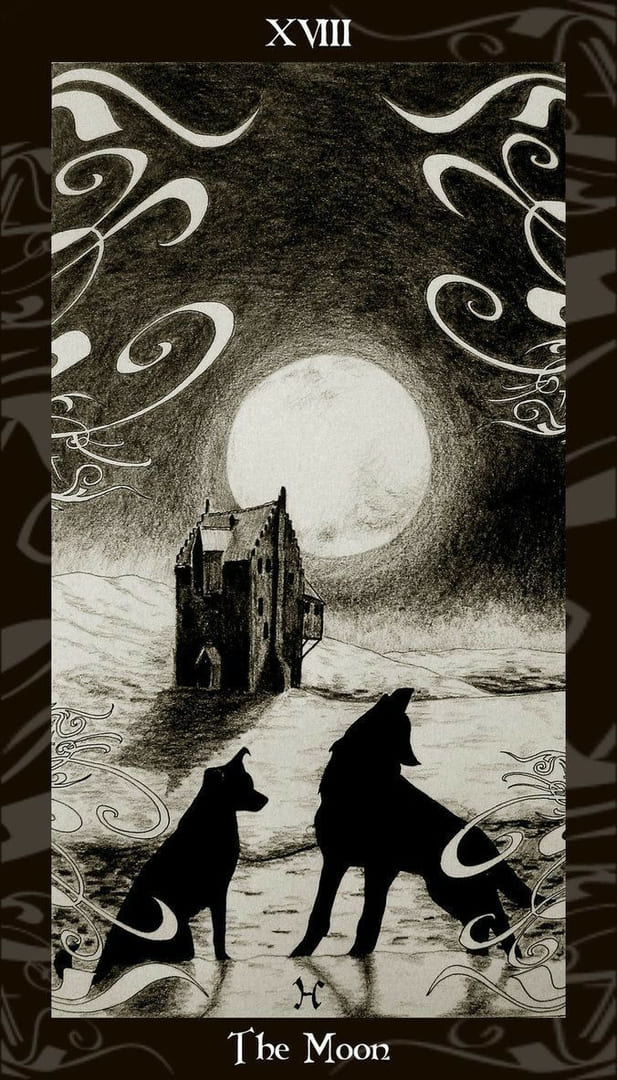
The Moon represents intuition, dreams, and the depths of the subconscious, encouraging openness to hunches and inner voice while highlighting imagination and mysticism. It is a double-edged card: it can guide one through inner exploration and empathic perception, yet also bring nightmares, illusions, and encounters with the shadow. Traditional symbols—the dog, the wolf, and the crab—illustrate the tension between tame and wild instincts and what scurries beneath conscious awareness. The card advises cautious, skillful exploration of fears and beliefs, suggesting that examining what terrifies us can reveal shelter, transformation, or deception depending on how we approach it.
The Sun
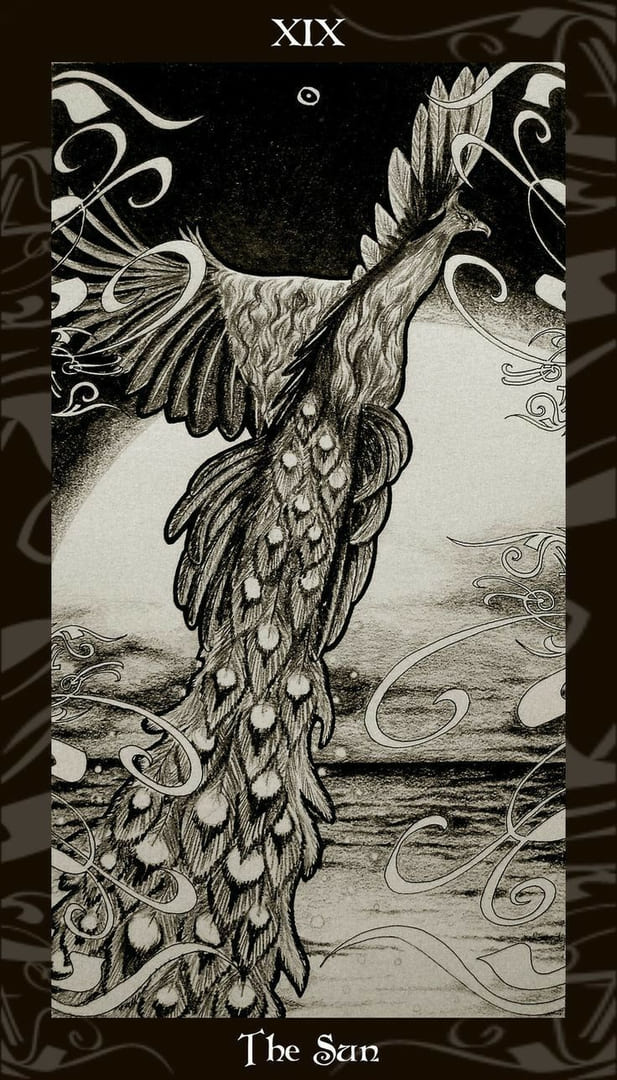
The Sun represents light, joy, courage, energy, insight, and success, signifying a time of clarity and triumph. It symbolizes illumination that diminishes shadows and reveals truth, bringing healing, inspiration, and optimism. In this deck the image of Fawkes the phoenix emphasizes solar and fire symbolism — rebirth, generosity, and the power to lift others out of darkness. The card advises embracing confidence, creativity, leadership, and the sunny side of life to realize completeness and glory.
Judgement

Judgment indicates a reckoning: you are being called to account for your actions and must face their consequences. If you can live with what you did, the card can signal resolution or a chance to justify yourself; if not, it warns of retribution and the need to redress past wrongs. The card emphasizes aligning with your true will and priorities, suggesting constructive handling of remorse and restoration of balance. The Lucius example illustrates external judgment stripping false roles away, leading to a painful but clarifying self-judgment and a redefined identity focused on what truly matters.
The World
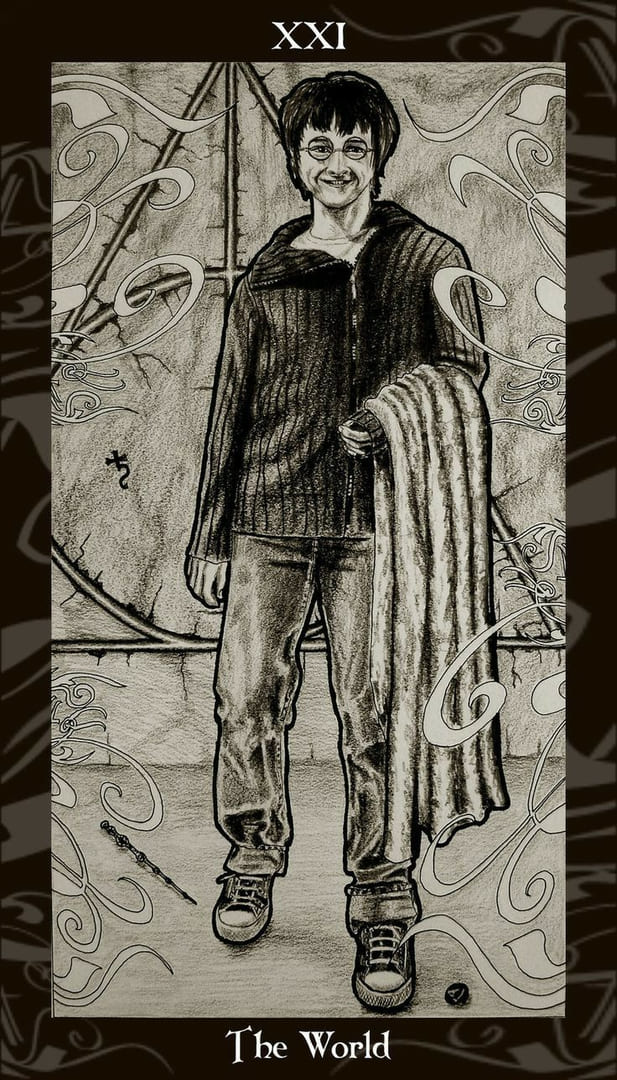
The World represents completion and the culmination of the hero's journey, signifying unity with all things. It indicates coming into one's own, transcending perceived limitations, and seeing the big picture to find one's true calling. The card emphasizes releasing the need for control—symbolized by discarding powerful relics—and embracing humility, harmony, and synergy with the universe. It promises a period of good times and the sense that you will receive what you need rather than always what you want.
Wands
Ace of Wands

The Ace of Wands embodies the spark of creation, raw will, and creative potential tied to the fire element. It signifies the arrival of new impulses and ideas and a period for inner development and the realization of long-held wishes and plans. It indicates doors opening and helpful new people and contacts that will assist progress. The card’s imagery connects to courage and generosity as exemplified by Gryffindor, and a reminder that elemental associations can vary between traditions.
Two of Wands

The 2 of Wands – Domination shows doubled impulses that clash, creating a struggle between competing drives. It represents determination, drive, and activity but also impatience, aggression, and a readiness to assert oneself forcefully. When it appears, expect competitive energy, conflict, and a push to have one's will win out — sometimes by headstrong or confrontational means. Corresponding to Mars in Aries and depicted as two wizards dueling, it warns of contentious dynamics while emphasizing the need to choose which impulse to follow.
Three of Wands

The 3 of Wands (Exploration) depicts prior decisions coming together into a defined plan, marking readiness to move forward. It connects the number three with Saturn's sense of limits and the enclosure formed by three points, while in the suit of Wands this signals fixed intentions, energy, and a willingness to embark on new ventures. The card emphasizes creativity, self-reliance, optimism, and the resolving of resistances that block progress. It invites planning, exploration, and taking concrete steps toward goals from a focal point where intentions meet.
Four of Wands

The 4 of Wands signifies crystallization and consolidation of prior creative energy, bringing stability and ease of mind. Ruled by Jupiter, the card emphasizes power balanced with jovial relaxation and the security of the number four's square. In the suit of Wands it marks the completion of impulse and a striving toward perfection through order, concentration, and control. It indicates finding one's center, mental balance, and the crowning completion of long and laborious tasks. The imagery underscores accessing inner strength and focused memory to achieve success in the face of challenge.
Five of Wands

The Five of Wands signals a disruptive shift from the stability of the Fours, bringing pain, insecurity and the need to adapt as structures break apart. Ruled by Mars, its energy is confrontational and can provoke competition, demonstrations of skill, or overt conflict. In the suit of Wands this Martian force is fiery but may do less lasting harm than in other suits, often serving as a necessary blow-out that clears the air. The card encourages asserting one's will, meeting resistance head-on, and using challenge and tension as catalysts for growth and resolution.
Six of Wands
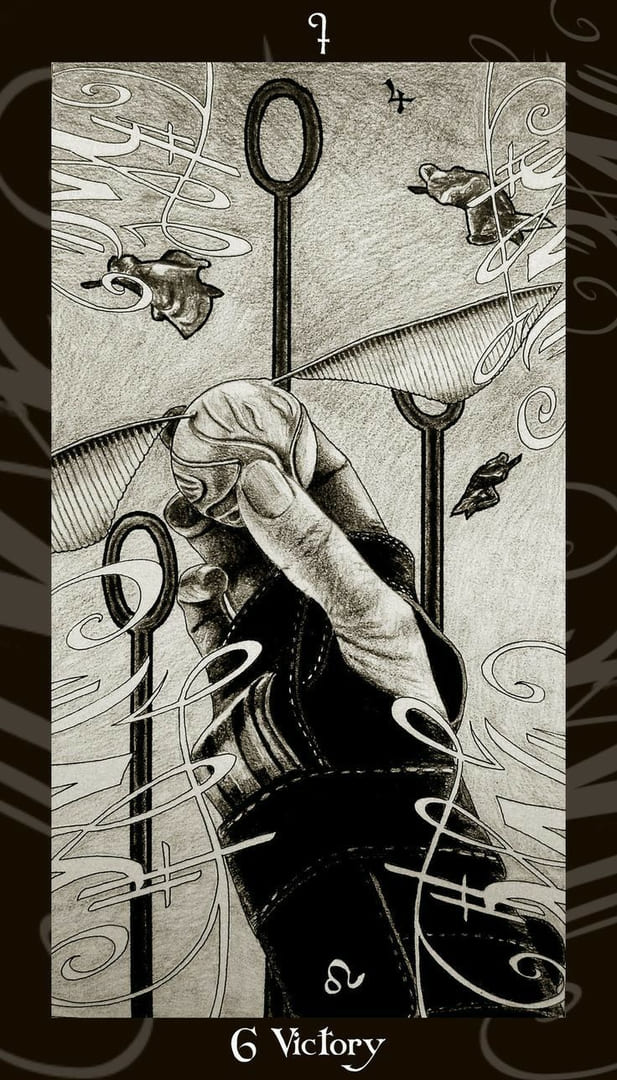
The Six of Wands represents stabilized energy, clarity, and the life force that brings order after disruption. That fiery will to act becomes triumph and public recognition, leading to acclaim and the successful resolution of conflicts. The card emphasizes fair competition, trust in one’s abilities, and feelings of joy, optimism, and crowning glory. Its imagery of a victorious figure holding a prize aloft symbolizes communal acknowledgment and the celebration of achievement.
Seven of Wands

The Seven of Wands represents courage and the will to stand firm against overwhelming odds. It warns that Venus-influenced emotion and wishful thinking can create an illusion of certain victory, yet true bravery is persisting despite improbable odds. The card celebrates heroism and stubborn resistance—standing for one's beliefs even when the fight may be futile. Its fiery will energy urges holding ground and moral conviction; the imagery (a portrait framed by seven wands) underscores honor and resolve.
Eight of Wands
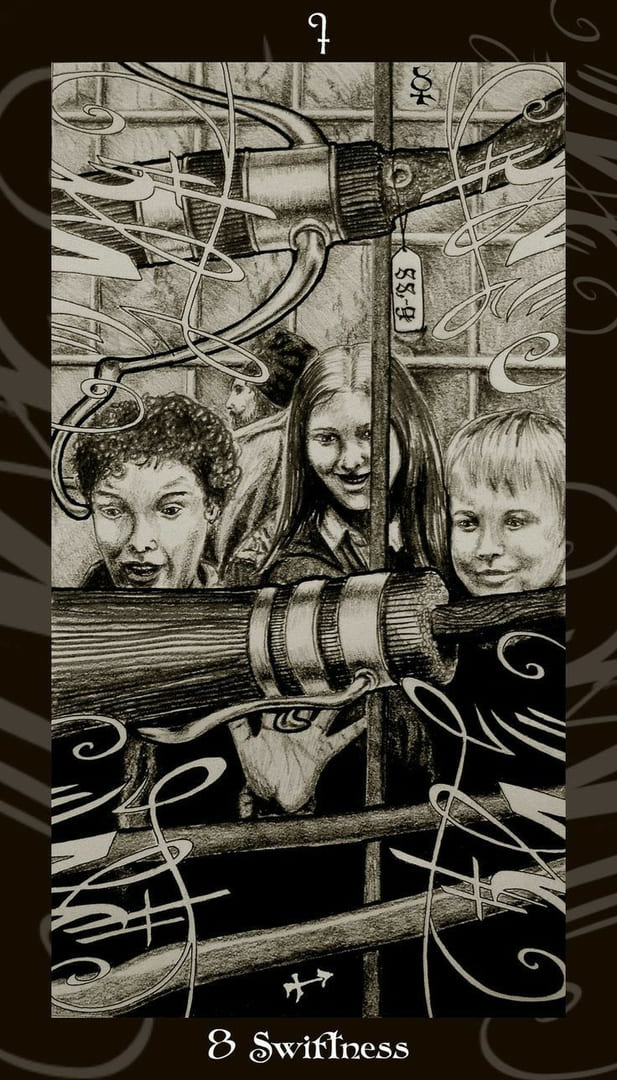
The Eight of Wands (Swiftness) signifies rapid mental activity, swift movement, and the sudden arrival of ideas or information under Mercury's influence. It highlights the Wands' drive and rational application of will, enabling inspired, ingenious solutions and accelerated learning. Progress and quick communication are favored, making this an excellent time to tackle persistent problems with out-of-the-box thinking. The card advises caution to communicate clearly so that more deliberate companions are not left behind, using your intellectual agility to bring others along.
Nine of Wands

The 9 of Wands (Power) shows the final impulse of the element of Fire, where subconscious drives align with conscious will under the Moon in Sagittarius. This alignment creates strength, energy, and a balance of impulses, enabling spiritual and physical harmony and access to inner resources and creativity. When drive and intuition pull in the same direction, actions flow effortlessly and one experiences heightened power or being "in the zone." The card signifies focused will, unity of intention and intuition, and the capacity to transform pure will into tangible results.
Ten of Wands
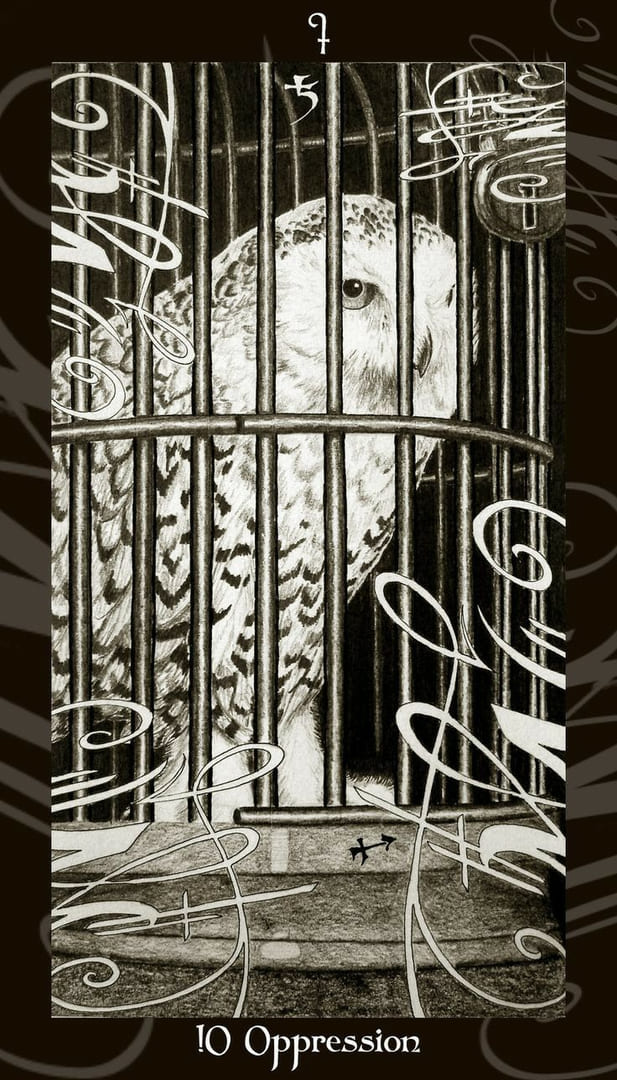
The Ten of Wands (Oppression) depicts the final, crystallized stage of the suit in which wishes and impulses meet hard reality and become weighted, structured burdens. In the realm of Fire this means drives and desires crash into material limits, producing frustration and the need for restraint. The card calls for a reality check, compromise, and disciplined channeling of energy rather than impulsive outbursts. It warns of dogmatism, problems with authority, and repressed aggression, while suggesting that focused work and structure can transform desire into a viable, if constrained, achievement.
Page of Wands
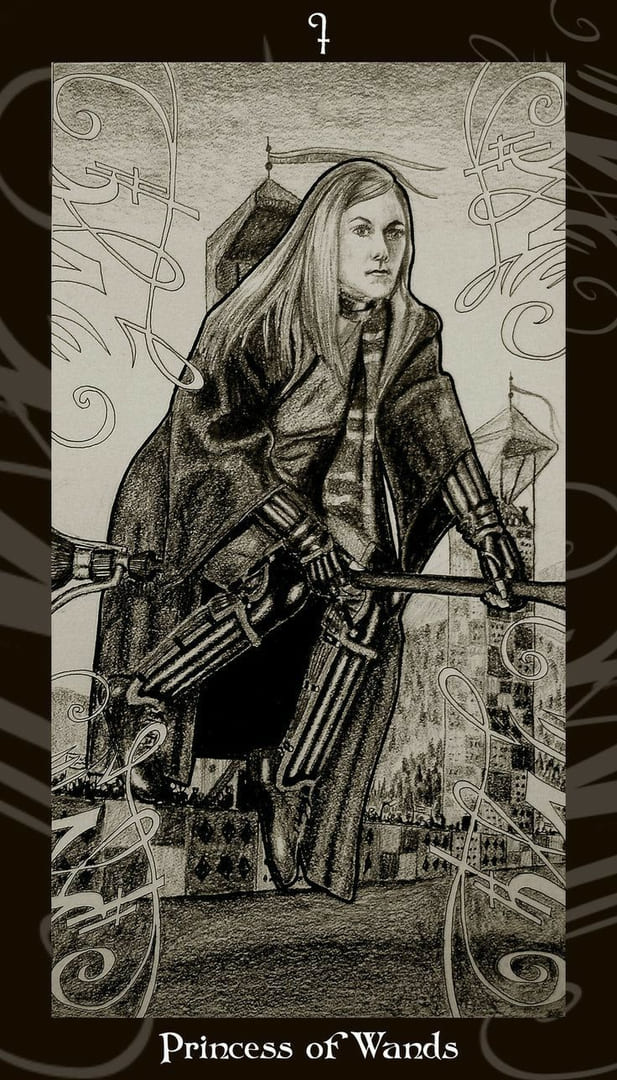
The Princess of Wands represents a passionate, youthful, and fiery spirit eager to embrace life and adventure. She is driven, fearless, spontaneous, and alluring, often following enthusiasm and personal desires. Her exuberance can sometimes come across as self-centered or lacking in empathy, and she may behave stubbornly or irresponsibly. The card encourages embracing vitality and passion while remaining mindful of others and tempering impulsiveness.
Knight of Wands

The Prince of Wands represents a fiery, impulsive energy characterized by activity, impatience, and enthusiasm for new projects. He is ready to take risks and pursues adventure with optimism and spontaneity. That outward frankness and spontaneity can hide feelings of insecurity and immaturity, so his motives or reliability may be questionable. In the provided example, the Wands court embodied by the Weasley family casts Ron as this Prince: bold and enthusiastic yet touchy, moody, and uncertain about his abilities.
Queen of Wands

The Queen of Wands represents a head-strong, mature figure who is optimistic, inspiring, charismatic, and energetic. She fiercely protects those she loves, is confident in her sensuality, and is a steadfast, loyal friend who demands respect from a strong partner. She does not tolerate fools and often leads others, preferring to have things her way. The card emphasizes independence, inner transformation, dignity, empathy, and a commanding presence tied to the Earth of Fire correspondence.
King of Wands

The King of Wands represents a mature, honorable, idealistic, proud, and intelligent man who is ready to lead and take responsibility. He cares deeply for the well-being of others, strives for improvements and better solutions, and prioritizes doing the right thing while protecting those who trust him. He is loyal, steadfast, generous, and acts with enthusiasm and benevolence. Arthur Weasley is presented as an example of these traits—committed to peaceful coexistence, defending his family's honor, and generously caring for Harry and Hermione despite limited means—while the card also depicts him at the Ministry of Magic guarding Muggles from magical mishaps.
Cups
Ace of Cups

The Ace of Cups represents the flow of emotion and a descent into the depths of the soul, indicating harmony between who we are, what we believe, and what we do. It points to discovering the source of love within ourselves and the completion, illumination, and freedom that arise from inner unity. As a water card it emphasizes feeling, union, and limitless bliss, inviting openness and emotional abundance. The Exploring section connects these themes to Slytherin symbolism, suggesting ambition as a form of deep-seated emotional hunger and a potential shadow-side of this element.
Two of Cups

The 2 of Cups represents a mutual emotional connection where two similar impulses meet, resulting in love, partnership, and harmony. It embodies union, sensuality, erotic attraction, trust, and general happiness in love. In readings it often points to an important positive encounter or the seeker's desire for completion through union with another person. The card's imagery — two cups and an amorous potion — highlights shared consent and mutual attraction as the foundation for true partnership.
Three of Cups

The 3 of Cups signifies abundance, enjoyment, and the joyful results that arise when elements come together. It represents consolidation and the formation of a bounded, fruitful space, linked to Saturn's themes of time and limits. For Cups this manifests as emotional fulfillment, creative or literal new life, and openness to life's generosity. Visually it evokes overflowing plenty and communal celebration, advising embracing shared success and gratitude.
Four of Cups
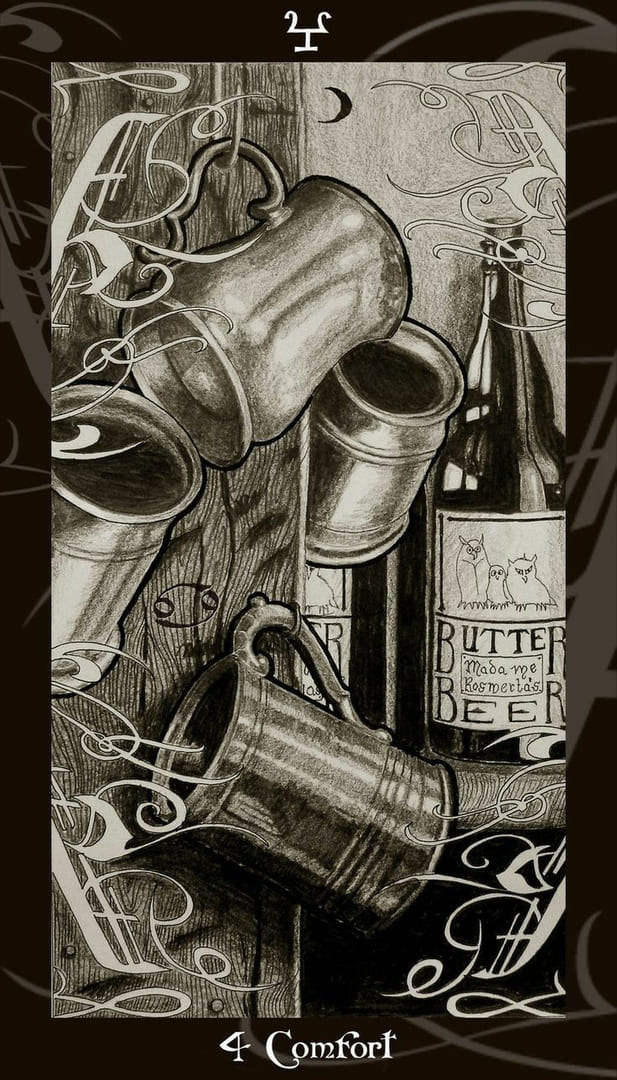
The 4 of Cups represents emotional stability, consolidation, and the comfort that comes from routine and domestic life. Ruled by Jupiter, the card conveys both power and a jovial ease of mind that follows from security and quiet. While this stability offers respite and fulfillment, it also carries the danger of stagnation, satiety turning into ennui, and becoming stuck in a rut. The card’s imagery of pewter tankards and butterbeer emphasizes both the warm communal comforts and the risk of using comfort to dull deeper emotional needs.
Five of Cups

The 5 of Cups signals a rupture of stability and the painful adjustments that follow when things we expected fail. Under Mars in Scorpio, this card's energy is eruptive and confrontational, driving change through conflict or crisis. Emotionally it denotes disappointment, disillusionment, farewells, separation and the risk of sorrow or depression as hopes prove elusive. It warns that negative wishes or mistrust of one's own feelings can deepen the hurt, urging acknowledgement of loss and careful self-awareness.
Six of Cups

The 6 of Cups symbolizes emotional happiness and stabilization, showing how sixes order the unbridled and sometimes destructive energy of the 5s and connect to the clarity, order, and life-giving energy of the sun. In the suit of Cups this solar energy heightens emotions into pure, unconditional happiness and reveals a wellspring of creativity, contentment, charisma, and success. The card suggests being able to let go, flow with synchronicity, and trust that wishes can come true and things will turn out as they should. It also evokes a sense of fortunate timing and shared good fortune, likened to a luck-bringing potion and the image of little glasses to pass around to friends.
Seven of Cups

The 7 of Cups (Illusion) warns of wishful thinking and emotional distortion, where desires cloud judgment and create false realities. It indicates being ruled by longing, leading to daydreams, idolization, or escape into pseudo-religion, substances, or false leaders. Choices and patterns may appear meaningful but are often shaped by our secret impulses rather than objective reality. The card calls for grounding, clear-eyed appraisal, and awareness of how personal desires form perception.
Eight of Cups

The 8 of Cups (Despair) depicts emotional exhaustion and a deep sense of resignation brought on by hyperactive, anxious thinking. Eights' Mercurial quicksilver mind produces sudden insights but also nervousness and hypersensitivity that the sensitive Cups cannot manage. This often manifests as late-night catastrophizing, a feeling that life is irreparably rotten, retreat, and even fatalistic or suicidal despair. The card warns of being stuck in a quagmire of negative thought patterns and evokes the image of emotional contamination like a cabinet of poisons. Awareness of these dynamics is the first step toward stepping back from destructive rumination.
Nine of Cups
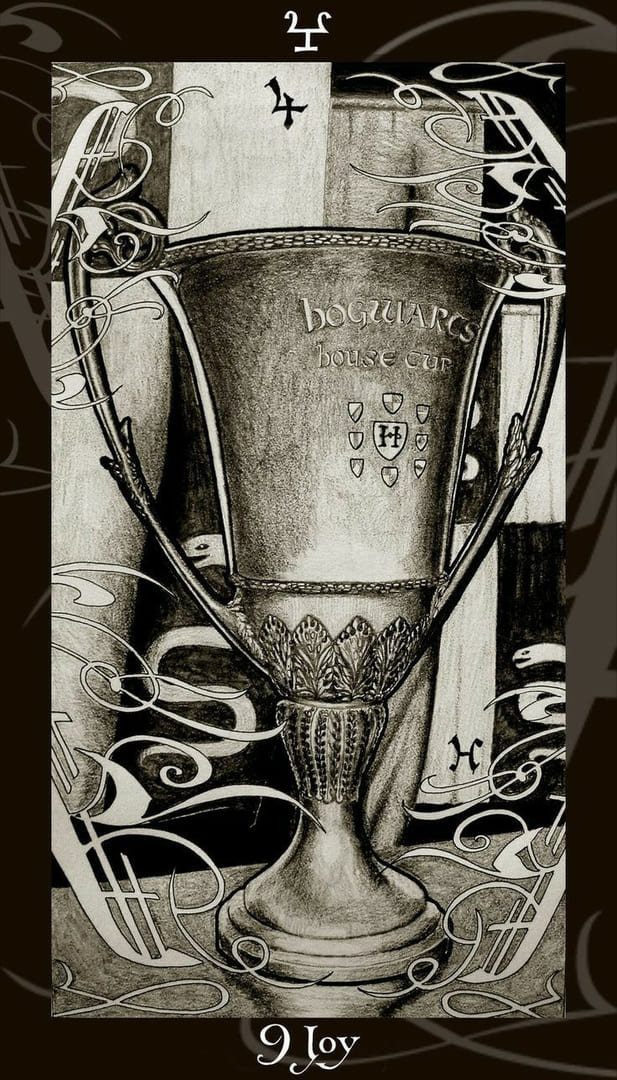
The Nine of Cups represents emotional fulfillment, contentment, and optimism as the culminating impulse before completion. Ruled by the Moon and tied to the subconscious, it highlights deep inner drives that bring faith in the universe and a sense that things are as they should be. In readings it signifies being at peace with oneself and others, feeling blessed, loved, and met with sympathy and understanding. The card also suggests recognition and rounded accomplishment, illustrated by the Hogwarts house cup imagery and its nine plaques.
Ten of Cups

The Ten of Cups represents full materialization and crystallization of emotional experience, marking the culmination of the suit. In the water element this is an afterglow beyond ecstasy, where intense feelings settle and often dissipate when observed. Fully realized emotions can leave one exhausted, so the card speaks to satiety and the need to let go. It encourages gratitude for the experience while advising that it is time to move on to other things.
Page of Cups
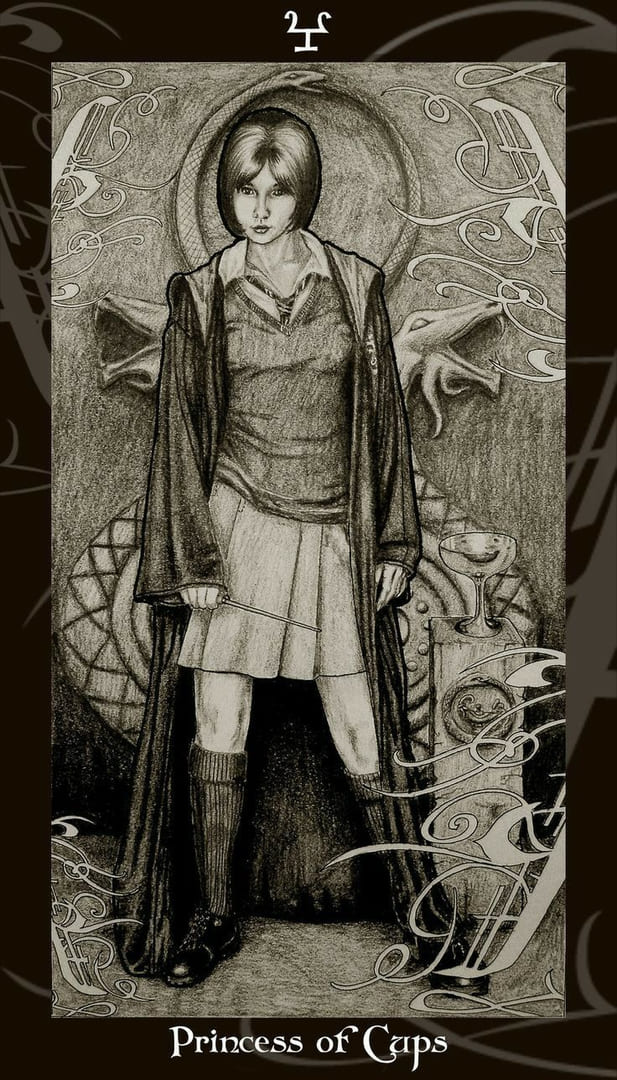
The Princess of Cups represents a young, alluring, and elusive emotional presence who often reflects back what others wish to see rather than her true self. She embodies intuition, dreaminess, and the seductive pull of fantasy, suggesting beginnings in emotional or spiritual development. Symbolism on the card (serpent, oil lamp) points toward the soul incarnate and the early stages of mastery. The card indicates someone at the start of their path who has potential but has yet to claim their suit's symbol or fully sit on their throne. It advises caution about illusion and encourages deeper discernment of inner truth.
Knight of Cups

The Prince of Cups represents a sensitive, charismatic, and romantic figure whose charm can mask problems with truth and reality. The card highlights a tension between feeling and mind, urging the seeker to reconcile intellect and emotion and gain clarity about their own feelings. It warns of conflicting emotions that can lead to betrayal or self-deception when ideals and reality clash. The Exploring the Card example shows how external expectations and loyalties can twist sensitivity into cruelty, yet conscience and shock at others' suffering may remain.
Queen of Cups
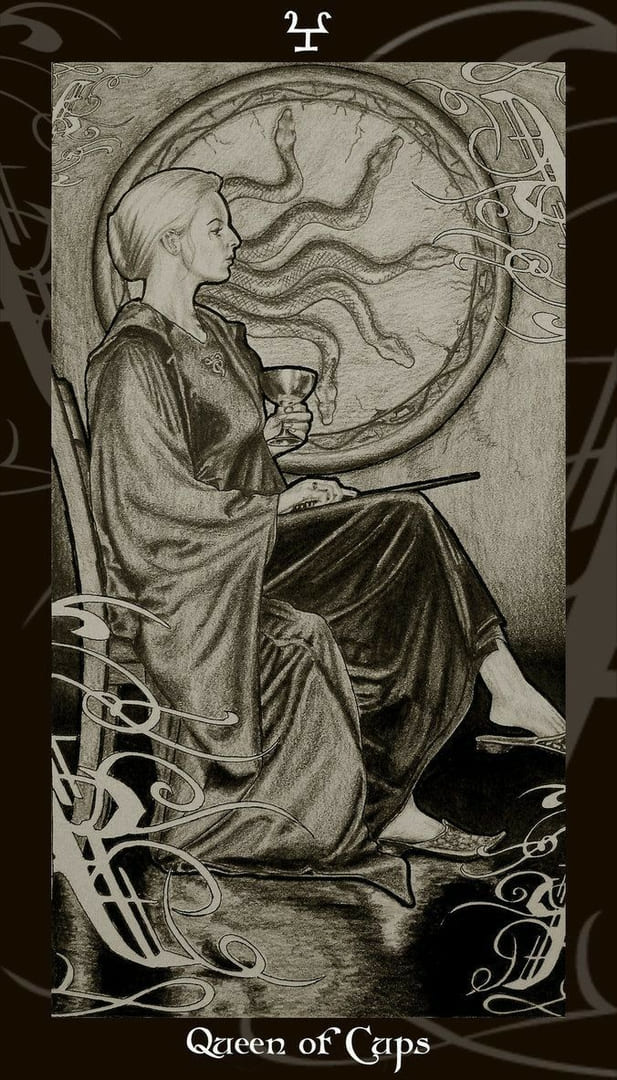
The Queen of Cups represents deep intuition, inner wisdom, and emotional sensitivity, often embodied by a nurturing, protective figure. She can signify an artist, medium, loving partner, mother, or anyone for whom home and family are central. Her gifts give her extraordinary insight and seductive influence, but they also allow for confusion and the potential to mislead — things are not always what they appear. The card advises balancing compassion and protectiveness with clear boundaries, and the Exploring the Card example (Narcissa) shows how quiet reserve and concealed feeling can be used to shield loved ones.
King of Cups

The King of Cups represents a complicated, emotionally guided figure who can serve as a wise counselor guided by intuition. He often embodies an 'injured king' archetype who attains wisdom through guilt, pain, and suffering. The card warns of possible weakness: being seduced by other powers, drawn into intrigues, or engaging in dubious dealings. It also highlights the balance between will and instinct and the danger of losing independence to darker influences, as exemplified by figures like Lucius Malfoy.
Swords
Ace of Swords

The Ace of Swords represents mental clarity, rational thought, and the power of objective analysis to cut through confusion. It urges reliance on intellect and reason to solve problems, make decisions, and have clarifying conversations. This card emphasizes ordering chaos through thinking, formulating theories, and finding solutions. Its associations with Air and the Ravenclaw archetype underscore quick intelligence, a nimble mind, and the value of mental acuity.
Two of Swords

The 2 of Swords represents dualistic thinking and the meeting of two opposing thoughts or ideas, producing balance, equilibrium, and justice. It denotes the capacity to hold conflicting options without immediately choosing, allowing calm analysis to resolve a stalemate. This card points to harmony through understanding and the resolution of differences, often through mediation or measured thought. Its correspondence with the Moon in Libra underscores seeking balance and peace in decision-making.
Three of Swords

Three of Swords signifies sorrow, heartbreak, and the painful consolidation that follows the meeting of opposites inherent in the 3s. Aligned with Saturn in Libra, it highlights limitations, endings, boundaries, and the hard lessons of time. In the realm of air and intellect this card points to mental pain, confusion, betrayal, and the destruction of comforting beliefs by harsh truth. Although the process can be destructive and leave one grieving, confronting these realities ultimately frees one from illusion and allows necessary growth.
Four of Swords

The Four of Swords (Truce) signifies a period of rest, contemplation, and consolidation after previous activity. It emphasizes mental relaxation and ease of mind that arise from stability and quiet, allowing recovery and insight. Ruled by Jupiter in Libra, the card suggests tolerance, peace, and a calming of impulses as creative energy hardens into a stable form. It often indicates a stalemate or pause where external forces cannot tilt the scales, encouraging solitude and recuperation.
Five of Swords
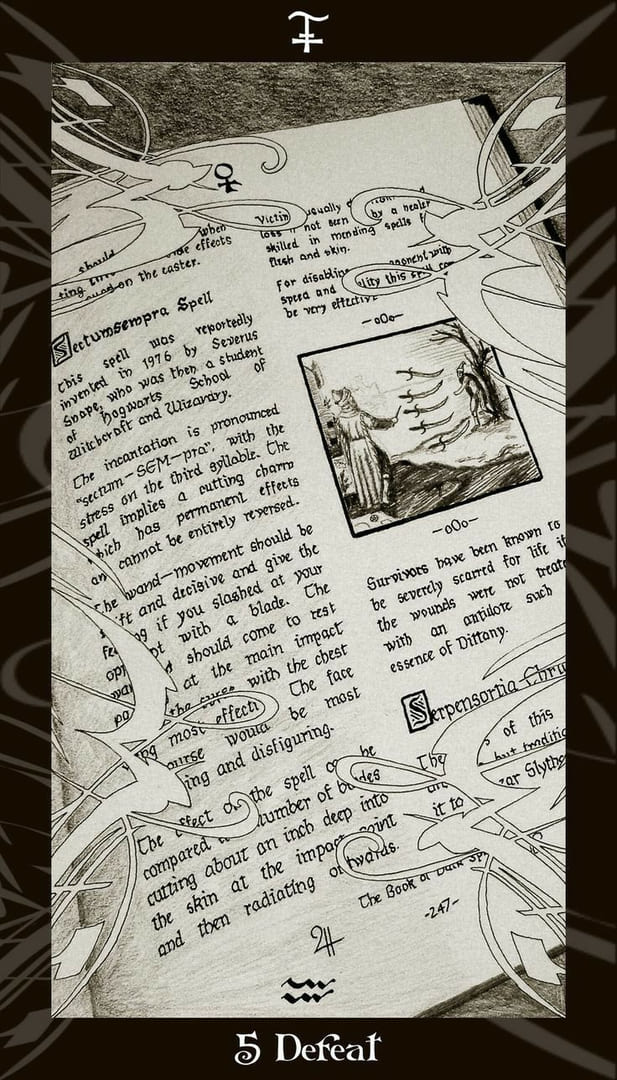
The Five of Swords marks an eruptive break from the stability of the Fours, bringing pain, insecurity, and the violent, disruptive energy associated with Mars. In the suit of Swords it signals humiliation, loss, fear, and betrayal, and the shattering of beliefs that once sustained self-worth. This can provoke doubt, feelings of being cursed, and a sense of aggression and rejection from others. The card's imagery of a cursed spell and flying daggers underscores actions born of despair and the small, piercing wounds that follow conflicts and moral struggles.
Six of Swords
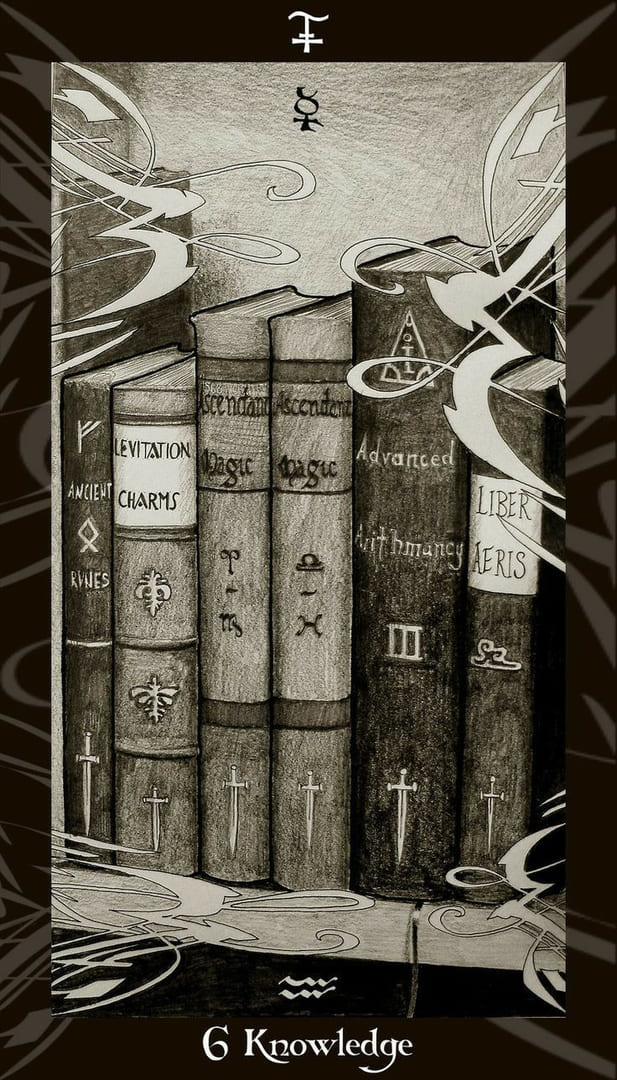
The 6 of Swords symbolizes stabilization and ordering of previously unbridled or destructive energy, linked to solar clarity, order, and life force. In the realm of Swords (air and the rational mind), this solar influence brings clarity and knowledge and prompts a search for truth and harmony between mind and nature. The card emphasizes objectivity, understanding, intelligence, and may herald sudden blazing insights or unconventional solutions. Its imagery—six books stamped with a sword publisher's symbol—points to esoteric and air-related practices and knowledge such as runes, levitation, astrology, arithmancy, and air itself.
Seven of Swords

The 7 of Swords warns of deception, whether self-inflicted or from others, rooted in wishful thinking and emotional bias. It emphasizes how illusions can override the rational mind, leading to clever but ultimately harmful schemes or gullibility. The card points to cunning, seduction, and tricks that mask true intentions, and cautions that the mind can be its own saboteur. The Monster Book of Monsters image reinforces misdirection and baited traps, highlighting how appearances can be deliberately misleading.
Eight of Swords

The Eight of Swords (Interference) highlights mental restlessness and a scattering of attention that prevents sustained effort. It indicates being pulled in multiple directions by inner hyperactivity and by external interference, such as unsolicited advice and too many choices. The card urges slowing down, re-evaluating priorities, and refusing to be side-tracked so that meaningful tasks can be completed. It blends quick mental acuity with nervous sensitivity, emphasizing the need to focus despite distracting energies.
Nine of Swords
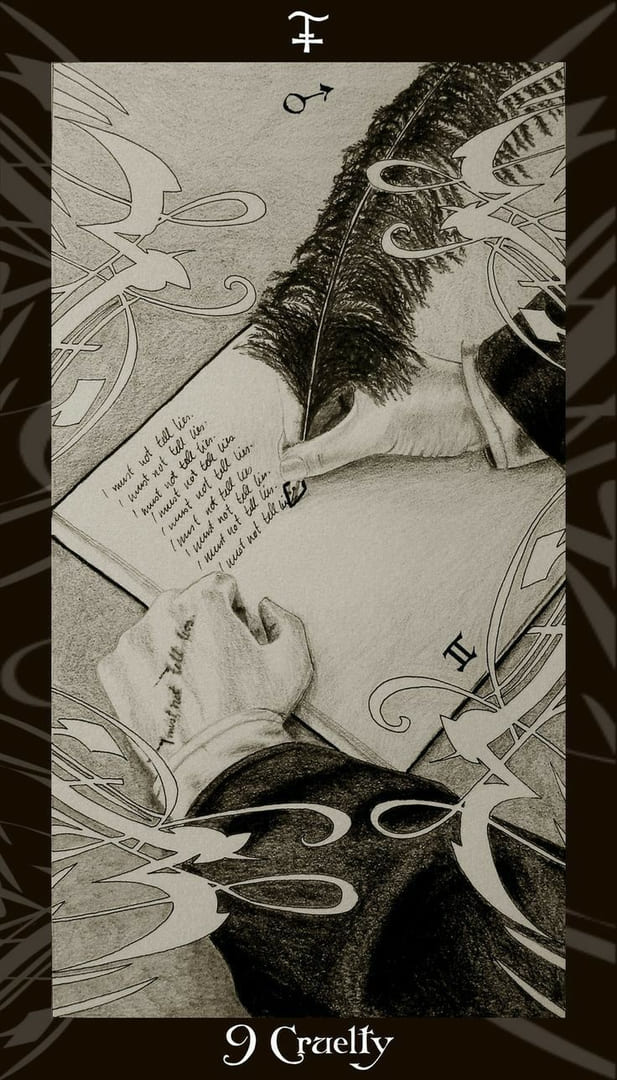
The Nine of Swords represents the final urge of the element before completion, governed by the Moon and the subconscious, bringing hidden drives and impulses to the surface. With Swords symbolizing the rational, conscious mind, these subconscious forces produce inner conflict, guilt, nightmares, and suffering rather than harmony. The card warns that repression, projection, and self-punishment are common reactions, and that avoidance only prolongs misery. The only path forward is to confront fear and shame directly, using reason to illuminate what lurks in the shadows so it can be overcome. The provided example of Umbridge and Harry illustrates how co-dependent guilt and sadistic punishment can lock people into destructive dynamics until the underlying wounds are faced.
Ten of Swords

The 10 of Swords represents finality and the conscious act of ending what no longer serves. As a Ten it shows full materialization and crystallization of the Swords' qualities, bringing a clear, unvarnished view without illusion. Unlike Death or The Tower, this card often signals that we must initiate the ending ourselves rather than being forced by outside events. In readings it can indicate resigning from a dead-end job or leaving a stalled relationship, cutting ties deliberately to free oneself. Though painful, this decisive closure clears the way for transformation and renewal.
Page of Swords
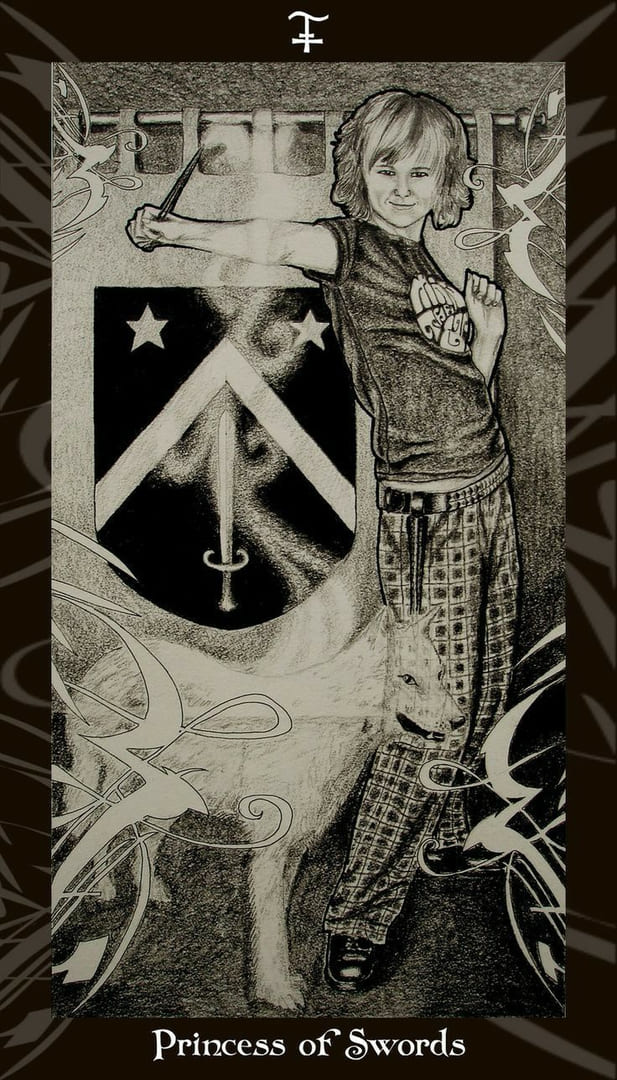
The Princess of Swords embodies a young, sharp-minded figure who is ready to meet the world with wit, logic, and spirited charm. She is impulsive, mischievous, and enjoys playful trickery while also being quick to confront perceived disrespect. This card signals rebellion and readiness to defend personal ideals, carrying an amazon warrior energy of renewal and bold action. It encourages speaking truth, embracing change, and maintaining a lively sense of fun even amid conflict.
Knight of Swords

The Prince of Swords represents a brilliant, independent intellect that values freedom over feeling and moral consequence. He seeks understanding and inventive solutions but may be indifferent to the harm his actions cause and can persuade others regardless of truth. His mindset can lead to reckless or naïve choices, and the card warns against valuing cleverness above conscience. The Regulus Black example shows that such a mind can reform and use its intellect for good when confronted with the consequences of its choices. Visually the card emphasizes contemplation and the weighing of actions and consequences.
Queen of Swords
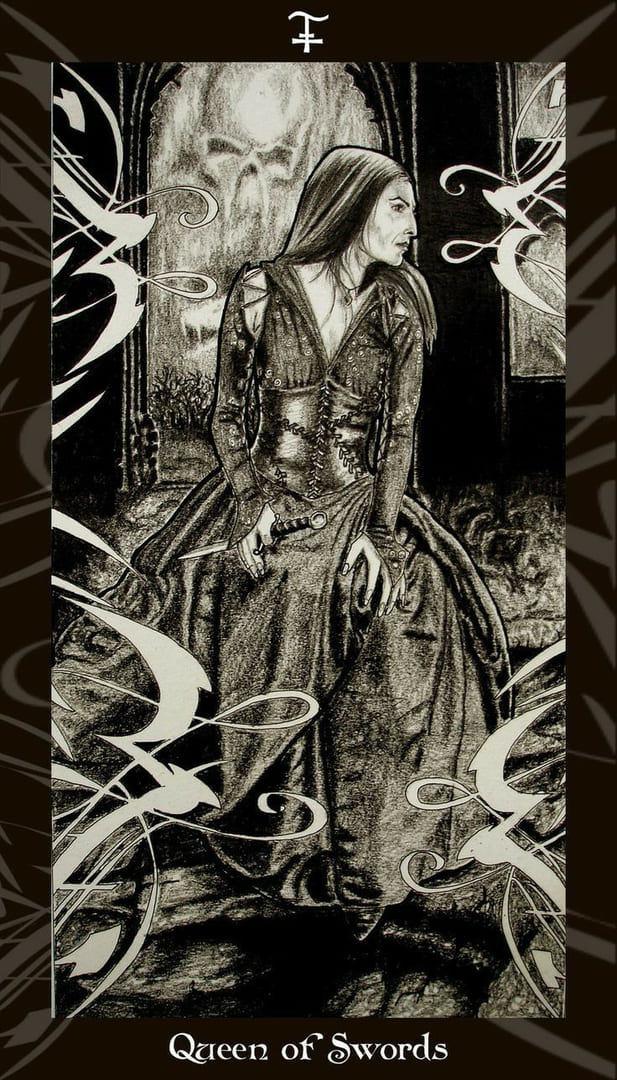
The Queen of Swords represents a woman who uses intellect to govern emotion, prioritizing reason, independence, and methodical action. Historically maligned as cold, masculine, or barren, the card has been reinterpreted to affirm women's autonomy, careers, and independent decision-making. Her most positive archetype is Athena—wise and strategic—while her shadow appears as a predatory black widow who drains others. In pop-cultural terms, Bellatrix Lestrange exemplifies the shadow aspect: cruel and ruthless yet powerful, trusted within a male domain, and fiercely authentic.
King of Swords

The King of Swords embodies the archetype of Ulysses and the spirit of Mercury, representing intelligence, strategy, and the trickster impulse. This card teaches that the mind is a powerful weapon that can be used for healing, justice, and understanding or for deception and harm. Its keywords point to activity, acuity, adaptability, and the potential for duplicity and cynicism. The card's dual nature is illustrated by the example of Sirius Black, who can be both a brilliant protector and an arrogant bully, showing how intellect can serve noble or harmful ends.
Pentacles
Ace of Pentacles

The Ace of Disks represents the roots of matter and the earth element, emphasizing materialization, the body, possessions, and tangible success. It urges pragmatism and grounding—concentrating on the here and now and ensuring plans are based on a firm foundation. The card promises stability, health, and an increase in wealth, status, and worldly power when efforts are sound. It celebrates sensual enjoyment of the earth's riches and encourages practical action to manifest aspirations.
Two of Pentacles

This card emphasizes change manifested through paired or opposing states, showing that material conditions are inherently transient. It highlights the power of opposites, the yin-yang balance, and the eternal cycle where one state becomes another. The card advises abandoning one-sided viewpoints and approaching situations with flexibility and an easy-going attitude. Symbolically, it points to transformation and the flow of change that moves us between states and roles.
Three of Pentacles

Three of Disks (Work) signifies manifestation through disciplined effort: the consolidation of opposing forces into a bounded, productive form. It emphasizes acceptance of material limitations and the use of time and structure (Saturnian themes) to develop and realize tangible results. Through focused labor, one can transform available materials and achieve recognition, material increase, and self-realization. The card draws an alchemical analogy—transforming base matter into gold—to illustrate the process of inner and outer work leading to growth and achievement.
Four of Pentacles

The 4 of Disks represents crystallization and consolidation of creative and material forces, offering stability, security, and the completion of earthly power. Ruled by Jupiter, it carries both dominance and a relaxed, jovial ease of mind that comes with established stability. The number four evokes the square—solid foundations and structural integrity—translating into status, influence, and an unerring sense of direction. In practical terms it points to material security and control of wealth, providing the chance to leave a lasting mark on the world.
Five of Pentacles

The 5 of Disks signals an abrupt breakdown of prior stability, bringing crisis, loss, and material suffering. Its Mars-driven energy produces painful upheaval as securities—food, home, possessions, or safety—are threatened or taken away. Imagery of a ruined farmstead captures the depth of devastation and helplessness this card can indicate. The card also evokes a cautionary tale of overreaching into forbidden forces, exemplified by the Horcrux ring, which leads to personal ruin and a path of torment.
Six of Pentacles

The Six of Disks represents the stabilization of chaotic energy into clarity, order, and life force, especially in material matters. In the suit of disks this brings material success, wealth, harmony, and the fulfillment of wishes, with events often working in our favor. The card emphasizes achievement through sustained effort combined with optimism and favorable timing. It also suggests that while hard work is necessary, a small measure of luck or a nudge from the universe helps things come together.
Seven of Pentacles

The 7 of Disks (Failure) warns of material setbacks and the collapse of projects born from unrealistic assumptions or wishful thinking. Linked to Saturn in Taurus and the Venus-influenced 7s, it highlights emotional misconception and the danger of clinging to old stereotypes. The card advises realism: accept consequences, avoid false hopes, and consider delaying new ventures if conditions are poor. Its imagery of a deadly, cursed object emphasizes how material choices or possessions can bring ruin.
Eight of Pentacles

The Eight of Disks channels Mercury's quicksilvery mental acuity, emphasizing clarity through organization, detailed insight, and disciplined planning. On the material plane it indicates that tactical, well-thought-out work and doing one's homework will pay off, and that patience to let developments run their course is often rewarded. The card also carries a note of nervousness and mental hyper-sensitivity, so objectivity and knowledge of rules help manage opportunities without overreaction. Its imagery—the put-outer absorbing eight disks of light—symbolizes foresight, strategic preparation, and subtle instruments used to move about undisturbed while achieving practical goals.
Nine of Pentacles

The 9 of Disks represents the final impulse of the elemental cycle, driven by the Moon and the subconscious, bringing hidden drives and impulses to fruition. In the Earth suit this energy supports growth, increased capability, and an instinctive trust that needs will be met along the way. The card often signals a stroke of good fortune in material affairs—successful deals, promotions, or the finding of a suitable partner. The imagery emphasizes manifestation and acquisition, illustrated by a threshold about to open and symbols of acquisitio.
Ten of Pentacles

The 10 of Disks represents the full materialization and culmination of effort in the realm of Earth and the suit of Disks. It signifies solid, crystallized achievement, a firm foundation, and both outer riches and inner security. This card speaks of reaping the harvest of aspirations and feeling mature, satisfied, and secure in who you are. The imagery emphasizes domestic contentment and simple, welcoming abundance.
Page of Pentacles

The Princess of Disks represents a shy, creative, warm-hearted figure who is grounded in the cycles of nature and committed to nurturing growth. She is trusting, open to new ideas, reliable, and willing to follow through on her plans, with insights that reveal deeper truths rather than mere intellectual understanding. The card emphasizes care, protection, and being at rest within oneself, and it points to learning through experience and even pain. The Luna Lovegood example illustrates how imagination, belief, and an "old soul" quality can ground others and reveal hidden magic.
Knight of Pentacles

The Prince of Disks represents a sober, dedicated, and reliable young energy grounded in practicality and perseverance. He may lack the quick intellect of the Swords or the fiery impulsiveness of the Wands, but his steady focus, stamina, and hands-on skill allow him to accomplish long-term goals. This card emphasizes pragmatic instincts, physical capability, and a disciplined work ethic. It often points to someone underestimated by others who becomes valuable through patience, perseverance, and specialized knowledge.
Queen of Pentacles

The Queen of Disks represents a mature, grounded woman who protects her material security and those in her care. She embodies creativity and the life-force, combining patience, realism, and practical dedication. This card advises steady work and personal sacrifice to achieve lasting results, warning that one must stand firm before reaching for lofty aims. It rejects frivolity and daydreaming, emphasizing matriarchal stewardship and a strong connection to all forms of life.
King of Pentacles

The King of Disks represents a sober, practical leader who stabilizes and protects material achievements. He is patient, methodical, and willing to do the necessary groundwork to ensure a plentiful harvest. He combines realism and conservatism with deep compassion and empathy for the earth and its creatures. Reliable and enduring, he cautiously tests new ventures and remains steadfast and trustworthy in his responsibilities.
Reading Tips for the Harry Potter Tarot
This deck rewards readers who know the source material, but you do not need to be a Potter scholar to read with it. The character assignments are a teaching tool — once you understand why Colin Creevey is The Fool or why Fawkes represents The Sun, the archetype clicks into place and stays there.
Use the characters as memory anchors. If you struggle to remember what The Devil means, think of Voldemort’s obsessive pursuit of immortality and the chains his followers wear out of fear. If Strength feels abstract, picture Hermione approaching Buckbeak with steady confidence. The Wizarding World gives every archetype a face.
Pay attention to Thoth naming. This deck follows the Thoth tradition, so the Minor Arcana cards carry titles like Domination, Swiftness, Cruelty, and Circumspection. These titles are not decorative — they sharpen the card’s meaning. “Seven of Cups” could mean many things; “Illusion” tells you exactly where to look.
Notice the house alignments. Wands are Gryffindor, Cups are Slytherin, Swords are Ravenclaw, and Disks are Hufflepuff. This means the suit of Cups carries Slytherin’s emotional complexity and ambition rather than the purely nurturing water energy of other decks. Let the house colors deepen your interpretation.
Read the court cards as real people. Because each court card is tied to a specific character — Ron as the Prince of Wands, Narcissa as the Queen of Cups, Luna as the Princess of Disks — they feel less like abstract personality types and more like people you already know. Use that familiarity to read the card’s strengths and shadows with nuance.
Frequently Asked Questions
How many cards are in the Harry Potter Tarot?
The Harry Potter Tarot contains the full 78 cards: 22 Major Arcana representing life's great turning points, and 56 Minor Arcana divided into four suits — Wands, Cups, Swords, and Disks (Pentacles).
Who created the Harry Potter Tarot?
The Harry Potter Tarot is a fan-made deck created by Eleonore F. Pieper. It reimagines classic tarot archetypes through the lens of the Wizarding World, assigning Harry Potter characters and scenes to each of the 78 cards.
How does the Harry Potter Tarot differ from traditional tarot?
While it follows the standard 78-card structure, the deck uses Thoth-influenced titles — The Magus instead of The Magician, Princess and Prince instead of Page and Knight, and Disks instead of Pentacles. Each card is mapped to a specific character or scene from the Harry Potter series to illustrate its meaning.
Is the Harry Potter Tarot good for beginners?
Yes, especially if you love the Wizarding World. The familiar characters make abstract tarot concepts much easier to grasp — for example, understanding The Devil card becomes more intuitive when you see Voldemort, Bellatrix, and Wormtail embodying obsession and fear. The character associations serve as built-in memory aids.