Hierophant & Lovers Together in Tarot: Tradition Meets Passion
The question that sits between these two cards
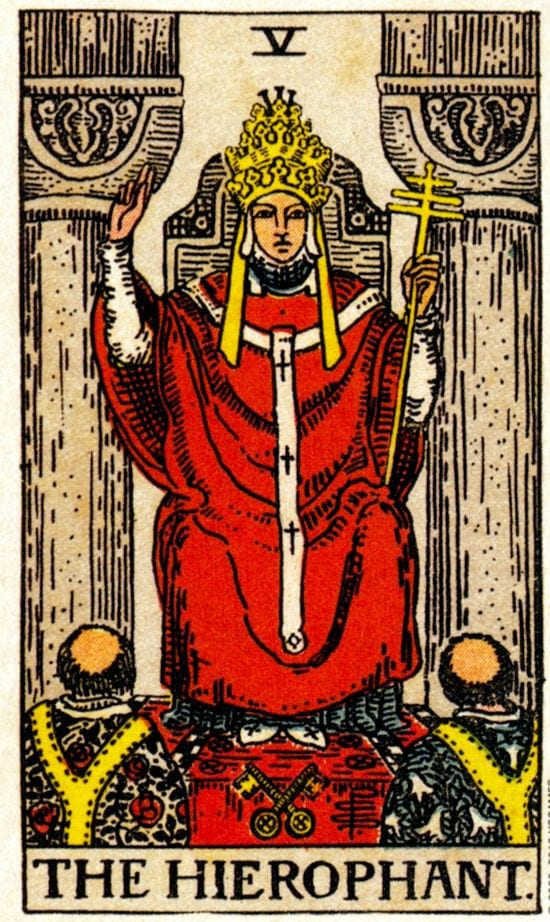
On one side: The Hierophant. Stone pillars. Formal robes. Two acolytes kneeling before a spiritual authority. Everything in order. Everything approved. The way it’s always been done.
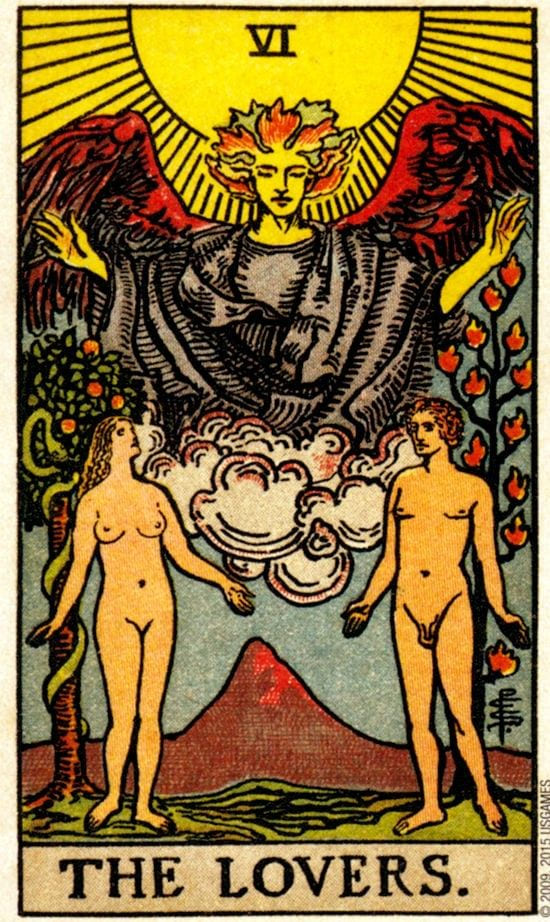
On the other side: The Lovers. Two naked figures under an angel’s gaze. No rules. No institutions. Just the raw, honest, vulnerable act of choosing someone — or something — because your heart said yes.
When these two cards appear together, they frame the question that every adult has to face at some point: do you live the life that’s expected of you, or the life that calls to you?
And the real answer — the one these cards are actually offering — is more nuanced than either/or.
The Hierophant: the way things are done
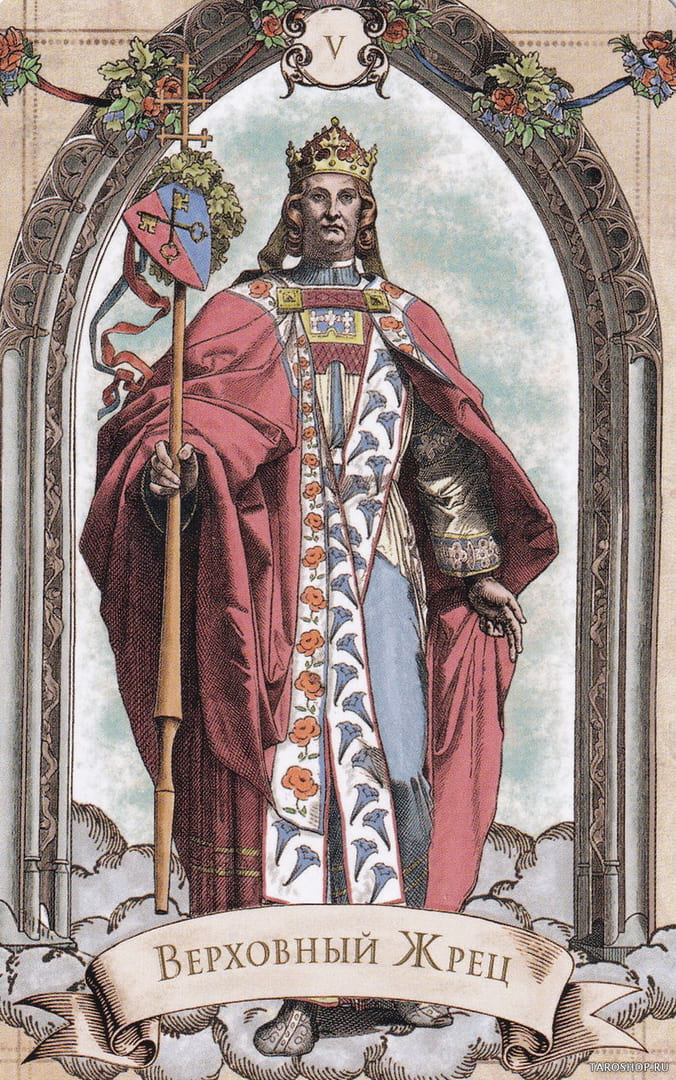
The Hierophant (V) represents structure, tradition, and conventional wisdom. He’s the priest, the teacher, the institution itself. The crossed keys at his feet open the doors of approved knowledge. The two acolytes at his feet accept his authority.
This card isn’t inherently negative — despite what many modern readers suggest. Tradition carries wisdom. Institutions provide stability. The “way things are done” often became that way because it works. The Hierophant at his best represents the kind of guidance that comes from generations of accumulated experience.
But The Hierophant at his worst represents conformity for its own sake — following rules because they’re rules, not because they’re wise. Staying in the approved lane because deviation feels dangerous. Choosing the expected path because the unexpected one has no guarantees.
Key qualities: tradition, convention, institutional authority, spiritual teaching, conformity, marriage ceremonies, established values, the approved path.
The Lovers: the choice that’s yours alone
The Lovers (VI) is the card of authentic choice. Not just romantic love — though it includes that — but the deeper act of choosing based on genuine values rather than external expectation.
In the Smith-Waite image, a man and woman stand naked beneath an angel. The Tree of Knowledge and the Tree of Life flank them. This is Eden — the moment before and after the choice that changed everything. The Lovers says: some choices can’t be made for you by tradition, parents, institutions, or society. Some choices require you to stand naked with your own truth and decide.
The Lovers represents the moment when conformity stops being enough and you have to ask: what do I actually want?
Key qualities: choice, authentic desire, values alignment, union, passion, vulnerability, the decision that defines you, following your heart.
Together: tradition and desire in the same room
Here’s why this combination is so rich: The Hierophant and The Lovers aren’t always in conflict.
Sometimes they are. The family that disapproves of who you love. The cultural expectation that conflicts with your personal truth. The career path that tradition says you should follow versus the one your heart is pulling toward. In these cases, the combination asks you to make a choice — and it validates the difficulty of that choice.
But sometimes — and this is the version people miss — tradition and desire align. The marriage that both your heart and your family celebrate. The career that satisfies your ambition and makes your parents proud. The spiritual path that’s both conventionally respected and personally meaningful. When The Hierophant and The Lovers agree, the result is deeply grounding: you’re living a life that’s both authentic and supported.
The key question this combination asks is: are your traditions serving your truth, or replacing it?
In love and relationships
Marriage and commitment: This is one of the strongest marriage indicators in tarot. The Hierophant represents the formal ceremony — the institution of marriage, the public commitment, the vows before witnesses. The Lovers represent the private truth — the genuine love that makes the ceremony meaningful rather than just conventional. Together: a commitment that has both the institutional weight and the authentic heart. If you’re considering marriage, this combination says: yes, and for the right reasons.
Family expectations in love: If your family or culture has opinions about who you should be with, this combination addresses that tension directly. The Hierophant is the family’s voice: “marry within the community,” “choose someone stable,” “follow the rules.” The Lovers is your heart’s voice: “but I love this person.” The cards don’t tell you which to follow — they acknowledge that both forces are real and both deserve consideration.
Conventional vs. unconventional relationships: This combination appears when you’re navigating the space between how relationships “should” look and how yours actually works. An age gap. A non-traditional arrangement. A partnership that makes people raise eyebrows. The Hierophant asks: can this work within the structures that matter to you? The Lovers asks: does this make your heart say yes?
If you’re choosing between two people: The Hierophant represents the “safe” choice — the partner who checks all the boxes, whom your family approves of, who fits the life you planned. The Lovers represents the authentic choice — the person who makes you feel alive, who may not check the boxes but fills the spaces the boxes don’t cover. The combination doesn’t tell you which to choose. It tells you both factors are in play.
In career and finances
Conventional career vs. passion: The Hierophant is the stable career — respected, well-paying, approved by the world. The Lovers is the work you actually love — risky, maybe unconventional, definitely yours. This combination in a career reading asks: is there a way to honor both? Sometimes the answer is integrating passion into a conventional framework. Sometimes it’s leaving the conventional path entirely. Sometimes it’s keeping the day job while building the dream on the side.
Business ethics: The Hierophant represents established business practices and ethical frameworks. The Lovers represents decisions made from the heart. Together in a business context: make decisions that are both ethically sound and genuinely aligned with your values. When profit and principle conflict, these cards ask: which serves your long-term integrity?
Financial decisions and values: Major financial choices where convention says one thing (save, invest conservatively, follow the safe path) and your heart says another (take the risk, fund the dream, invest in what matters to you). The combination asks you to find the intersection — the financially responsible choice that also makes your soul say yes.
In personal growth
This combination reaches its most profound meaning in the realm of values and identity.
Every person carries two sets of values: inherited and chosen. Your inherited values come from family, culture, religion, education — the Hierophant’s domain. Your chosen values emerge from experience, reflection, and the honest confrontation with what actually matters to you — the Lovers’ domain.
Maturity isn’t choosing one set over the other. It’s examining both, honestly, and consciously deciding which to keep, which to release, and which to transform.
This combination asks:
- Which of your beliefs were chosen by you, and which were assigned to you?
- Which traditions serve your actual life, and which just avoid the discomfort of questioning?
- Where are you conforming out of wisdom, and where are you conforming out of fear?
- Where does your heart’s desire align with the path you were taught, and where does it diverge?
The person who has done this work — who has examined their inherited values through the lens of their authentic self — doesn’t reject tradition entirely or follow it blindly. They make informed, conscious, deeply personal choices about which traditions to carry forward and which to set down with gratitude.
The order matters
Hierophant first, Lovers second: Convention comes first, then choice. You were following the approved path and now you’re being asked to make a genuinely personal decision. The structure was there — the degree, the career, the relationship framework — and now your heart is introducing a variable that the structure didn’t account for. Something personal is entering the conventional landscape.
Lovers first, Hierophant second: Choice comes first, then convention. You followed your heart and now you’re encountering the institutional reality. The love that was pure and personal now needs to navigate family, culture, or societal structures. The passionate beginning meets the systems that either support or resist it.
Both reversed: The Hierophant reversed represents breaking from tradition — questioning authority, rejecting convention, going your own way. The Lovers reversed represents confusion about what you actually want, or a choice that doesn’t feel right. Together reversed: you’ve rejected the old rules but haven’t yet found your new ones. The rebellion is clear; the direction is not. Take time to discover what you’re choosing toward, not just what you’re choosing against.
The wedding and the kiss
Here’s a way to understand this combination that cuts through the complexity: The Hierophant is the wedding. The Lovers is the kiss.
The wedding is the ceremony, the witnesses, the institution, the legal paper, the family gathering, the “I do” that society recognizes. The kiss is the private truth — the moment between two people where everything else falls away and only the connection remains.
A wedding without a kiss is a contract. A kiss without a wedding is a moment. But a wedding with a kiss — convention that holds genuine passion, structure that serves real love — that’s something worth building a life on.
These two cards together ask: does your life have both the wedding and the kiss? The structure and the truth? The tradition and the heart?
If it does, you’re rarer than you know. If it doesn’t, the cards are asking which one is missing — and whether you’re brave enough to find it.
Frequently Asked Questions
What does The Hierophant and The Lovers mean together?
This combination explores the tension — or harmony — between tradition and personal desire. The Hierophant represents established structures, conventional values, and doing things the 'right' way. The Lovers represent choice, passion, and authentic connection. Together they ask: can you honor both your heart and your commitments? Or must you choose?
Does the Hierophant and Lovers mean marriage?
It can. The Hierophant represents formal ceremonies and institutional commitments, while The Lovers represent the choice of a partner. Together they're one of the strongest marriage indicators in tarot — specifically marriage that has both institutional recognition (Hierophant) and genuine love (Lovers). But it can also mean any situation where convention and desire intersect.
Is the Hierophant and Lovers about a choice between duty and desire?
Often yes. The Hierophant asks: what does tradition, family, or society expect of you? The Lovers ask: what does your heart actually want? When they appear together, you may be facing a decision where these two pulls conflict — or discovering that they align more than you thought.
What does this combination mean reversed?
The Hierophant reversed suggests rebellion against convention or questioning established beliefs. The Lovers reversed suggests a difficult choice or misalignment in values. Together reversed: you're rejecting tradition but unsure what to replace it with, or making a choice that defies expectations and dealing with the consequences.