Hierophant Tarot as Feelings: Love With a Manual
The one who kneels before he holds
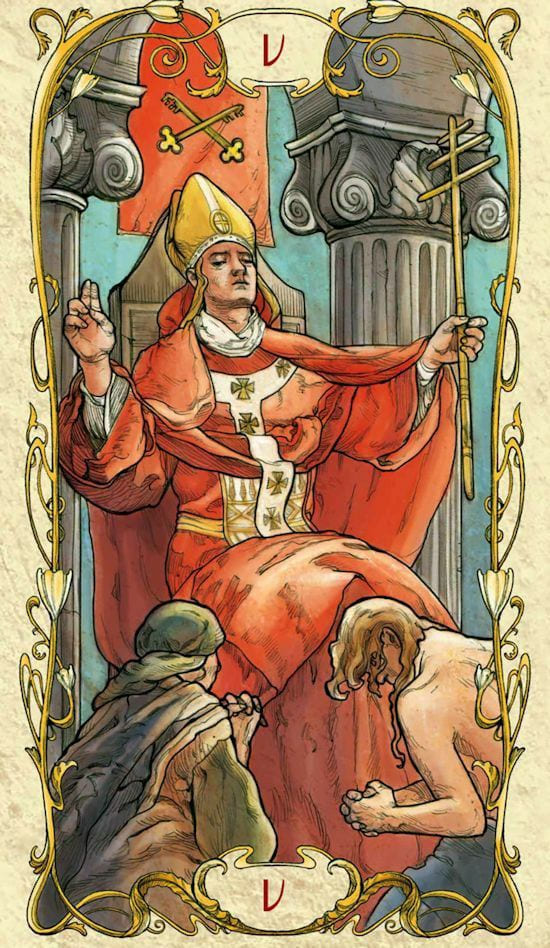
Two acolytes kneel before him. He sits between two pillars — gray and white, structure and spirit. His right hand is raised in benediction, two fingers pointing to heaven, two to earth. He wears the triple crown of the papal tiara. His left hand holds a triple cross — authority that transcends the personal and enters the sacred.
This is The Hierophant. And he doesn’t fall in love the way other cards do. He commits.
When someone feels The Hierophant toward you, they’re not swept up in passion (that’s the Devil), not intoxicated by fate (that’s the Wheel), not lost in healing (that’s the Star). They’re standing in a very specific place: the intersection of feeling and framework. They feel something and they want to give it a structure. A name. A commitment. A set of shared rules that both of you agree to follow.
His love comes with a manual. That sounds cold. It isn’t. It’s the love of someone who believes that feelings without commitment are foundations without houses. That passion without vows is fire without a hearth. That loving someone means choosing to love them within a framework that will survive the days when choosing feels hard.
Upright: as feelings for you
When The Hierophant appears upright in the feelings position, the person feels:
Devotion that wants a framework. They don’t just want to love you — they want to love you officially. Within a structure that both of you recognize. This might be marriage, engagement, moving in together, meeting each other’s families, or any other milestone that takes a private feeling and makes it public. The Hierophant as feelings is the person who thinks about labels not because they’re insecure, but because they believe names matter. What you call something shapes what it becomes.
Alignment of values, not just attraction. The Hierophant doesn’t care only about chemistry. He cares about compatibility — the deep, structural kind. Do you want the same things? Do you believe the same things? Do your life architectures fit together? His feelings for you include an assessment of whether your values match, because he knows that shared values outlast shared passion.
The desire to teach and learn together. The Hierophant is a teacher — he sits between knowledge and the seeker. As feelings, this manifests as someone who wants to grow with you, to share wisdom, to build understanding together. Not condescendingly — collaboratively. He’s not lecturing you. He’s enrolling you in a shared education called “us.”
Love expressed through consistency. The Hierophant doesn’t surprise you with grand gestures. He shows up to the same place, at the same time, with the same devotion, day after day. His love is liturgical — it has a rhythm, a structure, a predictability that more spontaneous cards might find boring but that is actually the most reliable form of love that exists. You always know where you stand with the Hierophant because he tells you, and then he does exactly what he said.
Spiritual or emotional resonance. Sometimes the Hierophant as feelings goes beyond the practical and into the sacred. This person feels that your connection has a spiritual dimension — that meeting you wasn’t just lucky but meaningful in a way that connects to something larger. Their love for you is part of their faith, their philosophy, their understanding of how the universe works.
Reversed: as feelings for you
When The Hierophant appears reversed in the feelings position:
Rebellion against traditional love. They love you but refuse to love you the way they’re “supposed to.” No marriage, no labels, no traditional milestones — not because they don’t care, but because they find traditional structures suffocating. The reversed Hierophant as feelings is the person who commits deeply but on their own terms, and those terms may look nothing like what your family or culture expects.
Feeling trapped by expectations. They want you, but the weight of what “wanting you” means in their world — family expectations, cultural norms, religious frameworks — feels crushing. The reversed Hierophant can mean someone who loves you in private but can’t figure out how to love you in public because the public framework doesn’t have room for what you are.
Questioning their own beliefs about love. Everything they were taught about relationships — by parents, by culture, by religion — is being challenged by what they feel for you. The reversed Hierophant is in a crisis of doctrine. Their feelings for you are rewriting their rulebook, and the process is disorienting.
Hypocrisy. The shadow: saying all the right things about commitment, values, and devotion while acting in contradiction. The reversed Hierophant can be the person who preaches fidelity and practices deception. Who values tradition in theory and breaks it in practice. Whose words about love are beautiful and whose actions are hollow.
Context: The Hierophant as feelings in different situations
As someone you’re dating
Upright: They’re thinking about making this official. Not necessarily tomorrow, but the trajectory is toward definition, commitment, and shared structure. If you’ve been wondering “where is this going?” — the Hierophant answers: toward something with a name, a shape, and a future that both of you agree on.
Reversed: They want you but resist the expected relationship escalator. Maybe they want commitment without marriage. Maybe they want partnership without cohabitation. Their feelings are real, but their relationship model doesn’t fit the standard template, and they’re trying to figure out what it does fit.
As an ex’s feelings
Upright: They think about what you were within the framework of what relationships are “supposed to be.” They may feel that you were the right person but the structure was wrong — or that the structure was right but they weren’t ready for it. The Hierophant ex processes the relationship through the lens of lessons and values.
Reversed: They feel that the relationship failed because neither of you could fit into the expected mold. The conventions didn’t work. The rules didn’t apply. And now they’re wondering if love without a manual is even possible — or if the manual just needed rewriting.
As a new connection
Upright: They see you as someone they could build something lasting with. Not a fling. Not a situationship. A partnership — with shared values, mutual respect, and a trajectory toward something permanent. If the Hierophant appears early as feelings, they’re already imagining the long game.
Reversed: Attracted to you but conflicted about what pursuing you would mean within their existing framework. Maybe they’re from a different background and their family wouldn’t approve. Maybe they’re questioning whether their idea of love is even what they actually want. The reversed Hierophant as new feelings is the tension between what the heart wants and what the world expects.
The Hierophant vs. other “commitment” cards as feelings
The Hierophant vs. The Emperor: The Emperor commits through personal power — “I will protect you with what I’ve built.” The Hierophant commits through shared belief — “We will protect each other with what we believe together.” One is individual devotion. The other is institutional devotion.
The Hierophant vs. Justice: Justice commits to fairness — balanced, reciprocal, measured. The Hierophant commits to faith — shared values, chosen doctrine, things believed rather than calculated. Justice as feelings is “I owe you what you gave me.” The Hierophant as feelings is “I pledge you what I believe.”
The Hierophant vs. Ten of Cups: The Ten of Cups is the result — family harmony, emotional fulfillment, the happily-ever-after. The Hierophant is the path to get there — the commitment, the structure, the shared agreements that make the Ten possible. One is the destination. The other is the wedding.
What The Hierophant as feelings is really telling you
Here’s the truth about The Hierophant that nobody in the feelings position wants to hear:
If someone feels The Hierophant toward you, they don’t just love you. They believe in you.
And belief is different from feeling. Feeling can change with the weather. Belief is chosen, maintained, defended. The Hierophant’s love is a creed — something recited daily, renewed intentionally, practiced whether the feeling is strong or quiet.
He doesn’t hold you the way the Empress does, with soft arms and garden warmth. He holds you the way a vow holds — with words spoken in public, with witnesses, with the understanding that what is said cannot be unsaid and what is pledged cannot be unpledged.
His love has a manual. But the manual isn’t a cage. It’s a covenant. A shared agreement between two people who decided that their feelings deserve the dignity of structure.
The acolytes kneel. The triple cross is raised. And the words spoken between the pillars — gray and white, earth and heaven, flesh and spirit — are meant to last.
Try it yourself
Pull a card with this question: “What do I believe about love — and is that belief serving me or constraining me?”
Because The Hierophant isn’t just about how someone else feels about you. It’s about the beliefs you carry into every relationship — about what love should look like, how commitment should feel, which rules are sacred and which are just inherited. The Hierophant invites you to examine the manual.
Not all of it is scripture. Some of it is fear wearing a holy mask.
Know the difference. Then choose what you believe.
Frequently Asked Questions
What does The Hierophant mean as someone's feelings for me?
When The Hierophant appears as feelings, the person feels deep commitment and devotion — the kind that follows rules, honors tradition, and takes vows seriously. They see you within a framework of shared values, long-term partnership, and spiritual or emotional alignment. This isn't casual. He's thinking about institutions: marriage, family, lasting partnership.
Does The Hierophant as feelings mean they want marriage?
Often yes — or at least formal, recognized commitment. The Hierophant values structure in love. He wants to name what you are, define it publicly, give it a framework. If this card appears as feelings, the person is thinking about the relationship as something to be built within tradition — whether that's marriage, cohabitation, or whatever their version of 'official' looks like.
What does The Hierophant reversed mean as feelings?
Reversed, The Hierophant as feelings means rebellion against the expected path — or suffocation within it. Either they want an unconventional relationship that breaks the rules, or they feel trapped by traditional expectations they can't live up to. The reversed Hierophant is the person who loves you but can't love you the way the world says they should.
How is The Hierophant different from The Emperor as feelings?
The Emperor protects through personal authority — 'I will build walls and make you safe.' The Hierophant protects through shared belief systems — 'We will follow the same path and it will hold us.' The Emperor is individual power. The Hierophant is institutional belonging. One builds a fortress. The other builds a church.