The Hierophant Tarot Card Meaning: Tradition, Teaching & the Path Between
First impression
There is a stillness to the Hierophant that feels different from other cards. Not the meditative quiet of The Hermit, who walks alone. This is institutional stillness — the hush of a cathedral, the weight of a ceremony that has been performed the same way for centuries. Someone is about to speak, and the room is waiting.
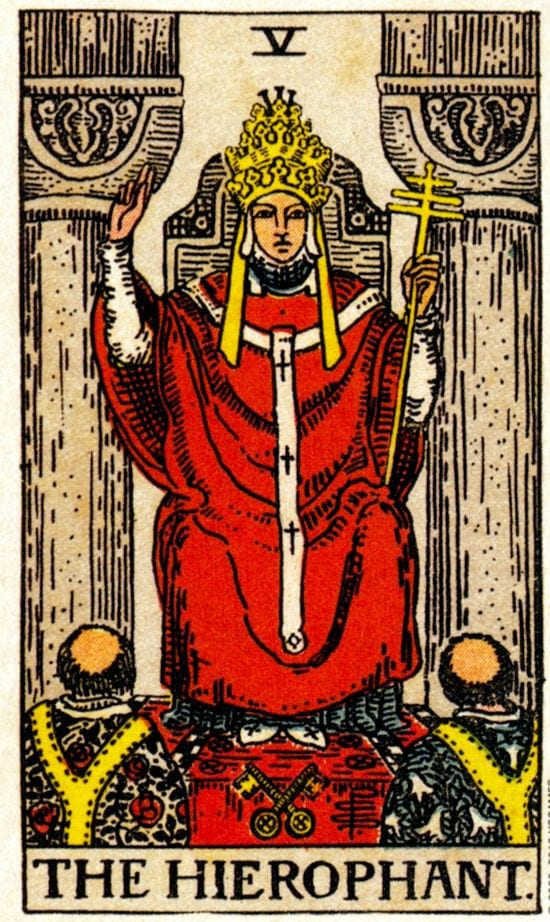
In the Rider-Waite-Smith image, a robed figure sits between two grey pillars on a stone throne. He wears a triple crown and holds a golden scepter with a triple cross. At his feet, two acolytes kneel — one in a robe patterned with red roses, the other with white lilies. Two crossed keys sit on the floor between them.
When this card first appeared in one of my readings, I was trying to decide whether to learn tarot from books or from a teacher. The Hierophant’s answer was clear: find the teacher. Not because books are wrong, but because some knowledge lives in transmission — in the space between two people where understanding passes not just through words but through presence.
That’s the Hierophant’s gift. And also its limitation.
Symbolism
The triple crown (the papal tiara) represents mastery over three realms: the conscious, the subconscious, and the superconscious. Or, in more grounded terms: body, mind, and spirit. The Hierophant doesn’t just know things intellectually — he embodies them through practice and ritual.
The triple-crossed scepter mirrors the crown, reinforcing the theme of bridging worlds. This is the card of the intermediary — the one who stands between the divine and the human and translates in both directions.
The two pillars are greyer and more sober than the High Priestess’s Boaz and Jachin. They represent law and liberty, obedience and disobedience. The Hierophant sits between them, suggesting that wisdom lies not in choosing one extreme but in understanding both.
The two acolytes are students, followers, congregants. The Hierophant is never alone — his role only exists in relationship to others. He teaches, and therefore he needs people who are willing to learn. The roses and lilies on their robes represent passion and purity, desire and devotion.
The crossed keys at his feet are the keys of knowledge — one gold (conscious, solar) and one silver (unconscious, lunar). Together, they unlock understanding. But notice: the keys are at his feet, not in his hands. The knowledge is available, but you have to kneel to receive it. This is the card’s central tension: wisdom that requires submission.
As card number V in the Major Arcana, The Hierophant follows The Emperor. Where The Emperor builds structure through worldly power, The Hierophant builds it through spiritual authority and shared belief. He is the bridge between the seen and the unseen, the teacher who gives the chaos of raw spiritual experience a shape you can hold.
Upright meaning
The Hierophant upright asks you to work within a system. Not blindly, but respectfully — recognizing that traditions, institutions, and established methods exist for a reason. Someone figured this out before you. You don’t have to reinvent every wheel.
This card often appears when:
You need a teacher, mentor, or guide. The Hierophant says: stop trying to figure it out alone. There is someone who has walked this path before and can show you where the ground is solid. This might be a formal teacher, a therapist, a spiritual director, or simply an elder whose wisdom you trust.
A commitment is forming. Contracts, vows, agreements — the Hierophant is the card of making things official. In love, this often means engagement or marriage. In career, it might mean signing a contract, joining an institution, or formalizing a partnership.
Traditional values are relevant. Family expectations, cultural norms, religious practices, conventional approaches — something in your situation calls for honoring what has been done before rather than inventing something new. The Hierophant says: there is value in the way things have always been done, even if it’s not fashionable to say so.
You’re joining a group or community. Study groups, congregations, professional organizations, any structured community of shared belief. The Hierophant represents the connective tissue of belonging — the part of you that needs to be part of something larger.
You’re learning a system of knowledge. Tarot itself, astrology, a new language, a degree program, a trade. Any body of knowledge with its own rules, vocabulary, and traditions. The Hierophant says: submit to the learning. Master the rules before you break them.
Reversed meaning
The Hierophant reversed is the rebel — but not always the hero. Sometimes the reversal reveals the shadow of both conformity and non-conformity.
Questioning authority. You’re pushing back against a system, institution, or belief that no longer serves you. This could be a religious tradition you grew up in, a corporate culture that stifles you, a relationship dynamic where one person makes all the rules. The reversed Hierophant gives you permission to ask: whose rules are these, and do I actually agree with them?
Unconventional paths. Choosing to live, love, or work outside the mainstream. Non-traditional relationships, freelance instead of corporate, spirituality instead of organized religion. The reversed Hierophant says: your path doesn’t have to look like anyone else’s.
A teacher who has failed you. A mentor whose advice is outdated, a leader who abuses their authority, an institution that protects itself at the expense of the people it claims to serve. The reversed Hierophant can point to spiritual manipulation, cult-like dynamics, or simply someone who’s stopped growing but still demands to be followed.
Rigidity or dogma. Clinging to rules for the sake of rules. Refusing to adapt because “this is how we’ve always done it.” The reversed Hierophant asks whether your traditions are alive and evolving or whether they’ve become walls that keep new ideas out.
Fear of commitment. You know what the traditional next step is, but you resist it — not because it’s wrong, but because formality feels like a cage. The reversed Hierophant asks: is your resistance wisdom or avoidance?
In love and relationships
Upright: The Hierophant in love is the commitment card. If you’ve been wondering whether the relationship is going anywhere, this is a strong yes — but in a traditional direction. Think engagement rings, meeting parents, shared bank accounts, building a life on shared values. The Hierophant loves relationships that have structure, shared beliefs, and mutual respect for what “we” means.
For singles, it may point to meeting someone through conventional channels — a friend of a friend, a religious community, a work event. Not a dating app swipe. Someone introduced properly.
Reversed: The relationship doesn’t fit the mold, and maybe it shouldn’t. You might be drawn to someone your family wouldn’t approve of, exploring non-traditional relationship structures, or realizing that you and your partner have fundamentally different values. The reversed Hierophant in love asks: are you following someone else’s script for what love should look like, or are you brave enough to write your own?
In career and finances
Upright: The Hierophant at work represents institutions, formal education, mentorship, and working within established systems. This is the card of corporate culture, academic paths, professional certifications, and climbing a ladder that already exists. It advises: learn the system before trying to change it. If you’re starting a new job, study how things work before proposing reforms.
Financially, the Hierophant favors conservative approaches — savings, pensions, traditional investments. Not the time for crypto experiments or risky ventures.
Reversed: Entrepreneurship, freelancing, rejecting the corporate ladder. The reversed Hierophant in career says you don’t need permission from an institution to do meaningful work. It can also indicate a toxic workplace where conformity is demanded and dissent is punished — a sign that the system is broken, not that you are.
In health and wellbeing
Upright: The Hierophant in health readings points toward conventional medicine, established treatment protocols, and trusted professionals. If you’ve been exploring alternative remedies, this card suggests: get the traditional opinion too. See the doctor. Follow the protocol. There’s a reason these systems exist.
Reversed: Seeking alternative healing modalities, questioning a diagnosis, or pushing back against a medical system that isn’t listening. The reversed Hierophant in health asks you to be your own advocate while remaining honest about the difference between healthy skepticism and dangerous denial.
Key combinations
The Hierophant + The Lovers: A profound choice about commitment. The Lovers follows the Hierophant in the Major Arcana for a reason — after learning the rules, you must choose whether to follow them. This combination often signals engagement or a significant relationship decision.
The Hierophant + The Tower: An institution or belief system crumbles. What you trusted falls apart. This is painful but ultimately liberating — the Tower destroys what the reversed Hierophant only questioned.
The Hierophant + The High Priestess: Inner knowing versus outer teaching. Are you following your intuition or someone else’s doctrine? This combination asks you to integrate both — the mystery within and the tradition without.
The Hierophant + Three of Pentacles: Learning a craft under a master. Apprenticeship, formal training, the slow and respectful accumulation of skill. This combination says: put in the hours. The expertise is worth it.
The Hierophant + Eight of Swords: Feeling trapped by beliefs or expectations. The rules that once gave comfort now feel like a prison. This combination asks: are these walls real, or have you simply never tried the door?
The Hierophant + The Devil: Dogma becoming toxic. A belief system or authority figure that controls through fear, shame, or manipulation. This is the shadow side of spiritual power — the teacher who has become the tyrant.
The card’s advice
The Hierophant asks a question most of us avoid: what do you believe?
Not what you think. Not what sounds enlightened. Not what your Instagram feed says you should believe. What do you actually, in the deepest part of yourself, hold as true? And where did those beliefs come from — from your own experience, or from someone who told you what to think?
The upright Hierophant says: there is wisdom in tradition, and humility in learning from those who came before. You don’t have to invent everything from scratch. Some paths are well-worn for a reason.
The reversed Hierophant says: not every inherited belief belongs to you. Some traditions serve the institution more than the individual. You have the right — maybe the duty — to question.
The wisest Hierophant holds both. He knows the tradition deeply enough to know which parts are alive and which parts are just habit. He teaches the rules so his students can decide for themselves which ones to keep.
Try it yourself
Pull three cards with this question: “Which of my beliefs were chosen, and which were inherited — and does the distinction matter right now?”
Card 1: A belief you chose for yourself Card 2: A belief you inherited from others Card 3: What happens if you examine the difference
The Hierophant isn’t telling you to believe or to doubt. He’s telling you to know the difference.
Frequently Asked Questions
Is the Hierophant a yes or no card?
The Hierophant is generally a yes — especially for questions about commitment, following established processes, or seeking guidance from an expert. It says yes to traditional approaches and conventional paths. Reversed, it's a yes to unconventional choices and breaking with tradition.
What does the Hierophant mean in love?
Upright, the Hierophant in love signals commitment, shared values, and traditional milestones — engagement, marriage, meeting the family. It's the card of relationships that want to go official. Reversed, it suggests unconventional relationships, questioning whether traditional structures serve your love, or a partner who feels controlling under the guise of tradition.
What zodiac sign is the Hierophant?
The Hierophant is associated with Taurus. This might seem surprising for a card about spiritual tradition, but Taurus connects through its themes of values, stability, sensory experience, and the deep need for a foundation that holds. The Hierophant builds that foundation through shared beliefs and time-tested wisdom.
Is the Hierophant a negative card?
The Hierophant is neither inherently positive nor negative — it depends on your relationship with structure and tradition. If you need guidance, community, or a framework to lean on, it's deeply supportive. If you're feeling trapped by rules, expectations, or someone else's beliefs, the card (especially reversed) asks you to examine which traditions serve you and which imprison you.