Judgement Tarot as Feelings: The Love That Woke Up and Can't Go Back to Sleep
The trumpet sounds once
There’s a moment in every relationship — romantic, past, potential — when someone sees you clearly for the first time. Not the curated version. Not the first-impression version. The real one. All of it. The brilliance and the damage. The love and the fear. The whole record, played from beginning to end.
That moment is Judgement.
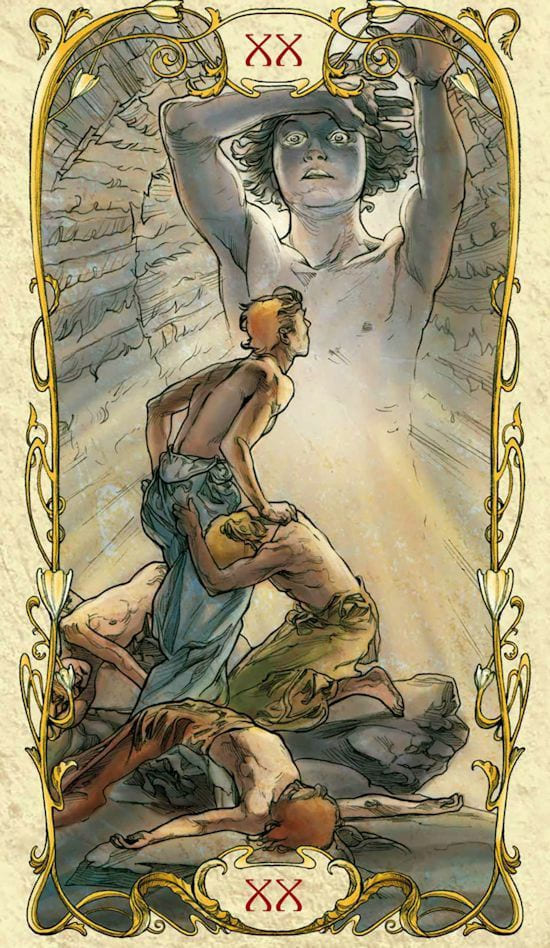
On the card, an angel blows a trumpet in the sky. Below, people rise from coffins — not in horror, but in recognition. They heard the call. They can’t unhear it. Whatever they were before — asleep, buried, pretending, avoiding — is over. The trumpet demands a response. Not someday. Now.
That’s what Judgement as feelings means. The person who drew this card about you has had a reckoning. Not a gentle realization over coffee. A reckoning. The kind that splits time into before and after. Before, they could pretend they didn’t know what you meant to them. After the trumpet? They know. And they can’t go back to sleep.
Notice that the people rising from coffins are a family — a man, a woman, a child. Judgement isn’t just personal. It’s relational. The reckoning isn’t “what do I feel?” alone. It’s “what do I feel, and what does that feeling demand of my life?” This is the card that asks whether your emotions are big enough to change your behavior. Not just how you feel — but whether you’re willing to live differently because of it.
Upright: as feelings for you
When Judgement appears upright in the feelings position, the person feels:
A realization they can’t undo. Something clicked. It might have been a moment — a conversation, a memory resurfacing, a dream, an absence that finally made its weight known. Whatever triggered it, they now understand something about you and about what you are to them that wasn’t accessible before. It’s not new information. It’s old information seen with new eyes. And those new eyes can’t go back to the old prescription.
The call to rise. Judgement as feelings isn’t passive. It’s a summons. This person feels called by you — not to rescue you or worship you, but to become the version of themselves that your presence demands. You represent a standard they can no longer ignore. Whether that standard is honesty, vulnerability, commitment, or growth, they feel the trumpet pointing directly at them and saying: are you going to rise, or are you going to stay in the box?
Accountability for the past. If there’s history between you — mistakes, hurt, missed chances — Judgement as feelings means they’ve stopped running from it. They’ve reviewed the record. They’ve seen their own role clearly, without the comfortable distortions of self-protection. This isn’t guilt (that’s the Devil). This is accountability — the mature, clear-eyed willingness to say “I see what happened, I see my part, and I’m ready to do differently.”
A verdict that favors you. Judgement is, at its core, a card of judgment. A decision has been rendered. And if this card appears upright in the feelings position, the decision is in your favor. Not blindly — not “I’ll take you back without conditions.” But with full awareness: “I’ve weighed everything. The good, the bad, the complicated. And the ruling is that you matter enough to act on.”
Transformation that begins with truth. The people on the card rise naked — not because they’re vulnerable, but because they’ve shed everything unnecessary. Judgement as feelings is someone who has dropped pretense, dropped the narrative they were telling themselves about you, and arrived at something rawer: the truth. Whatever that truth demands of them, they’re ready to face it.
Reversed: as feelings for you
When Judgement appears reversed in the feelings position:
The trumpet sounded and they covered their ears. They know. That’s the devastating part of the reversed Judgement. They had the realization. They felt the call. And they chose not to answer it. Not because the feeling isn’t real — but because what it asks of them feels too big. The change required, the vulnerability demanded, the past that would need confronting — it’s all too much. So they stay in the coffin and pretend the trumpet was for someone else.
Self-judgment without resolution. Instead of reckoning with you, they’re stuck reckoning with themselves — and losing. The reversed Judgement person is caught in a loop of self-criticism: “I should have done differently. I shouldn’t have let that happen. I’m not good enough for this.” This internal court never reaches a verdict. It just keeps replaying the evidence.
Fear of the consequences of honesty. They know what they feel. They know what it means. And they’re terrified of what happens when they say it out loud — because saying it out loud makes it real, and real demands action, and action means risking everything that’s currently comfortable. The reversed Judgement is the person who writes the message and never hits send.
Refusing to forgive — themselves or you. Judgement upright is absolution after honest examination. Reversed, it’s the refusal to absolve. They can’t forgive you for something you did — or, more commonly, they can’t forgive themselves for something they did to you. Without forgiveness, the reckoning remains incomplete. The dead stay in their graves. The trumpet echoes but nobody rises.
Context: Judgement as feelings in different situations
As someone you’re dating
Upright: A turning point. They’ve decided something about you — and it’s significant. This isn’t “I like you.” It’s “I understand what you are in my life, and I’m ready to act accordingly.” If the relationship has been hovering in uncertainty, Judgement is the card that ends the hovering. The verdict is in. Expect a conversation, a declaration, or a shift in how they show up.
Reversed: They know the relationship is at a crossroads but can’t bring themselves to choose a direction. The weight of what you mean to them is paralyzing instead of galvanizing. They’re stuck between “this matters” and “I’m scared of how much it matters.”
As an ex’s feelings
Upright: This is one of the strongest reconciliation cards in tarot. Your ex has done the work — the real work, not just missing you when they’re lonely. They’ve reviewed the relationship, acknowledged what went wrong and their part in it, and reached a conclusion. That conclusion includes you. Whether they act on it depends on courage, but the internal verdict is complete.
Reversed: They haven’t finished processing what happened between you. The review is ongoing but they keep getting stuck on certain memories, certain injuries, certain moments of shame. They may want reconciliation but feel they haven’t earned the right to ask for it. Or they’ve decided they don’t deserve another chance — not a verdict against you, but against themselves.
As a new connection
Upright: You triggered something in them that goes beyond attraction. Meeting you felt like a wake-up call — a challenge to become more honest, more present, more aligned with who they actually want to be. This is the person who looks at you and thinks: “If I’m going to be with someone like you, I need to be a better version of myself.” That’s Judgement’s highest expression as a new feeling.
Reversed: They feel the significance of the connection but it’s activating old wounds instead of inspiring growth. You remind them of something unresolved — a past relationship, a lost version of themselves, a standard they failed to meet before. They want to rise to you but keep stumbling over their own history.
Judgement vs. other “transformation” cards as feelings
Judgement vs. Death: Death doesn’t ask your permission. It transforms whether you’re ready or not. Judgement asks you to participate in your own transformation — to review, to decide, to rise voluntarily. Death as feelings is “my feelings changed and I couldn’t stop it.” Judgement as feelings is “my feelings changed because I finally looked honestly.”
Judgement vs. The Tower: The Tower destroys illusion violently. Judgement evaluates what remains after the destruction. The Tower as feelings is the shock of sudden truth. Judgement as feelings is the measured response to that truth — what you do after the dust settles, when you can see clearly for the first time.
Judgement vs. The World: The World is completion — the cycle finished, the lesson fully integrated. Judgement is the moment just before completion — the final review, the last reckoning, the decision that determines whether you complete the cycle or repeat it. Judgement is the exam. The World is graduation.
What Judgement as feelings is really telling you
Here’s what nobody in the feelings position wants to hear:
If someone feels Judgement toward you, they can never go back to not knowing.
That’s the power and the burden of this card. The trumpet can’t be unblown. The realization can’t be unrealized. Whatever they saw when they looked at you honestly — the love, the fear, the potential, the cost — it’s permanent now. It’s part of the record.
What they do with that knowledge is another question entirely. Judgement upright says they’re rising. Judgement reversed says they’re hiding. But in both cases, they know. And knowing, in Judgement’s world, is already a kind of transformation.
The angel doesn’t blow the trumpet twice. Once is enough. You either rise or you don’t.
They heard it. Because of you.
What they do next — that’s their Judgement to make.
Try it yourself
Pull a card with this question: “What truth about a relationship have I been avoiding because acting on it would change everything?”
Because Judgement isn’t just about how someone else feels about you. It’s about the truths you already know — the ones sitting in the coffin, waiting for the trumpet, waiting for you to have the courage to rise.
The dead are not dead. They’re waiting. For the sound that says: it’s time.
Frequently Asked Questions
What does Judgement mean as someone's feelings for me?
When Judgement appears as feelings, the person has had a reckoning about you — a sudden, unmistakable realization of what you mean to them. This isn't a gradual warming. It's the moment the trumpet sounds and they can't unhear it. They feel called by you — to decide, to change, to show up differently. You are their wake-up call.
Is Judgement as feelings a sign of reconciliation?
Often yes — Judgement is one of the strongest reconciliation cards in tarot. It represents someone who has reviewed their past, acknowledged their role, and reached a verdict about the connection. If your ex draws Judgement about you, they've completed an internal trial and the ruling favors returning. But reconciliation here comes with accountability, not just desire.
What does Judgement reversed mean as feelings?
Reversed, Judgement as feelings means the realization is there but the person refuses to act on it. They know what you mean to them — the trumpet sounded — but they're covering their ears. Fear, guilt, shame, or stubbornness is preventing them from rising to the call. The awakening happened but they're choosing to stay in the coffin.
How is Judgement different from Death as feelings?
Death transforms — it ends one thing so another can begin, whether you want it to or not. Judgement evaluates — it looks at everything that happened and makes a conscious decision about what to carry forward. Death as feelings is involuntary change. Judgement as feelings is voluntary reckoning. Death doesn't ask your opinion. Judgement specifically does.