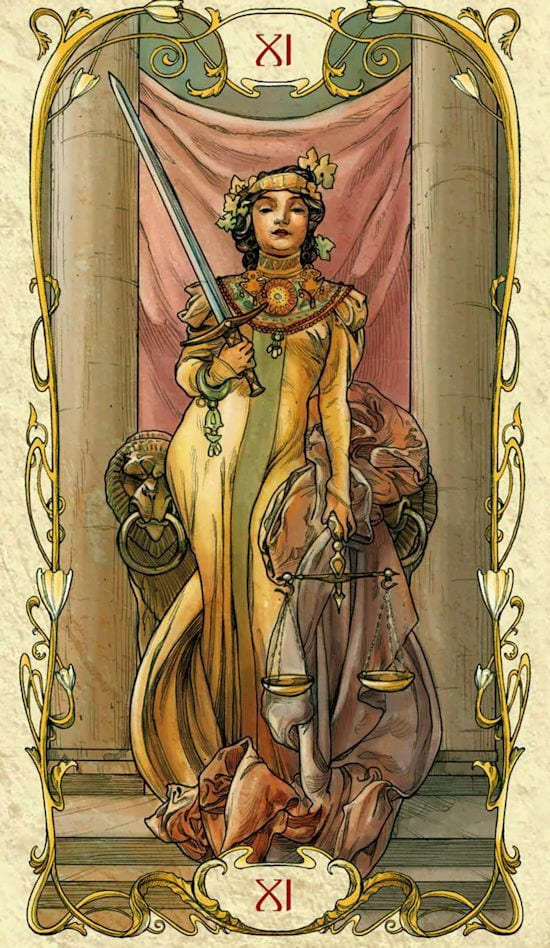
Justice Tarot as Feelings: Weighed Everything, Chose You
She already weighed it
A woman sits between two pillars. A sword in her right hand — truth, held upright, not for violence but for clarity. Scales in her left — balance, not leaning either way, waiting for the final piece of evidence before the verdict drops. Her eyes look straight ahead. She doesn’t glance away. She doesn’t soften the gaze. She sees.
That’s Justice. And as feelings, this is the most honest card you can receive — because when someone feels Justice toward you, they have done the math on loving you and the answer came out positive.
Not positive in a fairy-tale way. Positive in a ledger way. They’ve looked at what you offer and what you cost. What loving you gives them and what it asks of them. The joy and the work. The gifts and the complications. And after weighing all of it — honestly, without the comfortable distortions of infatuation — they’ve decided: the scales balance. You’re worth it. Not blindly. Deliberately.
That might sound unromantic. It’s the opposite. In a world full of people who love you based on who they imagine you are, Justice loves you based on who you actually are. And she chose you anyway. With her eyes open. Both sides of the scale visible.
Upright: as feelings for you
When Justice appears upright in the feelings position, the person feels:
Clarity that followed evaluation. Their feelings didn’t arrive in a lightning bolt. They arrived after a process — observing you, testing the connection, weighing the evidence. And the conclusion is clear: this matters. Not because it feels overwhelming, but because after careful consideration, it still feels right. Justice’s love is the love that survives scrutiny.
Fairness as devotion. They want to be fair to you. Not in a transactional way — in a foundational way. They want to give as much as they receive. They want to hear as much as they speak. They want to understand your perspective with the same seriousness they bring to their own. Justice as feelings is the person who will never take more than they give, and who notices when the balance shifts.
Honesty without apology. The sword is raised. Truth is the currency. This person will tell you difficult things because they respect you enough not to protect you from reality. Their love doesn’t come with comfortable lies or selective silence. It comes with the understanding that real connection requires real information — even when it’s uncomfortable.
Respect for your autonomy. Justice doesn’t try to change the evidence. She weighs it as-is. The person feeling Justice toward you respects your right to be exactly who you are — not a project, not a potential, not a version they’re working toward, but the full, imperfect, current reality of you. They may not love every detail. But they respect every detail enough to see it clearly.
Karma consciousness. They believe that what they put into this connection will come back to them. Not in a paranoid way — in a principled way. They treat you well because they believe in reciprocity as a universal law. Justice as feelings is the love that says: “I give you my best because I trust the universe to return it.”
Reversed: as feelings for you
When Justice appears reversed in the feelings position:
The scales are off. Something in the dynamic is unbalanced and they feel it — even if they can’t name it. Maybe they’re giving more than they’re receiving. Maybe they sense that the emotional investment isn’t equal. Maybe the relationship has been operating on unspoken rules that favor one person over the other. The reversed Justice person feels that something is unfair, and the feeling is eroding the connection.
Avoiding accountability. Instead of looking honestly at their role in the relationship’s problems, they’re deflecting. The reversed Justice as feelings can mean someone who blames you for imbalances they helped create, or who refuses to examine their own contribution to the dynamic because the truth would require changing.
Dishonesty — given or sensed. Either they’re being less than honest with you, or they sense that you’re being less than honest with them. The reversed Justice sword is pointed at something that’s been hidden, misrepresented, or selectively omitted. Trust is compromised, and without trust, the scales can’t balance.
Resentment from past unfairness. They feel they were treated unjustly — by you or in a previous relationship — and that feeling of injustice is coloring everything. The reversed Justice person carries a ledger of wrongs, and until it’s settled, every interaction is filtered through it.
Context: Justice as feelings in different situations
As someone you’re dating
Upright: They’ve assessed the relationship and concluded it’s good. Not perfect — good. Balanced. Worth continuing. This is the partner who doesn’t love-bomb but also doesn’t leave you guessing. Their consistency IS their declaration. If they’re still here after weighing everything, that’s the verdict.
Reversed: They feel the relationship is unequal. Either you’re not giving enough or they’re giving too much (or vice versa), and the imbalance is creating quiet resentment. The honest conversation needs to happen before the scales tip too far.
As an ex’s feelings
Upright: They’ve reached a fair assessment of what happened. Not bitter, not nostalgic — honest. They see both sides clearly: what they gave, what you gave, what was fair and what wasn’t. This is the ex who could sit across from you and discuss the relationship like two adults reviewing a contract that expired — with clarity, accountability, and mutual respect.
Reversed: They feel they were wronged and the scales haven’t balanced yet. There’s a debt outstanding — emotional, moral, or practical — and it’s preventing closure. The reversed Justice ex may seek accountability, apology, or simply acknowledgment that what happened wasn’t fair.
As a new connection
Upright: They’re evaluating you with clear eyes and liking what they see. Not starry-eyed — clear-eyed. They’re attracted to your honesty, your integrity, your willingness to show up as yourself rather than a performance. Justice as feelings for a new connection is the person who values substance over sparkle.
Reversed: Something feels off to them. An inconsistency in your story. A sense that what you’re showing doesn’t match what you’re hiding. The reversed Justice for a new connection is often the intuition that something isn’t adding up — and that intuition is usually right.
Justice vs. other “clear” cards as feelings
Justice vs. Judgement: Judgement is a spiritual awakening — a cosmic call that demands transformation from the depths. Justice is an intellectual evaluation — a measured weighing that leads to a clear decision. Judgement as feelings is revelation. Justice as feelings is conclusion.
Justice vs. The Emperor: The Emperor makes rules. Justice enforces them. The Emperor as feelings is “I will build structure to protect us.” Justice as feelings is “I will ensure the structure is fair to both of us.” One creates the system. The other audits it.
Justice vs. Temperance: Temperance finds balance through alchemy — blending, mixing, creating harmony from opposites. Justice finds balance through measurement — weighing, calculating, ensuring each side is equal. Temperance’s balance is felt. Justice’s balance is verified.
What Justice as feelings is really telling you
Here’s the truth about Justice that nobody in the feelings position wants to hear:
If someone feels Justice toward you, they love you with their eyes open. And that’s worth more than a thousand blind declarations.
Because anyone can love you when they don’t see clearly. When you’re new and shiny. When infatuation has blurred every edge and filled every gap with fantasy. That’s easy love. It costs nothing because it sees nothing.
Justice love costs everything — because it sees everything. It sees the scale and still places its heart on it. It sees the sword and still speaks the truth. It sees you — the real you, the complicated you, the you that isn’t always easy to love — and says: “I weighed it. And the verdict is you.”
The sword is raised. The scales are balanced. And the verdict, once given, doesn’t change with the weather.
That’s Justice. She doesn’t flinch. She doesn’t lie. She doesn’t pretend.
She just sees. And chooses.
Try it yourself
Pull a card with this question: “Where in my relationships am I being unfair — to myself or to someone else?”
Because Justice isn’t just about how someone else feels about you. It’s about whether the scales in your own life are balanced — whether you give as much as you take, whether you see as clearly as you expect to be seen, whether the sword of truth you carry is pointed at others or also at yourself.
The scales don’t lie. Neither should you.
Frequently Asked Questions
What does Justice mean as someone's feelings for me?
When Justice appears as feelings, the person has weighed their emotions with clear eyes and arrived at a considered verdict. This isn't impulsive love or blind infatuation — it's the feeling that comes after honest evaluation. They see you clearly, including your flaws, and have consciously decided that the balance tips in your favor.
Is Justice as feelings romantic or just logical?
Both — and that combination is rarer than you think. Justice's romance lives in its honesty. This is the person who won't tell you what you want to hear but will tell you the truth, consistently, without manipulation. Their love is built on clarity, not fantasy. That's not cold. That's the warmest form of respect.
What does Justice reversed mean as feelings?
Reversed, Justice as feelings means something is unbalanced. The person may feel the relationship is unfair — too much give, not enough receive, or vice versa. They might be avoiding accountability for their own role in the dynamic, or they sense dishonesty somewhere in the connection and can't pinpoint it.
How is Justice different from Judgement as feelings?
Judgement is a reckoning — an awakening, a call from above that demands transformation. Justice is an evaluation — a measured, deliberate weighing of evidence that leads to a clear decision. Judgement as feelings is 'I woke up and realized what you mean to me.' Justice as feelings is 'I examined everything and concluded that you matter.'