King of Swords Tarot Card Meaning: The Mind That Cuts Where Others Hesitate
First impression
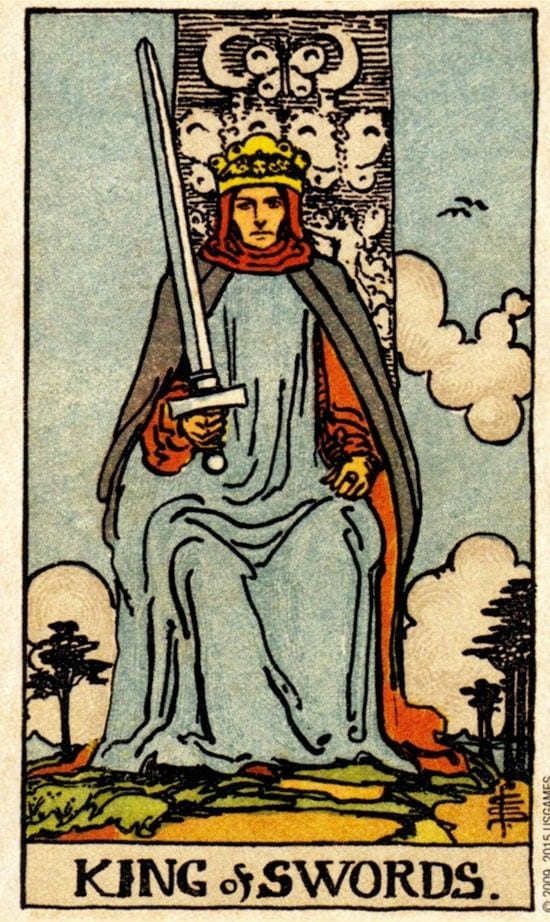
A king sits on a stone throne, holding a sword upright in his right hand. The blade tilts slightly — not perfectly vertical, because perfect objectivity doesn’t exist and the King knows it. His expression is calm but not warm. His eyes look forward with the focus of someone who has already processed the situation, identified the options, and is about to announce the decision. Butterflies and crescent moons adorn his throne. Clouds move behind him, but they don’t touch him.
That’s the King of Swords. The master of clear thought. The person who makes the hard call that everyone else has been circling around, and makes it look like the obvious choice — because to his mind, it was.
The King of Swords isn’t cold. That’s the common misreading. He has emotions — the butterflies on his throne prove he’s aware of transformation and subtlety. But he has trained himself to set emotion aside when a clear decision is needed. Not because feelings don’t matter, but because in certain moments, feeling clearly is less important than thinking clearly. He knows the difference. Most people don’t.
Card symbolism
The upright sword. Authority through intellect. The sword is his tool of office — not combat, not defense, but judgment. Like the scales of Justice, the King’s sword represents the ability to cut through complexity and find the essential truth. It tilts slightly to the left, toward intuition — a reminder that even the most rational mind has a subtle lean.
The stone throne. Permanence, structure, and immovability. Unlike the wooden or decorated thrones of other kings, the King of Swords sits on stone — unyielding, unchangeable by argument alone. His positions are reached through thought, and once reached, they hold.
The butterflies. Transformation and the life of the mind. These delicate creatures on the throne of the most analytical king in the deck say: he understands change, beauty, and metamorphosis. He’s not blind to subtlety. He’s chosen to prioritize clarity over sensitivity — but the sensitivity exists.
The clouds. Mental realm. The King sits above the landscape, in the realm of thought. Clouds represent ideas, concepts, the abstract world where his mind operates most naturally. They move behind him but don’t obscure his vision — he sees through them.
The direct gaze. Looking straight ahead. Not searching, not watching — assessing. The King’s eyes are the eyes of someone who has already gathered all the information and is now processing it into a decision. When this gaze lands on you, it’s not judgment in the emotional sense. It’s evaluation in the intellectual one.
Upright meaning
The King of Swords upright means intellectual authority, clear and impartial judgment, strategic thinking, the courage to make hard decisions, and the discipline to lead with the mind when the heart would make things worse.
Intellectual authority. You either are — or need to become — the person in the room who thinks most clearly. The King of Swords appears when a situation requires not empathy, not enthusiasm, not compromise, but precise thinking. Someone who can see through emotional noise to the actual issue, and then address the actual issue without getting sidetracked.
Clear, impartial judgment. The King rules by fairness, not favoritism. His decisions aren’t popular — they’re correct. When this card appears, it often means a situation requires you to judge impartially: to set aside what you want to be true and see what is true. To be the judge, not the advocate.
Strategic thinking. Planning several moves ahead. The King of Swords isn’t reactive — he’s strategic. He considers consequences, evaluates options, and chooses the path with the best long-term outcome, even when the short-term cost is high. This card often appears in business, legal, and career readings where strategic thinking is the difference between success and failure.
Honest communication. Direct, precise, no filler. The King doesn’t sugarcoat, doesn’t hint, doesn’t soften the blow with disclaimers. He says what he means, means what he says, and expects the same from others. In readings, this can mean: the situation requires honesty, not diplomacy. Say the thing clearly.
Moral authority. The King’s power comes not from force but from being right — and being willing to defend what’s right even when it’s unpopular. This is ethical leadership: making decisions that serve the greater good, not the decision-maker’s ego.
Reversed meaning
The King of Swords reversed is intellect without ethics — the sharp mind that serves itself.
Intellectual tyranny. Using intelligence to dominate. The reversed King makes others feel stupid, controls through superior reasoning, and confuses “being right” with “being in charge.” His mind is a weapon pointed at everyone who disagrees.
Cold, heartless decisions. Efficiency without empathy. The reversed King makes the logical choice without considering the human cost — firing without compassion, ending relationships by text, treating people as variables in an equation that only measures outcomes.
Manipulation through logic. Constructing airtight arguments to justify what serves him, regardless of fairness. The reversed King is the lawyer who defends the indefensible with brilliant logic, the partner who “wins” every argument by making you question your own perception.
Clouded judgment disguised as clarity. The most dangerous reversal: he thinks he’s being objective, but his biases have infiltrated his reasoning. The reversed King is the person whose prejudices are built into their “logic” — who presents opinions as facts and demands they be treated accordingly.
Abuse of authority. Power wielded through intellectual superiority rather than earned respect. The reversed King pulls rank, dismisses opposing views as “emotional” or “irrational,” and creates environments where only his thinking is allowed to exist.
In love and relationships
Upright. The King of Swords in love represents a partner of intellect — honest, direct, fair, and somewhat emotionally contained. This person shows love through clarity rather than romance: they remember your preferences, solve your problems, and communicate directly about issues instead of letting them fester. For some, this is exactly the partner they need. For others, it feels like dating a judge. For singles, the King often means needing to approach dating with your head: making clear decisions about what you want instead of letting chemistry override compatibility.
Reversed. The partner who’s always “right.” Who uses logic to dismiss your feelings, who wins every argument but loses the relationship, who confuses emotional control with emotional strength. The reversed King in love can also mean you’re being too analytical about romance — overthinking connection instead of feeling it.
In career and finances
Upright. Strategic authority. The King of Swords in career means you need to think like a leader: clearly, strategically, without letting office politics or emotional reactions drive your decisions. This card appears during complex professional situations that require precision — negotiations, restructurings, legal matters, strategic planning. Financially, the King means making money decisions based on data, analysis, and clear-eyed assessment rather than hope or fear.
Reversed. A boss who rules through intimidation rather than respect. Someone in authority who uses intelligence to control rather than guide. The reversed King in career can mean a toxic intellectual environment: the workplace where being “smart” matters more than being ethical. Financially: making cold calculations that ignore the human impact, or using financial complexity to obscure the truth.
In health and well-being
Upright. Clear-headed approach to health. The King of Swords in health means seeking expert opinions, following evidence-based treatment, and making rational decisions about your wellbeing rather than being swayed by fear or trends. This card often appears when someone needs to approach a health situation analytically — getting the diagnosis, understanding the options, choosing the treatment that the evidence supports, not the one that the internet promoted.
Reversed. Over-intellectualizing health at the expense of listening to your body. Ignoring physical signals because the logical mind says “it’s nothing.” The reversed King in health can mean prioritizing data over embodied experience — trusting test results more than how you actually feel, or using intellectual detachment to avoid processing the emotional component of illness.
Key combinations
King of Swords + Justice. The most authoritative combination. Truth, fairness, and judgment at their peak. Legal matters resolved correctly. A decision made with perfect clarity and complete impartiality.
King of Swords + The Emperor. Double authority. Structure meets intellect, discipline meets strategy. This combination represents maximum leadership power — the ability to both envision and enforce.
King of Swords + Queen of Cups. Head meets heart. The King’s logic balanced by the Queen’s emotional intelligence. Together, they represent the most complete form of wisdom: clear thinking informed by deep feeling.
King of Swords + The High Priestess. Conscious intellect meets unconscious knowing. The King’s analysis complemented by the Priestess’s intuition. A truth that can be both proven and felt — the rarest and most powerful kind.
King of Swords + The Devil. Intellect in service of manipulation. The King’s sharp mind used for control, addiction to power, or rationalizing unethical behavior. A warning: intelligence without conscience is dangerous.
King of Swords + Ten of Swords. The analysis is complete, and the conclusion is painful. The King sees the truth the Ten represents and doesn’t flinch. Sometimes the clearest thinker in the room is the one who has to say: this is over.
King of Swords + Ace of Swords. The master receives a new truth. The King’s established intellect is challenged or renewed by a breakthrough. Humility in wisdom: even the most experienced mind has something to learn.
The card’s advice
The King of Swords says: think clearly. Not coldly — clearly. There’s a difference, and right now, that difference matters.
The world is full of situations that people try to solve with emotion, compromise, or avoidance. The King says: some situations require none of those. Some situations require you to sit down, look at the facts without flinching, and make the decision that the facts support — even when it’s uncomfortable, even when it’s unpopular, even when it means saying something nobody wants to hear.
This doesn’t mean feelings don’t matter. The butterflies on the throne prove the King knows about transformation, sensitivity, the delicate side of life. But he also knows that there are moments when bringing feelings to the table makes the table collapse. Surgery requires a steady hand. Judgment requires a clear mind. Strategy requires cold assessment of warm situations.
Be the King when the situation demands one. Not the cold, reversed version — the upright one, who uses his sharpness in service of fairness, who cuts through confusion not to dominate but to illuminate, and who has the courage to speak truth even when everyone in the room would prefer a comfortable lie.
The sword is steady. The mind is clear. And the decision, once made, won’t need to be unmade — because it was right.
Try it yourself
Pull a card with this question: “Where in my life do I need to think more clearly — and what emotion is clouding my judgment?”
Because the King of Swords isn’t asking you to stop feeling. He’s asking you to notice when feeling is helping and when it’s interfering. Love is wonderful guidance for relationships. It’s terrible guidance for contracts. Anger is useful information about boundaries. It’s useless information for strategic planning.
The King knows when to feel and when to think. That’s not coldness. That’s mastery.
The throne is stone. The sword is sharp. And the question isn’t whether you can think clearly — it’s whether you’ll choose to, when the alternative is so much easier.
Frequently Asked Questions
Is the King of Swords a yes or no card?
The King of Swords is a yes based on logic, not feeling. If your question has a rational, evidence-based answer in its favor, the King says yes with authority. If you're asking because you want emotional validation, the King says: that's not how I operate. Think clearly, then decide.
What does the King of Swords mean in love?
In love, the King of Swords represents a partner who leads with intellect — someone honest, direct, and emotionally contained. For some, this feels safe and trustworthy. For others, it feels cold. The card asks: do you need a partner who feels deeply, or one who thinks clearly? The King offers the second.
What does the King of Swords reversed mean?
Reversed, the King of Swords becomes a tyrant of intellect — using sharp thinking to control, manipulate, or judge. It can mean someone who weaponizes their intelligence, makes decisions without heart, or believes being right justifies being cruel. Also: clouded judgment masquerading as authority.
Does the King of Swords represent a specific person?
Often yes — a figure of intellectual authority. A judge, lawyer, professor, surgeon, analyst, or anyone whose profession requires detached, precise thinking. Any gender. When representing energy rather than a person, it means a situation that requires you to think like a strategist: clearly, impartially, without letting emotion drive the decision.