Ostara for Beginners: Your First Spring Equinox Celebration
You belong here
If you’re reading this, you’re probably curious about Ostara but not sure whether it’s “for you.” Maybe you’re not pagan. Maybe you’ve never done a ritual in your life. Maybe you just like the idea of marking the seasons and want to know where to start.
Here’s the good news: Ostara is one of the most beginner-friendly celebrations in any seasonal tradition. It’s about spring. It’s about new starts. And the whole point is that things are just beginning — including, maybe, you.
What you need (almost nothing)
Required: Nothing. Seriously. You can celebrate Ostara with nothing but your attention and the awareness that something is shifting in the world around you.
Nice to have but totally optional:
- A candle (any color — green or white if you want to be traditional)
- An egg (from your fridge is fine)
- A flower (from a shop, a garden, or even a photo)
- A journal or piece of paper
- A tarot or oracle deck (if you have one; if not, that’s what apps are for)
You do NOT need: special robes, an altar, crystals, incense, a pentacle, years of study, or anyone’s permission.
The 5-minute version
If you have five minutes and nothing else, here’s your entire Ostara celebration:
- Step outside (or stand by an open window)
- Take three slow breaths
- Notice one sign of spring — a bud, a bird, the angle of the light
- Think of one thing you want to grow this season
- Say it out loud: “This spring, I’m growing ___.”
That’s it. You just celebrated Ostara. The equinox doesn’t need grandeur — it needs your attention.
The 30-minute version
Got a little more time? Add these:
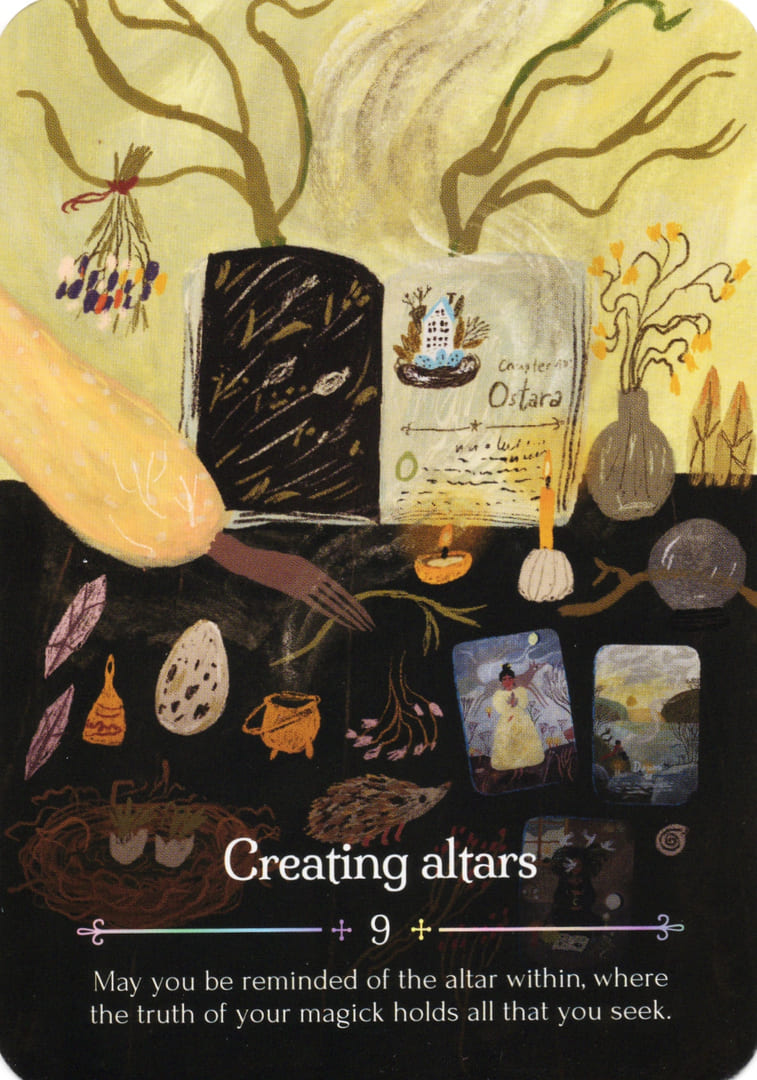
Set up a tiny altar (5 minutes): Put a candle, an egg, and a flower on a surface. Light the candle. This is your spring altar. It doesn’t need to be more than this.
Pull a card (5 minutes): If you have a tarot or oracle deck, shuffle while thinking about spring. Pull one card. Look at it. What do you notice? What feeling does it bring up? Write down the card name and your first impression.
Write an intention (10 minutes): In a journal or on a piece of paper, finish this sentence three times: “This spring, I want to…” Then pick the one that feels most alive and write it on the egg (a regular pen works on a hardboiled egg).
Sit with it (10 minutes): Hold the egg. Look at the candle. Breathe. You’re sitting at a hinge point of the year — the moment the light starts to win. Let that sink in.
The full afternoon version
For those who want to go deeper (or who just want a really nice afternoon):
Morning: Wake early and greet the sunrise. Make tea or coffee with intention. Do a tarot reading — try the Seed Spread (3 cards: What am I planting? / What nourishes it? / What blooms?).
Midday: Set up a proper altar — flowers, eggs, candles, crystals if you have them, images of what you want to grow. Write a letter to your future self at the autumn equinox.
Afternoon: Cook something seasonal — eggs, fresh bread, spring greens, anything with honey or lemon. Make it a celebration, even if you’re eating alone. Light candles at the table.
Evening: Do a release ritual. Write what you’re letting go of on paper and tear it up or burn it safely. Write what you’re welcoming on another paper and put it on your altar. End with a walk or a bath.
Common beginner worries (all answered)
“Am I doing it wrong?” No. There is no wrong way to acknowledge the season changing. If you feel self-conscious, remember that humans have been marking the spring equinox for at least 10,000 years. You’re joining a very, very long tradition.
“I don’t know the ‘correct’ words.” There aren’t any. Speak from your heart or don’t speak at all. Silence is just as valid as a formal invocation.
“I can’t pronounce Ostara/Eostre/sabbat correctly.” Nobody is checking. For the record: oh-STAR-ah, EE-oh-stray, SAB-at. But mispronouncing something doesn’t change its energy.
“I live in an apartment with no garden.” Many witches and seasonal practitioners live in cities. A windowsill pot, a candle on your desk, or a walk through a park counts just as much as a ritual in a meadow.
“Isn’t this cultural appropriation?” Modern Ostara is a contemporary reconstruction based on broad European spring traditions. The spring equinox has been celebrated across every human culture on Earth. Honoring the season is a universal human impulse.
“I tried it and didn’t feel anything special.” That’s okay. Sometimes the first time is about going through the motions so that next time, or the time after, the feeling arrives. Seasonal practice deepens with repetition, not perfection.
What to explore next
If Ostara resonated with you, here’s where to go from here:
- Learn the Wheel of the Year — Ostara is one of eight seasonal festivals. The next one is Beltane (May 1), which celebrates the full bloom of spring energy
- Start a daily card practice — One card every morning creates a rhythm that grows over weeks. No experience needed
- Try a spring spread — A 3-card or 5-card spread designed for the equinox goes deeper than a single card pull
- Read about correspondences — colors, crystals, herbs, and symbols that carry spring energy
The most important thing? You showed up. You got curious. You started. That’s more than enough for a first Ostara — and everything that grows started exactly this way.
Frequently Asked Questions
Do I need to be Wiccan or pagan to celebrate Ostara?
Not at all. Ostara's core themes — renewal, balance, fresh starts — are universal. Many people who celebrate it simply enjoy marking the seasons with intention. You don't need any specific beliefs, training, or spiritual identity.
What if I do something wrong during Ostara?
You can't. There's no official Ostara rulebook, no correct pronunciation police, and no mandatory supplies. If you acknowledge the shift of the season with any amount of intention — even just pausing to notice that spring is here — you're celebrating Ostara.
Do I need to buy special supplies for Ostara?
No. A candle, an egg from your fridge, and a quiet moment are more than enough. Fresh flowers from the grocery store or a walk outside cost little to nothing. Ostara responds to intention, not investment.
Is celebrating Ostara cultural appropriation?
Ostara as practiced today is a modern reconstruction based on broad European spring equinox traditions. It's not a closed practice belonging to a specific culture or lineage. Celebrating the spring equinox is something humans across every culture have done for millennia.